tenecteplase 25 MG Injection
Managing this medication for someone you care for? Eleplan keeps diagnoses, medications and appointments in one plan.
Start free with EleplanClinical drug
tenecteplase 25 MG Injection
25 MG · Injection · injection
A form of tenecteplase →
tenecteplase 25 MG Injection — Enzymes. INDICATIONS AND USAGE TNKase ® is indicated to reduce the risk of death associated with acute ST elevation myocardial infarction (STEMI). TNKase is…
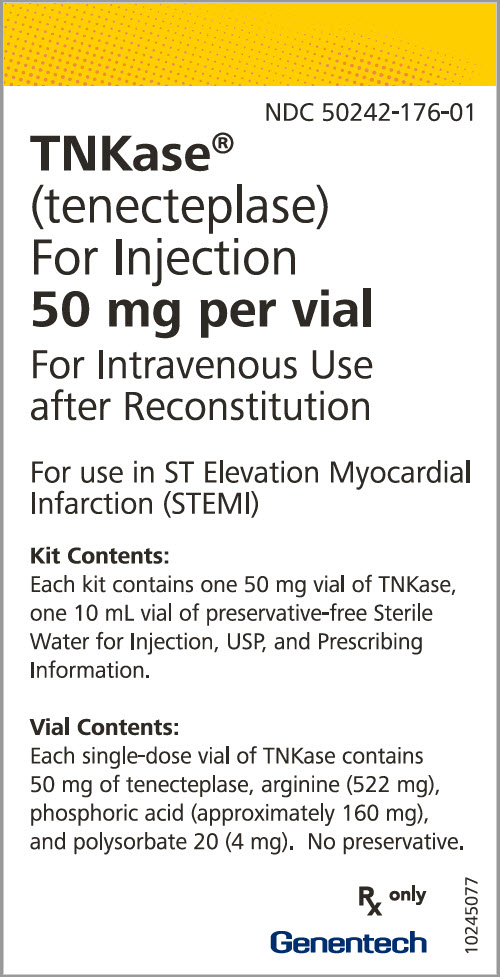
Active ingredient
Classification
Enzymes
Drug interactions
The label indicates that tenecteplase can interfere with coagulation test results.
- unknowncoagulation tests — results may be unreliable
- unknownfibrinolytic activity measures — results may be unreliable
Indications
INDICATIONS AND USAGE TNKase ® is indicated to reduce the risk of death associated with acute ST elevation myocardial infarction (STEMI). TNKase is a tissue plasminogen activator, indicated to reduce the risk of death associated with acute ST elevation myocardial infarction (STEMI). ( 1 )
Dosage
DOSAGE AND ADMINISTRATION Initiate treatment as soon as possible after the onset of STEMI symptoms. ( 2.1 ) TNKase is for intravenous administration only, administered as a single bolus over 5 seconds. Individualize dosage based on patient's weight. ( 2.1 ) 2.1 Recommended Dosage Initiate treatment as soon as possible after the onset of STEMI symptoms. TNKase is for intravenous (IV) administration only, administered as a single bolus over 5 seconds. Individualize dosage based on the patient's weight (see Table 1 ). Table 1: Recommended Dosage Patient Weight (kg) TNKase (mg) Volume TNKase From one vial of TNKase reconstituted with 10 mL Sterile Water for Injection. to be administered (mL) < 60 30 6 ≥ 60 to < 70 35 7 ≥ 70 to < 80 40 8 ≥ 80 to < 90 45 9 ≥ 90 50 10 2.2 Preparation Follow the below steps to prepare TNKase for administration: Remove the shield assembly from the supplied B-D ® 10 mL syringe with TwinPak™ Dual Cannula Device (see Figure 1 ) and aseptically withdraw 10 mL of Sterile Water for Injection, USP, from the supplied diluent vial using the red hub cannula syringe filling device. Only use the supplied Sterile Water for Injection, USP for reconstitution. Note: Do not discard the shield assembly. Aseptically reconstitute the vial with 10 mL Sterile Water for Injection, USP by directing the stream into the lyophilized powder to obtain a final concentration of 5 mg/mL. Slight foaming upon reconstitution is not unusual; any large bubbles will dissipate if the product is allowed to stand undisturbed for several minutes. Gently swirl until contents are completely dissolved. DO NOT SHAKE. The reconstituted preparation results in a colorless to pale yellow transparent solution. Determine the appropriate dose of TNKase [see Dosage and Administration (2.1) ] and withdraw this volume (in milliliters) from the reconstituted vial with the syringe. Discard any unused solution. Stand the shield vertically on a flat surface (with green side down) and passively recap the red hub cannula. Remove the entire shield assembly, including the red hub cannula, by twisting counterclockwise. Note: The shield assembly also contains the clear-ended blunt plastic cannula; retain for split septum intravenous access. Figure 1 Figure 1 2.3 Administration Follow the below steps for administration of TNKase; Inspect the product prior to administration for particulate matter and discoloration. Administer TNKase as reconstituted at 5 mg/mL. Precipitation may occur when TNKase is administered in an intravenous line containing dextrose. Flush dextrose-containing lines with a saline-containing solution prior to and following single bolus administration of TNKase. Administer reconstituted TNKase as a single intravenous bolus over 5 seconds. Because TNKase contains no antibacterial preservatives, reconstitute immediately before use. If the reconstituted TNKase is not used immediately, refrigerate the TNKase vial at 2°C to 8°C (36°F to 46°F) and use within 8 hours. Although the supplied syringe is compatible with a conventional needle, this syringe is designed to be used with needleless intravenous systems. From the information below, follow the instructions applicable to the intravenous system in use. Split septum intravenous system : Remove the green cap. Attach the clear-ended blunt plastic cannula to the syringe. Remove the shield and use the blunt plastic cannula to access the split septum injection port. Because the blunt plastic cannula has two side ports, air or fluid expelled through the cannula will exit in two sideways directions; direct away from face or mucous membranes. Luer-Lok ® system: Connect syringe directly to intravenous port. Conventional needle (not supplied in this kit): Attach a large bore needle, e.g., 18 gauge, to the syringe's universal Luer-Lok ® . Dispose of the syringe, cannula and shield per established procedures. 2.4 Chemical Incompatibilities TNKase is incompatible with dextrose containing solutions. When used together, precipitation may occur. Flush dextrose containing lines with saline-containing solution before using TNKase.
Warnings
WARNINGS AND PRECAUTIONS Bleeding: Increases the risk of bleeding. Avoid intramuscular injections. Monitor for bleeding. ( 5.1 ) Thromboembolism: The use of thrombolytics can increase the risk of thrombo-embolic events in patients with high likelihood of left heart thrombus. ( 5.2 ) Cholesterol Embolization: Has been reported in patients treated with thrombolytic agents. ( 5.3 ) Arrhythmias: It is recommended that anti-arrhythmic therapy for bradycardia and/or ventricular irritability be available when TNKase is administered. ( 5.4 ) Increased Risk of Heart Failure and Recurrent Ischemia when used with Planned Percutaneous Coronary Intervention (PCI) in STEMI: In patients with a large ST segment elevation myocardial infarction, physicians should choose either thrombolysis or PCI as the primary treatment strategy for reperfusion. Rescue PCI or subsequent elective PCI may be performed after administration of thrombolytic therapies if medically appropriate. ( 5.5 ) Hypersensitivity: Monitor patients treated with TNKase during and for several hours after infusion. If symptoms of hypersensitivity occur, initiate appropriate therapy (e.g., antihistamines, corticosteroids). ( 5.6 ) 5.1 Bleeding TNKase can cause bleeding, including intracranial hemorrhage and fatal bleeding. Concomitant use of other drugs that impair hemostasis increases the risk of bleeding. Should serious bleeding that is not controlled by local pressure occur, discontinue any concomitant heparin or antiplatelet agents immediately and treat appropriately. Avoid intramuscular injections and nonessential handling of the patient for the first few hours following treatment with TNKase. Perform arterial and venous punctures carefully and only as required. To minimize bleeding from noncompressible sites, avoid internal jugular and subclavian venous punctures. If an arterial puncture is necessary during TNKase infusion, use an upper extremity vessel that is accessible to manual compression. Apply pressure for at least 30 minutes. 5.2 Thromboembolism The use of thrombolytics can increase the risk of thrombo-embolic events in patients with high likelihood of left heart thrombus, such as patients with mitral stenosis or atrial fibrillation. 5.3 Cholesterol Embolization Cholesterol embolism has been reported in patients treated with thrombolytic agents. Investigate cause of any new embolic event and treat appropriately. 5.4 Arrhythmias Coronary thrombolysis may result in arrhythmias associated with reperfusion. These arrhythmias (such as sinus bradycardia, accelerated idioventricular rhythm, ventricular premature depolarizations, ventricular tachycardia) may be managed with standard anti-arrhythmic measures. It is recommended that anti-arrhythmic therapy for bradycardia and/or ventricular irritability be available when TNKase is administered. 5.5 Increased Risk of Heart Failure and Recurrent Ischemia when used with Planned Percutaneous Coronary Intervention (PCI) in STEMI. In a trial of patients with STEMI, there were trends toward worse outcomes in the individual components of the primary endpoint between TNKase plus PCI versus PCI alone (mortality 6.7% vs. 4.9%, respectively; cardiogenic shock 6.3% vs. 4.8%, respectively; and CHF 12% vs. 9.2%, respectively). In addition, there were trends towards worse outcomes in recurrent MI (6.1% vs. 3.7%, respectively; p = 0.03) and repeat target vessel revascularization (6.6% vs. 3.4%, respectively; p = 0.0045) in patients receiving TNKase plus PCI versus PCI alone [see Clinical Studies (14.1) ] . In patients with large ST segment elevation myocardial infarction, physicians should choose either thrombolysis or PCI as the primary treatment strategy for reperfusion. Rescue PCI or subsequent elective PCI may be performed after administration of thrombolytic therapies if medically appropriate; however, the optimal use of adjunctive antithrombotic and antiplatelet therapies in this setting is unknown. 5.6 Hypersensitivity Hypersensitivity, including urticarial / anaphylactic reactions, have been reported after administration of TNKase (e.g., anaphylaxis, angioedema, laryngeal edema, rash, and urticaria). Monitor patients treated with TNKase during and for several hours after infusion. If symptoms of hypersensitivity occur, initiate appropriate therapy (e.g., antihistamines, corticosteroids).
Contraindications
CONTRAINDICATIONS TNKase is contraindicated in patients with [see Warnings and Precautions (5.1) ] : Active internal bleeding History of cerebrovascular accident Intracranial or intraspinal surgery or trauma within 2 months Intracranial neoplasm, arteriovenous malformation, or aneurysm Known bleeding diathesis Severe uncontrolled hypertension Active internal bleeding ( 4 ) History of cerebrovascular accident ( 4 ) Intracranial or intraspinal surgery or trauma within 2 months ( 4 ) Intracranial neoplasm, arteriovenous malformation, or aneurysm ( 4 ) Known bleeding diathesis ( 4 ) Severe uncontrolled hypertension ( 4 )
Mechanism of action
Mechanism of Action Tenecteplase is a modified form of human tissue plasminogen activator (tPA) that binds to fibrin and converts plasminogen to plasmin. In the presence of fibrin, in vitro studies demonstrate that tenecteplase-mediated conversion of plasminogen to plasmin is increased relative to its conversion in the absence of fibrin. This fibrin specificity decreases systemic activation of plasminogen and the resulting degradation of circulating fibrinogen as compared to a molecule lacking this property. The clinical significance of fibrin-specificity on safety (e.g., bleeding) or efficacy has not been established.
Indicated ICD-10 codes
Source: RxNorm + openFDA + RxClass + FAERS · 2026
Look up another medication