Xenon
Managing this medication for someone you care for? Eleplan keeps diagnoses, medications and appointments in one plan.
Start free with EleplanMedication reference
Xenon
Inhalation Diagnostic Agent [EPC] — RESPIRATORY (INHALATION)
Xenon — Inhalation Diagnostic Agent [EPC]. INDICATIONS AND USAGE XENOVIEW ® , prepared from the Xenon Xe 129 Gas Blend, is indicated for use with magnetic resonance imaging (MRI) for…
Brand names
XenonXenon, Xe-133XENOVIEW
Active ingredients
XENON XE-133XENON XE-129, HYPERPOLARIZEDHELIUMNITROGENXENON XE-129
Indications
INDICATIONS AND USAGE XENOVIEW ® , prepared from the Xenon Xe 129 Gas Blend, is indicated for use with magnetic resonance imaging (MRI) for evaluation of lung ventilation in adults and pediatric patients aged 6 years and older. Limitations of Use XENOVIEW has not been evaluated for use with lung perfusion imaging. XENOVIEW, prepared from the Xenon Xe 129 Gas Blend, is a hyperpolarized contrast agent indicated for use with magnetic resonance imaging (MRI) for evaluation of lung ventilation in adults and pediatric patients aged 6 years and older. Limitations of Use XENOVIEW has not been evaluated for use with lung perfusion imaging. ( 1 )
Dosage
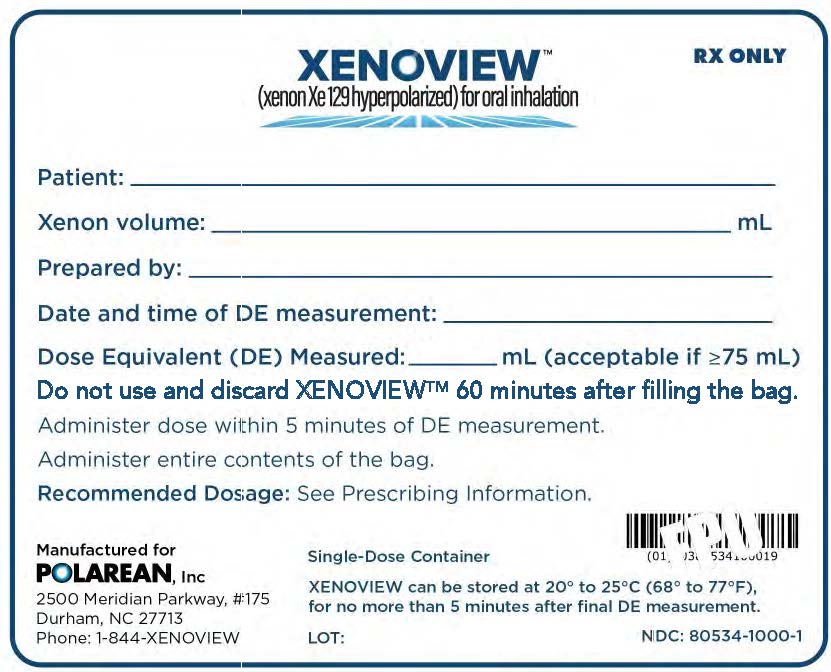
DOSAGE AND ADMINISTRATION The recommended target dose of XENOVIEW for adult and pediatric patients aged 6 years and older is 75 mL to 100 mL Dose Equivalent (DE) volume of hyperpolarized xenon Xe 129 by oral inhalation of the entire contents of one XENOVIEW Dose Delivery Bag. ( 2.1 ) Choose an appropriate size of the Dose Delivery Bag based on patient’s Total Lung Capacity (TLC) or Forced Vital Capacity (FVC). ( 2.1 ) Administer dose within 5 minutes of DE measurement. ( 2.2 ) Initiate imaging immediately after inhalation. ( 2.2 ) See Full Prescribing Information for detailed information regarding preparation, administration, image acquisition, and image interpretation. ( 2.2 , 2.3 ) 2.1 Recommended Dosage The recommended target dose of XENOVIEW for adults and pediatric patients aged 6 years and older is 75 mL to 100 mL Dose Equivalent (DE) volume of hyperpolarized xenon Xe 129 by oral inhalation of the entire contents of one XENOVIEW Dose Delivery Bag. Each bag contains at least 75 mL DE of hyperpolarized xenon Xe 129 measured within 5 minutes of administration, in a volume of 250 mL to 750 mL total xenon with additional nitrogen, NF (99.999% purity) added to reach a total volume of the Dose Delivery Bag. Select the Dose Delivery Bag based on the patient’s Total Lung Capacity (TLC) according to Table 1. If TLC is not available at the time of the procedure, select the Dose Delivery Bag based on patient’s Forced Vital Capacity (FVC). If neither TLC nor FVC values are available in the patient’s medical records, select the Dose Delivery Bag based on estimates of the patient’s TLC using American Thoracic Society (ATS)-endorsed plethysmography-based predictive equations based on sex and height. Table 1. Recommended Dose Delivery Bag Volume Based on TLC TLC (L) FVC † (L) Dose Delivery Bag (mL) <2.0 <1.5 300 2.0 to <3.3 1.5 to <2.5 500 3.3 to <5.0 2.5 to <3.8 750 ≥5.0 ≥3.8 1,000 † FVC is used when TLC is not available. The minimum DE for a dose of XENOVIEW is 75 mL with a recommended DE target range of 75 mL to 100 mL. DE of greater than 100 mL is acceptable. DE is the volume (mL) of 100% isotopically enriched, 100% hyperpolarized, xenon Xe 129 that would produce the equivalent net magnetization as the Xe 129 dose. The HPX Polarization Measurement Station measures DE. DE is defined by the following formula: DE = (total volume xenon gas) × (fraction of xenon Xe 129 isotopic enrichment in the xenon gas) × (fraction of hyperpolarization) where the total volume of xenon gas is 250 mL to 750 mL, the fraction of xenon Xe 129 isotopic enrichment is > 80% and the mean fraction of hyperpolarization is no less than 38% to 54% at the completion of polarization of 250 mL of xenon gas. For example, if 300 mL of total xenon gas with 83% enrichment of xenon Xe 129 is dispensed from the HPX Hyperpolarizer at 40% hyperpolarization: DE = 300 mL × 0.83 × 0.40 = 99.6 mL 2.2 Preparation, Administration, and Image Acquisition Preparation Choose an appropriate Dose Delivery Bag according to Table 1 [see Dosage and Administration ( 2.1 )] . Prepare hyperpolarized xenon Xe 129 in the HPX Hyperpolarizer from the Xenon Xe 129 Gas Blend and add Nitrogen, NF (99.999% purity) as necessary to fill the remaining volume in the XENOVIEW Dose Delivery Bag, according to the HPX Hyperpolarization System Operator’s Manual. Measure the volume and DE in the XENOVIEW Dose Delivery Bag using the HPX Polarization Measurement Station no more than 5 minutes prior to administration. The DE measurement should be at least 75 mL. Do not use and discard the dose of XENOVIEW ® if the volume is determined to be outside of the acceptable range or the DE is less than 75 mL. Administer dose within 5 minutes of DE measurement. Do not use and discard the dose of XENOVIEW 60 minutes after filling of Dose Delivery Bag. Administration Administer XENOVIEW according to the directions provided in the HPX Hyperpolarization System Operator’s Manual, Administering XENOVIEW. Fit the patient with an FDA-cleared Xe 129 chest coil in accordance with the chest coil manufacturer’s instructions for use. The chest coil and MRI scanner must be connected and compatible with one another. Position the patient supine with arms either by their side or above their head. Perform conventional 1 H localizer scan, position the desired Xe 129 slices, and prepare the Xe 129 scan. For patients on supplemental oxygen, withhold oxygen inhalation for two breaths prior to XENOVIEW inhalation, and resume oxygen inhalation immediately following the imaging breath hold. Attach the mouthpiece to the XENOVIEW Dose Delivery Bag. With the patient positioned in the MRI scanner, place the mouthpiece in the patient’s mouth and instruct the patient to completely inhale the contents of the XENOVIEW Dose Delivery Bag with a single inhalation. Instruct the patient to hold the inhaled breath (up to 15 seconds) during MR image acquisition. Image Acquisition Once the patient has inhaled the full dose of XENOVIEW, begin MRI scanning immediately. Upon scan completion, instruct the patient to breathe normally. If the image quality is insufficient or if the patient was not able to sufficiently inhale the contents of the XENOVIEW Dose Delivery Bag, the scan can be repeated with a new dose of XENOVIEW. 2.3 Image Display and Interpretation Evaluation of lung ventilation is based on distribution of XENOVIEW in the lungs.
Warnings
WARNINGS AND PRECAUTIONS Risk of Decreased Image Quality from Supplemental Oxygen : Supplemental oxygen administered simultaneously with XENOVIEW inhalation can cause degradation of image quality. For patients on supplemental oxygen, withhold oxygen inhalation for two breaths prior to XENOVIEW inhalation, and resume oxygen inhalation immediately following the imaging breath hold. ( 5.1 ) Risk of Transient Hypoxia : Inhalation of an anoxic gas such as XENOVIEW may cause transient hypoxemia in susceptible patients. Monitor all patients for oxygen saturation and symptoms of hypoxemia, and treat as clinically indicated. ( 5.2 ) 5.1 Risk of Decreased Image Quality from Supplemental Oxygen Supplemental oxygen administered simultaneously with XENOVIEW inhalation can cause degradation of image quality due to depolarization of XENOVIEW. For patients on supplemental oxygen, withhold oxygen inhalation for two breaths prior to XENOVIEW inhalation, and resume oxygen inhalation immediately following the imaging breath hold [see Dosage and Administration ( 2.2 )] . 5.2 Risk of Transient Hypoxia Inhalation of an anoxic gas such as XENOVIEW may cause transient hypoxemia in susceptible patients [see Adverse Reactions ( 6.1 )] . Monitor all patients for oxygen desaturation and symptoms of hypoxemia, and treat as clinically indicated.
Contraindications
CONTRAINDICATIONS None. None. ( 4 )
Adverse reactions
ADVERSE REACTIONS The adverse reactions (> one patient) in efficacy trials in adults were oropharyngeal pain, headache, and dizziness. ( 6.1 ) To report SUSPECTED ADVERSE REACTIONS, contact Polarean, Inc. at 1‑844-936-6843 or FDA at 1-800-FDA-1088 or www.fda.gov/medwatch. 6.1 Clinical Trials Experience Because clinical trials are conducted under widely varying conditions, adverse reaction rates observed in the clinical trials of a drug cannot be directly compared to rates in the clinical trials of another drug and may not reflect the rates observed in practice. Adverse Reactions in Adult Patients The safety of XENOVIEW was evaluated in two prospective efficacy trials that enrolled a total of 83 adult patients with various lung disorders who were being evaluated for possible lung surgery [see Clinical Studies ( 14 ) ] . Mean age of these patients was 62 years, 88% were White and 69% were male. In these two trials, mean xenon gas volume per XENOVIEW dose was 330.2 mL and 81 of 83 patients (98%) received a single administration of XENOVIEW. For safety assessment, the volume of administered xenon gas in the XENOVIEW dose is noted rather than the DE, because isotopic enrichment and hyperpolarization are not known to affect the safety profile of xenon gas. Adverse reactions were reported in 12 (14%) of the 83 patients. Adverse reactions reported by more than one patient were oropharyngeal pain (n = 4 patients), headache (n = 2 patients), and dizziness (n = 2 patients). A hypersensitivity reaction that included transient pruritus and erythema occurred in one patient with a history of allergic reactions to several drugs, foods, and other substances. In pooled data of 123 adult patients from published studies, most of whom had lung disorders such as COPD, idiopathic pulmonary fibrosis, and asthma, who received 1 dose to 2 doses of hyperpolarized xenon Xe 129 with xenon volumes of approximately 500 mL to 1,000 mL of xenon gas per dose, the following transient adverse reactions were reported: numbness, tingling, euphoria, and dizziness. Overall frequency of these adverse reactions could not be determined from the published information. Adverse Reactions in Pediatric Patients In pooled data of 120 pediatric patients aged 6 to 18 years from published studies, most of whom had either asthma or cystic fibrosis, who received 1 dose to 2 doses of hyperpolarized xenon Xe 129 with xenon volumes based on predicted TLC, the following transient adverse reactions were reported: blood oxygen desaturation, heart rate elevation, numbness, tingling, dizziness, and euphoria. Overall frequency of these adverse reactions could not be determined from the published information. In one of the published studies of 23 pediatric patients aged 6 to 18 years, 11 of whom had cystic fibrosis and 12 of whom were healthy, the mean difference of SpO 2 % from baseline was -6% following hyperpolarized xenon Xe 129 administration with xenon volumes based on predicted total lung capacity. In the same study, the mean change in heart rate from baseline was +6.6 beats per minute following hyperpolarized xenon Xe 129 administration. Both reported oxygen desaturation and heart rate elevation resolved by 2 minutes post-dose without intervention.
Mechanism of action
CLINICAL PHARMACOLOGY: Xenon Xe 133 is a readily diffusible gas which is neither utilized nor produced by the body. It passes through cell membranes and freely exchanges between blood and tissue. It tends to concentrate more in body fat than in blood, plasma, water or protein solutions. In the concentrations used for diagnostic purposes it is physiologically inactive. Inhaled Xenon Xe 133 Gas will enter the alveolar wall and enter the pulmonary venous circulation via the capillaries. Most of the Xenon Xe 133 that enters the circulation from a single breath is returned to the lungs and exhaled after a single pass through the peripheral circulation.
NDC examples
11994-12711994-12869945-09769945-09880534-030080534-050080534-0750
Indicated ICD-10 codes
Treats these conditions
Source: openFDA + RxNorm · 2026
Look up another medication