Tasimelteon
Managing this medication for someone you care for? Eleplan keeps diagnoses, medications and appointments in one plan.
Start free with EleplanMedication reference
Tasimelteon
Melatonin Receptor Agonist [EPC] — ORAL
Tasimelteon — Melatonin Receptor Agonist [EPC]. INDICATIONS AND USAGE Tasimelteon capsule is a melatonin receptor agonist. Tasimelteon capsules are indicated for the treatment of Non 24-Hour…
Brand names
Tasimelteon
Active ingredients
TASIMELTEON
Indications
INDICATIONS AND USAGE Tasimelteon capsule is a melatonin receptor agonist. Tasimelteon capsules are indicated for the treatment of Non 24-Hour Sleep-Wake Disorder (Non-24) in adults ( 1 ) 1.1 Non-24-Hour Sleep-Wake Disorder (Non-24) Tasimelteon capsules are indicated for the treatment of Non-24-Hour in adults.
Dosage
DOSAGE AND ADMINISTRATION Indicated Population Dosage Form Body Weight Recommended Dosage Non-24 ( 2.2 ) Adults Capsules Not applicable 20 mg one hour prior to bedtime Tasimelteon capsules and tasimelteon oral suspension are not substitutable ( 2.1 ) Administer at the same time every night ( 2.2 ) Take without food ( 2.4 ) 2.1 Non-Interchangeability between Tasimelteon Capsules and Tasimelteon Oral Suspension Tasimelteon capsules and tasimelteon oral suspension are not substitutable [see Clinical Pharmacology ( 12.3 )]. 2.2 Recommended Dosage for Tasimelteon Capsules for Non-24 Adults The recommended dosage of tasimelteon capsules in adults is 20 mg one hour before bedtime, at the same time every night. Because of individual differences in circadian rhythms, drug effect may not occur for weeks or months. 2.4 Important Administration Information Administer tasimelteon capsules without food [see Clinical Pharmacology ( 12.3 )]. If a patient is unable to take tasimelteon capsules at approximately the same time on a given night, they should skip that dose and take the next dose as scheduled.
Warnings
WARNINGS AND PRECAUTIONS May cause somnolence: After taking tasimelteon capsules, patients should limit their activity to preparing for going to bed, because tasimelteon capsules can impair the performance of activities requiring complete mental alertness ( 5.1 ) 5.1 Somnolence After taking tasimelteon capsules, patients should limit their activity to preparing for going to bed. Tasimelteon capsules can potentially impair the performance of activities requiring complete mental alertness.
Contraindications
CONTRAINDICATIONS None. None ( 4 )
Drug interactions
DRUG INTERACTIONS Strong CYP1A2 inhibitors (e.g., fluvoxamine): Avoid use of tasimelteon in combination with strong CYP1A2 inhibitors because of increased exposure ( 7.1 , 12.3 ) Strong CYP3A4 inducers (e.g., rifampin): Avoid use of tasimelteon in combination with rifampin or other CYP3A4 inducers, because of decreased exposure ( 7.2 , 12.3 ) 7.1 Strong CYP1A2 Inhibitors (e.g., fluvoxamine) Avoid use of tasimelteon in combination with fluvoxamine or other strong CYP1A2 inhibitors because of a potentially large increase in tasimelteon exposure and greater risk of adverse reactions [see Clinical Pharmacology ( 12.3 )]. 7.2 Strong CYP3A4 Inducers (e.g., rifampin) Avoid use of tasimelteon in combination with rifampin or other CYP3A4 inducers because of a potentially large decrease in tasimelteon exposure with reduced efficacy [see Clinical Pharmacology ( 12.3 )]. 7.3 Beta-Adrenergic Receptor Antagonists (e.g., acebutolol, metoprolol) Beta-adrenergic receptor antagonists have been shown to reduce the production of melatonin via specific inhibition of beta-1 adrenergic receptors. Nighttime administration of beta-adrenergic receptor antagonists may reduce the efficacy of tasimelteon.
Adverse reactions
ADVERSE REACTIONS The most common adverse reactions (incidence >5% and at least twice as high on tasimelteon than on placebo) were headache, increased alanine aminotransferase, nightmares or unusual dreams, and upper respiratory or urinary tract infection ( 6.1 ) To report SUSPECTED ADVERSE REACTIONS, contact Amneal Pharmaceuticals at 1-877-835-5472 or FDA at 1-800-FDA-1088 or www.fda.gov/medwatch . 6.1 Clinical Trials Experience Because clinical trials are conducted under widely varying conditions, adverse reaction rates observed in the clinical trials of a drug cannot be directly compared to rates in the clinical trials of another drug and may not reflect the rates observed in clinical practice. More than 2080 subjects have been treated with at least one dose of tasimelteon, of which more than 380 have been treated for > 26 weeks and more than 170 have been treated for > 1 year. Non-24-Hour Sleep-Wake Disorder (Non-24) A 26-week, parallel-arm placebo-controlled study (Study 1) evaluated tasimelteon (n=42) compared to placebo (n=42) in patients with Non-24. A randomized-withdrawal, placebo- controlled study of 8 weeks duration (Study 2) also evaluated tasimelteon (n=10), compared to placebo (n=10), in patients with Non-24. In placebo-controlled studies, 6% of patients exposed to tasimelteon discontinued treatment due to an adverse event, compared with 4% of patients who received placebo. Table 2 shows the incidence of adverse reactions from Study 1. Table 2: Adverse Reactions in Study 1 Tasimelteon N=42 Placebo N=42 Headache 17 % 7 % Alanine aminotransferase increased 10 % 5 % Nightmare/abnormal dreams 10 % 0 % Upper respiratory tract infection 7 % 0 % Urinary tract infection 7 % 2 % *Adverse reactions with an incidence > 5% and at least twice as high on Tasimelteon than on placebo are displayed.
Mechanism of action
Mechanism of Action The mechanism by which tasimelteon exerts its therapeutic effect in patients with Non-24 is unclear. However, tasimelteon is an agonist at melatonin MT 1 and MT 2 receptors which are thought to be involved in the control of circadian rhythms.
Available forms (4)
NDC examples
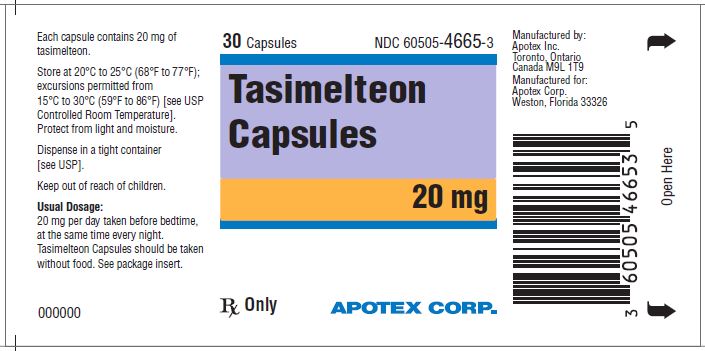
60505-466569238-2548
Indicated ICD-10 codes
Treats these conditions
Source: openFDA + RxNorm · 2026
Look up another medication