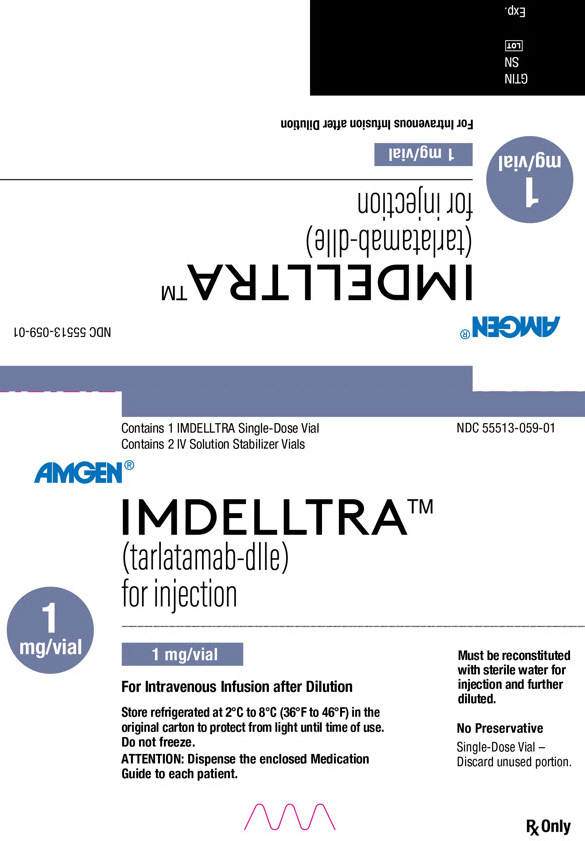
Tarlatamab. INDICATIONS AND USAGE IMDELLTRA is indicated for the treatment of adult patients with extensive stage small cell lung cancer (ES-SCLC) with disease…
Boxed warning
WARNING: CYTOKINE RELEASE SYNDROME and NEUROLOGIC TOXICITY including IMMUNE EFFECTOR CELL-ASSOCIATED NEUROTOXICITY SYNDROME Cytokine release syndrome (CRS), including life-threatening or fatal reactions, can occur in patients receiving IMDELLTRA. Initiate IMDELLTRA using the step-up dosing schedule to reduce the incidence and severity of CRS. Withhold IMDELLTRA until CRS resolves or permanently discontinue based on severity [see Dosage and Administration (2.5) and Warnings and Precautions (5.1) ] . Neurologic toxicity and immune effector cell-associated neurotoxicity syndrome (ICANS), including life-threatening or fatal reactions, can occur in patients receiving IMDELLTRA. Monitor patients for signs and symptoms of neurologic toxicity, including ICANS, during treatment and treat promptly. Withhold IMDELLTRA until ICANS resolves or permanently discontinue based on severity [see Dosage and Administration (2.5) and Warnings and Precautions (5.2) ] . WARNING: CYTOKINE RELEASE SYNDROME and NEUROLOGIC TOXICITY including IMMUNE EFFECTOR CELL-ASSOCIATED NEUROTOXICITY SYNDROME See full prescribing information for complete boxed warning . Cytokine release syndrome (CRS), including life-threatening or fatal reactions, can occur in patients receiving IMDELLTRA. Initiate treatment with the IMDELLTRA using step-up dosing schedule to reduce the incidence and severity of CRS. Withhold IMDELLTRA until CRS resolves or permanently discontinue based on severity. ( 2.5 , 5.1 ) Neurologic toxicity and Immune Effector Cell-Associated Neurotoxicity Syndrome (ICANS), including life-threatening or fatal reactions, can occur in patients receiving IMDELLTRA. Monitor patients for signs or symptoms of neurologic toxicity, including ICANS, during treatment and treat promptly. Withhold IMDELLTRA until ICANS resolves or permanently discontinue based on severity. ( 2.5 , 5.2 )
INDICATIONS AND USAGE IMDELLTRA is indicated for the treatment of adult patients with extensive stage small cell lung cancer (ES-SCLC) with disease progression on or after platinum-based chemotherapy. IMDELLTRA is a bispecific delta-like ligand 3 (DLL3)-directed CD3 T- cell engager indicated for the treatment of adult patients with extensive stage small cell lung cancer (ES-SCLC) with disease progression on or after platinum - based chemotherapy. ( 1 )
Dosage
DOSAGE AND ADMINISTRATION Administer as an intravenous infusion over 1 hour. ( 2.2 ) Administer IMDELLTRA according to the step - up dosing schedule in Table 1 to reduce the risk of cytokine release syndrome. ( 2.2 ) Administer concomitant medications as recommended. ( 2.3 ) Monitor patients from the start of the IMDELLTRA infusion for 22 to 24 hours on Cycle 1 Day 1 and Cycle 1 Day 8 in an appropriate healthcare setting. Recommend patients to remain within 1 hour of an appropriate healthcare setting for a total of 48 hours from the start of the infusion with IMDELLTRA following Cycle 1 Day 1 and Cycle 1 Day 8 doses, accompanied by a caregiver. ( 2.2 ) See Full Prescribing Information for instructions on preparation and administration. ( 2.2 , 2.6 ) 2.1 Important Dosage and Administration Information Administer IMDELLTRA according to the step-up dose and schedule in Table 1 to reduce the incidence and severity of cytokine release syndrome (CRS) [see Dosage and Administration (2.2) ] . Evaluate complete blood count, liver enzymes and bilirubin prior to administration of all doses of IMDELLTRA up through Cycle 5 Day 15 and then prior to administration of IMDELLTRA on Day 1 of each cycle starting with Cycle 6. More frequent evaluation may be necessary if clinically indicated [see Warnings and Precautions (5.3 , 5.5) ] . Ensure patients are well hydrated prior to administration of IMDELLTRA [see Warnings and Precautions (5.1) ] . For Cycle 1, administer recommended concomitant medications in Table 3 before and after Cycle 1 Day 1 and Cycle 1 Day 8 IMDELLTRA infusions to reduce the risk of CRS reactions [see Dosage and Administration (2.3) ] . IMDELLTRA should only be administered by a qualified healthcare professional with appropriate medical support to manage severe reactions, such as CRS and neurologic toxicity, including immune effector cell-associated neurotoxicity syndrome (ICANS) [see Warnings and Precautions (5.1 , 5.2) ] . Due to the risk of CRS and neurologic toxicity, including ICANS, monitor patients from the start of the IMDELLTRA infusion for 22 to 24 hours on Cycle 1 Day 1 and Cycle 1 Day 8 in an appropriate healthcare setting [see Dosage and Administration (2.5) and Warnings and Precautions (5.1 , 5.2) ] . Recommend patients to remain within 1 hour of an appropriate healthcare setting for a total of 48 hours from start of the infusion with IMDELLTRA following Cycle 1 Day 1 and Cycle 1 Day 8 doses, accompanied by a caregiver. Inform both the patient and the caregiver on the signs and symptoms of cytokine release syndrome (CRS) and immune effector cell-associated neurotoxicity syndrome (ICANS) prior to discharge. 2.2 Recommended Dosage and Administration Administer IMDELLTRA as an intravenous infusion for one hour. The recommended step-up dose and schedule for IMDELLTRA is provided in Table 1. Administer step-up dose and schedule on Cycle 1 Day 1 to reduce the incidence and severity of CRS. After step-up dose and schedule on Cycle 1 Day 1, administer IMDELLTRA every 2 weeks until disease progression or unacceptable toxicity. Table 1. Recommended Dose and Schedule of IMDELLTRA Dosing Schedule Day Dose of IMDELLTRA Administration Instructions Recommended Monitoring Note: See Table 4 for recommendation on restarting IMDELLTRA after dose delays. Step-up Dose and Schedule Cycle 1 Day 1 Administer recommended concomitant medications before and after Cycle 1 Day 1 and Cycle 1 Day 8 IMDELLTRA infusions as described in Table 3. Step-up dose 1 mg Administer IMDELLTRA as a 1-hour intravenous infusion in an appropriate healthcare setting. Monitor patients from the start of the IMDELLTRA infusion for 22 to 24 hours on Cycle 1 Day 1 and Cycle 1 Day 8 in an appropriate healthcare setting. Recommend that patients remain within 1 hour of an appropriate healthcare setting for a total of 48 hours from start of the IMDELLTRA infusion accompanied by a caregiver. Day 8 10 mg Day 15 10 mg Observe patients for 6-8 hours post IMDELLTRA infusion Extended monitoring in a healthcare setting is not required unless the patient experiences Grade ≥ 2 CRS, ICANS or neurological toxicity during prior treatments. See Tables 5 and 6 for monitoring recommendations. Cycle 2 Day 1 and 15 10 mg Observe patients for 6-8 hours post IMDELLTRA infusion . Cycles 3 and 4 Day 1 and 15 10 mg Observe patients for 3-4 hours post IMDELLTRA infusion . Cycle 5 and subsequent infusions Day 1 and 15 10 mg Observe patients for 2 hours post IMDELLTRA infusion . Administration The intravenous (IV) catheter for concomitant medications administration can be used to administer the IMDELLTRA infusion. To ensure patency, flush the IV catheter over 3 to 5 minutes using 0.9% Sodium Chloride for Injection. Administer the reconstituted and diluted IMDELLTRA as a 1-hour intravenous infusion at a constant flow rate using an infusion pump. The pump should be programmable, lockable, non-elastomeric, and have an alarm. Flush the IV-line upon completion of the IMDELLTRA infusion. Table 2 provides the infusion duration and rate. Table 2. IMDELLTRA Infusion Duration and Rate Infusion Duration for 250 mL IV Preparation Infusion Rate 1 hour 250 mL/hour 2.3 Recommended Concomitant Medications for IMDELLTRA Administration for Cycle 1 Day 1 and Cycle 1 Day 8 Administer recommended concomitant medications for IMDELLTRA during Cycle 1 Day 1 and Cycle 1 Day 8 as presented in Table 3 to reduce the risk of CRS [see Warnings and Precautions (5.1) ] . Table 3. Recommended Concomitant Medications for IMDELLTRA Administration for Cycle 1 Day 1 and Cycle 1 Day 8 Treatment Day Medication Administration Cycle 1 Day 1 and Cycle 1 Day 8 Administer dexamethasone 8 mg intravenously (or equivalent) Within 1 hour prior to IMDELLTRA administration Administer 1 liter of normal saline intravenously over 2 to 4 hours Immediately after completion of IMDELLTRA infusion 2.4 Restarting IMDELLTRA After Dosage Delay If a dose of IMDELLTRA is delayed, restart based on the recommendation as listed in Table 4 and resume the dose and schedule accordingly [see Dosage and Administration (2.2) ] . Administer recommended concomitant medications as indicated in Table 3. Table 4. Recommendations for Restarting IMDELLTRA After Dosage Delay Last Dose Administered Time Since the Last Dose Administered Action Administer recommended concomitant medications before and after Cycle 1 Day 1 and Cycle 1 Day 8 IMDELLTRA infusions and monitor patients accordingly [see Dosage and Administration (2.1 , 2.2 and 2.3) ] . 1 mg on Cycle 1 Day 1 2 weeks or less (≤ 14 days) Administer IMDELLTRA 10 mg, then resume with the planned dose and schedule. Greater than 2 weeks (> 14 days) Administer IMDELLTRA step-up dose 1 mg. If tolerated, increase to 10 mg 1 week later. Then resume with the planned dose and schedule. 10 mg on Cycle 1 Day 8 3 weeks or less (≤ 21 days) Administer IMDELLTRA 10 mg, then resume with the planned dose and schedule. Greater than 3 weeks (> 21 days) Administer IMDELLTRA step-up dose 1 mg. If tolerated, increase to 10 mg 1 week later. Then resume with the planned dose and schedule. 10 mg on Cycle 1 Day 15 and subsequent Cycles every 2 weeks thereafter 4 weeks or less (≤ 28 days) Administer IMDELLTRA 10 mg, then resume with the planned dose and schedule. Greater than 4 weeks (> 28 days) Administer IMDELLTRA step-up dose 1 mg. If tolerated, increase to 10 mg 1 week later. Then resume with the planned dose and schedule. 2.5 IMDELLTRA Dosage Modifications and Adverse Reaction Management No dose reduction for IMDELLTRA is recommended. See Table 5 and Table 6 for recommended management of CRS, neurologic toxicity including ICANS respectively and Table 7 for cytopenias, infections and other adverse reactions. Cytokine Release Syndrome (CRS) Diagnose CRS based on clinical presentation [see Warnings and Precautions (5.1) ] . Evaluate for and treat other causes of fever, hypoxia, and hypotension. If CRS is suspected, manage according to the recommendations in Table
Warnings
WARNINGS AND PRECAUTIONS Cytopenias : Monitor complete blood counts prior to administration of all doses of IMDELLTRA up through Cycle 5 Day 15 and then prior to administration of IMDELLTRA on Day 1 of each cycle starting with Cycle 6. More frequent evaluation may be necessary as clinically indicated. Withhold or permanently discontinue based on severity. ( 5.3 ) Infections : Monitor for signs and symptoms of infection; treat appropriately. Withhold or permanently discontinue based on severity. ( 5.4 ) Hepatotoxicity : Monitor liver enzymes and bilirubin prior to administration of all doses of IMDELLTRA up through Cycle 5 Day 15 and then prior to administration of IMDELLTRA on Day 1 of each cycle starting with Cycle 6. More frequent evaluation may be necessary as clinically indicated. Withhold or permanently discontinue based on severity. ( 5.5 ) Hypersensitivity : Monitor for signs and symptoms of hypersensitivity and treat accordingly. Withhold or permanently discontinue based on severity. ( 5.6 ) Embryo - Fetal Toxicity : May cause fetal harm. Advise females of reproductive potential of the potential risk to the fetus and to use effective contraception ( 5.7 , 8.1 , 8.3 ) 5.1 Cytokine Release Syndrome IMDELLTRA can cause cytokine release syndrome (CRS) including life-threatening or fatal reactions. In the pooled safety population [see Adverse Reactions (6.1) ] , CRS occurred in 57% (268/473) of patients who received IMDELLTRA, including 39% Grade 1, 15% Grade 2, 1.7% Grade 3 and 0.2% Grade 4. Recurrent CRS occurred in 24% of IMDELLTRA-treated patients including 20% Grade 1 and 3.4% Grade 2; one patient experienced recurrent Grade 3. Among the 268 patients who experienced CRS, 73% had CRS after the first dose, 60% had CRS after the second dose, and 15% had CRS following the third or later dose. Following the Cycle 1 Day 1, Day 8, Day 15 infusions, 24%, 8%, and 1% of patients experienced Grade ≥ 2 CRS, respectively. From Cycle 2 onwards, 1.5% of patients experienced Grade ≥ 2 CRS. Of the patients who experienced CRS, 31% received steroids and 10% required tocilizumab. The median time to onset of all grade CRS from most recent dose of IMDELLTRA was 16 hours (range: start of infusion to 15 days). The median time to onset of Grade ≥ 2 CRS from most recent dose of IMDELLTRA was 15 hours (range: start of infusion to 15 days). Clinical signs and symptoms of CRS included pyrexia, hypotension, fatigue, tachycardia, headache, hypoxia, nausea and vomiting. Potentially life-threatening complications of CRS may include cardiac dysfunction, acute respiratory distress syndrome, neurologic toxicity, renal and/or hepatic failure, and disseminated intravascular coagulation (DIC). Administer IMDELLTRA following the recommended step-up dosing and administer concomitant medications before and after Cycle 1 Day 1 and Cycle 1 Day 8 IMDELLTRA infusions as described in Table 3 to reduce the risk of CRS [see Dosage and Administration (2.3) ] . Administer IMDELLTRA in an appropriate healthcare facility equipped to monitor and manage CRS. Ensure patients are well hydrated prior to administration of IMDELLTRA. Closely monitor patients for signs and symptoms of CRS during treatment with IMDELLTRA. At the first sign of CRS, immediately discontinue IMDELLTRA infusion, evaluate the patient for hospitalization and institute supportive care based on severity. Withhold or permanently discontinue IMDELLTRA based on severity [see Dosage and Administration (2.5) ] . Counsel patients and caregivers to seek medical attention should signs or symptoms of CRS occur. 5.2 Neurologic Toxicity Including ICANS IMDELLTRA can cause life-threatening or fatal neurologic toxicity including ICANS. In the pooled safety population [see Adverse Reactions (6.1) ] , neurologic toxicity occurred in 65% of patients who received IMDELLTRA, with Grade 3 or higher events in 7% of patients including fatal events in 0.2%. The most frequent neurologic toxicities were dysgeusia (34%), headache (17%), peripheral neuropathy (9%), dizziness (9%), and insomnia (8%). The incidence of signs and symptoms consistent with ICANS was 10% in IMDELLTRA- treated patients, including events with the preferred terms: ICANs (4.7%), muscular weakness (3.2%), cognitive disorder (0.6%), aphasia (0.6%), depressed level of consciousness (0.4%), seizures (0.4%), encephalopathy (0.4%), and leukoencephalopathy (0.2%). There was one fatal reaction of ICANS [see Adverse Reactions (6.1) ] . Recurrent ICANS occurred in 1.5% of patients. Of the patients who experienced ICANS, most experienced the event following Cycle 1 Day 1 (2.5%) and Cycle 1 Day 8 (3.6%). Following Day 1, Day 8, and Day 15 infusions, 1.3%, 1.3% and 0.4% of patients experienced Grade ≥ 2 ICANS, respectively. ICANS can occur several weeks following administration of IMDELLTRA. The median time to onset of ICANS from the first dose of IMDELLTRA was 16 days (range: 1 to 862 days). The median time to resolution of ICANS was 4 days (range: 1 to 40 days). The onset of ICANS can be concurrent with CRS, following resolution of CRS, or in the absence of CRS. Clinical signs and symptoms of ICANS may include but are not limited to confusional state, depressed level of consciousness, disorientation, somnolence, lethargy, and bradyphrenia. Patients receiving IMDELLTRA are at risk of neurologic adverse reactions and ICANS resulting in depressed level of consciousness. Advise patients to refrain from driving and engaging in hazardous occupations or activities, such as operating heavy or potentially dangerous machinery, until neurologic symptoms resolve . Closely monitor patients for signs and symptoms of neurologic toxicity and ICANS during treatment with IMDELLTRA. At the first sign of ICANS, immediately discontinue the infusion, evaluate the patient and provide supportive therapy based on severity. Withhold IMDELLTRA or permanently discontinue based on severity [see Dosage and Administration (2.5) ] . 5.3 Cytopenias IMDELLTRA can cause cytopenias including neutropenia, thrombocytopenia, and anemia. In the pooled safety population, [see Adverse Reactions (6.1) ] based on laboratory data, decreased neutrophils occurred in 16% of patients, including 9% Grade 3 or 4. The median time to onset for Grade 3 or 4 decreased neutrophil count was 41 days (range: 2 to 306 days). Decreased platelets occurred in 30%, including 2.2% Grade 3 or 4. The median time to onset for Grade 3 or 4 decreased platelets was 67 days (range: 3 to 420 days). Decreased hemoglobin occurred in 56% of patients, including 4.7% Grade 3 or 4. Febrile neutropenia was reported as an adverse event in 1.5% of patients treated with IMDELLTRA. Monitor patients for signs and symptoms of cytopenias. Perform complete blood counts prior to treatment with all doses of IMDELLTRA, up through Cycle 5 Day 15 and then prior to administration of IMDELLTRA on Day 1 of each cycle starting with Cycle 6. Based on the severity of cytopenias, temporarily withhold or permanently discontinue IMDELLTRA [see Dosage and Administration (2.5) ] . 5.4 Infections IMDELLTRA can cause serious infections, including life-threatening and fatal infections. In the pooled safety population, [see Adverse Reactions (6.1) ] , infections including opportunistic infections occurred in 43% of patients who received IMDELLTRA, including 14% Grade 3 or 4. The most frequent infections were pneumonia (11%), urinary tract infection (9%), COVID-19 (6%), upper respiratory tract infection (4.7%), respiratory tract infection (4%), candida infection (2.1%), oral candidiasis (2.1%) and nasopharyngitis (2.1%). Monitor patients for signs and symptoms of infection prior to and during treatment with IMDELLTRA and treat as clinically indicated. Withhold or permanently discontinue IMDELLTRA based on severity [see Dosage and Administration (2.5) ] . 5.5 Hepatotoxicity IMDELLTRA can cause hepatotoxicity. In the pooled safety population [see Adverse Reactions (6.1) ] , based on laboratory data
Contraindications
CONTRAINDICATIONS None . None. ( 4 )
Adverse reactions
ADVERSE REACTIONS The following clinically significant adverse reactions are described elsewhere in the labeling: Cytokine Release Syndrome (CRS) [see Warnings and Precautions (5.1) ] Neurologic Toxicity Including ICANS [see Warnings and Precautions (5.2) ] Cytopenias [see Warnings and Precautions (5.3) ] Infections [see Warnings and Precautions (5.4) ] Hepatotoxicity [see Warnings and Precautions (5.5) ] Hypersensitivity [see Warnings and Precautions (5.6) ] The most common adverse reactions (> 20%) were cytokine release syndrome, fatigue, decreased appetite, anemia, dysgeusia, pyrexia, constipation, musculoskeletal pain, and nausea. The most common (≥ 5%) Grade 3 or 4 laboratory abnormalities were decreased lymphocytes, decreased sodium, decreased total neutrophils, and increased uric acid. To report SUSPECTED ADVERSE REACTIONS, contact Amgen Inc. at 1-800-77-AMGEN (1-800-772-6436) or FDA at 1-800-FDA-1088 or www.fda.gov/medwatch . 6.1 Clinical Trials Experience Because clinical trials are conducted under widely varying conditions, adverse reaction rates observed in the clinical trials of a drug cannot be directly compared to rates in the clinical trials of another drug and may not reflect the rates observed in practice. The pooled safety population described in the WARNINGS AND PRECAUTIONS reflects exposure to intravenous IMDELLTRA, as a single agent, at the recommended dosage of IMDELLTRA 1 mg on Cycle 1 Day 1 followed by 10 mg on Days 8 and 15, and then every 2 weeks until disease progression or intolerable toxicity in 473 patients with small cell lung cancer enrolled in three clinical trials: DeLLphi-300, DeLLphi-301 and DeLLphi-304. Among 473 patients who received IMDELLTRA, 40% were exposed for 6 months or longer and 19% were exposed for greater than one year. The most common (≥ 20%) adverse reactions were CRS (57%), fatigue (48%), decreased appetite (38%), dysgeusia (34%), pyrexia (33%), constipation (31%), musculoskeletal pain (31%), and nausea (25%). The most common (≥ 5%) Grade 3 or 4 laboratory abnormalities were decreased lymphocytes (43%), decreased sodium (12%), decreased total neutrophils (9%), and increased uric acid (6%). Extensive Stage Small Cell Lung Cancer The safety of IMDELLTRA was evaluated in 252 patients in DeLLphi-304, a multicenter, randomized, open label trial in patients with extensive stage small cell lung cancer (ES- SCLC) with disease progression following treatment with platinum-based chemotherapy with or without an anti-PD-(L)1 antibody [see Clinical Studies (14.1) ]. Patients received IMDELLTRA (n=252) or investigator's choice or investigator's choice of topotecan [n=176], lurbinectedin [n=45] or amrubicin [n=23]. Among patients who received IMDELLTRA, 41% were exposed for 6 months or longer and 18% were exposed for greater than one year. The demographic characteristics of patients who received IMDELLTRA were: median age 64 years (range: 20 to 86); 71% male; 60% White, 38 % Asian, 0.8% Black or African American; and 4.8% were of Hispanic or Latino ethnicity. Serious adverse reactions occurred in 52% of patients who received IMDELLTRA. Serious adverse reactions in >3% of patients included CRS (17%), pyrexia (6%), pneumonia (5%) and ICANS (3.6%). Fatal adverse reactions occurred in 8% of patients who received IMDELLTRA, including one fatal adverse reaction of ICANS (0.4%). Fatal adverse reactions occurring in more than one patient included pneumonia (1.6%), cardio-respiratory arrest (1.6%), and sepsis (0.8%). Permanent discontinuation of IMDELLTRA due to an adverse reaction occurred in 6% of patients. Adverse reactions which resulted in permanent discontinuation of IMDELLTRA in > 1% of patients included pneumonia (1.2%). Dosage interruptions of IMDELLTRA due to an adverse reaction occurred in 38% of patients. Adverse reactions which required dosage interruption in ≥ 2% of patients included neutropenia (5%), fatigue (4.4%), pneumonia (4%), decreased appetite (2.8%), COVID-19 (2%). Table 13 summarizes adverse reactions observed in DeLLphi-304. Table 13. Adverse Reactions (≥ 15%) in Patients with SCLC Who Received IMDELLTRA in DeLLphi-304 Adverse Reaction IMDELLTRA Graded using CTCAE Version 4.0 and Version 5.0. (N = 252) Standard of Care (N = 244) Any Grade (%) Grade 3 or 4 (%) Any Grade (%) Grade 3 or 4 (%) Immune system disorders Cytokine release syndrome Based on American Society for Transplantation and Cellular Therapy (ASTCT) 2019. 56 1.2 1.2 0 General disorders and administration site conditions Fatigue Includes fatigue and asthenia 39 6 43 10 Pyrexia Includes body temperature increased, hyperthermia, pyrexia 29 1.2 11 1.2 Metabolism and nutrition disorders Decreased appetite 37 2 23 1.6 Gastrointestinal disorders Constipation 30 0.4 22 0 Nausea 25 0.4 32 0 Nervous system disorders Dysgeusia Includes ageusia, dysgeusia, hypogeusia 28 0 2.5 0 Headache Includes headache and tension headache 16 0 9 0 Musculoskeletal and connective tissue disorders Musculoskeletal pain Includes arthralgia, back pain, bone pain, musculoskeletal pain, myalgia, neck pain, non-cardiac chest pain, pain in extremity, spinal pain 27 1.6 21 2.5 Respiratory, thoracic and mediastinal disorders Cough Includes cough and productive cough 17 0 17 0 Clinically relevant adverse reactions occurring in < 15% of patients who received IMDELLTRA were immune effector cell-associated neurotoxicity syndrome, neurotoxicity, tremor, seizure, ataxia, confusional state, delirium, dyspnea, encephalopathy and weight decreased. Table 14 summarizes laboratory abnormalities in DeLLphi-304. Table 14. Laboratory Abnormalities (≥ 20%) That Worsened from Baseline in Patients with SCLC in DeLLphi-304 Laboratory Abnormality IMDELLTRA The denominator used to calculate the rate varied for IMDELLTRA (Range: 229 to 250) and SOC (Range: 205 to 226) based on the number of patients with a baseline value and at least one post-treatment value. N=252 Standard of care N=244 All Grades (%) Grade 3 or 4 (%) All Grades (%) Grade 3 or 4 (%) Hematology Lymphocytes decreased 65 27 62 27 Hemoglobin decreased 51 4.5 86 29 White blood cells decreased 50 7 70 29 Platelets decreased 25 0.4 55 20 Neutrophils decreased All Grade lab abnormalities occurring at a frequency less than 20% included decreased neutrophils. 15 10 44 36 Chemistry Sodium decreased 57 8 38 7 Potassium decreased 41 4.8 34 4 Aspartate amino transferase increased 40 2.8 29 0.4 Sodium increased 35 0.4 27 0 Alanine aminotransferase increased 32 2 25 0.9 Activated Partial Thromboplastin Time (sec) increased 26 1.3 16 0.9 Creatinine increased 23 0.8 19 0.4 Alkaline phosphate increased 22 0.4 26 1.4 Magnesium decreased 21 0.8 15 1.8 Potassium increased 21 0.8 12 1.8 Creatine Phosphokinase increased 21 1.7 11 0 DeLLphi-300 and DeLLphi-301 The safety of IMDELLTRA, as a single agent, at the recommended dosage was evaluated in patients with extensive stage small cell lung cancer enrolled in DeLLphi-300 and DeLLphi-301 [see Clinical Studies (14.1) ]. Among 187 patients who received IMDELLTRA, 31% were exposed for 6 months or longer and 14% were exposed for greater than one year. The demographic characteristics of patients who received IMDELLTRA were: median age 66 years (range: 35 to 82); 65% male; 70% White, 26% Asian, 2.1% Black or African American; and 2.1% Hispanic or Latino. Serious adverse reactions occurred in 58% of patients who received IMDELLTRA. Serious adverse reactions in >3% of patients included cytokine release syndrome (24%), pneumonia (6%), pyrexia (3.7%) and hyponatremia (3.6%). Fatal adverse reactions occurred in 2.7% of patients who received IMDELLTRA including pneumonia 0.5%, aspiration (0.5%), pulmonary embolism (0.5%), respiratory acidosis (0.5%), and respiratory failure (0.5%). Permanent discontinuation of IMDELLTRA due to an adverse reaction occurred in 7% of patients. Adverse reactions which resulted in permanent discontinuation of IMDELLTRA in >1% of patients included cytokine release syndrome (1.6%) and
Mechanism of action
Mechanism of Action Tarlatamab-dlle is a bispecific T-cell engager that binds to DLL3 expressed on the surface of cells, including tumor cells, and CD3 expressed on the surface of T cells. Tarlatamab-dlle causes T-cell activation, release of inflammatory cytokines, and lysis of DLL3-expressing cells. Tarlatamab-dlle had anti-tumor activity in mouse models of SCLC.