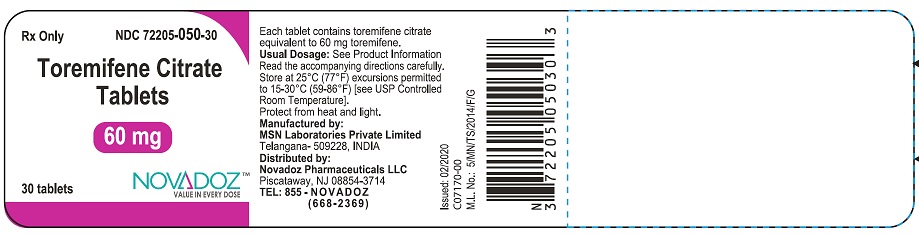
toremifene 60 MG Oral Tablet [Fareston] — Anti-estrogens. INDICATIONS AND USAGE FARESTON® is an estrogen agonist/antagonist indicated for the treatment of metastatic breast cancer in postmenopausal women…
Boxed warning
WARNING: QT PROLONGATION FARESTON has been shown to prolong the QTc interval in a dose- and concentration-related manner [see Clinical Pharmacology (12.2) ] . Prolongation of the QT interval can result in a type of ventricular tachycardia called Torsade de pointes, which may result in syncope, seizure, and/or death. Toremifene should not be prescribed to patients with congenital/acquired QT prolongation, uncorrected hypokalemia or uncorrected hypomagnesemia. Drugs known to prolong the QT interval and strong CYP3A4 inhibitors should be avoided [see Warnings and Precautions (5.1) ] . WARNING: QT PROLONGATION FARESTON has been shown to prolong the QTc interval in a dose- and concentration-related manner [see Clinical Pharmacology (12.2) ] . Prolongation of the QT interval can result in a type of ventricular tachycardia called Torsade de pointes, which may result in syncope, seizure, and/or death. Toremifene should not be prescribed to patients with congenital/acquired QT prolongation, uncorrected hypokalemia or uncorrected hypomagnesemia. Drugs known to prolong the QT interval and strong CYP3A4 inhibitors should be avoided [see Warnings and Precautions (5.1) ] .
Toremifene has several drug interactions that may affect its exposure and the risk of adverse effects.
moderatethiazide diuretics — may increase the risk of hypercalcemia
majorstrong CYP3A4 inducers (e.g., dexamethasone, phenytoin, carbamazepine, rifampin) — may result in a relevant decrease in FARESTON exposure
majorstrong CYP3A4 inhibitors (e.g., ketoconazole, itraconazole, clarithromycin) — can result in a relevant increase in FARESTON exposure
moderatewarfarin — should be used with caution and require careful monitoring
majorgrapefruit juice — may increase plasma concentrations of toremifene
majoragents that prolong QT (e.g., Class 1A and Class III antiarrhythmics, certain antipsychotics, certain antidepressants) — should be avoided due to risk of QT prolongation
Indications
INDICATIONS AND USAGE FARESTON® is an estrogen agonist/antagonist indicated for the treatment of metastatic breast cancer in postmenopausal women with estrogen-receptor positive or unknown tumors. FARESTON® is an estrogen agonist/antagonist indicated for the treatment of metastatic breast cancer in postmenopausal women with estrogen-receptor positive or unknown tumors. ( 1 )
Dosage
DOSAGE AND ADMINISTRATION The dosage of FARESTON is 60 mg, once daily, orally. Treatment is generally continued until disease progression is observed. 60 mg once daily, orally ( 2 )
Warnings
WARNINGS AND PRECAUTIONS Prolongation of the QT Interval ( 5.1 ) Heptatotoxicty ( 5.2 ) Hypercalcemia and Tumor Flare ( 5.3 ) Risk of Uterine Malignancy ( 5.4 ) General ( 5.5 ) Laboratory Tests ( 5.6 ) Pregnancy: Fetal harm may occur when administered to a pregnant woman. Women should be advised not to become pregnant when taking FARESTON. ( 5.7 , 8.1 ) Women of Childbearing Potential: Use effective nonhormonal contraception during FARESTON therapy. ( 5.8 ) 5.1 Prolongation of the QT Interval Toremifene has been shown to prolong the QTc interval in a dose- and concentration-related manner [see Clinical Pharmacology (12.2) ] . Prolongation of the QT interval can result in a type of ventricular tachycardia called Torsade de pointes, which may result in syncope, seizure, and/or death. Toremifene should be avoided in patients with long QT syndrome. Caution should be exercised in patients with congestive heart failure, hepatic impairment and electrolyte abnormalities. Hypokalemia or hypomagnesemia must be corrected prior to initiating toremifene and these electrolytes should be monitored periodically during therapy. Drugs that prolong the QT interval should be avoided. In patients at increased risk, electrocardiograms (ECGs) should be obtained at baseline and as clinically indicated [see Drug Interactions (7.2) and Clinical Pharmacology (12.2) ] . 5.2 Hepatotoxicity Hepatotoxicity, both increases in the serum concentration for grade 3 and 4 transaminitis and hyperbilirubinemia, including jaundice, hepatitis, and non-alcoholic fatty liver disease, have also been reported in clinical trials and postmarketing with FARESTON. Liver function tests should be performed periodically. [ see Adverse Reactions (6.1) , Post-marketing Experience (6.2) ] 5.3 Hypercalcemia and Tumor Flare As with other antiestrogens, hypercalcemia and tumor flare have been reported in some breast cancer patients with bone metastases during the first weeks of treatment with FARESTON. Tumor flare is a syndrome of diffuse musculoskeletal pain and erythema with increased size of tumor lesions that later regress. It is often accompanied by hypercalcemia. Tumor flare does not imply failure of treatment or represent tumor progression. If hypercalcemia occurs, appropriate measures should be instituted and, if hypercalcemia is severe, FARESTON treatment should be discontinued. 5.4 Risk of Uterine Malignancy Endometrial cancer, endometrial hypertrophy, hyperplasia, and uterine polyps have been reported in some patients treated with FARESTON. Endometrial hyperplasia of the uterus was observed in animals treated with toremifene [see Nonclinical Toxicology (13.1) ] . Long-term use of FARESTON has not been established in patients with pre-existing endometrial hyperplasia. All patients should have baseline and annual gynecological examinations. In particular, patients at high risk of endometrial cancer should be closely monitored. 5.5 General Patients with a history of thromboembolic diseases should generally not be treated with FARESTON. Patients with bone metastases should be monitored closely for hypercalcemia during the first weeks of treatment [see Warnings and Precautions (5.2) ] . Leukopenia and thrombocytopenia have been reported rarely; leukocyte and platelet counts should be monitored when using FARESTON in patients with leukopenia and thrombocytopenia. 5.6 Laboratory Tests Periodic complete blood counts, calcium levels, and liver function tests should be obtained. 5.7 Use in Pregnancy Based on its mechanism of action in humans and findings of increased pregnancy loss and fetal malformation in animal studies, FARESTON can cause fetal harm when administered to a pregnant woman. Toremifene caused embryo-fetal toxicities at maternal doses that were lower than the 60 mg daily recommended human dose on a mg/m 2 basis. There are no adequate and well-controlled studies in pregnant women using FARESTON. If this drug is used during pregnancy, or if the patient becomes pregnant while taking this drug, the patient should be apprised of the potential hazard to the fetus [see Use in Specific Populations (8.1) ] . 5.8 Women of Childbearing Potential FARESTON is indicated only in postmenopausal women. However, premenopausal women prescribed FARESTON should use effective non-hormonal contraception and should be apprised of the potential hazard to the fetus should pregnancy occur.
Contraindications
CONTRAINDICATIONS Hypersensitivity to the drug ( 4.1 ) QT Prolongation, Hypokalemia, Hypomagnesemia ( 4.2 ) 4.1 Hypersensitivity to the Drug FARESTON is contraindicated in patients with known hypersensitivity to the drug. 4.2 QT Prolongation, Hypokalemia, Hypomagnesemia Toremifene should not be prescribed to patients with congenital/acquired QT prolongation (long QT syndrome), uncorrected hypokalemia, or uncorrected hypomagnesemia.
Mechanism of action
Mechanism of Action Toremifene is a nonsteroidal triphenylethylene derivative. Toremifene binds to estrogen receptors and may exert estrogenic, antiestrogenic, or both activities, depending upon the duration of treatment, animal species, gender, target organ, or endpoint selected. In general, however, nonsteroidal triphenylethylene derivatives are predominantly antiestrogenic in rats and humans and estrogenic in mice. In rats, toremifene causes regression of established dimethylbenzanthracene (DMBA)-induced mammary tumors. The antitumor effect of toremifene in breast cancer is believed to be mainly due to its antiestrogenic effects, i.e., its ability to compete with estrogen for binding sites in the cancer, blocking the growth-stimulating effects of estrogen in the tumor.
A drug lookup is just the start. Eleplan keeps the whole care plan in one place.
Medications, diagnoses, documents, appointments, and the whole care team — organized and always in sync, with Ellie, your AI care assistant, on top of it. Free to start.