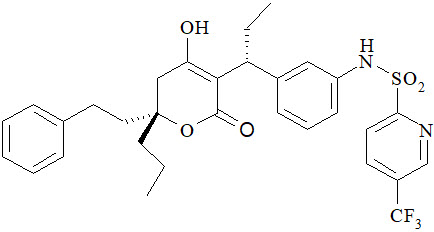
tipranavir 250 MG Oral Capsule [Aptivus] — Protease inhibitors. INDICATIONS AND USAGE APTIVUS, co-administered with ritonavir, is indicated for combination antiretroviral treatment of HIV-1 infected adults and…
Boxed warning
WARNING: HEPATOTOXICITY and INTRACRANIAL HEMORRHAGE WARNING: HEPATOTOXICITY and INTRACRANIAL HEMORRHAGE See full prescribing information for complete boxed warning. Clinical hepatitis and hepatic decompensation including some fatalities. Extra vigilance is warranted in patients with chronic hepatitis B or hepatitis C co-infection. ( 5.2 ) Fatal and non-fatal intracranial hemorrhage ( 5.3 ) Hepatotoxicity: Clinical hepatitis and hepatic decompensation, including some fatalities, have been reported. Extra vigilance is warranted in patients with chronic hepatitis B or hepatitis C co-infection, as these patients have an increased risk of hepatotoxicity [ see Warnings and Precautions (5.2) ] . Intracranial Hemorrhage: Both fatal and non-fatal intracranial hemorrhage have been reported [ see Warnings and Precautions (5.3) ] .
Tipranavir has several clinically significant drug interactions, particularly with drugs that are substrates or inhibitors of CYP3A and P-glycoprotein.
majorritonavir — may increase plasma concentrations of agents primarily metabolized by CYP3A
majoretravirine — significant decrease in plasma concentrations of etravirine
moderateabacavir — decreased AUC by approximately 40%
moderatedidanosine — decreased levels of didanosine
moderatezidovudine — decreased AUC by approximately 35%
majorfosamprenavir — not recommended to combine with APTIVUS/ritonavir
majorlopinavir — not recommended to combine with APTIVUS/ritonavir
majorsaquinavir — not recommended to combine with APTIVUS/ritonavir
moderateatazanavir — decreased levels of atazanavir
moderateraltegravir — decreased levels of raltegravir
Indications
INDICATIONS AND USAGE APTIVUS, co-administered with ritonavir, is indicated for combination antiretroviral treatment of HIV-1 infected adults and pediatric patients weighing 36 kg or higher who are treatment-experienced and infected with HIV-1 strains resistant to more than one protease inhibitor (PI) [see Use in Specific Populations (8.4) ] . This indication is based on analyses of plasma HIV-1 RNA levels in two controlled studies of APTIVUS/ritonavir of 48 weeks duration in treatment-experienced adults and one open-label 48-week study in pediatric patients. The adult studies were conducted in clinically advanced, 3-class antiretroviral (NRTI, NNRTI, PI) treatment-experienced adults with evidence of HIV-1 replication despite ongoing antiretroviral therapy. The following points should be considered when initiating therapy with APTIVUS/ritonavir: The use of APTIVUS/ritonavir in treatment-naïve patients is not recommended [ see Warnings and Precautions (5.2) ]. The use of other active agents with APTIVUS/ritonavir is associated with a greater likelihood of treatment response [ see Microbiology (12.4) and Clinical Studies (14) ]. Genotypic or phenotypic testing and/or treatment history should guide the use of APTIVUS/ritonavir [ see Microbiology (12.4) ]. The number of baseline primary protease inhibitor mutations affects the virologic response to APTIVUS/ritonavir [ see Microbiology (12.4) ]. Use caution when prescribing APTIVUS/ritonavir to patients with elevated transaminases, hepatitis B or C co-infection or patients with mild hepatic impairment [ see Warnings and Precautions (5.2) ]. Liver function tests should be performed at initiation of therapy with APTIVUS/ritonavir and monitored frequently throughout the duration of treatment [ see Warnings and Precautions (5.2) ]. The drug-drug interaction potential of APTIVUS/ritonavir when co-administered with other drugs must be considered prior to and during APTIVUS/ritonavir use [ see Contraindications (4) and Drug Interactions (7) ]. Use caution when prescribing APTIVUS/ritonavir in patients who may be at risk for increased bleeding or who are receiving medications known to increase the risk of bleeding [ see Warnings and Precautions (5.5) ]. There are no study results demonstrating the effect of APTIVUS/ritonavir on clinical progression of HIV-1. APTIVUS, a protease inhibitor, co-administered with ritonavir, is indicated for combination antiretroviral treatment of HIV-1 infected adult and pediatric patients weighing 36 kg or higher who are treatment-experienced and infected with HIV-1 strains resistant to more than one protease inhibitor ( 1 ) Do not use APTIVUS/ritonavir in treatment-naïve patients ( 1 )
Dosage
DOSAGE AND ADMINISTRATION Adults: 500 mg APTIVUS, co-administered with 200 mg ritonavir, twice daily ( 2.2 ) Pediatric patients (weighing 36 kg or higher): 500 mg APTIVUS, co-administered with 200 mg ritonavir twice daily. ( 2.2 ) APTIVUS taken with ritonavir tablets must be taken with meals ( 2.1 ) APTIVUS capsules must be swallowed whole and must not be opened or chewed ( 2.1 ) Children should be assessed for their ability to swallow capsules before prescribing APTIVUS capsules. ( 2.1 ) Store unopened bottles of APTIVUS capsules in the refrigerator. ( 16 ) 2.1 Dosage and Administration Overview APTIVUS must be co-administered with ritonavir to exert its therapeutic effect. Failure to correctly co-administer APTIVUS with ritonavir will result in plasma levels of tipranavir that will be insufficient to achieve the desired antiviral effect and will alter some drug interactions [see Warnings and Precautions (5.1) ] . Children should be assessed for their ability to swallow capsules before prescribing APTIVUS capsules [see Use in Specific Populations (8.4) ] . APTIVUS co-administered with ritonavir tablets must only be taken with meals [see Clinical Pharmacology (12.3) ] . APTIVUS is supplied as capsules. APTIVUS capsules must be swallowed whole and must not be opened or chewed. Due to the need for co-administration of APTIVUS with ritonavir, please refer to the ritonavir prescribing information. 2.2 Recommended Dosage in Adults and Pediatric Patients Weighing 36 kg or Higher The recommended dosage in adults and pediatric patients weighing 36 kg or higher is 500 mg (two 250 mg capsules) of APTIVUS co-administered with 200 mg of ritonavir, twice daily.
Warnings
WARNINGS AND PRECAUTIONS Co-administration with Ritonavir: APTIVUS must be co-administered with ritonavir and food to achieve the desired antiviral effect. Failure to administer APTIVUS with ritonavir and food may result in a loss of efficacy of tipranavir. ( 5.1 ) Hepatic Impairment: Discontinue for signs and symptoms of clinical hepatitis or asymptomatic increases in ALT/AST >10 times ULN or asymptomatic increases in ALT/AST 5-10 times ULN with concomitant increases in total bilirubin. Monitor liver function tests prior to therapy and frequently thereafter. ( 5.2 ) Intracranial Hemorrhage/Platelet Aggregation and Coagulation: Use with caution in patients at risk for increased bleeding or who are receiving medications that increase the risk of bleeding. ( 5.3 , 5.5 ) The concomitant use of APTIVUS/ritonavir and certain other drugs may result in known or potentially significant drug interactions. Consult the full prescribing information prior to and during treatment for potential drug interactions. ( 5.4 , 7.2 ) Rash: Discontinue and initiate appropriate treatment if severe skin reaction occurs or is suspected. ( 5.6 ) Use with caution in patients with a known sulfonamide allergy. ( 5.7 ) Patients may develop new onset or exacerbations of diabetes mellitus, hyperglycemia ( 5.8 ), immune reconstitution syndrome ( 5.9 ), redistribution/accumulation of body fat ( 5.10 ), and elevated lipids. ( 5.11 ) Monitor cholesterol and triglycerides prior to therapy and periodically thereafter. Hemophilia: Spontaneous bleeding may occur, and additional factor VIII may be required. ( 5.12 ) 5.1 Importance of Co-administration with Ritonavir APTIVUS must be co-administered with ritonavir and food to achieve the desired antiviral effect. Failure to administer APTIVUS with ritonavir and food may result in a loss of efficacy of tipranavir. Please refer to the ritonavir prescribing information for additional information on precautionary measures. 5.2 Hepatic Impairment and Toxicity Clinical hepatitis and hepatic decompensation, including some fatalities, were reported with APTIVUS co-administered with 200 mg of ritonavir. These have generally occurred in subjects with advanced HIV-1 disease taking multiple concomitant medications. A causal relationship to APTIVUS/ritonavir could not be established. Physicians and patients should be vigilant for the appearance of signs or symptoms of hepatitis, such as fatigue, malaise, anorexia, nausea, jaundice, bilirubinuria, acholic stools, liver tenderness or hepatomegaly. Patients with signs or symptoms of clinical hepatitis should discontinue APTIVUS/ritonavir treatment and seek medical evaluation. All patients should be followed closely with clinical and laboratory monitoring, especially those with chronic hepatitis B or C co-infection, as these patients have an increased risk of hepatotoxicity. Liver function tests should be performed prior to initiating therapy with APTIVUS/ritonavir, and frequently throughout the duration of treatment. If asymptomatic elevations in AST or ALT greater than 10 times the upper limit of normal occur, APTIVUS/ritonavir therapy should be discontinued. If asymptomatic elevations in AST or ALT between 5 – 10 times the upper limit of normal and increases in total bilirubin greater than 2.5 times the upper limit of normal occur, APTIVUS/ritonavir therapy should be discontinued. Treatment-experienced patients with chronic hepatitis B or hepatitis C co-infection or elevated transaminases are at approximately 2-fold risk for developing Grade 3 or 4 transaminase elevations or hepatic decompensation. In two large, randomized, open-label, controlled clinical trials with an active comparator (1182.12 and 1182.48) of treatment-experienced subjects, Grade 3 and 4 increases in hepatic transaminases were observed in 10.3% (10.9/100 PEY) receiving APTIVUS/ritonavir through week 48. In a study of treatment-naïve subjects, 20.3% (21/100 PEY) experienced Grade 3 or 4 hepatic transaminase elevations while receiving APTIVUS/ritonavir 500 mg/200 mg through week 48. Tipranavir is principally metabolized by the liver. Caution should be exercised when administering APTIVUS/ritonavir to patients with mild hepatic impairment (Child-Pugh Class A) because tipranavir concentrations may be increased [ see Clinical Pharmacology (12.3) ]. 5.3 Intracranial Hemorrhage APTIVUS, co-administered with 200 mg of ritonavir, has been associated with reports of both fatal and non-fatal intracranial hemorrhage (ICH). Many of these subjects had other medical conditions or were receiving concomitant medications that may have caused or contributed to these events. No pattern of abnormal coagulation parameters has been observed in subjects in general, or preceding the development of ICH. Therefore, routine measurement of coagulation parameters is not currently indicated in the management of patients on APTIVUS. 5.4 Risk of Serious Adverse Reactions Due to Drug Interactions Initiation of APTIVUS/ritonavir, a CYP3A inhibitor, in patients receiving medications metabolized by CYP3A or initiation of medications metabolized by CYP3A in patients already receiving APTIVUS/ritonavir, may increase plasma concentrations of medications metabolized by CYP3A. Initiation of medications that inhibit or induce CYP3A may increase or decrease concentrations of APTIVUS/ritonavir, respectively. These interactions may lead to: Clinically significant adverse reactions, potentially leading to severe, life-threatening, or fatal events from greater exposures of concomitant medications. Clinically significant adverse reactions from greater exposures of APTIVUS/ritonavir. Loss of therapeutic effect of APTIVUS/ritonavir and possible development of resistance. See Table 4 for steps to prevent or manage these possible and known significant drug interactions, including dosing recommendations [ see Drug Interactions (7) ]. Consider the potential for drug interactions prior to and during APTIVUS/ritonavir therapy; review concomitant medications during APTIVUS/ritonavir therapy; and monitor for the adverse reactions associated with the concomitant medications [ see Contraindications (4) and Drug Interactions (7) ]. 5.5 Effects on Platelet Aggregation and Coagulation APTIVUS/ritonavir should be used with caution in patients who may be at risk of increased bleeding from trauma, surgery or other medical conditions, or who are receiving medications known to increase the risk of bleeding such as antiplatelet agents and anticoagulants, or who are taking supplemental high doses of vitamin E. In rats, tipranavir treatment alone induced dose-dependent changes in coagulation parameters, bleeding events and death. Co-administration with vitamin E significantly increased these effects [ see Nonclinical Toxicology (13.2) ]. However, analyses of stored plasma from adult and pediatric subjects treated with APTIVUS capsules plus low-dose ritonavir showed no effect of APTIVUS/ritonavir on vitamin K-dependent coagulation factors (Factor II and Factor VII), Factor V, or on prothrombin or activated partial thromboplastin times. In in vitro experiments, tipranavir was observed to inhibit human platelet aggregation at levels consistent with exposures observed in subjects receiving APTIVUS/ritonavir. 5.6 Rash Rash, including urticarial rash, maculopapular rash, and possible photosensitivity, has been reported in subjects receiving APTIVUS/ritonavir. In some cases rash was accompanied by joint pain or stiffness, throat tightness, or generalized pruritus. In controlled adult clinical trials, rash (all grades, all causality) was observed in 10% of females and in 8% of males receiving APTIVUS/ritonavir through 48 weeks of treatment. The median time to onset of rash was 53 days and the median duration of rash was 22 days. The discontinuation rate for rash in clinical trials was 0.5%. In an uncontrolled compassionate use program (n=3920), cases of rash, some of which were severe, accompanied by myalgia, feve
Contraindications
CONTRAINDICATIONS APTIVUS is contraindicated in patients with moderate or severe (Child-Pugh Class B or C, respectively) hepatic impairment [ see Warnings and Precautions (5.2) ]. APTIVUS/ritonavir is contraindicated when co-administered with drugs that are highly dependent on CYP3A for clearance or are potent CYP3A inducers (see Table 1 ) [ see Drug Interactions (7.2) ]. Table 1 Drugs that are Contraindicated with APTIVUS Co-Administered with Ritonavir Drug Class Drugs within Class that are Contraindicated with APTIVUS Co-administered with Ritonavir Clinical Comments: Alpha 1-adrenoreceptor antagonist Alfuzosin Potentially increased alfuzosin concentrations can result in hypotension. Antiarrhythmics Amiodarone, bepridil, flecainide, propafenone, quinidine Potential for serious and/or life-threatening reactions such as cardiac arrhythmias secondary to increases in plasma concentrations of antiarrhythmics. Antimycobacterials Rifampin May lead to loss of virologic response and possible resistance to APTIVUS or to the class of protease inhibitors or other co-administered antiretroviral agents. Ergot derivatives Dihydroergotamine, ergonovine, ergotamine, methylergonovine Potential for acute ergot toxicity characterized by peripheral vasospasm and ischemia of the extremities and other tissues. GI motility agent Cisapride Potential for cardiac arrhythmias. Herbal products St. John's wort (hypericum perforatum) May lead to loss of virologic response and possible resistance to APTIVUS or to the class of protease inhibitors. HMG CoA reductase inhibitors Lovastatin, simvastatin Potential for myopathy including rhabdomyolysis. Antipsychotics Pimozide Potential for cardiac arrhythmias. Lurasidone Potential for serious and/or life-threatening reactions. PDE-5 inhibitors Sildenafil (Revatio) [for treatment of pulmonary arterial hypertension] A safe and effective dose has not been established when used with APTIVUS/ritonavir. There is increased potential for sildenafil-associated adverse events (which include visual disturbances, hypotension, prolonged erection, and syncope). Sedatives/hypnotics Oral midazolam, triazolam Prolonged or increased sedation or respiratory depression. Due to the need for co-administration of APTIVUS with ritonavir, please refer to the ritonavir prescribing information for a description of ritonavir contraindications. Patients with moderate or severe (Child-Pugh Class B or C) hepatic impairment ( 4 , 5.2 ) Use with drugs highly dependent on CYP3A for clearance or are potent CYP3A inducers ( 4 , 5.4 , 7 )
Mechanism of action
Mechanism of Action Tipranavir is an antiretroviral drug [ see Microbiology (12.4) ].
A drug lookup is just the start. Eleplan keeps the whole care plan in one place.
Medications, diagnoses, documents, appointments, and the whole care team — organized and always in sync, with Ellie, your AI care assistant, on top of it. Free to start.