pyrazinamide 500 MG Oral Tablet
Managing this medication for someone you care for? Eleplan keeps diagnoses, medications and appointments in one plan.
Start free with EleplanClinical drug
pyrazinamide 500 MG Oral Tablet
500 MG · Oral Tablet · oral
A form of pyrazinamide →
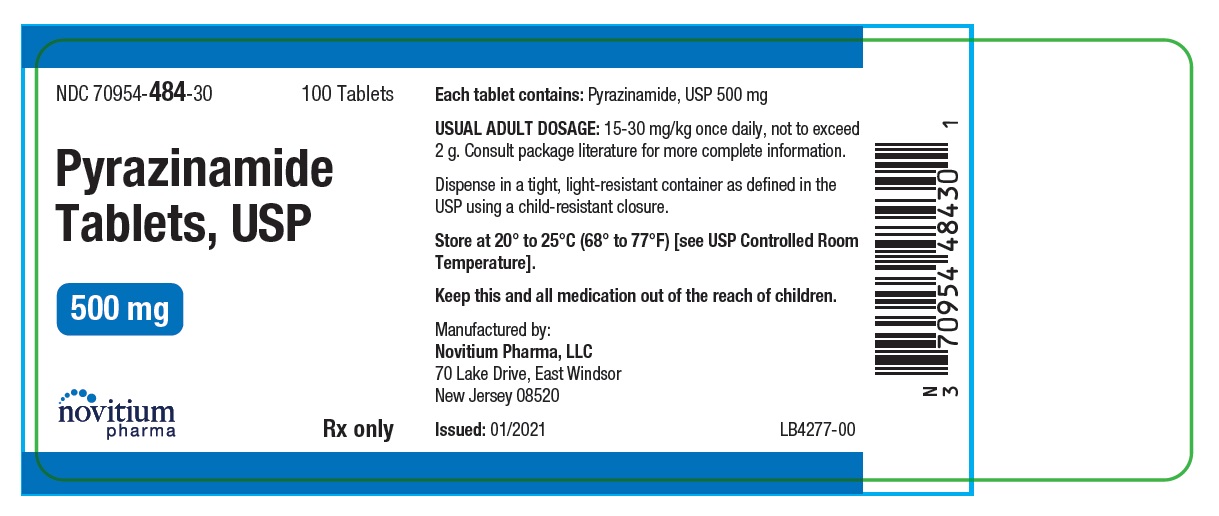
pyrazinamide 500 MG Oral Tablet — Other drugs for treatment of tuberculosis. INDICATIONS AND USAGE Pyrazinamide is indicated for the initial treatment of active tuberculosis in adults and children when combined with other…
Active ingredient
Classification
Other drugs for treatment of tuberculosisAntimycobacterial
Indications
INDICATIONS AND USAGE Pyrazinamide is indicated for the initial treatment of active tuberculosis in adults and children when combined with other antituberculous agents. (The current recommendation of the CDC for drug-susceptible disease is to use a six-month regimen for initial treatment of active tuberculosis, consisting of isoniazid, rifampin and pyrazinamide given for 2 months, followed by isoniazid and rifampin for 4 months.* 4 ) (Patients with drug-resistant disease should be treated with regimens individualized to their situation. Pyrazinamide frequently will be an important component of such therapy.) (In patients with concomitant HIV infection, the physician should be aware of current recommendation of CDC. It is possible these patients may require a longer course of treatment). It is also indicated after treatment failure with other primary drugs in any form of active tuberculosis. Pyrazinamide should only be used in conjunction with other effective antituberculous agents. *See recommendations of Center for Disease Control (CDC) and American Thoracic Society for complete regimen and dosage recommendations. 4
Dosage
DOSAGE & ADMINISTRATION: Pyrazinamide should always be administered with other effective antituberculous drugs. It is administered for the initial 2 months of a 6-month or longer treatment regimen for drug-susceptible patients. Patients who are known or suspected to have drug-resistant disease should be treated with regimens individualized to their situation. Pyrazinamide frequently will be an important component of such therapy. Patients with concomitant HIV infection may require longer courses of therapy. Physicians treating such patients should be alert to any revised recommendations from CDC for this group of patients. Usual dose: Pyrazinamide is administered orally, 15 to 30 mg/kg once daily. Older regimens employed 3 or 4 divided doses daily, but most current recommendations are for once a day. Three grams per day should not be exceeded. The CDC recommendations do not exceed 2 g per day when given as a daily regimen (see table). Alternatively, a twice weekly dosing regimen (50 to 75 mg/kg twice weekly based on lean body weight) has been developed to promote patient compliance with a regimen on an outpatient basis. In studies evaluating the twice weekly regimen, doses of pyrazinamide in excess of 3 g twice weekly have been administered. This exceeds the recommended maximum 3 g/daily dose. However, an increased incidence of adverse reactions has not been reported. This table is taken from the CDC-American Thoracic Society joint recommendations. 4 Recommended Drugs for the Initial Treatment of Tuberculosis in Children and Adults Daily Dose * Maximal Daily Dose in Children and Adults Twice Weekly Dose Drug Children Adults Children Adults Isoniazid 10 to 20 mg/kg PO or IM 5 mg/kg PO or IM 300 mg 20 to 40 mg/kg Max. 900 mg 15 mg/kg Max. 900 mg Rifampin 10 to 20 mg/kg PO 10 mg/kg PO 600 mg 10 to 20 mg/kg Max. 600 mg 10 mg/kg Max. 600 mg Pyrazinamide 15 to 30 mg/kg PO 15 to 30 mg/kg PO 2 g 50 to 70 mg/kg 50 to 70 mg/kg Streptomycin 20 to 40 mg/kg IM 15 mg/kg** IM 1 g** 25 to 30 mg/kg IM 25 to 30 mg/kg IM Ethambutol 15 to 25 mg/kg PO 15 to 25 mg/kg PO 2.5 g 50 mg/kg 50 mg/kg Definition of abbreviations: PO = perorally; IM = intramuscularly. * Doses based on weight should be adjusted as weight changes. **In persons older than 60 yrs of age the daily dose of streptomycin should be limited to 10 mg/kg with a maximal dose of 750 mg.
Warnings
WARNINGS Patients started on pyrazinamide should have baseline serum uric acid and liver function determinations. Those patients with preexisting liver disease or those at increased risk for drug related hepatitis (e.g., alcohol abusers) should be followed closely. Pyrazinamide should be discontinued and not be resumed if signs of hepatocellular damage or hyperuricemia accompanied by an acute gouty arthritis appear.
Contraindications
CONTRAINDICATIONS: Pyrazinamide is contraindicated in persons: • with severe hepatic damage. • who have shown hypersensitivity to it. • with acute gout.
Mechanism of action
CLINICAL PHARMACOLOGY: Pyrazinamide is well absorbed from the GI tract and attains peak plasma concentrations within 2 hours. Plasma concentrations generally range from 30 to 50 mcg/mL with doses of 20 to 25 mg/kg. It is widely distributed in body tissues and fluids including the liver, lungs and cerebrospinal fluid (CSF). The CSF concentration is approximately equal to concurrent steady-state plasma concentrations in patients with inflamed meninges. 1 Pyrazinamide is approximately 10% bound to plasma proteins. 2 The half-life (t 1/2 ) of pyrazinamide is 9 to 10 hours in patients with normal renal and hepatic function. The plasma half-life may be prolonged in patients with impaired renal or hepatic function. Pyrazinamide is hydrolyzed in the liver to its major active metabolite, pyrazinoic acid. Pyrazinoic acid is hydroxylated to the main excretory product, 5-hydroxypyrazinoic acid. 3 Approximately 70% of an oral dose is excreted in the urine, mainly by glomerular filtration within 24 hours. 3 Pyrazinamide may be bacteriostatic or bactericidal against Mycobacterium tuberculosis depending on the concentration of the drug attained at the site of infection. The mechanism of action is unknown. In vitro and in vivo the drug is active only at a slightly acidic pH. Susceptibility Testing For specific information regarding susceptibility test interpretive criteria and associated test methods and quality control standards recognized by FDA for this drug, please see: https://www.fda.gov/STIC.
Indicated ICD-10 codes
Source: RxNorm + openFDA + RxClass + FAERS · 2026
Look up another medication