istradefylline 20 MG Oral Tablet
Managing this medication for someone you care for? Eleplan keeps diagnoses, medications and appointments in one plan.
Start free with EleplanClinical drug
istradefylline 20 MG Oral Tablet
20 MG · Oral Tablet · oral
A form of istradefylline →
istradefylline 20 MG Oral Tablet — Other antiparkinson drugs. INDICATIONS AND USAGE NOURIANZ is indicated as adjunctive treatment to levodopa/carbidopa in adult patients with Parkinson's disease (PD)…
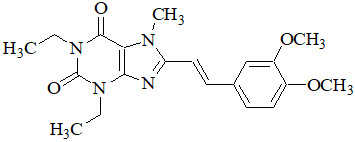
Active ingredient
Classification
Other antiparkinson drugs
Drug interactions
Istradefylline has several interactions with CYP3A4 inhibitors and inducers, as well as with P-glycoprotein substrates.
- majorstrong CYP3A4 inhibitors — increased istradefylline exposure
- majorstrong CYP3A4 inducers — decreased istradefylline exposure
- moderateCYP3A4 substrates — increased exposure of CYP3A4 substrates
- moderateP-glycoprotein substrates — increased exposure of P-gp substrates
Real-world adverse events (FAERS)
Death706Drug Ineffective624Hallucination603Dyskinesia479Condition Aggravated446Dizziness419Product Dose Omission Issue359Constipation353
Indications
INDICATIONS AND USAGE NOURIANZ is indicated as adjunctive treatment to levodopa/carbidopa in adult patients with Parkinson's disease (PD) experiencing "off" episodes. NOURIANZ is an adenosine receptor antagonist indicated as adjunctive treatment to levodopa/carbidopa in adult patients with Parkinson's disease (PD) experiencing "off" episodes ( 1 ).
Dosage
DOSAGE AND ADMINISTRATION The recommended dosage is 20 mg orally once daily. The dosage may be increased to a maximum of 40 mg once daily ( 2.1 ). May be taken with or without food ( 2.1 ). Patients with hepatic impairment: Maximum recommended dosage with moderate hepatic impairment is 20 mg once daily; use of NOURIANZ in patients with severe hepatic impairment should be avoided ( 2.4 , 8.7 ). Patients who smoke 20 or more cigarettes per day (or the equivalent of another tobacco product): Recommended dosage is 40 mg once daily ( 2.5 , 8.8 ). 2.1 Dosing Information The recommended dosage of NOURIANZ is 20 mg administered orally once daily. The dosage may be increased to a maximum of 40 mg once daily, based on individual need and tolerability. Initial dose titration is not required. NOURIANZ can be taken with or without food [see Clinical Pharmacology (12.3) ] . 2.2 Dosage Adjustment with Strong CYP3A4 Inhibitors The maximum recommended dosage of NOURIANZ with concomitant use of strong CYP3A4 inhibitors is 20 mg once daily [see Drug Interactions (7.1) ] . 2.3 Dosing with Strong CYP3A4 Inducers Avoid use of NOURIANZ with strong CYP3A4 inducers [see Drug Interactions (7.1) ] . 2.4 Dosage Adjustment in Patients with Hepatic Impairment The maximum recommended dosage of NOURIANZ in patients with moderate hepatic impairment (Child-Pugh Class B) is 20 mg once daily. Closely monitor patients with moderate hepatic impairment for adverse reactions when on NOURIANZ treatment [see Adverse Reactions (6.1) ] . Avoid use of NOURIANZ in patients with severe hepatic impairment (Child-Pugh Class C) [see Use in Specific Populations (8.7) ] . 2.5 Dosage Adjustment for Tobacco Smokers The recommended dosage of NOURIANZ in patients who use tobacco in amounts of 20 or more cigarettes per day (or the equivalent of another tobacco product) is 40 mg once daily [see Use in Specific Populations (8.8) and Clinical Pharmacology (12.3) ] .
Warnings
WARNINGS AND PRECAUTIONS Dyskinesia: Monitor patients for dyskinesia or exacerbation of existing dyskinesia ( 5.1 ). Hallucinations / Psychotic Behavior: Consider dosage reduction or stopping NOURIANZ if occurs ( 5.2 ). Impulse Control / Compulsive Behaviors: Consider dosage reduction or stopping NOURIANZ if occurs ( 5.3 ). 5.1 Dyskinesia NOURIANZ in combination with levodopa may cause dyskinesia or exacerbate pre-existing dyskinesia. In controlled clinical trials (Studies 1, 2, 3, and 4) [see Clinical Studies (14) ] , the incidence of dyskinesia was 15% for NOURIANZ 20 mg, 17% for NOURIANZ 40 mg, and 8% for placebo, in combination with levodopa. One percent of patients treated with either NOURIANZ 20 mg or 40 mg discontinued treatment because of dyskinesia, compared to 0% for placebo. 5.2 Hallucinations / Psychotic Behavior Because of the potential risk of exacerbating psychosis, patients with a major psychotic disorder should not be treated with NOURIANZ. Consider dosage reduction or discontinuation if a patient develops hallucinations or psychotic behaviors while taking NOURIANZ. In controlled clinical trials (Studies 1, 2, 3, and 4) [see Clinical Studies (14) ] , the incidence of hallucinations was 2% for NOURIANZ 20 mg, 6% for NOURIANZ 40 mg, and 3% for placebo. In patients treated with NOURIANZ 40 mg, 1% discontinued because of hallucinations, compared to 0% for placebo and 0% for patients treated with NOURIANZ 20 mg. The incidence of "abnormal thinking and behavior" (paranoid ideation, delusions, confusion, mania, disorientation, aggressive behavior, agitation, or delirium) reported as an adverse reaction was 1% for NOURIANZ 20 mg, 2% for NOURIANZ 40 mg, and 1% for placebo. 5.3 Impulse Control / Compulsive Behaviors Patients treated with NOURIANZ and one or more medication(s) for the treatment of Parkinson's disease (including levodopa) may experience intense urges to gamble, increased sexual urges, intense urges to spend money, binge or compulsive eating, and/or other intense urges, and the inability to control these urges. In controlled clinical trials (Studies 1, 2, 3 and 4) [see Clinical Studies (14) ] , one patient treated with NOURIANZ 40 mg was reported to have impulse control disorder, compared to no patient on placebo or NOURIANZ 20 mg. In some postmarketing cases, these urges were reported to have stopped when the dose was reduced, or the medication was discontinued. Because patients may not recognize these behaviors as abnormal, it is important for prescribers to specifically ask patients or their caregivers about the development of new or increased gambling urges, sexual urges, uncontrolled spending, binge or compulsive eating, or other urges while being treated with NOURIANZ. Consider dose reduction or discontinuation if a patient develops such urges while taking NOURIANZ [see Adverse Reactions (6.2) ] .
Contraindications
CONTRAINDICATIONS None. None ( 4 ).
Mechanism of action
Mechanism of Action The precise mechanism by which istradefylline exerts its therapeutic effect in Parkinson’s disease is unknown. In in vitro studies and in in vivo animal studies, istradefylline was demonstrated to be an adenosine A 2A receptor antagonist.
Indicated ICD-10 codes
Source: RxNorm + openFDA + RxClass + FAERS · 2026
Look up another medication