exenatide 2 MG Injection
Managing this medication for someone you care for? Eleplan keeps diagnoses, medications and appointments in one plan.
Start free with EleplanClinical drug
exenatide 2 MG Injection
2 MG · Injection · injection
A form of exenatide →
exenatide 2 MG Injection — Glucagon-like peptide-1 (GLP-1) analogues. INDICATIONS AND USAGE BYETTA is indicated as an adjunct to diet and exercise to improve glycemic control in adults with type 2 diabetes mellitus…
Active ingredient
Classification
Glucagon-like peptide-1 (GLP-1) analoguesGLP-1 Receptor Agonist
Drug interactions
Exenatide has several clinically relevant drug interactions that may affect the absorption of other medications and increase the risk of hypoglycemia when used with certain drugs.
- majorwarfarin — increased INR sometimes associated with bleeding
- majorinsulin secretagogues (e.g., sulfonylureas) or insulin — increased risk of hypoglycemia
- moderateorally administered medications (e.g., acetaminophen) — reduced rate of absorption
Indications
INDICATIONS AND USAGE BYETTA is indicated as an adjunct to diet and exercise to improve glycemic control in adults with type 2 diabetes mellitus. Limitations of Use • BYETTA contains exenatide. Coadministration with other exenatide-containing products is not recommended. BYETTA (exenatide) is a glucagon-like peptide-1 (GLP-1) receptor agonist indicated as an adjunct to diet and exercise to improve glycemic control in adults with type 2 diabetes mellitus. ( 1 , 14 ) Limitations of Use • Coadministration with other exenatide-containing products is not recommended ( 1 ).
Dosage
DOSAGE AND ADMINISTRATION • Inject subcutaneously within 60 minutes prior to morning and evening meals (or before the two main meals of the day, approximately 6 hours or more apart). ( 2.1 ) • Initiate at 5 mcg per dose twice daily; increase to 10 mcg twice daily after 1 month based on clinical response. ( 2.1 ) 2.1 Recommended Dosing • Initiate BYETTA at 5 mcg administered subcutaneously twice daily at any time within the 60-minute period before the morning and evening meals (or before the two main meals of the day, approximately 6 hours or more apart). Do not administer after a meal. • Based on clinical response, the dose of BYETTA can be increased to 10 mcg twice daily which is recommended after 1 month of therapy, in order to reduce the risk of gastrointestinal adverse reactions [see Warnings and Precautions (5.5) and Adverse Reactions (6.1) ] . • Administer as a subcutaneous injection in the thigh, abdomen, or upper arm. • Rotate injections sites with each dose. Do not use the same site for each injection. • Inspect visually for particulate matter and discoloration. Only use BYETTA if the solution appears clear, colorless, and contains no particles. • When using BYETTA with insulin, administer as separate injections and never mix. It is acceptable to inject BYETTA and insulin in the same body region, but the injections should not be adjacent to each other. • If a dose is missed, resume the treatment regimen as prescribed with the next scheduled dose. 2.1 Recommended Dosing • Initiate BYETTA at 5 mcg administered subcutaneously twice daily at any time within the 60-minute period before the morning and evening meals (or before the two main meals of the day, approximately 6 hours or more apart). Do not administer after a meal. • Based on clinical response, the dose of BYETTA can be increased to 10 mcg twice daily which is recommended after 1 month of therapy, in order to reduce the risk of gastrointestinal adverse reactions [see Warnings and Precautions (5.5) and Adverse Reactions (6.1) ] . • Administer as a subcutaneous injection in the thigh, abdomen, or upper arm. • Rotate injections sites with each dose. Do not use the same site for each injection. • Inspect visually for particulate matter and discoloration. Only use BYETTA if the solution appears clear, colorless, and contains no particles. • When using BYETTA with insulin, administer as separate injections and never mix. It is acceptable to inject BYETTA and insulin in the same body region, but the injections should not be adjacent to each other. • If a dose is missed, resume the treatment regimen as prescribed with the next scheduled dose.
Warnings
WARNINGS AND PRECAUTIONS • Acute Pancreatitis : Has been observed in patients treated with GLP-1 receptor agonists, including BYETTA. Discontinue if pancreatitis is suspected. ( 5.1 ) • Never share a BYETTA pen between patients, even if the needle is changed. ( 5.2 ) • Hypoglycemia with Concomitant Use of Insulin Secretagogues or Insulin: Patients taking an insulin secretagogue or insulin may have an increased risk of hypoglycemia, including severe hypoglycemia. Reduction in the dose of insulin secretagogues or insulin may be necessary. ( 5.3 ) • Acute Kidney Injury Due to Volume Depletion : Monitor renal function in patients reporting adverse reactions that could lead to volume depletion ( 5.4 ) • Severe Gastrointestinal Adverse Reactions : Use has been associated with gastrointestinal adverse reactions, sometimes severe. BYETTA is not recommended in patients with severe gastroparesis. ( 5.5 ) • Immunogenicity: Patients may develop antibodies to exenatide. If there is worsening glycemic control or failure to achieve target glycemic control, consider alternative antidiabetic therapy. ( 5.6 ) • Hypersensitivity: Serious hypersensitivity reactions (e.g., anaphylaxis and angioedema) have been reported. Discontinue BYETTA and promptly seek medical advice. ( 5.7 ) • Drug-induced Immune-mediated Thrombocytopenia: Serious bleeding which may be fatal has been reported. Discontinue BYETTA promptly and avoid re-exposure to exenatide. ( 5.8 ) • Acute Gallbladder Disease: If cholelithiasis or cholecystitis are suspected, gallbladder studies are indicated. ( 5.9 ) • Pulmonary Aspiration During General Anesthesia or Deep Sedation: Has been reported in patients receiving GLP-1 receptor agonists undergoing elective surgeries or procedures. Instruct patients to inform healthcare providers of any planned surgeries or procedures. ( 5.10 ) 5.1 Acute Pancreatitis Acute pancreatitis, including fatal and non-fatal hemorrhagic or necrotizing pancreatitis, has been observed in patients treated with glucagon-like peptide-1 (GLP-1) receptor agonists, including BYETTA [see Adverse Reactions (6.2) ] . After initiation of BYETTA, observe patients carefully for signs and symptoms of pancreatitis (including persistent severe abdominal pain, sometimes radiating to the back and which may or may not be accompanied by vomiting). If pancreatitis is suspected, discontinue BYETTA and initiate appropriate management. 5.2 Never Share a BYETTA Pen Between Patients BYETTA pens must never be shared between patients, even if the needle is changed. Pen-sharing poses a risk for transmission of blood-borne pathogens. 5.3 Hypoglycemia with Concomitant Use of Insulin Secretagogues or Insulin Patients receiving BYETTA in combination with an insulin secretagogue (e.g., sulfonylurea) or insulin may have an increased risk of hypoglycemia including severe hypoglycemia [see Adverse Reactions (6) and Drug Interactions (7) ] . The risk of hypoglycemia may be lowered by a reduction in the dose of sulfonylurea (or other concomitantly administered insulin secretagogue) or insulin. Inform patients using these concomitant medications of the risk of hypoglycemia and educate them on the signs and symptoms of hypoglycemia. 5.4 Acute Kidney Injury Due to Volume Depletion There have been postmarketing reports of acute kidney injury, in some cases requiring hemodialysis, in patients treated with GLP-1 receptor agonists, BYETTA [see Adverse Reactions (6.2) ] . The majority of the reported events occurred in patients who experienced gastrointestinal reactions leading to dehydration such as nausea, vomiting, or diarrhea [see Adverse Reactions (6) ] . Monitor renal function in patients reporting adverse reactions to BYETTA that could lead to volume depletion, especially during dosage initiation and escalation of BYETTA. BYETTA is not recommended in patients with severe renal impairment (creatinine clearance <30 mL/min) or end-stage renal disease and should be used with caution in patients with renal transplantation [see Use in Specific Populations (8.6) ] . 5.5 Severe Gastrointestinal Adverse Reactions Use of GLP-1 receptor agonists, including BYETTA, has been associated with gastrointestinal adverse reactions, sometimes severe [see Adverse Reactions (6) ] . BYETTA is not recommended in patients with severe gastroparesis. 5.6 Immunogenicity Patients may develop antibodies to exenatide following treatment with BYETTA. Antibody levels were measured in 90% of subjects in the 30-week, 24-week, and 16-week placebo-controlled studies and the 30-week comparator-controlled study of BYETTA. In 3%, 4%, 1%, and 1% of these patients, respectively, antibody formation was associated with an attenuated glycemic response. If there is worsening glycemic control or failure to achieve targeted glycemic control, alternative antidiabetic therapy should be considered [see Adverse Reactions (6.1) ] . 5.7 Hypersensitivity There have been postmarketing reports of serious hypersensitivity reactions (e.g., anaphylaxis and angioedema) in patients treated with BYETTA. If a hypersensitivity reaction occurs, the patient should discontinue BYETTA and other suspect medications and promptly seek medical advice. Inform and closely monitor patients with a history of anaphylaxis or angioedema with another GLP-1 receptor agonist for allergic reactions, because it is unknown whether such patients will be predisposed to anaphylaxis with BYETTA [see Adverse Reactions (6.2) ] . 5.8 Drug-Induced Thrombocytopenia Serious bleeding, which may be fatal, from drug-induced immune-mediated thrombocytopenia has been reported in the postmarketing setting with exenatide use. Drug-induced thrombocytopenia is an immune-mediated reaction, with exenatide-dependent anti-platelet antibodies. In the presence of exenatide, these antibodies cause platelet destruction. If drug-induced thrombocytopenia is suspected, discontinue BYETTA immediately and do not re-expose the patient to exenatide [see Adverse Reactions (6.2) ] . 5.9 Acute Gallbladder Disease Acute events of gallbladder disease such as cholelithiasis or cholecystitis have been reported in GLP-1 receptor agonist trials and postmarketing. In a clinical study with exenatide, 1.9% of exenatide-treated patients and 1.4% of placebo-treated patients reported an acute event of gallbladder disease, such as cholelithiasis or cholecystitis. If cholelithiasis is suspected, gallbladder studies and appropriate clinical follow-up are indicated. 5.10 Pulmonary Aspiration During General Anesthesia or Deep Sedation BYETTA delays gastric emptying [ see Clinical Pharmacology (12.2) ]. There have been rare postmarketing reports of pulmonary aspiration in patients receiving GLP-1 receptor agonists undergoing elective surgeries or procedures requiring general anesthesia or deep sedation who had residual gastric contents despite reported adherence to preoperative fasting recommendations. Available data are insufficient to inform recommendations to mitigate the risk of pulmonary aspiration during general anesthesia or deep sedation in patients taking BYETTA, including whether modifying preoperative fasting recommendations or temporarily discontinuing BYETTA could reduce the incidence of retained gastric contents. Instruct patients to inform healthcare providers prior to any planned surgeries or procedures if they are taking BYETTA. 5.1 Acute Pancreatitis Acute pancreatitis, including fatal and non-fatal hemorrhagic or necrotizing pancreatitis, has been observed in patients treated with glucagon-like peptide-1 (GLP-1) receptor agonists, including BYETTA [see Adverse Reactions (6.2) ] . After initiation of BYETTA, observe patients carefully for signs and symptoms of pancreatitis (including persistent severe abdominal pain, sometimes radiating to the back and which may or may not be accompanied by vomiting). If pancreatitis is suspected, discontinue BYETTA and initiate appropriate management. 5.2 Never Share a BYETTA Pen Between Patients BYETTA pens
Contraindications
CONTRAINDICATIONS BYETTA is contraindicated in patients with: • A prior severe hypersensitivity reaction to exenatide or to any of the excipients in BYETTA. Serious hypersensitivity reactions including anaphylaxis and angioedema have been reported with BYETTA [see Warnings and Precautions (5.7) ]. • A history of drug-induced immune-mediated thrombocytopenia from exenatide products. Serious bleeding, which may be fatal, from drug-induced immune-mediated thrombocytopenia has been reported with exenatide use [see Warnings and Precautions (5.8) ] . • History of severe hypersensitivity to exenatide or any of the excipients in BYETTA. (4) • History of drug-induced immune-mediated thrombocytopenia from exenatide products. ( 4 )
Mechanism of action
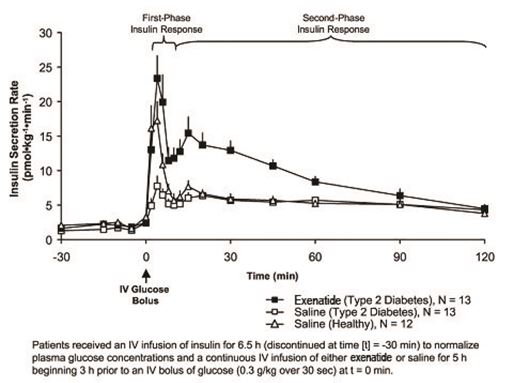
Mechanism of Action Incretins, such as glucagon-like peptide-1 (GLP-1), enhance glucose-dependent insulin secretion and exhibit other antihyperglycemic actions following their release into the circulation from the gut. BYETTA is a GLP-1 receptor agonist that enhances glucose-dependent insulin secretion by the pancreatic beta-cell, suppresses inappropriately elevated glucagon secretion, and slows gastric emptying. The amino acid sequence of exenatide partially overlaps that of human GLP-1. Exenatide has been shown to bind and activate the human GLP-1 receptor in vitro . This leads to an increase in both glucose-dependent synthesis of insulin, and in vivo secretion of insulin from pancreatic beta cells, by mechanisms involving cyclic AMP and/or other intracellular signaling pathways. BYETTA improves glycemic control by reducing fasting and postprandial glucose concentrations in patients with type 2 diabetes through the actions described below.
Indicated ICD-10 codes
Source: RxNorm + openFDA + RxClass + FAERS · 2026
Look up another medication