eplerenone 100 MG Oral Tablet
Managing this medication for someone you care for? Eleplan keeps diagnoses, medications and appointments in one plan.
Start free with EleplanClinical drug
eplerenone 100 MG Oral Tablet
100 MG · Oral Tablet · oral
A form of eplerenone →
eplerenone 100 MG Oral Tablet — Aldosterone antagonists. INDICATIONS AND USAGE Eplerenone is an aldosterone antagonist indicated for: Improving survival of stable adult patients with symptomatic heart…
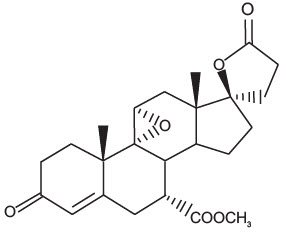
Active ingredient
Classification
Aldosterone antagonistsAldosterone Antagonist
Drug interactions
Eplerenone has several drug interactions that require monitoring and dosage adjustments.
- majorCYP3A inhibitors — Increased risk of adverse effects due to altered metabolism of eplerenone.
- moderateACE inhibitors and Angiotensin II Receptor Antagonists — Increased risk of hyperkalemia.
- majorlithium — Potential for lithium toxicity.
- majorNSAIDs — Reduced antihypertensive effect and risk of severe hyperkalemia.
Indications
INDICATIONS AND USAGE Eplerenone is an aldosterone antagonist indicated for: Improving survival of stable adult patients with symptomatic heart failure with reduced ejection fraction (HFrEF) after an acute myocardial infarction. (1.1) The treatment of hypertension in adults, to lower blood pressure. Lowering blood pressure reduces the risk of fatal and nonfatal cardiovascular events, primarily strokes and myocardial infarctions. ( 1.2 ) 1.1 Heart Failure Post-Myocardial Infarction Eplerenone is indicated to improve survival of stable adult patients with symptomatic heart failure with reduced ejection fraction (≤40%) (HFrEF) after an acute myocardial infarction (MI). 1.2 Hypertension Eplerenone tablets are indicated for the treatment of hypertension in adults, to lower blood pressure. Lowering blood pressure reduces the risk of fatal and nonfatal cardiovascular (CV) events, primarily strokes and MI. These benefits have been seen in controlled trials of antihypertensive drugs from a wide variety of pharmacologic classes. Control of high blood pressure should be part of comprehensive CV risk management, including, as appropriate, lipid control, diabetes management, antithrombotic therapy, smoking cessation, exercise, and limited sodium intake. Many patients will require more than one drug to achieve blood pressure goals. For specific advice on goals and management, see published guidelines, such as those of the National High Blood Pressure Education Program's Joint National Committee on Prevention, Detection, Evaluation, and Treatment of High Blood Pressure (JNC).Control of high blood pressure should be part of comprehensive CV risk management, including, as appropriate, lipid control, diabetes management, antithrombotic therapy, smoking cessation, exercise, and limited sodium intake. Many patients will require more than one drug to achieve blood pressure goals. For specific advice on goals and management, see published guidelines, such as those of the National High Blood Pressure Education Program's Joint National Committee on Prevention, Detection, Evaluation, and Treatment of High Blood Pressure (JNC). Numerous antihypertensive drugs, from a variety of pharmacologic classes and with different mechanisms of action, have been shown in randomized controlled trials to reduce CV morbidity and mortality, and it can be concluded that it is blood pressure reduction, and not some other pharmacologic property of the drugs, that is largely responsible for those benefits. The largest and most consistent CV outcome benefit has been a reduction in the risk of stroke, but reductions in MI and CV mortality also have been seen regularly.Numerous antihypertensive drugs, from a variety of pharmacologic classes and with different mechanisms of action, have been shown in randomized controlled trials to reduce CV morbidity and mortality, and it can be concluded that it is blood pressure reduction, and not some other pharmacologic property of the drugs, that is largely responsible for those benefits. The largest and most consistent CV outcome benefit has been a reduction in the risk of stroke, but reductions in MI and CV mortality also have been seen regularly. Elevated systolic or diastolic pressure causes increased CV risk, and the absolute risk increase per mmHg is greater at higher blood pressures, so that even modest reductions of severe hypertension can provide substantial benefit. Relative risk reduction from blood pressure reduction is similar across populations with varying absolute risk, so the absolute benefit is greater in patients who are at higher risk independent of their hypertension (for example, patients with diabetes or hyperlipidemia), and such patients would be expected to benefit from more aggressive treatment to a lower blood pressure goal.Elevated systolic or diastolic pressure causes increased CV risk, and the absolute risk increase per mmHg is greater at higher blood pressures, so that even modest reductions of severe hypertension can provide substantial benefit. Relative risk reduction from blood pressure reduction is similar across populations with varying absolute risk, so the absolute benefit is greater in patients who are at higher risk independent of their hypertension (for example, patients with diabetes or hyperlipidemia), and such patients would be expected to benefit from more aggressive treatment to a lower blood pressure goal. Some antihypertensive drugs have smaller blood pressure effects (as monotherapy) in black patients, and many antihypertensive drugs have additional approved indications and effects (e.g., on angina, heart failure, or diabetic kidney disease). These considerations may guide selection of therapy.Some antihypertensive drugs have smaller blood pressure effects (as monotherapy) in black patients, and many antihypertensive drugs have additional approved indications and effects (e.g., on angina, heart failure, or diabetic kidney disease). These considerations may guide selection of therapy. Eplerenone may be used alone or in combination with other antihypertensive agents.
Dosage
DOSAGE AND ADMINISTRATION HFrEF Post-MI: Initiate treatment with 25 mg once daily. Titrate to maximum of 50 mg once daily within 4 weeks, as tolerated. Dose adjustments may be required based on potassium levels. ( 2.1 ) Hypertension: 50 mg once daily, alone or combined with other antihypertensive agents. For inadequate response, increase to 50 mg twice daily. Higher dosages are not recommended. ( 2.2 ) For all patients: Measure serum potassium before starting eplerenone tablets and periodically thereafter. ( 2.3 ) 2.1 Heart Failure Post-Myocardial Infarction Initiate treatment at 25 mg once daily and titrate to the recommended dose of 50 mg once daily, preferably within 4 weeks as tolerated by the patient. Once treatment with eplerenone has begun, adjust the dose based on the serum potassium level as shown in Table 1. Table 1. Dose Adjustment in Heart Failure Post-MI Serum Potassium (mEq/L) Dose Adjustment less than 5.0 25 mg every other day to 25 mg once daily 25 mg once daily to 50 mg once daily 5.0 to 5.4 No adjustment 5.5 to 5.9 50 mg once daily to 25 mg once daily 25 mg once daily to 25 mg every other day 25 mg every other day to withhold greater than or equal to 6.0 Withhold and restart at 25 mg every other day when potassium levels fall to less than 5.5 mEq/L 2.2 Hypertension The recommended starting dose of eplerenone tablet is 50 mg administered once daily. The full therapeutic effect of eplerenone is apparent within 4 weeks. For patients with an inadequate blood pressure response to 50 mg once daily increase the dosage of eplerenone tablets to 50 mg twice daily. Higher dosages of eplerenone are not recommended because they have no greater effect on blood pressure than 100 mg and are associated with an increased risk of hyperkalemia [see CLINICAL STUDIES (14.2) ]. 2.3 Recommended Monitoring Measure serum potassium before initiating eplerenone therapy, within the first week, and at one month after the start of treatment or dose adjustment. Assess serum potassium periodically thereafter. Check serum potassium and serum creatinine within 3 to 7 days of a patient initiating a moderate CYP3A inhibitor ACE inhibitors, angiotensin-II blockers or non-steroidal-anti-inflammatories. 2.4 Dose Modifications for Use with Moderate CYP3A Inhibitors In post-MI HFrEF patients receiving a moderate CYP3A inhibitor (e.g., erythromycin, saquinavir, verapamil, and fluconazole), do not exceed 25 mg once daily. In patients with hypertension receiving a moderate CYP3A inhibitor, initiate at 25 mg once daily. For inadequate blood pressure response, dosing may be increased to a maximum of 25 mg twice daily [see DRUG INTERACTIONS (7.1) ].
Warnings
WARNINGS AND PRECAUTIONS • Hyperkalemia : Patients with decreased renal function, diabetes, proteinuria or patients who are taking ACEs and ARBs, NSAIDs or moderate CYP3A inhibitors are at increased risk. Monitor serum potassium levels and adjust dose as needed. ( 5.1 ) 5.1 Hyperkalemia The risk of hyperkalemia is higher in patients with impaired renal function, proteinuria, diabetes and those concomitantly treated with ACEs, ARBs, NSAIDs and moderate CYP3A inhibitors. Minimize the risk of hyperkalemia with proper patient selection and monitoring [see Dosage and Administration (2.1) , Contraindications (4) , Adverse Reactions (6.2) , and Drug Interactions (7) ] . Monitor patients for the development of hyperkalemia until the effect of eplerenone tablets is established. Patients who develop hyperkalemia (5.5 to 5.9 mEq/L) may continue eplerenone tablets therapy with proper dose adjustment. Dose reduction decreases potassium levels. Patients on moderate CYP3A inhibitors that cannot be avoided should have their dose of eplerenone reduced [see Drug Interactions (7.2) ].
Contraindications
CONTRAINDICATIONS For all patients: • Serum potassium greater than 5.5 mEq/L at initiation ( 4 ) • Creatinine clearance less than or equal to 30 mL/min ( 4 ) • Concomitant use with strong CYP3A inhibitors ( 4 , 7.1 ) For the treatment of hypertension: • Type 2 diabetes with microalbuminuria ( 4 ) • Serum creatinine greater than 2.0 mg/dL in males, greater than 1.8 mg/dL in females ( 4 ) • Creatinine clearance less than 50 mL/min ( 4 ) • Concomitant use of potassium supplements or potassium-sparing diuretics ( 4 ) For all patients: Eplerenone is contraindicated in all patients with: • serum potassium greater than 5.5 mEq/L at initiation, • creatinine clearance less than or equal to 30 mL/min, or • concomitant administration of strong CYP3A inhibitors (e.g., ketoconazole, itraconazole, nefazodone, troleandomycin, clarithromycin, ritonavir, and nelfinavir) [see DRUG INTERACTIONS (7.1) , CLINICAL PHARMACOLOGY (12.3) ], For Patients Treated for Hypertension Eplerenone is contraindicated for the treatment of hypertension in patients with: • type 2 diabetes with microalbuminuria, • serum creatinine greater than 2.0 mg/dL in males or greater than 1.8 mg/dL in females, • creatinine clearance less than 50 mL/min, or • concomitant administration of potassium supplements or potassium-sparing diuretics (e.g., amiloride, spironolactone, or triamterene) [see WARNINGS AND PRECAUTIONS (5.1) , ADVERSE REACTIONS (6.2) , DRUG INTERACTIONS (7) , and CLINICAL PHARMACOLOGY (12.3) ].
Mechanism of action
Mechanism of Action Eplerenone binds to the mineralocorticoid receptor and blocks the binding of aldosterone, a component of the renin-angiotensin-aldosterone-system (RAAS). Aldosterone synthesis, which occurs primarily in the adrenal gland, is modulated by multiple factors, including angiotensin II and non-RAAS mediators such as adrenocorticotropic hormone (ACTH) and potassium. Aldosterone binds to mineralocorticoid receptors in both epithelial (e.g., kidney) and nonepithelial (e.g., heart, blood vessels, and brain) tissues and increases blood pressure through induction of sodium reabsorption and possibly other mechanisms. Eplerenone has been shown to produce sustained increases in plasma renin and serum aldosterone, consistent with inhibition of the negative regulatory feedback of aldosterone on renin secretion. The resulting increased plasma renin activity and aldosterone circulating levels do not overcome the effects of eplerenone. Eplerenone selectively binds to human mineralocorticoid receptors relative to its binding to recombinant human glucocorticoid, progesterone, and androgen receptors. 12.2 Pharmacodynamics There was no significant change in average heart rate among patients treated with eplerenone in the combined clinical studies. No consistent effects of eplerenone on heart rate, QRS duration, or PR or QT interval were observed in 147 normal subjects evaluated for electrocardiographic changes during pharmacokinetic studies.
Source: RxNorm + openFDA + RxClass + FAERS · 2026
Look up another medication