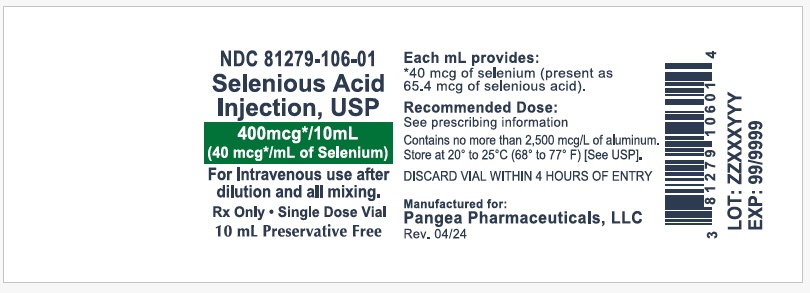
10 ML selenious acid 0.0654 MG/ML Injection
Managing this medication for someone you care for? Eleplan keeps diagnoses, medications and appointments in one plan.
Start free with EleplanClinical drug
10 ML selenious acid 0.0654 MG/ML Injection
0.0654 MG/ML · Injection · injection
A form of selenious acid →
10 ML selenious acid 0.0654 MG/ML Injection. INDICATIONS AND USAGE Selenious Acid Injection is indicated in adult and pediatric patients as a source of selenium for parenteral nutrition when…
Active ingredient
Indications
INDICATIONS AND USAGE Selenious Acid Injection is indicated in adult and pediatric patients as a source of selenium for parenteral nutrition when oral or enteral nutrition is not possible, insufficient, or contraindicated. Selenious Acid Injectionis a trace element indicated in adult and pediatric patients as a source of selenium for parenteral nutrition when oral or enteral nutrition is not possible, insufficient, or contraindicated. ( 1 )
Dosage
DOSAGE AND ADMINISTRATION • Pharmacy Bulk Package or Single-Dose Vial: Not for direct intravenous infusion. ( 2.1 ) • See full prescribing information for information on preparation, administration, and general dosing considerations. ( 2.1 , 2.2 , 2.3 , 2.4 ) Recommended Dosage ( 2.5) • Selenious Acid Injection provides 60 mcg/mL of selenium. • Selenious Acid Injection in a concentration of 6 mcg/mL is recommended for use in pediatric patients, particularly those weighing 7 kg or less. • Individualize the dosage based upon the patient’s clinical condition, nutritional requirements, and the contribution of oral or enteral selenium intake. The following dosages are general recommendations intended for most patients. However, based upon clinical requirements, some patients may require a higher dosage: ○ Adults: 60 mcg/day ○ Pediatric Patients 7 kg and above: 2 mcg/kg/day (up to 60 mcg/day) ○ Pediatric Patients less than 7 kg: 2 to 4 mcg/kg/day • Monitor selenium concentrations during treatment. 2.1 Important Administration Information Selenious Acid Injection is supplied as a pharmacy bulk package or single-dose vial for admixing use only. It is not for direct intravenous infusion . Prior to administration, Selenious Acid Injection must be transferred to a separate parenteral nutrition container, prepared and used as an admixture in parenteral nutrition solutions. The Pharmacy Bulk Package vial of Selenious Acid Injection is intended for dispensing of single doses to multiple patients in a pharmacy admixture program. The final parenteral nutrition solution is for intravenous infusion into a central or peripheral vein. The choice of a central or peripheral venous route should depend on the osmolarity of the final infusate. Solutions with osmolarity of 900 mOsmol/L or greater must be infused through a central venous catheter [see Warnings and Precautions ( 5.2 )] . 2.2 Preparation and Administration Instructions • Selenious Acid Injection is not for direct intravenous infusion . Prior to administration, Selenious Acid Injection must be prepared and used as an admixture inparenteral nutrition solutions. • Selenious Acid Injection is to be prepared only in a suitable work area such as a laminar flow hood (or an equivalent clean air compounding area). The key factor in the preparation is careful aseptic technique to avoid inadvertent touch contamination during mixing of solutions and addition of other nutrients. • Visually inspect the prepared parenteral nutrition solution containing Selenious Acid Injection for particulate matter before admixing, after admixing, and prior to administration. 2.3 Preparation Instructions for Admixing Using a Parenteral Nutrition Container Inspect Selenious Acid Injection vials for particulate matter. Transfer Selenious Acid Injection to the parenteral nutrition solution following the admixture of amino acids, dextrose, lipid (if added), and electrolytes solutions. Because additives may be incompatible, evaluate all additions to the parenteral nutrition container for compatibility and stability of the resulting preparation. Consult with pharmacist, if available. Questions about compatibility may be directed to America Regent. If it is deemed advisable to introduce additives to the parenteral nutrition container, use aseptic technique. Inspect the final parenteral nutrition containing Selenious Acid Injection to ensure that: Precipitates have not formed during mixing or addition of additives. The admixed emulsion has not separated, if a lipid emulsion has been added. Separation of the admixed emulsion can be visibly identified by a yellowish streaking of the accumulation of yellowish droplets. Discard if any precipitates are observed. Stability and Storage Single-dose vial (2 mL): Discard unused portion. Pharmacy Bulk Package vial (10 mL): Penetrate vial closure only one time with a suitable sterile transfer device or dispensing set that allows measured dispensing of the content. Use Selenious Acid Injection for admixing promptly once the sterile transfer set has been inserted into the Pharmacy Bulk Package container or not more than 4 hours at room temperature (25ºC/77ºF) after the container closure has been penetrated. Discard any remaining drug. Use parenteral nutrition solutions containing Selenious Acid Injection promptly after mixing. Any storage of the admixture should be under refrigeration from 2°C to 8°C (36°F to 46°F) and limited to a period of time no longer than 9 days. After removal from refrigeration, use promptly and complete the infusion within 24 hours. Discard any remaining admixture. Protect the admixed parenteral nutrition solution from light. 2.4 Dosing Considerations The dosage of the final parenteral nutrition containing Selenious Acid Injection must be based on the concentrations of all components in the solution and the recommended daily nutritional requirements [see Dosage and Administration ( 2.5 )] . Consult the prescribing information of all added components to determine the recommended nutritional requirements for dextrose, amino acids and lipid emulsion, as applicable. Prior to administration of parenteral nutrition solution containing Selenious Acid Injection, correct severe fluid, electrolyte and acid-base disorders. 2.5 Recommended Dosage and Monitoring in Adults and Pediatric Patients There are two dosage strengths for Selenious Acid Injection: 6 mcg/mL and 60 mcg/mL of selenium. Selenious Acid Injection in a concentration of 6 mcg/mL is recommended for use in pediatric patients, particularly those weighing 7 kg or less. The dosage of Selenious Acid Injection should be individualized based on the patient’s clinical condition, nutritional requirements, and the contribution of oral or enteral selenium intake. The dosages in Table 1 are general recommendations intended for most patients. However, based on clinical requirements, some patients may require a higher dosage. Table 1: Recommended Dosage of Selenious Acid Injection for Adults and Pediatric Patients by Estimated Weight Population Recommended Dosage Adults 60 mcg/day Pediatric Patients 7 kg and above 2 mcg/kg/day (up to 60 mcg/day) Pediatric Patients less than 7 kg 2 to 4 mcg/kg/day Monitor selenium concentrations during treatment. Selenium concentrations may vary depending on the assay used and the laboratory reference range.
Warnings
WARNINGS AND PRECAUTIONS • Pulmonary Embolism due to Pulmonary Vascular Precipitates: If signs of pulmonary distress occur, stop the infusion and initiate a medical evaluation. ( 5.1 ) • Vein Damage and Thrombosi s: Solutions with osmolarity of 900 mOsmol/L or more must be infused through a central venous catheter. ( 2.1 , 5.2 ) • Aluminum Toxicity : Increased risk in patients with renal impairment, including preterm infants. ( 5.3 , 5.4 ) • Monitoring and Laboratory Tests : Monitor selenium concentrations, fluid and electrolyte status, serum osmolarity, blood glucose, liver and kidney function, blood count and coagulation parameters throughout treatment. ( 5.4 , 2.5 ) 5.1 Pulmonary Embolism due to Pulmonary Vascular Precipitates Pulmonary vascular precipitates causing pulmonary vascular emboli and pulmonary distress have been reported in patients receiving parenteral nutrition. The cause of precipitate formation has not been determined in all cases; however, in some fatal cases, pulmonary emboli occurred as a result of calcium phosphate precipitates. Precipitation has occurred following passage through an in-line filter; in vivo precipitate formation may also have occurred. If signs of pulmonary distress occur, stop the parenteral nutrition infusion and initiate a medical evaluation. In addition to inspection of the solution [see Dosage and Administration ( 2.2, 2.3 )], the infusion set and catheter should also periodically be checked for precipitates. 5.2 Vein Damage and Thrombosis Selenious Acid Injection has a low pH and must be prepared and used as an admixture in parenteral nutrition solutions. It is not for direct intravenous infusion. In addition, consider the osmolarity of the final parenteral nutrition solution in determining peripheral versus central administration. Solutions with an osmolarity of 900 mOsmol/L or greater must be infused through a central catheter [see Dosage and Administration ( 2.1 )]. The infusion of hypertonic nutrient injections into a peripheral vein may result in vein irritation, vein damage, and/or thrombosis. The primary complication of peripheral access is venous thrombophlebitis, which manifests as pain, erythema, tenderness or a palpable cord. Remove the catheter as soon as possible, if thrombophlebitis develops. 5.3 Aluminum Toxicity Selenious Acid Injection contains aluminum that may be toxic. Aluminum may reach toxic levels with prolonged parenteral administration if kidney function is impaired. Preterm infants are particularly at risk for aluminum toxicity because their kidneys are immature, and they require large amounts of calcium and phosphate solutions, which also contain aluminum. Patients with impaired kidney function, including preterm neonates, who receive greater than 4 to 5 mcg/kg/day of parenteral aluminum can accumulate aluminum to levels associated with central nervous system and bone toxicity. Tissue loading may occur at even lower rates of administration. Exposure to aluminum from Selenious Acid Injection is not more than 0.6 mcg/kg/day. When prescribing Selenious Acid Injection for use in parenteral nutrition containing other small volume parenteral products, the total daily patient exposure to aluminum from the admixture should be considered and maintained at no more than 5 mcg/kg/day [see Use in Specific Populations ( 8.4 )]. 5.4 Monitoring and Laboratory Tests Monitor selenium concentrations, fluid and electrolyte status, serum osmolarity, blood glucose, liver and kidney function, blood count and coagulation parameters during treatment [see Dosage and Administration ( 2.5 )].
Contraindications
CONTRAINDICATIONS Selenium Injection should not be given undiluted by direct injection into a peripheral vein because of the potential for infusion phlebitis.
Mechanism of action
CLINICAL PHARMACOLOGY Selenium is part of glutathione peroxidase which protects cell components from oxidative damage due to peroxides produced in cellular metabolism. Prolonged TPN support in humans has resulted in selenium deficiency symptoms which include muscle pain and tenderness. The symptoms have been reported to respond to supplementation of TPN solutions with selenium. Pediatric conditions, Keshan disease, and Kwashiorkor, have been associated with low dietary intake of selenium. The conditions are endemic to geographical areas with low selenium soil content. Dietary supplementation with selenium salts has been reported to reduce the incidence of the conditions among affected children. Normal blood levels of selenium in different human populations have been found to vary and depend on the selenium content of the food consumed. Results of surveys carried out in some countries are tabulated below: Country Number of Samples SELENIUM (mcg/100mL) (a) Whole Blood Blood Cells Plasma / Serum Canada 254 Adults (37.9 ± 7.8) (23.6 ± 6.0) (14.4 ± 2.9) England 8 (b) 26 - 37 (32) - - Guatemala & Southern USA 10 Adults 9 Children (c) 19 - 28 (22) (23 ± 5) - (36 ± 12) - (15 ± 5) New Zealand (d) 113 Adults (5.4 ± 0.1) (6.6 ± 0.3) (4.3 ± 0.1) Thailand 3 Adults 9 Children (e) 14.4 - 20.2 (12.0 ± 3.6) (f) 17.8 - 35.8 (19.5 ± 8.2) 8.1 - 12.5 (8.3 ± 2.2) USA 210 Adults 15.7 - 25.6 (20.6) - - (a) Mean values with or without standard deviation in parentheses, all other ranges. (b) Age group unknown. (c) Three children recovered from Kwashiorkor and the other six under treatment for other diseases. (d) Low selenium-content soil area. (e) Well nourished children, three recovered from Kwashiorkor and the other six under treatment for other diseases. (f) Mean values from seven subjects. Plasma selenium levels of 0.3 and 0.9 mcg/100 mL have been reported to produce deficiency symptoms in humans. Selenium is eliminated primarily in urine. However, significant endogenous losses through feces also occur. The rate of excretion and the relative importance of two routes varies with the chemical form of selenium used in supplementation. Ancillary routes of elimination are lungs and skin.
Source: RxNorm + openFDA + RxClass + FAERS · 2026
Look up another medication