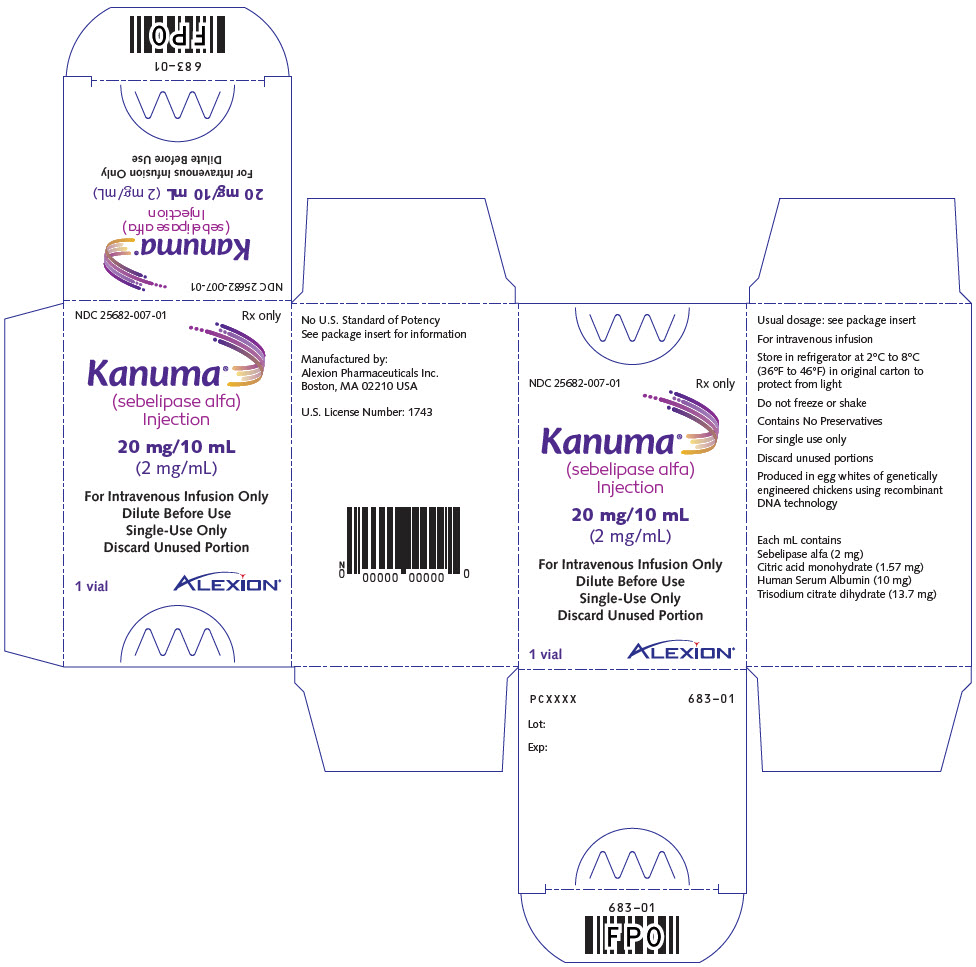
10 ML sebelipase alfa 2 MG/ML Injection [Kanuma] — Enzymes. INDICATIONS AND USAGE KANUMA ® is indicated for the treatment of patients with a diagnosis of Lysosomal Acid Lipase (LAL) deficiency. KANUMA ® is a…
Boxed warning
WARNING: HYPERSENSITIVITY REACTIONS INCLUDING ANAPHYLAXIS Patients treated with enzyme replacement therapies have experienced life-threatening hypersensitivity reactions, including anaphylaxis. Anaphylaxis has occurred during the early course of enzyme replacement therapy and after extended duration of therapy. Initiate KANUMA in a healthcare setting with appropriate medical monitoring and support measures, including access to cardiopulmonary resuscitation equipment. If a severe hypersensitivity reaction (e.g., anaphylaxis) occurs, discontinue KANUMA and immediately initiate appropriate medical treatment, including use of epinephrine. Inform patients of the symptoms of life-threatening hypersensitivity reactions, including anaphylaxis and to seek immediate medical care should symptoms occur [see Warnings and Precautions (5.1) ]. WARNING: HYPERSENSITIVITY REACTIONS INCLUDING ANAPHYLAXIS See full prescribing information for complete boxed warning. Anaphylaxis has occurred during the early course of enzyme replacement therapy and after extended duration of therapy. ( 5.1 ) Initiate KANUMA in a healthcare setting with appropriate medical monitoring and support measures, including access to cardiopulmonary resuscitation. ( 5.1 ) If a severe hypersensitivity reaction (e.g., anaphylaxis) occurs, discontinue KANUMA and immediately initiate appropriate medical treatment, including use of epinephrine. ( 5.1 )
INDICATIONS AND USAGE KANUMA ® is indicated for the treatment of patients with a diagnosis of Lysosomal Acid Lipase (LAL) deficiency. KANUMA ® is a hydrolytic lysosomal cholesteryl ester and triacylglycerol-specific enzyme indicated for the treatment of patients with a diagnosis of Lysosomal Acid Lipase (LAL) deficiency. ( 1 )
Dosage
DOSAGE AND ADMINISTRATION Administration of KANUMA should be supervised by a healthcare provider knowledgeable in the management of hypersensitivity reactions including anaphylaxis. ( 2.1 ) Infants with Rapidly Progressive LAL Deficiency Presenting within the First 6 Months of Life: The recommended starting dosage is 1 mg/kg as an intravenous infusion once weekly. ( 2.2 ) For patients with a suboptimal clinical response, increase the dosage to 3 mg/kg once weekly. ( 2.2 ) For patients with continued suboptimal clinical response, further increase the dosage to 5 mg/kg once weekly. ( 2.2 ) Pediatric and Adult Patients with LAL Deficiency: The recommended dosage is 1 mg/kg as an intravenous infusion once every other week. ( 2.2 ) For patients with a suboptimal clinical response, increase the dosage to 3 mg/kg once every other week. ( 2.2 ) See Full Prescribing Information for complete Dosage and Administration Information. Administration Instructions Infuse over at least 2 hours. ( 2.4 ) Consider further prolonging the infusion time for patients receiving dosages greater than 1 mg/kg or for those who have experienced a hypersensitivity reaction. ( 2.4 ) Consider a 1-hour infusion for the 1 mg/kg dose in patients who tolerate the infusion. ( 2.4 ) 2.1 Recommendations Prior to KANUMA Treatment Administration of KANUMA should be supervised by a healthcare provider knowledgeable in the management of hypersensitivity reactions including anaphylaxis [see Warnings and Precautions (5.1) ]. Initiate KANUMA in a healthcare setting with appropriate medical monitoring and support measures, including access to cardiopulmonary resuscitation equipment [see Warnings and Precautions (5.1) ]. 2.2 Recommended Dosage Infants with Rapidly Progressive LAL Deficiency Presenting within the First 6 Months of Life: The recommended starting dosage is 1 mg/kg administered as an intravenous infusion once weekly. For patients with a suboptimal clinical response, increase the dosage to 3 mg/kg once weekly. For patients with continued suboptimal clinical response on the 3 mg/kg once weekly dosage, further increase the dosage to 5 mg/kg once weekly. A suboptimal clinical response is defined as any of the following: poor growth, deteriorating biochemical markers, or persistent or worsening organomegaly. Pediatric and Adult Patients with LAL Deficiency: The recommended dosage is 1 mg/kg administered as an intravenous infusion once every other week. For patients with a suboptimal clinical response, increase the dosage to 3 mg/kg once every other week. A suboptimal clinical response is defined as any of the following: poor growth, deteriorating biochemical markers [e.g., alanine aminotransferase (ALT), aspartate aminotransferase (AST)], and/or parameters of lipid metabolism [e.g., low-density lipoprotein cholesterol (LDL-c), triglycerides (TG)]. 2.3 Preparation Instructions KANUMA is for intravenous infusion only. Prepare KANUMA using the following steps. Determine the number of vials needed based on the patient's weight and the recommended dose of 1 mg/kg, 3 mg/kg, or 5 mg/kg using the following calculations (a-b): Total dose (mg) = Patient's weight (kg) × Recommended dose (mg/kg) Total number of vials = Total dose (mg) divided by 20 mg/vial Round to the next whole vial and remove the required number of vials from the refrigerator to allow them to reach room temperature. Volume (mL) of calculated total dose = Total dose (mg) divided by the 2 mg/mL concentration Volume (mL) of 0.9% Sodium Chloride for dilution = Total infusion volume (mL) for patient's weight (see Table 1 ) - Volume (mL) of calculated total dose Table 1: Total Infusion Volumes The infusion volume should be based on the prescribed dose and should be prepared to a final KANUMA concentration of 0.1 mg/mL to 1.5 mg/mL. Weight Range (kg) 1 mg/kg dose 3 mg/kg dose 5 mg/kg dose Total Infusion Volume (mL) Total Infusion Volume (mL) Total Infusion Volume (mL) 1 to 2.9 4 8 12 3 to 5.9 6 12 20 6 to 10.9 10 25 50 11 to 24.9 25 50 150 25 to 49.9 50 100 250 50 to 99.9 100 250 500 100 to 120.9 250 500 600 Mix gently by inversion. Do not shake the vials or the prepared infusion. The solution should be inspected visually for particulate matter and discoloration prior to administration. The solution should be a clear to slightly opalescent, colorless to slightly colored solution. Thin, translucent particles or fibers may be present in the vials or diluted solution. Do not use if the solution is cloudy or if other particulate matter is observed. Vials are for single-use only. Discard any unused product. Do not freeze. 2.4 Administration Instructions Administer the diluted solution as an intravenous infusion using a low-protein binding infusion set with an in-line, low-protein binding 0.2 micron filter. Infuse over at least 2 hours. Consider further prolonging the infusion time for patients receiving dosages greater than 1 mg/kg or those who have experienced hypersensitivity reactions [see Warnings and Precautions (5.1) ] . A 1-hour infusion may be considered for those patients receiving the 1 mg/kg dose who tolerate the infusion. 2.5 Storage of Diluted Solution KANUMA contains no preservatives; therefore, product should be used immediately after dilution. If immediate use is not possible, the diluted product may be stored up to 24 hours in the refrigerator at 2°C to 8°C (36°F to 46°F). Do not freeze or shake. Protect from light.
Warnings
WARNINGS AND PRECAUTIONS Hypersensitivity to Eggs or Egg Products: Consider the risks and benefits of treatment in patients with known systemic hypersensitivity reactions to eggs or egg products. ( 5.2 ) 5.1 Hypersensitivity Reactions Including Anaphylaxis Life-threatening hypersensitivity reactions, including anaphylaxis, have been reported in patients treated with enzyme replacement therapies, including KANUMA. These reactions in KANUMA-treated patients were based on application of Sampson criteria to identify signs/symptoms consistent with anaphylaxis. In clinical trials, 3 (infants) of 106 (3%) patients treated with KANUMA experienced signs and symptoms consistent with anaphylaxis. These patients experienced reactions during infusion with signs and symptoms including chest discomfort, conjunctival injection, dyspnea, generalized and itchy rash, hyperemia, swelling of eyelids, rhinorrhea, severe respiratory distress, tachycardia, tachypnea, and urticaria. In clinical trials, 21 of 106 (20%) KANUMA-treated patients, including 9 of 14 (64%) infants and 12 of 92 (13%) pediatric patients who were 4 years and older and adults, experienced signs and symptoms either consistent with or that may be related to a hypersensitivity reaction. Signs and symptoms of hypersensitivity reactions, occurring in two or more patients, included abdominal pain, agitation, fever, chills, diarrhea, eczema, edema, hypertension, irritability, laryngeal edema, nausea, pallor, pruritus, rash, and vomiting. The majority of reactions occurred during or within 4 hours of the completion of the infusion. Patients were not routinely pre-medicated prior to infusion of KANUMA in these clinical trials. Anaphylaxis has occurred during the early course of enzyme replacement therapy and after extended duration of therapy. Administration of KANUMA should be supervised by a healthcare provider knowledgeable in the management of hypersensitivity reactions including anaphylaxis. Initiate KANUMA in a healthcare setting with appropriate medical monitoring and support measures, including access to cardiopulmonary resuscitation equipment. Observe patients closely during and after the infusion. The management of hypersensitivity reactions should be based on the severity of the reaction and may include temporarily interrupting the infusion, lowering the infusion rate, and/or treatment with antihistamines, antipyretics, and/or corticosteroids. If a severe hypersensitivity reaction (e.g., anaphylaxis) occurs, discontinue KANUMA and immediately initiate appropriate medical treatment, including use of epinephrine. If interrupted, the infusion may be resumed at a slower rate with increases as tolerated. Pre-treatment with antipyretics and/or antihistamines may prevent subsequent reactions in those cases where symptomatic treatment was required. Inform patients of the symptoms of life-threatening hypersensitivity reactions, including anaphylaxis and to seek immediate medical care should symptoms occur. Consider the risks and benefits of re-administering KANUMA following a severe reaction. Monitor patients, with appropriate resuscitation measures available, if the decision is made to re-administer the product. 5.2 Hypersensitivity to Eggs or Egg Products KANUMA is produced in the egg whites of genetically engineered chickens. Patients with a known history of egg allergies were excluded from the clinical trials. Consider the risks and benefits of treatment with KANUMA in patients with known systemic hypersensitivity reactions to eggs or egg products.
Contraindications
CONTRAINDICATIONS None. None. ( 4 )
Mechanism of action
Mechanism of Action LAL deficiency is an autosomal recessive lysosomal storage disorder characterized by a genetic defect resulting in a marked decrease or loss in activity of the lysosomal acid lipase (LAL) enzyme. The primary site of action of the LAL enzyme is the lysosome, where the enzyme normally causes the breakdown of lipid particles, including LDL-c and triglycerides. Deficient LAL enzyme activity results in progressive complications due to the lysosomal accumulation of cholesteryl esters and triglycerides in multiple organs, including the liver, spleen, intestine, and the walls of blood vessels. The resulting lipid accumulation in the liver may lead to increased liver fat content and progression of liver disease, including fibrosis and cirrhosis. Lipid accumulation in the intestinal wall leads to malabsorption and growth failure. In parallel, dyslipidemia due to impaired degradation of lysosomal lipid is common with elevated LDL-c and triglycerides and low HDL-cholesterol (HDL-c). Sebelipase alfa binds to cell surface receptors via glycans expressed on the protein and is subsequently internalized into lysosomes. Sebelipase alfa catalyzes the lysosomal hydrolysis of cholesteryl esters and triglycerides to free cholesterol, glycerol and free fatty acids.
A drug lookup is just the start. Eleplan keeps the whole care plan in one place.
Medications, diagnoses, documents, appointments, and the whole care team — organized and always in sync, with Ellie, your AI care assistant, on top of it. Free to start.