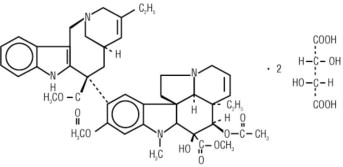
1 ML vinorelbine 10 MG/ML Injection [Navelbine] — Vinca alkaloids and analogues. INDICATIONS AND USAGE Vinorelbine Injection is indicated: In combination with cisplatin for first-line treatment of patients with locally advanced…
Boxed warning
WARNING: MYELOSUPPRESSION Severe myelosuppression resulting in serious infection, septic shock, hospitalization and death can occur [see Warnings and Precautions ( 5.1 )]. Decrease the dose or withhold vinorelbine in accord with recommended dose modifications [see Dosage and Administration ( 2.2 )]. WARNING: MYELOSUPPRESSION See full prescribing information for complete boxed warning. Severe myelosuppression resulting in serious infection, septic shock, and death can occur ( 5.1 ). Decrease the dose or withhold vinorelbine in accord with recommended dose modifications ( 2.2 ).
Vinorelbine may interact with CYP3A4 inhibitors, leading to increased adverse reactions.
moderateCYP3A4 inhibitors — may cause earlier onset and/or increased severity of adverse reactions
Indications
INDICATIONS AND USAGE Vinorelbine Injection is indicated: In combination with cisplatin for first-line treatment of patients with locally advanced or metastatic non-small cell lung cancer (NSCLC) As a single agent for the treatment of patients with metastatic NSCLC Vinorelbine Injection is a vinca alkaloid indicated: In combination with cisplatin for first-line treatment of patients with locally advanced or metastatic non-small cell lung cancer (NSCLC) ( 1 ) As a single agent for first-line treatment of patients with metastatic NSCLC ( 1 )
Dosage
DOSAGE AND ADMINISTRATION In combination with cisplatin: 25 to 30 mg/m 2 as an intravenous injection or infusion once weekly ( 2.1 ) Single agent: 30 mg/m 2 as intravenously once a week ( 2.1 ) Adjust dose in patients with decreased neutrophil counts or elevated serum total bilirubin ( 2.2 ) 2.1 Recommended Dosage In Combination with Cisplatin 100 mg/m 2 The recommended dosage of Vinorelbine Injection is 25 mg/m 2 administered as an intravenous injection or infusion over 6 to 10 minutes on Days 1, 8, 15 and 22 of a 28-day cycle in combination with cisplatin 100 mg/m 2 on Day 1 only of each 28-day cycle. In Combination with Cisplatin 120 mg/m 2 The recommended dosage of Vinorelbine Injection is 30 mg/m 2 administered as an intravenous injection or infusion over 6 to 10 minutes once a week in combination with cisplatin 120 mg/m 2 on Days 1 and 29, then every 6 weeks. Single Agent The recommended dosage of Vinorelbine Injection is 30 mg/m 2 administered intravenously over 6 to 10 minutes once a week. 2.2 Dosage Modifications Myelosuppression Hold or decrease the dose of Vinorelbine Injection in patients with decreased neutrophil counts according to the following schema [see Warnings and Precautions ( 5.1 )]: Neutrophils on Day of Treatment (cells/mm 3 ) Percentage of Starting Dose of Vinorelbine Injection ≥ 1,500 100% 1,000 to 1,499 50% < 1,000 Do not administer Vinorelbine Injection. Repeat neutrophil count in one week. If three consecutive weekly doses are held because neutrophil count is < 1,000 cells/mm 3 , discontinue Vinorelbine Injection Note: For patients who experience fever and/or sepsis while neutrophil count is < 1,500 cells/mm 3 or had 2 consecutive weekly doses held due to neutropenia, subsequent doses of Vinorelbine Injection should be: > 1,500 75% 1,000 to 1,499 37.5% < 1,000 Do not administer Vinorelbine Injection. Repeat neutrophil count in one week. Hepatic Impairment/Toxicity Reduce Vinorelbine Injection dose in patients with elevated serum total bilirubin concentration according to the following schema [see Warnings and Precautions ( 5.2 ) and Use in Specific Populations ( 8.6 )] : Serum Total Bilirubin Concentration (mg/dl) Percentage of Starting Dose of Vinorelbine Injection ≤ 2.0 100% 2.1 to 3.0 50% > 3.0 25% Concurrent Myelosuppression and Hepatic Impairment/Toxicity In patients with both myelosuppression and hepatic impairment/toxicity, administer the lower of the doses based on the corresponding starting dose of Vinorelbine Injection determined from the above schemas. Neurologic Toxicity Discontinue Vinorelbine Injection for Common Terminology Criteria for Adverse Events (CTCAE) Grade 2 or higher peripheral neuropathy or autonomic neuropathy causing constipation [see Warnings and Precautions ( 5.5 )]. 2.3 Preparation and Administration Preparation Dilute Vinorelbine Injection in an intravenous bag to a concentration between 0.5 mg/mL and 2 mg/mL. Use one of the following recommended solutions for dilution: 5% Dextrose Injection, USP 0.9% Sodium Chloride Injection, USP 0.45% Sodium Chloride Injection, USP 5% Dextrose and 0.45% Sodium Chloride Injection, USP Ringer's Injection, USP Lactated Ringer's Injection, USP Stability and Storage Conditions of Diluted Solutions Diluted Vinorelbine Injection may be used for up to 24 hours under normal room light when stored in polyvinyl chloride bags at 5° to 30°C (41° to 86°F). Administration Administer diluted Vinorelbine Injection over 6 to 10 minutes into the side port of a free-flowing intravenous line followed by flushing with at least 75 to 125 mL of one of the solutions. Vinorelbine Injection must only be administered intravenously. It is extremely important that the intravenous needle or catheter be properly positioned before any Vinorelbine Injection is injected. Parenteral drug products should be visually inspected for particulate matter and discoloration prior to administration whenever solution and container permit. If particulate matter is seen, Vinorelbine Injection should not be administered. Management of Suspected Extravasation If Vinorelbine Injection leakage into surrounding tissue occurs or is suspected, immediately stop administration of Vinorelbine Injection and initiate appropriate management measures in accordance with institutional policies [see Warnings and Precautions ( 5.4 )]. 2.4 Procedures for Proper Handling and Disposal Vinorelbine Injection is a cytotoxic drug. Follow applicable special handling and disposal procedures 1 . Exercise caution in handling and preparing the solution of Vinorelbine Injection. The use of gloves is recommended. If the solution of Vinorelbine Injection contacts the skin or mucosa, immediately wash the skin or mucosa thoroughly with soap and water. Avoid contamination of the eye with Vinorelbine Injection. If exposure occurs, flush the eyes with water immediately and thoroughly. Discard unused portion.
Warnings
WARNINGS AND PRECAUTIONS Hepatic Toxicity: Monitor hepatic function prior to initiation and during treatment ( 5.2 ) Severe constipation and bowel obstruction, including necrosis and perforation, occur. Institute a prophylactic bowel regimen to mitigate potential constipation, bowel obstruction and/or paralytic ileus ( 5.3 ) Extravasation can result in severe tissue injury, local tissue necrosis and/or thrombophlebitis. Immediately stop vinorelbine and institute recommended management procedures ( 5.4 ) Neurologic Toxicity: Severe sensory and motor neuropathies occur. Monitor patients for new or worsening signs and symptoms of neuropathy. Discontinue for Grade 2 or greater neuropathy ( 5.5 ) Pulmonary toxicity and respiratory failure occur. Interrupt vinorelbine in patients who develop unexplained dyspnea or have any evidence of pulmonary toxicity. Permanently discontinue for confirmed interstitial pneumonitis or ARDS ( 5.6 ) Embryo-Fetal Toxicity: Can cause fetal harm. Advise females of reproductive potential of potential risk to the fetus and to use effective contraception ( 5.7 , 8.1 , 8.3 ) 5.1 Myelosuppression Myelosuppression, manifested by neutropenia, anemia and thrombocytopenia, occur in patients receiving vinorelbine as a single agent and in combination with cisplatin [see Adverse Reactions ( 6.1 , 6.2 )] . Neutropenia is the major dose-limiting toxicity with vinorelbine. Grade 3-4 neutropenia occurred in 53% of patients treated with vinorelbine at 30 mg/m 2 per week. Dose adjustment due to myelosuppression occurred in 51% of patients (Study 2). In clinical trials with vinorelbine administered at 30 mg/m 2 per week, neutropenia resulted in hospitalizations for pyrexia and/or sepsis in 8% of patients. Death due to sepsis occurred in 1% of patients. Neutropenia nadirs occur between 7 and 10 days after dosing with neutropenia count recovery usually occurring within the following 7 to 14 days. Monitor complete blood counts prior to each dose of vinorelbine. Do not administer vinorelbine to patients with neutrophil counts <1,000 cells/mm 3 . Adjustments in the dosage of vinorelbine should be based on neutrophil counts obtained on the day of treatment [see Dosage and Administration ( 2.2 )]. 5.2 Hepatic Toxicity Drug-induced liver injury manifest by elevated aspartate aminotransferase (AST) and bilirubin occur in patients receiving vinorelbine as a single agent and in combination with cytotoxic agents. Assess hepatic function prior to initiation of vinorelbine and periodically during treatment. Reduce the dose of vinorelbine for patients who develop elevations in total bilirubin ≥ 2 times upper limit of normal [see Dosage and Administration ( 2.2 ) and Use in Specific Populations ( 8.6 )]. 5.3 Severe Constipation and Bowel Obstruction Severe and fatal paralytic ileus, constipation, intestinal obstruction, necrosis, and perforation occur in patients receiving vinorelbine. Institute a prophylactic bowel regimen to mitigate potential constipation, bowel obstruction and/or paralytic ileus, considering adequate dietary fiber intake, hydration and routine use of stool softeners. 5.4 Extravasation and Tissue Injury Extravasation of vinorelbine can result in severe irritation, local tissue necrosis and/or thrombophlebitis. If signs or symptoms of extravasation occur, immediately stop administration of vinorelbine and institute recommended management procedures [see Dosage and Administration ( 2.2 ) and Adverse Reactions ( 6.1 )]. 5.5 Neurologic Toxicity Sensory and motor neuropathies, including severe neuropathies, occur in patients receiving vinorelbine. Monitor patients for new or worsening signs and symptoms of neuropathy, such as paresthesia, hyperesthesia, hyporeflexia and muscle weakness while receiving vinorelbine. Discontinue vinorelbine for CTCAE Grade 2 or greater neuropathy [see Dosage and Administration ( 2.2 ) and Adverse Reactions ( 6.1 )]. 5.6 Pulmonary Toxicity and Respiratory Failure Pulmonary toxicity, including severe acute bronchospasm, interstitial pneumonitis, acute respiratory distress syndrome (ARDS) occur in patients receiving vinorelbine. Interstitial pneumonitis and ARDS included fatalities. The mean time to onset of interstitial pneumonitis and ARDS after vinorelbine administration was one week (range 3 to 8 days) [see Adverse Reactions ( 6.1 )]. Interrupt vinorelbine in patients who develop unexplained dyspnea or have any evidence of pulmonary toxicity. Permanently discontinue vinorelbine for confirmed interstitial pneumonitis or ARDS. 5.7 Embryo-Fetal Toxicity Based on findings from animal studies and its mechanism of action, vinorelbine can cause fetal harm when administered to a pregnant woman. In animal reproduction studies in mice and rabbits, embryo and fetal toxicity were observed with administration of vinorelbine at doses approximately 0.33 and 0.18 times the human therapeutic dose, respectively. Advise pregnant women of the potential risk to a fetus. Advise females of reproductive potential to use effective contraception during treatment with vinorelbine and for 6 months after the final dose. Advise males with female partners of reproductive potential to use effective contraception during treatment with vinorelbine and for 3 months after the final dose [see Use in Specific Populations ( 8.1 , 8.3 )].
Contraindications
CONTRAINDICATIONS None None
Mechanism of action
Mechanism of Action Vinorelbine is a vinca alkaloid that interferes with microtubule assembly. The antitumor activity of vinorelbine is thought to be due primarily to inhibition of mitosis at metaphase through its interaction with tubulin. Vinorelbine may also interfere with: 1) amino acid, cyclic AMP and glutathione metabolism, 2) calmodulin-dependent Ca++-transport ATPase activity, 3) cellular respiration, and 4) nucleic acid and lipid biosynthesis. Vinorelbine inhibited mitotic microtubule formation in intact mouse embryo tectal plates at a concentration of 2 μM inducing a blockade of cells at metaphase, but produced depolymerization of axonal microtubules at a concentration 40 μM, suggesting a modest selectivity of vinorelbine for mitotic microtubules.
A drug lookup is just the start. Eleplan keeps the whole care plan in one place.
Medications, diagnoses, documents, appointments, and the whole care team — organized and always in sync, with Ellie, your AI care assistant, on top of it. Free to start.