Morphine Tincture
Managing this medication for someone you care for? Eleplan keeps diagnoses, medications and appointments in one plan.
Start free with EleplanMedication reference
Morphine Tincture
Opioid Agonist [EPC] — ORAL
Morphine Tincture — Opioid Agonist [EPC]. INDICATIONS AND USAGE Opium tincture is useful for the treatment of diarrhea.
Brand names
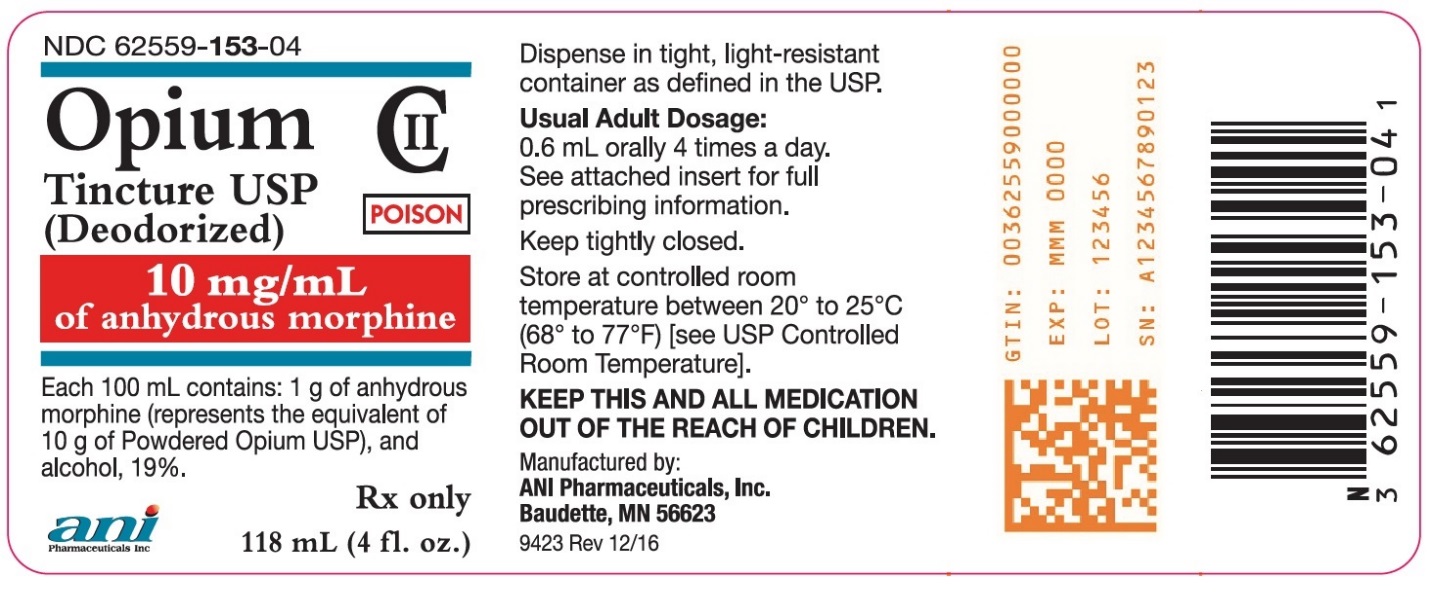
Opium Tincture Deodorized
Active ingredients
MORPHINE
Indications
INDICATIONS AND USAGE Opium tincture is useful for the treatment of diarrhea.
Dosage
DOSAGE AND ADMINISTRATION Usual Adult Dose – 0.6 mL orally 4 times a day.
Warnings
WARNINGS Addiction can result from opium usage. Opium preparations should be given in the smallest effective dose and as infrequently as possible to minimize the development of tolerance and physical dependence.
Contraindications
CONTRAINDICATIONS This preparation is not recommended for use in children. It should not be used in diarrhea caused by poisoning until the toxic material is eliminated from the gastrointestinal tract.
Adverse reactions
ADVERSE REACTIONS Constipation, nausea, and vomiting may occur in some patients. Pruritus and urticaria have been observed. To report SUSPECTED ADVERSE REACTIONS, contact ANI Pharmaceuticals, Inc. at 1-855-204-1431 or FDA at 1-800-FDA-1088 or www.fda.gov/medwatch.
Mechanism of action
CLINICAL PHARMACOLOGY The opiates act by enhancing tone in the long segments of longitudinal muscle and by inhibiting propulsive contraction of both circular and longitudinal muscles. Clinical evidence indicates that the analgesic activity of opium preparations is due to their morphine content. Relatively small doses that do not produce significant analgesia are effective in controlling diarrhea. The papaverine content of the mixed alkaloids is too small to have demonstrable spasmolytic activity. Following oral administration, morphine is well absorbed from the gastrointestinal tract. It is rapidly metabolized following oral administration, however, and plasma levels of unconjugated morphine are lower than those achieved after parenteral administration. Like other narcotic analgesics, opium preparations are metabolized in the liver. Morphine undergoes conjugation with glucuronic acid at the 3-hydroxyl group. Secondary conjugation may also occur at the 6-hydroxyl group to form the 3,6-diglucuronide. Morphine is excreted in the urine mainly as morphine-3-glucuronide and smaller amounts of morphine-3,6-diglucuronide and unchanged drug. Approximately 75% of a dose of morphine is excreted in the urine within 48 hours.
NDC examples
63629-196562559-153
Indicated ICD-10 codes
Treats these conditions
Source: openFDA + RxNorm · 2026
Look up another medication