Meclizine Hydrocloride
Managing this medication for someone you care for? Eleplan keeps diagnoses, medications and appointments in one plan.
Start free with EleplanMedication reference
Meclizine Hydrocloride
ORAL
Meclizine Hydrocloride. INDICATIONS AND USAGE Meclizine hydrochloride is indicated for the treatment of vertigo associated with diseases affecting the vestibular system in…
Brand names
MECLIZINE HYDROCHLORIDEMeclizine Hydrocloride
Active ingredients
MECLIZINE HYDROCHLORIDE
Indications
INDICATIONS AND USAGE Meclizine hydrochloride is indicated for the treatment of vertigo associated with diseases affecting the vestibular system in adults. Meclizine hydrochloride is indicated for the treatment of vertigo associated with diseases affecting the vestibular system in adults ( 1 ).
Dosage
DOSAGE AND ADMINISTRATION Recommended dosage: 25 mg to 100 mg daily, in divided doses ( 2.1 ). Tablets: Swallow whole ( 2.2 ). 2.1 Recommended Dosage The recommended dosage is 25 mg to 100 mg daily administered orally, in divided doses, depending upon clinical response. 2.2 Administration Instructions Tablets Meclizine hydrochloride tablets must be swallowed whole.
Warnings
WARNINGS AND PRECAUTIONS May cause drowsiness: Use caution when driving a car or operating dangerous machinery ( 5.1 ). Potential anticholinergic action: this drug should be prescribed with care to patients with a history of asthma, glaucoma, or enlargement of the prostate gland ( 5.2 ). 5.1 Drowsiness Since drowsiness may occur with use of meclizine hydrochloride, patients should be warned of this possibility and cautioned against driving a car or operating dangerous machinery. Patients should avoid alcoholic beverages while taking meclizine hydrochloride [see Drug Interactions (7.1) ]. 5.2 Concurrent Medical Conditions Because of its potential anticholinergic action, meclizine hydrochloride should be used with caution in patients with asthma, glaucoma, or enlargement of the prostate gland.
Contraindications
CONTRAINDICATIONS Meclizine hydrochloride is contraindicated in patients with a hypersensitivity to meclizine or any of the inactive ingredients [see Adverse Reactions (6) and Description (11) ]. Meclizine hydrochloride is contraindicated in patients with hypersensitivity to meclizine or any of the inactive ingredients ( 4 ).
Drug interactions
DRUG INTERACTIONS Coadministration of Meclizine hydrochloride with other CNS depressants, including alcohol, may result in increased CNS depression ( 7.1 ). CYP2D6 inhibitors: As meclizine is metabolized by CYP2D6, there is a potential for drug-drug interactions between Meclizine hydrochloride and CYP2D6 inhibitors ( 7.2 ). 7.1 CNS Depressants There may be increased CNS depression when meclizine hydrochloride is administered concurrently with other CNS depressants, including alcohol [see Warnings and Precautions (5.1) ]. 7.2 CYP2D6 Inhibitors Based on in-vitro evaluation, meclizine is metabolized by CYP2D6. Therefore, there is a possibility for a drug interaction between meclizine hydrochloride and CYP2D6 inhibitors. Therefore, monitor for adverse reactions and clinical effect accordingly.
Adverse reactions
ADVERSE REACTIONS The following adverse reactions associated with the use of meclizine hydrochloride were identified in clinical studies or postmarketing reports. Because some of these reactions were reported voluntarily from a population of uncertain size, it is not always possible to reliably estimate their frequency or establish a causal relationship to drug exposure. Anaphylactic reaction, drowsiness, dry mouth, headache, fatigue, and vomiting. On rare occasions blurred vision has been reported. Common adverse reactions are anaphylactic reaction, drowsiness, dry mouth, headache, fatigue, and vomiting. On rare occasions blurred vision has been reported ( 6 ). To report SUSPECTED ADVERSE REACTIONS, contact Jubilant Cadista Pharmaceuticals Inc. at 1-800313-4623 or FDA at 1-800-FDA-1088 or www.fda.gov/medwatch.
Mechanism of action
CLINICAL PHARMACOLOGY Meclizine Hydrochloride is an antihistamine which shows marked protective activity against nebulized histamine and lethal doses of intravenously injected histamine in guinea pigs. It has a marked effect in blocking the vasodepressor response to histamine, but only a slight blocking action against acetylcholine. Its activity is relatively weak in inhibiting the spasmogenic action of histamine on isolated guinea pig ileum.
NDC examples
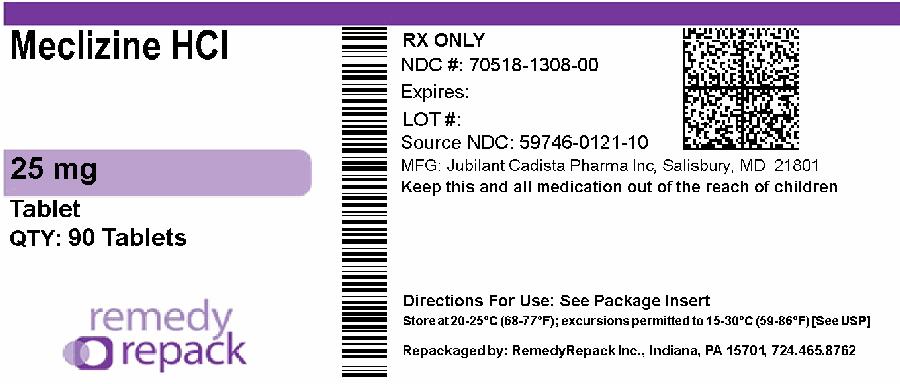
76420-13068071-301759746-12159746-12242708-102
Indicated ICD-10 codes
Source: openFDA + RxNorm · 2026
Look up another medication