Medication reference
Inclisiran
SUBCUTANEOUS
Inclisiran. INDICATIONS AND USAGE LEQVIO ® is indicated as an adjunct to diet and exercise to reduce low-density lipoprotein cholesterol (LDL-C) in: adults with h
Brand names
LEQVIO
Active ingredients
INCLISIRAN SODIUM
Indications
INDICATIONS AND USAGE LEQVIO ® is indicated as an adjunct to diet and exercise to reduce low-density lipoprotein cholesterol (LDL-C) in: adults with hypercholesterolemia. adults and pediatric patients aged 12 years and older with heterozygous familial hypercholesterolemia (HeFH). pediatric patients aged 12 years and older with homozygous familial hypercholesterolemia (HoFH). LEQVIO is a small interfering RNA (siRNA) directed to proprotein convertase subtilisin kexin type 9 (PCSK9) mRNA indicated as an adjunct to diet and exercise to reduce low-density lipoprotein cholesterol (LDL-C) in: adults with hypercholesterolemia. ( 1 ) adults and pediatric patients aged 12 years and older with heterozygous familial hypercholesterolemia (HeFH). ( 1 ) pediatric patients aged 12 years and older with homozygous familial hypercholesterolemia (HoFH). ( 1 )
Dosage
DOSAGE AND ADMINISTRATION The recommended dosage of LEQVIO for adults and pediatric patients aged 12 years and older is 284 mg administered as a single subcutaneous injection initially, again at 3 months, and then every 6 months. ( 2.1 ) LEQVIO should be administered by a healthcare professional. ( 2.2 ) Inject LEQVIO subcutaneously into the abdomen, upper arm, or thigh. ( 2.2 ) 2.1 Recommended Dosage The recommended dosage of LEQVIO for adults and pediatric patients aged 12 years and older is 284 mg administered as a single subcutaneous injection initially, again at 3 months, and then every 6 months. If a planned dose is missed by less than 3 months, administer LEQVIO and maintain dosing according to the patient’s original schedule. If a planned dose is missed by more than 3 months, restart with a new dosing schedule - administer LEQVIO initially, again at 3 months, and then every 6 months. Assess LDL-C when clinically indicated. The LDL-lowering effect of LEQVIO may be measured as early as 30 days after initiation and anytime thereafter without regard to timing of the dose. 2.2 Important Administration Instructions LEQVIO should be administered by a healthcare professional. Inject LEQVIO subcutaneously into the abdomen, upper arm, or thigh. Do not inject in areas of active skin disease or injury, such as sunburns, skin rashes, inflammation, or skin infections. Inspect LEQVIO visually before use. It should appear clear and colorless to pale yellow. Do not use if particulate matter or discoloration is seen. For more detailed instruction on administration of the prefilled syringe, see Instructions for Use.
Warnings
WARNINGS AND PRECAUTIONS Hypersensitivity Reactions: Have been reported in patients treated with LEQVIO. Advise patients on the signs and symptoms of hypersensitivity reactions and instruct patients to seek medical attention promptly. ( 5.1 ) 5.1 Hypersensitivity Reactions Hypersensitivity reactions, including anaphylaxis and angioedema, have been reported in patients treated with LEQVIO [see Adverse Reactions (6.2)] . Advise patients on the signs and symptoms of hypersensitivity reactions and instruct patients to seek medical attention promptly. LEQVIO is contraindicated in patients with a prior serious hypersensitivity reaction to inclisiran or any of the excipients in LEQVIO.
Contraindications
CONTRAINDICATIONS LEQVIO is contraindicated in patients with a prior serious hypersensitivity reaction to inclisiran or any of the excipients in LEQVIO. Serious hypersensitivity reactions have included anaphylaxis and angioedema [see Adverse Reactions (6.2)] . Prior serious hypersensitivity to inclisiran or any of the excipients in LEQVIO.
Adverse reactions
ADVERSE REACTIONS The following adverse reactions are also discussed in other sections of the label: Hypersensitivity Reactions [see Warnings and Precautions (5.1)] Common adverse reactions in clinical trials (≥ 3%): injection site reaction, arthralgia, and bronchitis. ( 6 ) To report SUSPECTED ADVERSE REACTIONS, contact Novartis Pharmaceuticals Corporation at 1-888-669-6682 or FDA at 1-800-FDA-1088 or www.fda.gov/medwatch. 6.1 Clinical Trials Experience Because clinical trials are conducted under widely varying conditions, adverse reaction rates observed in the clinical trials of a drug cannot be directly compared to rates in the clinical trials of another drug and may not reflect the rates observed in practice. Adverse Reactions in Adults with Hypercholesterolemia The data in Table 1 are derived from 3 placebo-controlled trials that included 1,833 adults with hypercholesterolemia treated with LEQVIO, including 1,682 exposed for 18 months (median treatment duration of 77 weeks) [see Clinical Studies (14)] . The mean age of the population was 64 years, 32% of the population were female, 92% were White, 6% were Black or African American, 1% were Asian, and < 1% were other races; 6% identified as Hispanic or Latino ethnicity. At baseline, 12% of patients had a diagnosis of HeFH and 85% had clinical atherosclerotic cardiovascular disease (ASCVD). Adverse reactions reported in at least 3% of LEQVIO-treated patients, and more frequently than in placebo-treated patients, are shown in Table 1. Table 1: Adverse Reactions Occurring in Greater Than or Equal to 3% of LEQVIO-treated Adults with Hypercholesterolemia and More Frequently than with Placebo (Trials 1, 2, and 3) Adverse Reactions Placebo (N = 1,822) % LEQVIO (N = 1,833) % †includes related terms such as: injection site pain, erythema and rash Injection site reaction† 2 8 Arthralgia 4 5 Bronchitis 3 4 Adverse reactions led to discontinuation of treatment in 2.5% of patients treated with LEQVIO and 1.9% of patients treated with placebo. The most common adverse reactions leading to treatment discontinuation in patients treated with LEQVIO were injection site reactions (0.2% versus 0% for LEQVIO and placebo, respectively). Adverse Reactions in Pediatric Patients with HeFH In a 24-month, two-part trial of 141 pediatric patients aged 12 years and older with HeFH (Trial 4), consisting of a 12-month randomized, double-blind, placebo-controlled part (Part 1/Year 1), followed by a 12-month open-label part (Part 2/Year 2), 93 patients received 284 mg of LEQVIO subcutaneously during Part 1 and 139 patients were treated with LEQVIO during Part 2 [see Clinical Studies (14)] . During Part 2, 91 patients continued LEQVIO treatment for a second year and 48 patients switched from placebo to LEQVIO for 1 year of treatment. The safety profile reported in pediatric patients with HeFH was consistent with the description above for adult patients with hypercholesterolemia, with the exception of headache. In pediatric patients with HeFH, the incidence of headache was 6% among patients who received placebo versus 13% of LEQVIO-treated patients during the double-blind study period. Adverse Reactions in Pediatric Patients with HoFH In a 24-month, two-part trial of 13 pediatric patients aged 12 years and older with HoFH (Trial 5), consisting of a 12-month randomized, double-blind, placebo-controlled part (Part 1/Year 1), followed by a 12-month open-label part (Part 2/Year 2), 9 patients received 284 mg of LEQVIO administered subcutaneously during Part 1 and 13 patients were treated with LEQVIO during Part 2 [see Clinical Studies (14)] . During Part 2, 9 patients continued LEQVIO treatment for a second year and 4 patients switched from placebo to LEQVIO for 1 year of treatment. The safety profile reported in pediatric patients was consistent with adult patients with hypercholesterolemia. 6.2 Postmarketing Experience The following adverse reactions have been identified during post-approval use of LEQVIO. Because these reactions are reported voluntarily from a population of uncertain size, it is not always possible to reliably estimate their frequency or establish a causal relationship to drug exposure. Hypersensitivity: anaphylaxis, angioedema, rash, pruritus, and urticaria.
Mechanism of action
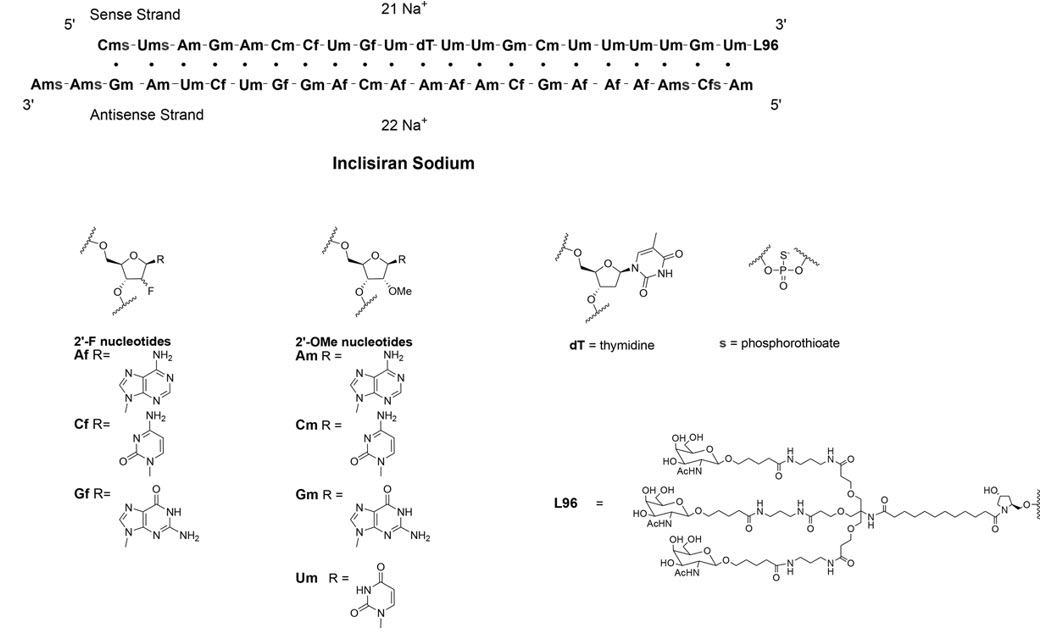
Mechanism of Action Inclisiran is a double-stranded small interfering ribonucleic acid (siRNA), conjugated on the sense strand with triantennary N-Acetylgalactosamine (GalNAc) to facilitate uptake by hepatocytes. In hepatocytes, inclisiran utilizes the RNA interference mechanism and directs catalytic breakdown of mRNA for PCSK9. This increases LDL-C receptor recycling and expression on the hepatocyte cell surface, which increases LDL-C uptake and lowers LDL-C levels in the circulation.
Available forms (2)
NDC examples
0078-1000
Indicated ICD-10 codes
Treats these conditions
Common side effects
Source: openFDA + RxNorm · 2026
Look up another medication