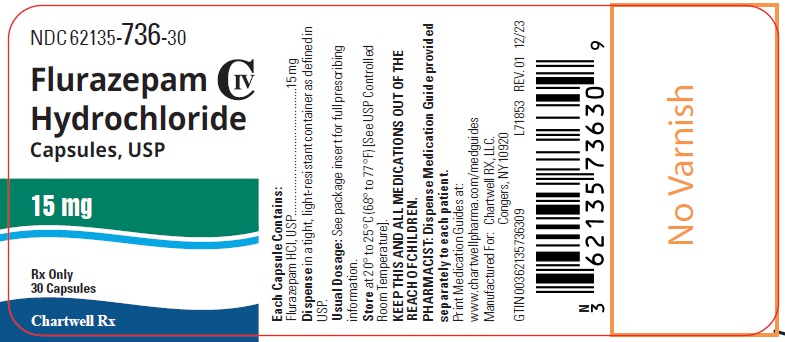
Flurazepam. INDICATIONS AND USAGE Flurazepam hydrochloride capsules are indicated for the treatment of insomnia characterized by difficulty in falling asleep…
Boxed warning
WARNING: RISKS FROM CONCOMITANT USE WITH OPIOIDS; ABUSE, MISUSE, AND ADDICTION; and DEPENDENCE AND WITHDRAWAL REACTIONS Concomitant use of benzodiazepines and opioids may result in profound sedation, respiratory depression, coma, and death. Reserve concomitant prescribing of these drugs in patients for whom alternative treatment options are inadequate. Limit dosages and durations to the minimum required. Follow patients for signs and symptoms of respiratory depression and sedation [see Warnings and Precautions ( 5.1 ) and Drug Interactions ( 7.1 ) ]. The use of benzodiazepines, including flurazepam hydrochloride capsules, exposes users to risks of abuse, misuse, and addiction, which can lead to overdose or death. Abuse and misuse of benzodiazepines commonly involve concomitant use of other medications, alcohol, and/or illicit substances, which is associated with an increased frequency of serious adverse outcomes. Before prescribing flurazepam hydrochloride capsules, and throughout treatment, assess each patient’s risk for abuse, misuse, and addiction [ see Warnings and Precautions ( 5.2 ) ]. The continued use of benzodiazepines, including flurazepam hydrochloride capsules, may lead to clinically significant physical dependence. The risks of dependence and withdrawal increase with longer treatment duration and higher daily dose. Abrupt discontinuation or rapid dosage reduction of flurazepam hydrochloride capsules after continued use may precipitate acute withdrawal reactions, which can be life-threatening. To reduce the risk of withdrawal reactions, use a gradual taper to discontinue flurazepam hydrochloride capsules or reduce the dosage [ see Dosage and Administration ( 2.3 ) and Warnings and Precautions ( 5.3 ) ]. WARNING: RISKS FROM CONCOMITANT USE WITH OPIOIDS; ABUSE, MISUSE, AND ADDICTION; and DEPENDENCE AND WITHDRAWAL REACTIONS See full prescribing information for complete boxed warning. Concomitant use of benzodiazepines and opioids may result in profound sedation, respiratory depression, coma, and death. Reserve concomitant prescribing of these drugs in patients for whom alternative treatment options are inadequate. Limit dosages and durations to the minimum required. Follow patients for signs and symptoms of respiratory depression and sedation ( 5.1 , 7.1 ). The use of benzodiazepines, including flurazepam hydrochloride capsules, exposes users to risks of abuse, misuse, and addiction, which can lead to overdose or death. Before prescribing flurazepam hydrochloride capsules and throughout treatment, assess each patient’s risk for abuse, misuse, and addiction ( 5.2 ). Abrupt discontinuation or rapid dosage reduction of flurazepam hydrochloride capsules after continued use may precipitate acute withdrawal reactions, which can be life-threatening. To reduce the risk of withdrawal reactions, use a gradual taper to discontinue flurazepam hydrochloride capsules or reduce the dosage ( 2.3 , 5.3 ).
INDICATIONS AND USAGE Flurazepam hydrochloride capsules are indicated for the treatment of insomnia characterized by difficulty in falling asleep, frequent nocturnal awakenings, and/or early morning awakenings [see Clinical Studies ( 14 ) ]. Since insomnia is often transient and intermittent, short-term use is usually sufficient. Prolonged use of hypnotics is usually not indicated and should only be undertaken concomitantly with appropriate evaluation of the patient. Flurazepam, a gamma-aminobutyric (GABA A ) agonist, is indicated for the treatment of insomnia characterized by difficulty falling asleep, frequent nocturnal awakenings, and/or early morning awakenings. ( 1 )
Dosage
DOSAGE AND ADMINISTRATION Use the lowest dose effective for the patient. Recommended initial dose is 15 mg for women and 15 mg or 30 mg for men. ( 2.1 ) Elderly or debilitated patients: recommended dose is 15 mg. ( 2.2 ) 2.1 Dosage in Adults Use the lowest dose effective for the patient, as important adverse effects of flurazepam hydrochloride capsules are dose related. The recommended initial dose is 15 mg for women and either 15 mg or 30 mg for men. The 15 mg dose can be increased to 30 mg if necessary for efficacy. The recommended initial doses for women and men are different because flurazepam clearance is lower in women [see Pharmacokinetics ( 12.3 ) ]. 2.2 Dosage in Elderly or Debilitated Patients Elderly or debilitated patients may be especially sensitive to flurazepam. Since the risk of the development of oversedation, dizziness, confusion and/or ataxia increases substantially with larger doses in elderly or debilitated patients, it is recommended that in such patients the dosage be limited to 15 mg. Staggering and falling have also been reported, particularly in geriatric patients [see Warnings and Precautions ( 5.2 ) ]. 2.3 Discontinuation or Dosage Reduction of Flurazepam Hydrochloride Capsules To reduce the risk of withdrawal reactions, use a gradual taper to discontinue flurazepam hydrochloride capsules or reduce the dosage. If a patient develops withdrawal reactions, consider pausing the taper or increasing the dosage to the previous tapered dosage level. Subsequently decrease the dosage more slowly [ see Warnings and Precautions ( 5.3 ) and Drug Abuse and Dependence ( 9.3 ) ].
Warnings
WARNINGS AND PRECAUTIONS CNS depressant effects: Impaired alertness and motor coordination, including risk of falling. Daytime impairment. Caution patients against driving and other activities requiring complete mental alertness. ( 5.4 ) The failure of insomnia to remit after 7 to 10 days of treatment may indicate the presence of a primary psychiatric and/or medical illness that should be evaluated. ( 5.5 ) Severe anaphylactic/anaphylactoid reactions: Angioedema and anaphylaxis have been reported. Do not rechallenge if such reactions occur. ( 5.6 ) Sleep driving and other complex behaviors while not fully awake: Risk increases with dose and concomitant CNS depressants and alcohol. Immediately evaluate any new onset behavioral changes. ( 5.7 ) Worsening of depression or suicidal thinking may occur: Prescribe the least number of capsules feasible to avoid intentional overdose. ( 5.8 ) Neonatal Sedation and Withdrawal Syndrome: Flurazepam use during pregnancy can result in neonatal sedation and/or neonatal withdrawal. ( 5.9 ) 5.1 Risks from Concomitant Use of Opioids Concomitant use of benzodiazepines, including flurazepam, and opioids may result in profound sedation, respiratory depression, coma, and death. Because of these risks, reserve concomitant prescribing of benzodiazepines and opioids in patients for whom alternative treatment options are inadequate. Observational studies have demonstrated that concomitant use of opioid analgesics and benzodiazepines increases the risk of drug-related mortality compared to use of opioids alone. If a decision is made to prescribe flurazepam concomitantly with opioids, prescribe the lowest effective dosages and minimum durations of concomitant use, and follow patients closely for signs and symptoms of respiratory depression and sedation. Advise both patients and caregivers about the risks of respiratory depression and sedation when flurazepam is used with opioids [see Drug Interactions ( 7 )]. 5.2 Abuse, Misuse, and Addiction The use of benzodiazepines, including flurazepam hydrochloride capsules, exposes users to the risks of abuse, misuse, and addiction, which can lead to overdose or death. Abuse and misuse of benzodiazepines often (but not always) involve the use of doses greater than the maximum recommended dosage and commonly involve concomitant use of other medications, alcohol, and/or illicit substances, which is associated with an increased frequency of serious adverse outcomes, including respiratory depression, overdose, or death [see Drug Abuse and Dependence ( 9.2 ) ]. Before prescribing flurazepam hydrochloride capsules and throughout treatment, assess each patient’s risk for abuse, misuse, and addiction (e.g., using a standardized screening tool). Use of flurazepam hydrochloride capsules, particularly in patients at elevated risk, necessitates counseling about the risks and proper use of flurazepam hydrochloride capsules along with monitoring for signs and symptoms of abuse, misuse, and addiction. Prescribe the lowest effective dosage; avoid or minimize concomitant use of CNS depressants and other substances associated with abuse, misuse, and addiction (e.g., opioid analgesics, stimulants); and advise patients on the proper disposal of unused drug. If a substance use disorder is suspected, evaluate the patient and institute (or refer them for) early treatment, as appropriate. 5.3 Dependence and Withdrawal Reactions To reduce the risk of withdrawal reactions, use a gradual taper to discontinue flurazepam hydrochloride capsules or reduce the dosage (a patient-specific plan should be used to taper the dose) [see Dosage and Administration ( 2.3 )] . Patients at an increased risk of withdrawal adverse reactions after benzodiazepine discontinuation or rapid dosage reduction include those who take higher dosages, and those who have had longer durations of use. Acute Withdrawal Reactions: The continued use of benzodiazepines, including flurazepam hydrochloride capsules, may lead to clinically significant physical dependence. Abrupt discontinuation or rapid dosage reduction of flurazepam hydrochloride capsules after continued use, or administration of flumazenil (a benzodiazepine antagonist) may precipitate acute withdrawal reactions, which can be life-threatening (e.g., seizures) [ see Drug Abuse and Dependence ( 9.3 ) ]. Protracted Withdrawal Syndrome: In some cases, benzodiazepine users have developed a protracted withdrawal syndrome with withdrawal symptoms lasting weeks to more than 12 months [ see Drug Abuse and Dependence ( 9.3 ) ]. 5.4 CNS-Depressant Effects and Next-Day Impairment Dizziness, drowsiness, light-headedness, staggering, ataxia and falling can occur, particularly in elderly or debilitated persons. Severe sedation, lethargy, disorientation and coma, probably indicative of drug intolerance or overdosage, have been reported. Flurazepam is a central nervous system (CNS) depressant and can impair daytime function even when used as prescribed. Prescribers should monitor for excess depressant effects, but impairment can occur in the absence of subjective symptoms, and may not be reliably detected by ordinary clinical exam (i.e., less than formal psychomotor testing). While pharmacodynamic tolerance or adaptation to some adverse depressant effects of flurazepam may develop, patients using flurazepam should be cautioned against driving or engaging in other hazardous activities or activities requiring complete mental alertness. Additive effects occur with concomitant use of other CNS depressants (e.g., other benzodiazepines, opioids, tricyclic antidepressants, alcohol). Downward dose adjustment of flurazepam and concomitant CNS depressants should be considered. The potential for adverse drug interactions continues for several days following discontinuation of flurazepam, until serum levels of psychoactive metabolites decline. Use of flurazepam with other sedative-hypnotics is not recommended. Alcohol generally should not be used during treatment with flurazepam. The risk of next-day psychomotor impairment is increased if flurazepam is taken with less than a full night of sleep remaining (7 to 8 hours); if higher than the recommended dose is taken; if coadministered with other CNS depressants [see Dosage and Administration ( 2 )]. Because flurazepam can cause drowsiness and a decreased level of consciousness, patients, particularly the elderly, are at higher risk of falls. 5.5 Need to Evaluate for Co-morbid Disorders Because sleep disturbances may be the presenting manifestation of a physical and/or psychiatric disorder, symptomatic treatment of insomnia should be initiated only after a careful evaluation of the patient. The failure of insomnia to remit after 7 to 10 days of treatment may indicate the presence of a primary psychiatric and/or medical illness that should be evaluated. Worsening of insomnia or the emergence of new thinking or behavior abnormalities may be the consequence of an unrecognized psychiatric or physical disorder. Such findings have emerged during the course of treatment with sedative-hypnotic drugs. 5.6 Severe Anaphylactic or Anaphylactoid Reactions Rare cases of angioedema involving the tongue, glottis or larynx have been reported in patients after taking the first or subsequent doses of sedative-hypnotics, including flurazepam. Some patients have had additional symptoms such as dyspnea, throat closing, or nausea and vomiting that suggest anaphylaxis. Some patients have required medical therapy in the emergency department. If angioedema involves the tongue, glottis or larynx, airway obstruction may occur and be fatal. Patients who develop angioedema after treatment with flurazepam should not be rechallenged with the drug. 5.7 Abnormal Thinking and Behavior Changes Abnormal thinking and behavior changes have been reported in patients treated with sedative-hypnotics including flurazepam. Some of these changes include decreased inhibition (e.g., aggressiveness and extroversio
Contraindications
CONTRAINDICATIONS Flurazepam hydrochloride capsules are contraindicated in patients with known hypersensitivity to flurazepam or other benzodiazepines. Rare cases of angioedema involving the tongue, glottis or larynx have been reported in patients after taking the first or subsequent doses of flurazepam. Some patients have had additional symptoms such as dyspnea, throat closing, or nausea and vomiting that suggest anaphylaxis. Patients who develop such reactions should not be rechallenged with flurazepam. Hypersensitivity to flurazepam or other benzodiazepines. ( 4 )
Drug interactions
DRUG INTERACTIONS Concomitant use of benzodiazepines and opioids may result in profound sedation, respiratory depression, and death. ( 7.1 ) CNS Depressants: Downward dose adjustment may be necessary due to additive effects. ( 7.2 ) 7.1 Opioids The concomitant use of benzodiazepines and opioids increases the risk of respiratory depression because of actions at different receptor sites in the CNS that control respiration. Benzodiazepines interact at GABA A sites, and opioids interact primarily at mu receptors. When benzodiazepines and opioids are combined, the potential for benzodiazepines to significantly worsen opioid-related respiratory depression exists. Limit dosage and duration of concomitant use of benzodiazepines and opioids, and follow patients closely for respiratory depression and sedation. 7.2 CNS Depressants Benzodiazepines, including flurazepam, produce additive CNS depressant effects when co-administered with ethanol or other CNS depressants (e.g., psychotropic medications, anticonvulsants, antihistamines). Downward dose adjustment of flurazepam and/or concomitant CNS depressants may be necessary because of additive effects.
Adverse reactions
ADVERSE REACTIONS The following serious adverse reactions are discussed in greater detail in other sections of the label: Risks from Concomitant Use with Opioids [see Warnings and Precautions ( 5.1 ) ] Abuse, Misuse, and Addiction [see Warnings and Precautions ( 5.2 )] Dependence and Withdrawal Reactions [see Warnings and Precautions ( 5.3 ) ] CNS-depressant effects and next-day impairment [see Warnings and Precautions ( 5.4 )] Severe Anaphylactic and Anaphylactoid Reactions [see Warnings and Precautions ( 5.6 )] Abnormal thinking and behavior changes, and complex behaviors [see Warnings and Precautions ( 5.7 )] Worsening of depression [see Warnings and Precautions ( 5.8 )] Neonatal Sedation and Withdrawal Syndrome [see Warnings and Precautions ( 5.9 )] Adverse reactions: dizziness, drowsiness, light-headedness, staggering, ataxia, falling. ( 6.1 ) To report SUSPECTED ADVERSE REACTIONS, contact Chartwell RX, LLC. at 1-845-232-1683 or FDA at 1-800-FDA-1088 or www.fda.gov/medwatch . 6.1 Clinical Trials Experience Reported were headache, heartburn, upset stomach, nausea, vomiting, diarrhea, constipation, gastrointestinal pain, nervousness, talkativeness, apprehension, irritability, weakness, palpitations, chest pains, body and joint pains, and genitourinary complaints. There have also been rare occurrences of leukopenia, granulocytopenia, sweating, flushes, difficulty in focusing, blurred vision, burning eyes, faintness, hypotension, shortness of breath, pruritus, skin rash, dry mouth, bitter taste, excessive salivation, anorexia, euphoria, depression, slurred speech, confusion, restlessness, hallucinations and elevated SGOT, SGPT, total and direct bilirubin elevations, and elevated alkaline phosphatase.
Mechanism of action
CLINICAL PHARMACOLOGY 12.1 Mechanism of Action Flurazepam, like other central nervous system agents of the 1,4-benzodiazepine class, presumably exerts its effects by binding to stereo-specific receptors at several sites within the central nervous system (CNS). The exact mechanism of action is unknown. 12.3 Pharmacokinetics Flurazepam hydrochloride is rapidly absorbed from the gastro-intestinal tract. Flurazepam is rapidly metabolized and is excreted primarily in the urine. Following a single oral dose, peak flurazepam plasma concentrations ranging from 0.5 to 4.0 ng/mL occur at 30 to 60 minutes post-dosing. The harmonic mean apparent half-life of flurazepam is 2.3 hours. The blood level profile of flurazepam and its major metabolites was determined in man following the oral administration of 30 mg daily for 2 weeks. The N1-hydroxyethyl-flurazepam was measurable only during the early hours after a 30 mg dose and was not detectable after 24 hours. The major metabolite in blood was N1-desalkyl-flurazepam, which reached steady-state (plateau) levels after 7 to 10 days of dosing, at levels approximately 5- to 6-fold greater than the 24-hour levels observed on Day 1. The half-life of elimination of N1-desalkyl-flurazepam ranged from 47 to 100 hours. The major urinary metabolite is conjugated N1-hydroxyethyl-flurazepam which accounts for 22% to 55% of the dose. Less than 1% of the dose is excreted in the urine as N1-desalkyl-flurazepam. This pharmacokinetic profile may be responsible for the clinical observation that flurazepam is increasingly effective on the second or third night of consecutive use and that for 1 or 2 nights after the drug is discontinued both sleep latency and total wake time may still be decreased. The single dose pharmacokinetics of flurazepam were studied in 12 healthy geriatric subjects (aged 61 to 85 years). The mean elimination half-life of desalkyl-flurazepam was longer in elderly male subjects (160 hours) compared with younger male subjects (74 hours), while mean elimination half-life was similar in geriatric female subjects (120 hours) and younger female subjects (90 hours). After multiple dosing, mean steady-state plasma levels of desalkyl-flurazepam were higher in elderly male subjects (81 ng/mL) compared with younger male subjects (53 ng/mL), while values were similar between elderly female subjects (85 ng/mL) and younger female subjects (86 ng/mL). The mean washout half-life of desalkyl-flurazepam was longer in elderly male and female subjects (126 and 158 hours, respectively) compared with younger male and female subjects (111 and 113 hours, respectively). 1 1 Greenblatt DJ, Divoll M, Hammatz JS, MacLauglin DS, Shader RI: Kinetics and clinical effects of flurazepam in young and elderly noninsomniacs. Clin Pharmacol Ther 30: 475-486, 1981.