Fluciclovine
Managing this medication for someone you care for? Eleplan keeps diagnoses, medications and appointments in one plan.
Start free with EleplanMedication reference
Fluciclovine
Radioactive Diagnostic Agent [EPC] — INTRAVENOUS
Fluciclovine — Radioactive Diagnostic Agent [EPC]. INDICATIONS AND USAGE Axumin is indicated for positron emission tomography (PET) in men with suspected prostate cancer recurrence based on elevated…
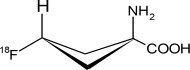
Brand names
Axumin
Active ingredients
FLUCICLOVINE F-18
Indications
INDICATIONS AND USAGE Axumin is indicated for positron emission tomography (PET) in men with suspected prostate cancer recurrence based on elevated blood prostate specific antigen (PSA) levels following prior treatment. Axumin is a radioactive diagnostic agent indicated for positron emission tomography (PET) imaging in men with suspected prostate cancer recurrence based on elevated blood prostate specific antigen (PSA) levels following prior treatment ( 1 ).
Dosage
DOSAGE AND ADMINISTRATION Use appropriate radiation safety handling measures ( 2.1 ). Aseptically withdraw Axumin from its container and administer 370 MBq (10 mCi) as a bolus intravenous injection. ( 2.2 ). Initiate imaging 3 minutes to 5 minutes after administration. Scanning should start from mid-thigh and proceed to base of skull, with a total scan time of approximately 20 minutes to 30 minutes ( 2.4 ). The (radiation absorbed) effective dose associated with 370 MBq (10 mCi) of injected activity of Axumin is approximately 8 mSv (0.8 rem) in an adult ( 2.6 ). 2.1 Radiation Safety - Drug Handling Axumin is a radioactive drug and should be handled with appropriate safety measures to minimize radiation exposure during administration [see Warnings and Precautions ( 5.3 ) ]. Use waterproof gloves and effective shielding, including syringe shields, when handling and administering Axumin. 2.2 Recommended Dose and Administration Instructions The recommended dose is 370 MBq (10 mCi) administered as an intravenous bolus injection. Inspect Axumin visually for particulate matter and discoloration before administration. Do not use the drug if the solution contains particulate matter or is discolored. Use aseptic technique and radiation shielding when withdrawing and administering Axumin. Calculate the necessary volume to administer based on calibration time and date, using a suitably calibrated instrument. The recommended maximum volume of injection of undiluted Axumin is 5mL. Axumin may be diluted with 0.9% Sodium Chloride Injection, USP. After the Axumin injection, administer an intravenous flush of sterile 0.9% Sodium Chloride Injection, USP to ensure full delivery of the dose. Dispose of any unused drug in a safe manner in compliance with applicable regulations. 2.3 Patient Preparation Prior to PET Imaging Advise the patient to avoid any significant exercise for at least one day prior to PET imaging. Advise patients not to eat or drink for at least 4 hours (other than sips of water for taking medications) prior to administration of Axumin. Advise patients to void approximately 30 minutes to 60 minutes prior to administration of Axumin and then refrain from voiding until after the scan has been completed 2.4 Image Acquisition Guidelines Position the patient supine with arms above the head. Begin PET scanning 3 minutes to 5 minutes after completion of the Axumin injection. It is recommended that image acquisition should start from mid-thigh and proceed to the base of the skull. Typical total scan time is between 20 minutes to 30 minutes. 2.5 Image Display and Interpretation Localization of prostate cancer recurrence in sites typical for prostate cancer recurrence is based on fluciclovine F 18 uptake in comparison with tissue background. For small lesions (less than 1cm in diameter) focal uptake greater than blood pool should be considered suspicious for prostate cancer recurrence. For larger lesions, uptake equal to or greater than bone marrow is considered suspicious for prostate cancer recurrence. 2.6 Radiation Dosimetry The radiation absorbed doses estimated for adult patients following intravenous injection of Axumin are shown in Table 1 . Values were calculated from human biodistribution data using OLINDA/EXM (Organ Level Internal Dose Assessment/Exponential Modeling) software. The (radiation absorbed) effective dose resulting from the administration of the recommended activity of 370 MBq of Axumin is 8 mSv. For an administered activity of 370 MBq (10 mCi), the highest-magnitude radiation doses are delivered to the pancreas, cardiac wall, and uterine wall: 38 mGy, 19 mGy, and 17 mGy, respectively. If a CT scan is simultaneously performed as part of the PET procedure, exposure to ionizing radiation will increase in an amount dependent on the settings used in the CT acquisition. Table 1: Estimated Radiation Absorbed Doses in Various Organs/Tissues in Adults who Received Axumin Organ/Tissue Mean Absorbed Dose per Unit Administered Activity (microGy/MBq) Adrenal glands 16 Brain 9 Breasts 14 Gallbladder wall 17 Lower large intestine wall 12 Small intestine wall 13 Stomach wall 14 Upper large intestine wall 13 Heart wall 52 Kidneys 14 Liver 33 Lungs 34 Muscle 11 Ovaries 13 Pancreas 102 Red bone marrow 25 Osteogenic cells 23 Skin 8 Spleen 24 Testes 17 Thymus gland 12 Thyroid 10 Urinary bladder wall 25 Uterus 45 Total body 13 Effective dose 22 (microSv/MBq)
Warnings
WARNINGS AND PRECAUTIONS Image interpretation errors can occur with Axumin imaging ( 5.1 ). Radiation risk: Axumin contributes to a patient's long-term cumulative radiation exposure. Ensure safe handling to protect patients and health care workers from unintentional radiation exposure ( 2.1 , 5.3 ). 5.1 Risk for Image Misinterpretation Image interpretation errors can occur with Axumin PET imaging. A negative image does not rule out the presence of recurrent prostate cancer and a positive image does not confirm the presence of recurrent prostate cancer. The performance of Axumin seems to be affected by PSA levels [See Clinical Studies ( 14 )] . Fluciclovine F 18 uptake is not specific for prostate cancer and may occur with other types of cancer and benign prostatic hypertrophy in primary prostate cancer. Clinical correlation, which may include histopathological evaluation of the suspected recurrence site, is recommended. 5.2 Hypersensitivity Reactions Hypersensitivity reactions including anaphylaxis may occur in patients who receive Axumin. Emergency resuscitation equipment and personnel should be immediately available. 5.3 Radiation Risks Axumin use contributes to a patient's overall long-term cumulative radiation exposure. Long-term cumulative radiation exposure is associated with an increased risk for cancer. Ensure safe handling to minimize radiation exposure to the patient and health care providers [see Dosage and Administration ( 2.1 )] .
Contraindications
CONTRAINDICATIONS None None ( 4 )
Adverse reactions
ADVERSE REACTIONS Most commonly reported adverse reactions are injection site pain, erythema, and dysgeusia ( 6.1 ). To report SUSPECTED ADVERSE REACTIONS, contact Blue Earth Diagnostics, Ltd at 1-855-AXUMIN1 (1-855-298-6461) or FDA at 1-800-FDA-1088 or www.fda.gov/medwatch . Clinical Trials Experience Because clinical trials are conducted under widely varying conditions, adverse reaction rates observed in the clinical trials of a drug cannot be directly compared to rates in the clinical trials of another drug and may not reflect the rates observed in practice. The clinical trial database for Axumin includes data from 877 subjects including 797 males diagnosed with prostate cancer. Most patients received a single administration of Axumin, a small number of subjects (n = 50) received up to five administrations of the drug. The mean administered activity was 370 MBq (range, 163 MBq to 485 MBq). Adverse reactions were reported in ≤1% of subjects during clinical studies with Axumin. The most common adverse reactions were injection site pain, injection site erythema and dysgeusia.
Mechanism of action
Mechanism of action Fluciclovine F 18 is a synthetic amino acid transported across mammalian cell membranes by amino acid transporters, such as LAT-1 and ASCT2, which are upregulated in prostate cancer cells. Fluciclovine F 18 is taken up to a greater extent in prostate cancer cells compared with surrounding normal tissues.
NDC examples
69932-001
Indicated ICD-10 codes
Treats these conditions
Source: openFDA + RxNorm · 2026
Look up another medication