Eflapegrastim
Managing this medication for someone you care for? Eleplan keeps diagnoses, medications and appointments in one plan.
Start free with EleplanMedication reference
Eflapegrastim
Leukocyte Growth Factor [EPC] — SUBCUTANEOUS
Eflapegrastim — Leukocyte Growth Factor [EPC]. INDICATIONS AND USAGE Rolvedon is indicated to decrease the incidence of infection, as manifested by febrile neutropenia, in adult patients with…
Brand names
Rolvedon
Active ingredients
EFLAPEGRASTIM
Indications
INDICATIONS AND USAGE Rolvedon is indicated to decrease the incidence of infection, as manifested by febrile neutropenia, in adult patients with non-myeloid malignancies receiving myelosuppressive anti-cancer drugs associated with clinically significant incidence of febrile neutropenia. Limitations of Use Rolvedon is not indicated for the mobilization of peripheral blood progenitor cells for hematopoietic stem cell transplantation. Rolvedon is a leukocyte growth factor indicated to decrease the incidence of infection, as manifested by febrile neutropenia, in adult patients with non-myeloid malignancies receiving myelosuppressive anti-cancer drugs associated with clinically significant incidence of febrile neutropenia. ( 1 ) Limitations of Use Rolvedon is not indicated for the mobilization of peripheral blood progenitor cells for hematopoietic stem cell transplantation. ( 1 )
Dosage
DOSAGE AND ADMINISTRATION • Recommended Dose: 13.2 mg administered subcutaneously once per chemotherapy cycle. ( 2.1 ) • Administer approximately 24 hours after cytotoxic chemotherapy. Do not administer within the period from 14 days before to 24 hours after administration of cytotoxic chemotherapy. ( 2.1 ) 2.1 Recommended Dosage The recommended dosage of Rolvedon is a single subcutaneous injection of 13.2 mg administered once per chemotherapy cycle. Administer approximately 24 hours after cytotoxic chemotherapy. Do not administer within the period from 14 days before to 24 hours after administration of cytotoxic chemotherapy. 2.2 Administration Rolvedon is administered subcutaneously via a single-dose prefilled syringe. Prior to use‚ take the carton out of the refrigerator and place the sealed blister tray on a clean flat surface for a minimum of 30 minutes to allow the product to reach room temperature. Do not warm up the prefilled syringe in any other way. Discard any prefilled syringe left at room temperature for greater than 72 hours. Do not shake. If Rolvedon is accidentally frozen, do not use. Remove the tray from box and carefully remove the prefilled syringe from the tray. If you drop the prefilled syringe onto a hard surface, do not use it. Use a new syringe for the injection. Parenteral drug products should be inspected visually for particulate matter and discoloration prior to administration, whenever solution and container permit. Do not administer Rolvedon if discoloration or particulates are observed. Administer the entire contents of the prefilled syringe. If the patient or caregiver misses a dose of Rolvedon, instruct them to contact their healthcare provider. The Rolvedon prefilled syringe does not bear graduation marks and is intended only to deliver the entire contents of the syringe (13.2 mg/0.6 mL) for direct administration. Not made with natural rubber latex.
Warnings
WARNINGS AND PRECAUTIONS • Fatal splenic rupture: Evaluate patients who report left upper abdominal or shoulder pain for an enlarged spleen or splenic rupture. ( 5.1 ) • Acute respiratory distress syndrome (ARDS): Evaluate patients who develop fever, lung infiltrates, or respiratory distress. Discontinue Rolvedon in patients with ARDS. ( 5.2 ) • Serious allergic reactions, including anaphylaxis: Permanently discontinue Rolvedon in patients with serious allergic reactions. ( 5.3 ) • Sickle Cell Crisis in Patients with Sickle Cell Disorders: Discontinue Rolvedon if sickle cell crisis occurs. ( 5.4 ) • Glomerulonephritis: Evaluate and consider dose-reduction or interruption of Rolvedon if causality is likely. ( 5.5 ) • Leukocytosis: Monitor complete blood count (CBC) during Rolvedon therapy. ( 5.6 ) • Thrombocytopenia: Monitor platelet counts. ( 5.7 ) • Myelodysplastic Syndrome (MDS) and Acute Myeloid Leukemia (AML): Monitor patients with breast and lung cancer using Rolvedon in conjunction with chemotherapy and/or radiotherapy for signs and symptoms of MDS/AML. ( 5.10 ) 5.1 Splenic Rupture Splenic rupture, including fatal cases, can occur following the administration of recombinant human granulocyte colony-stimulating factor (rhG-CSF) products, such as Rolvedon. Evaluate for an enlarged spleen or splenic rupture in patients who report left upper abdominal or shoulder pain after receiving Rolvedon. 5.2 Acute Respiratory Distress Syndrome Acute respiratory distress syndrome (ARDS) can occur in patients receiving rhG-CSF products, such as Rolvedon. Evaluate patients who develop fever and lung infiltrates or respiratory distress after receiving Rolvedon for ARDS. Discontinue Rolvedon in patients with ARDS. 5.3 Serious Allergic Reactions Serious allergic reactions, including anaphylaxis, can occur in patients receiving rhG-CSF products, such as Rolvedon. Permanently discontinue Rolvedon in patients with serious allergic reactions. Rolvedon is contraindicated in patients with a history of serious allergic reactions to eflapegrastim, pegfilgrastim, or filgrastim products [see Contraindications ( 4 )]. 5.4 Sickle Cell Crisis in Patients with Sickle Cell Disorders Severe and sometimes fatal sickle cell crises can occur in patients with sickle cell disorders receiving rhG-CSF products, such as Rolvedon. Discontinue Rolvedon if sickle cell crisis occurs. 5.5 Glomerulonephritis Glomerulonephritis has occurred in patients receiving rhG-CSF products. The diagnoses were based upon azotemia, hematuria (microscopic and macroscopic), proteinuria, and renal biopsy. Generally, events of glomerulonephritis resolved after dose-reduction or discontinuation of rhG-CSF. If glomerulonephritis is suspected, evaluate for cause. If causality is likely, consider dose-reduction or interruption of Rolvedon. 5.6 Leukocytosis White blood cell (WBC) counts of 100 x 10 9 /L or greater have been observed in patients receiving rhG-CSF products. Monitor complete blood count (CBC) during Rolvedon therapy. Discontinue Rolvedon treatment if WBC count of 100 x 10 9 /L or greater occurs. 5.7 Thrombocytopenia Thrombocytopenia has been reported in patients receiving rhG-CSF products. Monitor platelet counts. 5.8 Capillary Leak Syndrome Capillary leak syndrome has been reported after administration of rhG-CSF products and is characterized by hypotension, hypoalbuminemia, edema and hemoconcentration. Episodes vary in frequency and severity, and may be life-threatening if treatment is delayed. Patients who develop symptoms of capillary leak syndrome should be closely monitored and receive standard symptomatic treatment, which may include a need for intensive care. 5.9 Potential for Tumor Growth Stimulatory Effects on Malignant Cells The granulocyte colony-stimulating factor (G-CSF) receptor through which Rolvedon acts has been found on tumor cell lines. The possibility that Rolvedon acts as a growth factor for any tumor type, including myeloid malignancies and myelodysplasia, diseases for which Rolvedon is not approved, cannot be excluded. 5.10 Myelodysplastic Syndrome (MDS) and Acute Myeloid Leukemia (AML) in Patients with Breast and Lung Cancer MDS and AML have been associated with the use of rhG-CSF products in conjunction with chemotherapy and/or radiotherapy in patients with breast and lung cancer. Monitor patients for signs and symptoms of MDS/AML in these settings. 5.11 Aortitis Aortitis has been reported in patients receiving rhG-CSF products. It may occur as early as the first week after start of therapy. Manifestations may include generalized signs and symptoms such as fever, abdominal pain, malaise, back pain, and increased inflammatory markers (e.g., c-reactive protein and white blood cell count). Consider aortitis in patients who develop these signs and symptoms without known etiology. Discontinue Rolvedon if aortitis is suspected. 5.12 Nuclear Imaging Increased hematopoietic activity of the bone marrow in response to growth factor therapy has been associated with transient positive bone imaging findings. This should be considered when interpreting bone imaging results.
Contraindications
CONTRAINDICATIONS Rolvedon is contraindicated in patients with a history of serious allergic reactions to eflapegrastim, pegfilgrastim, or filgrastim products. Reactions may include anaphylaxis [see Warnings and Precautions ( 5.3 )] . Patients with a history of serious allergic reactions to human granulocyte colony-stimulating factors such as eflapegrastim, pegfilgrastim or filgrastim products. ( 4 )
Adverse reactions
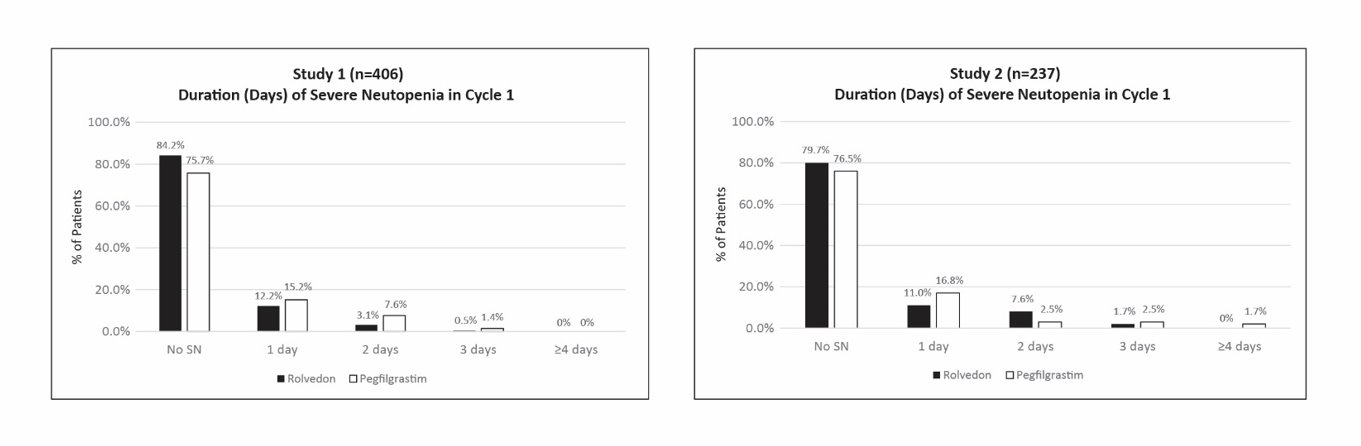
ADVERSE REACTIONS The following clinically significant adverse reactions are discussed in greater detail in other sections of the labeling: • Splenic rupture [see Warnings and Precautions ( 5.1 )] • Acute respiratory distress syndrome [see Warnings and Precautions ( 5.2 )] • Serious allergic reactions [see Warnings and Precautions ( 5.3 )] • Sickle cell crisis in patients with sickle cell disorders [see Warnings and Precautions ( 5.4 )] • Glomerulonephritis [see Warnings and Precautions ( 5.5 )] • Leukocytosis [see Warnings and Precautions ( 5.6 )] • Thrombocytopenia [see Warnings and Precautions ( 5.7 )] • Capillary leak syndrome [see Warnings and Precautions ( 5.8 )] • Potential for tumor growth stimulatory effects on malignant cells [see Warnings and Precautions ( 5.9 )] • Myelodysplastic Syndrome (MDS) and Acute Myeloid Leukemia (AML) in Patients with Breast and Lung Cancer [see Warnings and Precautions ( 5.10 )] • Aortitis [see Warnings and Precautions ( 5.11 )] • Nuclear Imaging [see Warnings and Precautions ( 5.12 )] The most common adverse reactions (≥20%) are fatigue, nausea, diarrhea, bone pain, headache, pyrexia, anemia, rash, myalgia, arthralgia, and back pain. ( 6.1 ) To report SUSPECTED ADVERSE REACTIONS, contact Spectrum Pharmaceuticals, Inc. at 1-888-713-0688 or FDA at 1-800-FDA-1088 or www.fda.gov/medwatch 6.1 Clinical Trials Experience Because clinical trials are conducted under widely varying conditions, adverse reaction rates observed in the clinical trials of a drug cannot be directly compared to rates in the clinical trials of another drug and may not reflect the rates observed in clinical practice. The safety of Rolvedon was evaluated in Study 1 and Study 2 [see Clinical Studies ( 14 )]. Patients with early-stage breast cancer received Rolvedon 13.2 mg by subcutaneous injection (n=314) or pegfilgrastim 6 mg by subcutaneous injection (n=326) on Day 2 of each cycle after docetaxel 75 mg/m 2 and cyclophosphamide 600 mg/m 2 (TC) chemotherapy. Among patients receiving Rolvedon, a total of 272 patients received four 21-day treatment cycles. The most common adverse reactions (≥20%) were fatigue, nausea, diarrhea, bone pain, headache, pyrexia, anemia, rash, myalgia, arthralgia, and back pain. Table 1 summarizes the adverse reactions that occurred in Studies 1 and 2. Table 1. Common Adverse Reactions with a Frequency of ≥10% Through Week 14 in Patients with Early-Stage Breast Cancer in Study 1 and Study 2 Adverse Reaction Rolvedon (N = 314) % Pegfilgrastim** (N=326) % *Grouped Terms **Study 1 and Study 2 were not designed to evaluate meaningful comparisons of the incidence of adverse reactions in the Rolvedon and the pegfilgrastim treatment groups. Fatigue * 181 (58%) 192 (59%) Nausea 162 (52%) 166 (51%) Diarrhea 125 (40%) 126 (39%) Bone pain 119 (38%) 121 (37%) Headache * 92 (29%) 90 (28%) Pyrexia * 87 (28%) 84 (26%) Anemia * 77 (25%) 52 (16%) Rash * 77 (25%) 99 (30%) Myalgia 69 (22%) 49 (15%) Arthralgia 66 (21%) 48 (15%) Back pain * 63 (20%) 55 (17%) Decreased appetite 61 (19%) 50 (15%) Peripheral edema * 57 (18%) 53 (16%) Abdominal pain * 53 (17%) 67 (21%) Dizziness * 50 (16%) 38 (12%) Dyspnea * 49 (16%) 44 (13%) Cough * 48 (15%) 51 (16%) Thrombocytopenia * 44 (14%) 17 (5%) Pain 37 (12%) 42 (13%) Pain in extremity 36 (11%) 42 (13%) Local administration reactions * 34 (11%) 27 (8%) Flushing 32 (10%) 27 (8%) Permanent discontinuation due to an adverse reaction occurred in 4% of patients who received Rolvedon. The adverse reaction requiring permanent discontinuation in 3 patients who received Rolvedon was rash.
Mechanism of action
Mechanism of Action Eflapegrastim-xnst is a recombinant human granulocyte growth factor that binds to G-CSF receptors on myeloid progenitor cells and neutrophils, triggering signaling pathways that control cell differentiation, proliferation, migration and survival.
NDC examples
82497-13276961-101
Indicated ICD-10 codes
Source: openFDA + RxNorm · 2026
Look up another medication