Lidocaine Hydrochloride and Dextrose
Managing this medication for someone you care for? Eleplan keeps diagnoses, medications and appointments in one plan.
Start free with EleplanMedication reference
Lidocaine Hydrochloride and Dextrose
INTRAVENOUS
Lidocaine Hydrochloride and Dextrose. Lidocaine hydrochloride administered intravenously is specifically indicated in the acute management of (1) ventricular arrhythmias occurring during…
Brand names
LIDOCAINE HYDROCHLORIDE AND DEXTROSE
Active ingredients
LIDOCAINE HYDROCHLORIDE
Indications
Lidocaine hydrochloride administered intravenously is specifically indicated in the acute management of (1) ventricular arrhythmias occurring during cardiac manipulations, such as cardiac surgery and (2) life-threatening arrhythmias which are ventricular in origin, such as occur during acute myocardial infarction.
Dosage
Therapy of ventricular arrhythmias is often initiated with a single IV bolus of 1.0 to 1.5 mg/kg at a rate of 25 to 50 mg/min. of lidocaine hydrochloride injection. Following acute treatment by bolus in patients in whom arrhythmias tend to recur and who are incapable of receiving oral antiarrhythmic agents, intravenous infusion of Lidocaine Hydrochloride and 5% Dextrose Injection, USP is administered continuously at the rate of 1 to 4 mg/min (0.020 to 0.050 mg/kg/min in the average 70 kg adult). The 0.4% solution (4 mg/mL) can be given at a rate of 15 to 60 mL/hr (0.25 to 1 mL/min). The 0.8% solution (8 mg/mL) can be given at a rate of 7.5 to 30 mL/hr (0.12 to 0.5 mL/min). Precise dosage regimen is determined by patient characteristics and response. Infusion rate should be reduced by approximately one-half to compensate for decreased rate of clearance after prolonged infusion (24 hours) (see Clinical Pharmacology). Failure to adjust the rate of infusion in keeping with this altered ability to eliminate lidocaine may result in toxic accumulation of the drug in the patient’s serum. Intravenous infusions of lidocaine hydrochloride must be administered under constant ECG monitoring to avoid potential overdosage and toxicity. Intravenous infusion should be terminated as soon as the patient’s basic cardiac rhythm appears to be stable or at the earliest signs of toxicity (see OVERDOSAGE). It should rarely be necessary to continue intravenous infusions beyond 24 hours. As soon as possible and when indicated, patients should be changed to an oral antiarrhythmic agent for maintenance therapy. Caution: When administering lidocaine hydrochloride by continuous infusion, it is advisable to closely monitor the infusion rate. Administer Lidocaine Hydrochloride and 5% Dextrose Injection, USP only with a calibrated infusion device. Pediatric: Clinical studies to establish pediatric dosing schedules have not been conducted. The usual dosage is a bolus dose of 1 mg/kg followed by an infusion rate of 20 mcg to 50 mcg/kg/min. The bolus dose should be repeated if infusion is not initiated within 15 minutes of the initial bolus dose. Hepatic impairment is likely to decrease clearance and increase exposure level of lidocaine. Administer lidocaine at lower maintenance infusion rate with close monitoring of toxicity in patients with hepatic impairment. Renal Impairment: In patients with severe renal impairment (eGFR less than 30 mL/min/1.73 m2), administer lidocaine at lower maintenance infusion rate with close monitoring of toxicity. Lidocaine is incompatible with the following due to precipitate formation (includes but is not limited to): • Amphotericin • Cephazolin sodium • Phenytoin sodium Parenteral drug products should be inspected visually for particulate matter and discoloration prior to administration whenever solution and container permit. Do not administer unless solution is clear, the seal is intact, and the container is undamaged. Some opacity of the container plastic due to moisture absorption during the sterilization process may be observed. This is normal and does not affect solution quality or safety. The opacity will diminish gradually. Use of a final filter is recommended during administration of all parenteral solutions, where possible. Lidocaine must not be infused simultaneously through the same tubing with other medicinal products without first verifying their compatibility. Set the vent to the close position on a vented intravenous administration set to prevent air embolism. All injections in VIAFLEX Plus plastic containers are intended for intravenous administration using sterile equipment. Because dosages of this drug are titrated to response, no additives should be made to Lidocaine Hydrochloride and 5% Dextrose Injection, USP.
Warnings
Constant monitoring with an electrocardiograph is essential to the administration of lidocaine hydrochloride intravenously. Signs of excessive depression of cardiac conductivity, such as prolongation of the PR interval, widening of the QRS interval and the appearance or aggravation of arrhythmias, should be followed by prompt cessation of the intravenous infusion of this agent. It is mandatory to have emergency resuscitative equipment and drugs immediately available to manage adverse reactions involving cardiovascular, respiratory, or central nervous systems. Central nervous system adverse reactions are associated with venous plasma levels above 6.0 μg free base per mL (see ADVERSE REACTIONS). Hypersensitivity, including anaphylaxis, has been reported with lidocaine-containing solutions. Stop the infusion immediately if signs of hypersensitivity develop. Acceleration of ventricular rate may occur in patients with atrial fibrillation or flutter treated with lidocaine. In patients with sinus bradycardia or incomplete heart block, the administration of lidocaine hydrochloride intravenously for the elimination of ventricular ectopic beats without prior acceleration in heart r ate (e.g., by isoproterenol or by electric pacing) may promote more frequent and serious ventricular arrhythmias or complete heart block (see Contraindications). Because lidocaine is metabolized mainly in the liver and excreted by the kidneys, patients with renal or hepatic insufficiency may be at increased risk for toxicity.
Contraindications
Hypersensitivity reactions, including anaphylactic reactions, have been reported with lidocaine. Lidocaine hydrochloride is contraindicated in patients with a history of hypersensitivity to local anesthetics of the amide type. Lidocaine is contraindicated in patients with Stokes-Adams syndrome, Wolff-Parkinson-White syndrome, or with severe degrees of sinoatrial, atrioventricular, or intraventricular block.
Adverse reactions
Systemic reactions of the following types have been reported: Nervous System Disorders: respiratory depression and arrest; unconsciousness; convulsions; tremors; twitching; vomiting; blurred or double vision; drowsiness; dizziness; light-headedness; tinnitus; sensation of heat, cold or numbness; euphoria; apprehension; agitation; confused state; paresthesia; dysarthria. Cardiovascular System: cardiovascular arrest; bradycardia which may lead to cardiac arrest; hypotension, Ventricular fibrillation, Ventricular tachycardia, Ventricular arrhythmia, Asystole. Gastrointestinal Disorders: Hypoesthesia oral, Nausea, Hematologic Effects: methemoglobinemia. Psychiatric Disorders: Disorientation Allergic reactions, including anaphylactic reactions, may occur but are infrequent. There have been no reports of cross sensitivity between lidocaine hydrochloride and procainamide or between lidocaine hydrochloride and quinidine.
Mechanism of action
Mechanism of Action Lidocaine hydrochloride exerts an antiarrhythmic effect by increasing the electrical stimulation threshold of the ventricle during diastole. In usual therapeutic doses, lidocaine hydrochloride produces no change in myocardial contractility, in systemic arterial pressure, or in absolute refractory period. Central nervous system adverse reactions become apparent with increasing venous plasma levels above 6.0 μg free base per mL. Pharmacokinetics The plasma protein binding of lidocaine is dependent on drug concentration, and the fraction bound decreases with increasing concentration. At concentrations of 1 to 4 micrograms of free base per milliliter 60 to 80 percent of lidocaine is protein bound. Binding is also dependent on the plasma concentration of alpha-1-acid glycoprotein. Lidocaine crosses the blood-brain and placental barriers, presumably by passive diffusion. Approximately 90% of lidocaine administered is excreted in the form of various metabolites, and less than 10% is excreted unchanged. Biotransformation includes oxidative N-dealkylation, ring hydroxylation, cleavage of the amide linkage, and conjugation. CYP1A2 and CYP3A4 mediated N-dealkylation, a major pathway of biotransformation, yields the metabolites monoethyl glycine xylidide (MEGX) and glycine xylidide (GX). The pharmacological/toxicological actions of these metabolites are similar to, but less potent than, those of lidocaine. The primary metabolite in urine is a conjugate of 4-hydroxy-2,6-dimethylaniline. The elimination half-life of lidocaine following an intravenous bolus injection is typically 1.5 to 2.0 hours. Specific Populations Hepatic Impairment Because of the rapid rate at which lidocaine is metabolized, any condition that affects liver function may alter lidocaine kinetics. The half-life may be prolonged two-fold or more in patients with liver dysfunction. Renal Impairment Mild or moderate renal impairment does not affect lidocaine kinetics; while in patients with severe renal dysfunction, lidocaine clearance is decreased by half and the accumulation of GX increased 1.5-fold. Lidocaine toxicity is related to systemic blood levels. The decreased clearance and longer half-life of lidocaine should be taken into consideration with prolonged (24 hour) infusions. Constant rate of infusion may result in toxic accumulation of lidocaine.
NDC examples
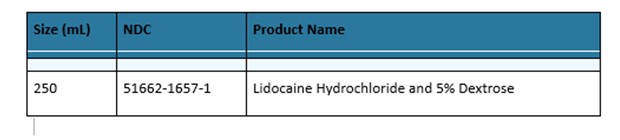
51662-1657
Treats these conditions
Source: openFDA + RxNorm · 2026
Look up another medication