Flutemetamol
Managing this medication for someone you care for? Eleplan keeps diagnoses, medications and appointments in one plan.
Start free with EleplanMedication reference
Flutemetamol
Radioactive Diagnostic Agent [EPC] — INTRAVENOUS
Flutemetamol — Radioactive Diagnostic Agent [EPC]. INDICATIONS AND USAGE VIZAMYL is indicated for positron emission tomography (PET) of the brain to estimate amyloid beta neuritic plaque density in…
Brand names
Vizamyl
Active ingredients
FLUTEMETAMOL F-18
Indications
INDICATIONS AND USAGE VIZAMYL is indicated for positron emission tomography (PET) of the brain to estimate amyloid beta neuritic plaque density in adults with cognitive impairment for: Evaluation of Alzheimer's disease (AD) and other causes of cognitive decline Selection of patients who are indicated for amyloid beta-directed therapy as described in the prescribing information of the therapeutic products VIZAMYL is a radioactive diagnostic drug indicated for positron emission tomography (PET) of the brain to estimate amyloid beta neuritic plaque density in adults with cognitive impairment for: Evaluation of Alzheimer's disease (AD) and other causes of cognitive decline Selection of patients who are indicated for amyloid beta-directed therapy as described in the prescribing information of the therapeutic products ( 1 )
Dosage
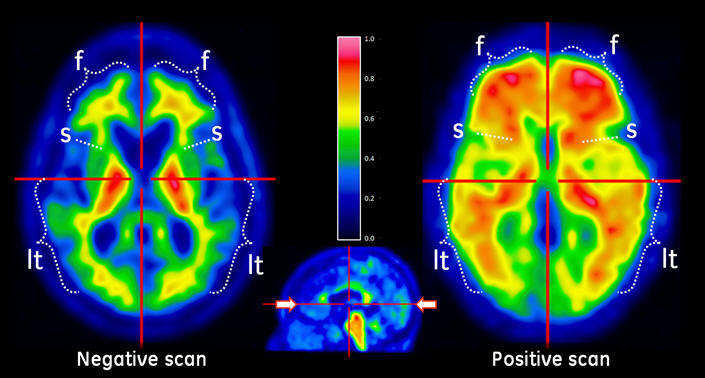
DOSAGE AND ADMINISTRATION The recommended amount of radioactivity is 185 MBq (5 mCi) administered as a single intravenous bolus within 40 seconds in a total volume of up to 10 mL. ( 2.2 ) Follow injection with an intravenous flush of 5 mL to 15 mL of 0.9% sodium chloride injection. ( 2.2 ) Obtain 10-minute to 20-minute PET images starting approximately 60 minutes to 120 minutes after drug administration. ( 2.3 ) See full prescribing information for image interpretation and radiation dosimetry. ( 2.4 , 2.5 , 2.6 ) 2.1 Radiation Safety - Drug Handling Handle VIZAMYL with appropriate safety measures to minimize radiation exposure during administration [see Warnings and Precautions (5.3) ] . Use waterproof gloves and effective radiation shielding, including lead-glass syringe shields when handling and administering VIZAMYL. Radiopharmaceuticals, including VIZAMYL, should be used by or under the control of healthcare providers who are qualified by specific training and experience in the safe use and handling of radionuclides, and whose experience and training have been approved by the appropriate governmental agency authorized to license the use of radionuclides. 2.2 Recommended Dosage and Administration Instructions Recommended Dosage The recommended amount of activity of VIZAMYL is 185 MBq (5 mCi) in a total volume of up to 10 mL, administered as a single intravenous bolus within 40 seconds. The maximum mass dose is 20 mcg. Follow the injection with an intravenous flush of 5 mL to 15 mL of 0.9% sodium chloride injection. Patient Preparation Instruct patients to hydrate before and after VIZAMYL administration and to void frequently following VIZAMYL administration to reduce radiation exposure [see Warnings and Precautions (5.3) ] . Administration Use aseptic technique and radiation shielding to withdraw and administer VIZAMYL. Visually inspect VIZAMYL for particulate matter and discoloration prior to administration. Do not use VIZAMYL if it contains particulate matter or if it is discolored. Do not dilute VIZAMYL. Calculate the necessary volume to administer based on calibration time and required dose. Measure the activity of VIZAMYL with a dose calibrator immediately prior to administration to the patient. Dispose of unused product in a safe manner in compliance with applicable regulations. 2.3 Image Acquisition Instructions Position the patient supine with the head positioned to center the brain, including the cerebellum, within a single field of view. The patient's head should be tilted so that the anterior commissure-posterior commissure (AC-PC) plane is at right angles to the bore-axis of the PET scanner, with the head positioned in a suitable head support. Tape or other flexible head restraints may be employed to reduce head movement. Acquire 10-minute to 20-minute PET images starting 60 minutes to 120 minutes after VIZAMYL administration using a PET scanner in 3-D mode with appropriate data corrections. Iterative or filtered back-projection reconstruction is recommended with a slice thickness of 2 mm to 4 mm, and matrix size of 128 × 128 with pixel sizes of approximately 2 mm. Where a post-smoothing filter is applied, full width at half maximum (FWHM) of not more than 5 mm is recommended; filter FWHM should be chosen to optimize the signal-to-noise ratio while preserving the sharpness of the reconstructed image. 2.4 Image Orientation and Display Image Orientation Orient axial and coronal images to show symmetry of brain structures, with equal heights of structures bilaterally. Orient sagittal images so that the head and neck are neither flexed nor extended; the anterior and posterior aspects of the corpus callosum should be parallel to the AC-PC line as shown in Figure 2. Image Display Display images with all planes (axial, sagittal, and coronal planes) linked by crosshairs. Select a color scale that provides a progression of low through high intensity (e.g., rainbow or Sokoloff). The selected color scale should: (1) provide colors that allow the reader to discriminate signal intensity above and below the signal intensity of the pons; (2) provide a color for regions with little or no amyloid binding such as the cerebellar cortex; and (3) provide a range of at least five distinct colors above 50% to 60% of the peak signal intensity. Display the reference scale. Adjust the color scale to set the pons to approximately 90% maximum signal intensity. The cerebellar cortex should represent approximately 20% to 30% of peak signal intensity on both negative and positive VIZAMYL scans. Display axial brain slices sequentially from the bottom of the brain to the top and look for signs of atrophy. Systematically review signal intensity in the following brain regions (recommended plane) for image interpretation [see Dosage and Administration (2.5) ] : Frontal lobes (axial, with optional sagittal plane view) Posterior cingulate and precuneus (sagittal, with optional coronal plane view) Lateral temporal lobes (axial, with optional coronal plane view) Inferolateral parietal lobes (coronal, with optional axial plane view) Striatum (axial, with optional sagittal plane view) 2.5 Image Interpretation Visual Assessment VIZAMYL images should be interpreted only by readers who successfully complete the training program provided by the manufacturer [see Warnings and Precautions (5.2) ] . Perform image interpretation independently of the patient's clinical features, relying on the recognition of unique image features. Interpret VIZAMYL images based upon the distribution of signal intensity within the cerebral cortex by comparing the signal intensity in the cortical gray matter and the adjacent white matter, or based on the signal intensity in the five regions mentioned above [see Dosage and Administration (2.4) ] . The signal intensity in the cerebellum does not contribute to scan interpretation. For example, a positive scan may show retained cerebellar gray-white contrast even when the cortical gray-white contrast is lost. Among patients with clinically important amyloid beta neuritic plaques in the brain, the temporal lobes, parietal lobes, and striatum may not be as affected compared to other brain regions. Therefore, in some images, the signal in these regions may not be as intense as in the frontal lobes or the posterior cingulate and precuneus regions. Some scans may be difficult to interpret due to image noise, suboptimal patient positioning, or over-smoothing of the reconstructed image. Atrophy may affect the interpretability of scans, particularly in the frontal, temporal, and parietal lobes. Other factors that may affect the ability to interpret VIZAMYL images include patient factors such as brain pathology, surgical changes, post-radiation therapy changes, and implants. For cases in which atrophy is apparent or suspected and there is uncertainty as to the location of the gray matter on the PET scan, examine the striatum for VIZAMYL signal as it is less affected by atrophy than other regions of the brain. If the patient's MRI or CT brain images are available, examine the CT or MRI images to clarify the relationship between VIZAMYL signal and gray matter anatomy [see Warnings and Precautions (5.2) ] . Negative VIZAMYL Scan Negative scans show more signal in white matter than in gray matter, creating clear gray-white matter contrast. Specifically, a negative scan would have the following characteristics: frontal, lateral temporal, and inferolateral parietal lobes: gradual gradient from bright intensity of the white matter to lower intensity at the periphery of the brain; distinct sulci with concave surfaces (white matter sulcal pattern), and posterior cingulate and precuneus: gray matter uptake below 50% to 60% of peak intensity; gap of lower intensity separates two hemispheres on coronal view, and striatum: approximately 50% of peak intensity or lower in the region between the higher intensities of the thalamus and frontal white matter (striatal "gap"). A negati
Warnings
WARNINGS AND PRECAUTIONS Anaphylaxis and Other Serious Hypersensitivity Reactions: Always have emergency resuscitation equipment and trained personnel available at the time of VIZAMYL administration. ( 5.1 ) Risk of Image Misinterpretation and Other Errors: Image interpretation errors have been observed. ( 5.2 ) Radiation Risk: VIZAMYL contributes to a patient's long-term cumulative radiation exposure. Ensure safe drug handling to protect patients and health care providers from unintentional radiation exposure. Advise patients to hydrate before and after administration and to void frequently after administration. ( 2.1 , 2.2 , 5.3 ) 5.1 Anaphylaxis and Other Serious Hypersensitivity Reactions Serious hypersensitivity reactions including anaphylaxis, presenting with flushing, dyspnea, and hypotension, have been observed within minutes following VIZAMYL administration. These reactions may occur in patients with no history of exposure to VIZAMYL [see Adverse Reactions (6.1 , 6.2) ] . Obtain a history of allergy or hypersensitivity reactions. Always have resuscitation equipment and trained personnel immediately available at the time of VIZAMYL administration. If a hypersensitivity reaction is suspected, immediately discontinue the injection and initiate appropriate therapy. VIZAMYL is contraindicated in patients with a history of hypersensitivity to VIZAMYL or polysorbate 80 [see Contraindications (4) ] . 5.2 Risk of Image Misinterpretation and Other Errors Errors may occur in the estimation of amyloid beta neuritic plaque density during VIZAMYL image interpretation [see Clinical Studies (14) ] . The use of clinical information in the interpretation of VIZAMYL images has not been evaluated and may lead to an inaccurate assessment. Extensive brain atrophy and motion artifacts that distort the image may limit the ability to distinguish gray and white matter on a VIZAMYL scan. Perform image interpretation independently of the patient's clinical information. For cases where there is uncertainty as to the location of cortical signal, use co-registered anatomical imaging to improve localization of signal or examine the striatum for VIZAMYL signal as it is less affected by atrophy [see Dosage and Administration (2.5) ] . 5.3 Radiation Risk VIZAMYL contributes to a patient's overall long-term cumulative radiation exposure. Long-term cumulative radiation exposure is associated with an increased risk of cancer. Ensure safe drug handling to protect patients and health care providers from unintentional radiation exposure. Advise patients to hydrate before and after administration and to void frequently after administration [see Dosage and Administration (2.1 , 2.2) ] .
Contraindications
CONTRAINDICATIONS VIZAMYL is contraindicated in patients with a history of hypersensitivity reaction to VIZAMYL or polysorbate 80 [see Warnings and Precautions (5.1) ] . Known hypersensitivity to VIZAMYL or polysorbate 80 ( 4 )
Adverse reactions
ADVERSE REACTIONS The following clinically significant adverse reaction is described elsewhere in the labeling: Hypersensitivity Reactions [see Warnings and Precautions (5.1) ] Most common adverse reactions (incidence ≥ 1%) were flushing, increased blood pressure, headache, nausea, and dizziness. ( 6.1 ) To report SUSPECTED ADVERSE REACTIONS, contact GE HealthCare at 1-800-654-0118 or FDA at 1-800-FDA-1088 or www.fda.gov/medwatch. 6.1 Clinical Trials Experience Because clinical trials are conducted under widely varying conditions, adverse reaction rates observed in the clinical trials of a drug cannot be directly compared to rates in the clinical trials of another drug and may not reflect the rates observed in clinical practice. The safety of VIZAMYL was evaluated in 761 adult subjects who received VIZAMYL by intravenous injection in clinical trials. Most subjects (70%) received a dose of 185 MBq (5 mCi). The subjects had a mean age of 62 years (range 18 years to 93 years); 45% of the subjects were male and 91% were White. A serious hypersensitivity reaction characterized by flushing, dyspnea, and chest pressure was reported within minutes following VIZAMYL administration in one subject who recovered with treatment. Adverse reactions reported in ≥ 1% of subjects from the clinical trials are shown in Table 2. Table 2: Adverse Reactions Reported in ≥ 1% of Adult Subjects Who Received VIZAMYL in Clinical Trials Adverse Reaction VIZAMYL N=761 % Flushing 2 Increased blood pressure 2 Headache 1 Nausea 1 Dizziness 1 6.2 Postmarketing Experience The following adverse reactions have been identified during postapproval use of VIZAMYL. Because these reactions are reported voluntarily from a population of uncertain size, it is not always possible to reliably estimate their frequency or establish a causal relationship to drug exposure. Immune system disorders : anaphylactic reactions
Mechanism of action
Mechanism of Action Flutemetamol F 18 binds to amyloid beta plaques in the brain and the F 18 isotope produces a positron signal that is detected by a PET scanner. In in vitro binding studies using postmortem human brain homogenates containing fibrillar amyloid beta, the dissociation constant (Kd) for flutemetamol was 6.7 nM. Selectivity of 3 H-flutemetamol binding in postmortem human brain sections was demonstrated using autoradiography, silver-stained protein, and immunohistochemistry (monoclonal antibody to amyloid beta) correlation studies.
NDC examples
17156-067
Indicated ICD-10 codes
Treats these conditions
Assistance programs
Alzheimer’s Adult Day Services ProgramAlzheimer’s Day Care Resource CentersAlzheimer's Disease Demonstration Grants to StatesAlzheimer’s Disease Program Initiative (ADPI)Connecticut’s National Family Caregiver Support ProgramMassachusetts Caregiver Family Services ProgramMassachusetts Home Care ProgramTennessee Respite Care ProgramWisconsin Alzheimer’s Family Caregiver Support ProgramAlzheimer’s Care and SupportAlzheimer’s Disease Education and Referral Center (ADEAR)Alzheimer’s Disease & Other Memory Disorders Program
Source: openFDA + RxNorm · 2026
Look up another medication