Entacapone
Managing this medication for someone you care for? Eleplan keeps diagnoses, medications and appointments in one plan.
Start free with EleplanMedication reference
Entacapone
Catechol-O-Methyltransferase Inhibitor [EPC] — ORAL
Entacapone — Catechol-O-Methyltransferase Inhibitor [EPC]. INDICATIONS Entacapone tablets, USP are indicated as an adjunct to levodopa and carbidopa to treat end-of-dose “wearing-off” in patients with…
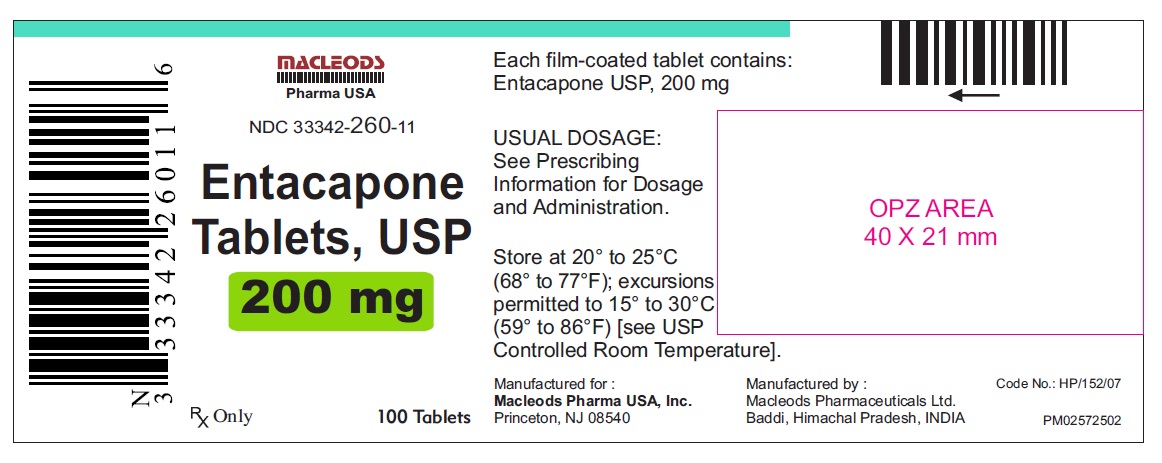
Brand names
EntacaponeENTACAPONE
Active ingredients
ENTACAPONE
Indications
INDICATIONS Entacapone tablets, USP are indicated as an adjunct to levodopa and carbidopa to treat end-of-dose “wearing-off” in patients with Parkinson’s disease (see CLINICAL PHARMACOLOGY, Clinical Studies ). Entacapone tablets, USP effectiveness has not been systematically evaluated in patients with Parkinson’s disease who do not experience end-of-dose “wearing-off”.
Dosage
DOSAGE AND ADMINISTRATION The recommended dose of Entacapone Tablets is one 200 mg tablet administered concomitantly with each levodopa and carbidopa dose to a maximum of 8 times daily (200 mg x 8 = 1,600 mg per day). Clinical experience with daily doses above 1,600 mg is limited. Entacapone Tablets should always be administered in association with levodopa and carbidopa. Entacapone has no antiparkinsonian effect of its own. In clinical studies, the majority of patients required a decrease in daily levodopa dose if their daily dose of levodopa had been greater than or equal to 800 mg or if patients had moderate or severe dyskinesia before beginning treatment. To optimize an individual patient’s response, reductions in daily levodopa dose or extending the interval between doses may be necessary. In clinical studies, the average reduction in daily levodopa dose was about 25% in those patients requiring a levodopa dose reduction (more than 58% of patients with levodopa doses above 800 mg daily required such a reduction). Entacapone Tablets can be combined with both the immediate and sustained-release formulations of levodopa and carbidopa. Entacapone Tablets may be taken with or without food (see CLINICAL PHARMACOLOGY). Patients With Impaired Hepatic Function : Patients with hepatic impairment should be treated with caution. The AUC and C max of entacapone approximately doubled in patients with documented liver disease, compared to controls. However, these studies were conducted with single-dose entacapone without levodopa and dopa decarboxylase inhibitor coadministration, and therefore the effects of liver disease on the kinetics of chronically administered entacapone have not been evaluated (see CLINICAL PHARMACOLOGY, Pharmacokinetics of Entacapone). Withdrawing Patients from Entacapone Tablets: Rapid withdrawal or abrupt reduction in the Entacapone Tablets dose could lead to emergence of signs and symptoms of Parkinson’s disease (see CLINICAL PHARMACOLOGY, Clinical Studies), and may lead to hyperpyrexia and confusion, a symptom complex resembling NMS (see PRECAUTIONS, Other Events Reported With Dopaminergic Therapy). This syndrome should be considered in the differential diagnosis for any patient who develops a high fever or severe rigidity. If a decision is made to discontinue treatment with Entacapone Tablets, patients should be monitored closely and other dopaminergic treatments should be adjusted as needed. Although tapering Entacapone Tablets have not been systematically evaluated, it seems prudent to withdraw patients slowly if the decision to discontinue treatment is made.
Warnings
WARNINGS Monoamine oxidase (MAO) and COMT are the two major enzyme systems involved in the metabolism of catecholamines. It is theoretically possible, therefore, that the combination of entacapone tablets and a non-selective MAO inhibitor (e.g., phenelzine and tranylcypromine) would result in inhibition of the majority of the pathways responsible for normal catecholamine metabolism. For this reason, patients should ordinarily not be treated concomitantly with entacapone tablets and a non-selective MAO inhibitor. Entacapone can be taken concomitantly with a selective MAO-B inhibitor (e.g., selegiline). Drugs Metabolized By Catechol-O-Methyltransferase (COMT) When a single 400 mg dose of entacapone was given with intravenous isoprenaline (isoproterenol) and epinephrine without coadministered levodopa and dopa decarboxylase inhibitor, the overall mean maximal changes in heart rate during infusion were about 50% and 80% higher than with placebo, for isoprenaline and epinephrine, respectively. Therefore, drugs known to be metabolized by COMT, such as isoproterenol, epinephrine, norepinephrine, dopamine, dobutamine, alpha-methyldopa, apomorphine, isoetherine, and bitolterol should be administered with caution in patients receiving entacapone regardless of the route of administration (including inhalation), as their interaction may result in increased heart rates, possible arrhythmias, and excessive changes in blood pressure. Ventricular tachycardia was noted in one 32-year-old healthy male volunteer in an interaction study after epinephrine infusion and oral entacapone administration. Treatment with propranolol was required. A causal relationship to entacapone administration appears probable but cannot be attributed with certainty. Falling Asleep During Activities of Daily Living and Somnolence Patients with Parkinson’s disease treated with entacapone tablets, which increases plasma levodopa levels, or with levodopa have reported suddenly falling asleep without prior warning of sleepiness while engaged in activities of daily living (including the operation of motor vehicles). Some of these episodes resulted in accidents. Although many of these patients reported somnolence while on entacapone tablets, some did not perceive warning signs, such as excessive drowsiness, and believed that they were alert immediately prior to the event. Some of these events have been reported as late as one year after initiation of treatment. The risk of somnolence was increased (entacapone 2% and placebo 0%) in controlled studies. It has been reported that falling asleep while engaged in activities of daily living always occurs in a setting of preexisting somnolence, although patients may not give such a history. For this reason, prescribers should reassess patients for drowsiness or sleepiness especially since some of the events occur well after the start of treatment. Prescribers should also be aware that patients may not acknowledge drowsiness or sleepiness until directly questioned about drowsiness or sleepiness during specific activities. Patients should be advised to exercise caution while driving, operating machines, or working at heights during treatment with entacapone tablets. Patients who have already experienced somnolence and/or an episode of sudden sleep onset should not participate in these activities during treatment with entacapone tablets. Before initiating treatment with entacapone tablets, advise patients of the potential to develop drowsiness and specifically ask about factors that may increase this risk such as concomitant use of sedating medications and the presence of sleep disorders. If a patient develops daytime sleepiness or episodes of falling asleep during activities that require active participation (e.g., conversations, eating, etc.), entacapone tablets should ordinarily be discontinued (see DOSAGE AND ADMINISTRATION for guidance on discontinuing entacapone tablets). If the decision is made to continue entacapone tablets, patients should be advised not to drive and to avoid other potentially dangerous activities. There is insufficient information to establish whether dose reduction will eliminate episodes of falling asleep while engaged in activities of daily living.
Contraindications
CONTRAINDICATIONS Entacapone tablets are contraindicated in patients who have demonstrated hypersensitivity to the drug or its ingredients.
Drug interactions
Drug Interactions In vitro studies of human CYP enzymes showed that entacapone inhibited the CYP enzymes 1A2, 2A6, 2C9, 2C19, 2D6, 2E1 and 3A only at very high concentrations (IC50 from 200 microM to over 1,000 microM; an oral 200 mg dose achieves a highest level of approximately 5 microM in people); these enzymes would therefore not be expected to be inhibited in clinical use. In an interaction study in healthy volunteers, entacapone did not significantly change the plasma levels of S-warfarin while the AUC for R-warfarin increased on average by 18% [Cl90 11% to 26%], and the INR values increased on average by 13% [Cl90 6% to 19%]. Nevertheless, cases of significantly increased INR in patients concomitantly using warfarin have been reported during the postapproval use of entacapone tablets. Therefore, monitoring of INR is recommended when entacapone treatment is initiated or when the dose is increased for patients receiving warfarin. Protein Binding Entacapone is highly protein bound (98%). In vitro studies have shown no binding displacement between entacapone and other highly bound drugs, such as warfarin, salicylic acid, phenylbutazone, and diazepam. Drugs Metabolized by Catechol-O-Methyltransferase (COMT) See WARNINGS. Hormone Levels Levodopa is known to depress prolactin secretion and increase growth hormone levels. Treatment with entacapone coadministered with levodopa and dopa decarboxylase inhibitor does not change these effects. Effect of Entacapone on the Metabolism of Other Drugs See WARNINGS regarding concomitant use of entacapone tablets and non-selective MAO inhibitors. No interaction was noted with the MAO-B inhibitor selegiline in two multiple-dose interaction studies when entacapone was coadministered with a levodopa and dopa decarboxylase inhibitor (n=29). More than 600 patients with Parkinson’s disease in clinical studies have used selegiline in combination with entacapone and levodopa and dopa decarboxylase inhibitor. As most entacapone excretion is via the bile, caution should be exercised when drugs known to interfere with biliary excretion, glucuronidation, and intestinal beta-glucuronidase are given concurrently with entacapone. These include probenecid, cholestyramine, and some antibiotics (e.g., erythromycin, rifampicin, ampicillin, and chloramphenicol). No interaction with the tricyclic antidepressant imipramine was shown in a single-dose study with entacapone without coadministered levodopa and dopa-decarboxylase inhibitor.
Adverse reactions
ADVERSE REACTIONS Because clinical studies are conducted under widely varying conditions, the incidence of adverse reactions (number of unique patients experiencing an adverse reaction associated with treatment per total number of patients treated) observed in the clinical studies of a drug cannot be directly compared to the incidence of adverse reactions in the clinical studies of another drug and may not reflect the incidence of adverse reactions observed in practice. A total of 1,450 patients with Parkinson’s disease were treated with entacapone in premarketing clinical studies. Included were patients with fluctuating symptoms, as well as those with stable responses to levodopa therapy. All patients received concomitant treatment with levodopa preparations, however, and were similar in other clinical aspects. The most commonly observed adverse reactions (incidence at least 3% greater than placebo) in double-blind, placebo-controlled studies (N=1,003) associated with the use of entacapone were: dyskinesia, urine discoloration, diarrhea, nausea, hyperkinesia, abdominal pain, vomiting, and dry mouth. Approximately 14% of the 603 patients given entacapone in the double-blind, placebo-controlled studies discontinued treatment due to adverse reactions, compared to 9% of the 400 patients who received placebo. The most frequent causes of discontinuation in decreasing order were: psychiatric disorders (2% vs. 1%), diarrhea (2% vs. 0%), dyskinesia and hyperkinesia (2% vs. 1%), nausea (2% vs. 1%), and abdominal pain (1% vs. 0%). Adverse Event Incidence in Controlled Clinical Studies Table 4 lists treatment-emergent adverse events that occurred in at least 1% of patients treated with entacapone participating in the double-blind, placebo-controlled studies and that were numerically more common in the entacapone group, compared to placebo. In these studies, either entacapone or placebo was added to levodopa and carbidopa (or levodopa and benserazide). Table 4: Summary of Patients with Adverse Events after Start of Trial Drug Administration At least 1% in Entacapone Group and Greater Than Placebo SYSTEM ORGAN CLASS Preferred term Entacapone (n = 603) % of patients Placebo (n = 400) % of patients SKIN AND APPENDAGES DISORDERS Sweating increased 2 1 MUSCULOSKELETAL SYSTEM DISORDERS Back pain 2 1 CENTRAL AND PERIPHERAL NERVOUS SYSTEM DISORDERS Dyskinesia Hyperkinesia Hypokinesia Dizziness 25 10 9 8 15 5 8 6 SPECIAL SENSES, OTHER DISORDERS Taste perversion 1 0 PSYCHIATRIC DISORDERS Anxiety Somnolence Agitation 2 2 1 1 0 0 GASTROINTESTINAL SYSTEM DISORDERS Nausea Diarrhea Abdominal pain Constipation Vomiting Mouth dry Dyspepsia Flatulence Gastritis Gastrointestinal disorders 14 10 8 6 4 3 2 2 1 1 8 4 4 4 1 0 1 0 0 0 RESPIRATORY SYSTEM DISORDERS Dyspnea 3 1 PLATELET, BLEEDING AND CLOTTING DISORDERS Purpura 2 1 URINARY SYSTEM DISORDERS Urine discoloration 10 0 BODY AS A WHOLE - GENERAL DISORDERS Back pain Fatigue Asthenia 4 6 2 2 4 1 RESISTANCE MECHANISM DISORDERS Infection bacterial 1 0 Effects of Gender and Age on Adverse Reactions No differences were noted in the rate of adverse events attributable to entacapone by age or gender. Postmarketing Reports The following spontaneous reports of adverse events temporally associated with entacapone have been identified since market introduction and are not listed in Table 4. Because these reactions are reported voluntarily from a population of unknown size, it is not always possible to reliably estimate their frequency or establish causal relationship to entacapone exposure. Hepatitis with mainly cholestatic features has been reported. To report SUSPECTED ADVERSE REACTIONS contact AvKARE, Inc. at 1-855-361-3993; email drugsafety@avkare.com ; or FDA at 1-800-FDA-1088 or www.fda.gov/medwatch .
Mechanism of action
CLINICAL PHARMACOLOGY Mechanism of Action Entacapone is a selective and reversible inhibitor of COMT. In mammals, COMT is distributed throughout various organs with the highest activities in the liver and kidney. COMT also occurs in the heart, lung, smooth and skeletal muscles, intestinal tract, reproductive organs, various glands, adipose tissue, skin, blood cells, and neuronal tissues, especially in glial cells. COMT catalyzes the transfer of the methyl group of S-adenosyl-L-methionine to the phenolic group of substrates that contain a catechol structure. Physiological substrates of COMT include dopa, catecholamines (dopamine, norepinephrine, and epinephrine) and their hydroxylated metabolites. The function of COMT is the elimination of biologically active catechols and some other hydroxylated metabolites. In the presence of a decarboxylase inhibitor, COMT becomes the major metabolizing enzyme for levodopa, catalyzing the metabolism to 3-methoxy-4-hydroxy-L-phenylalanine (3-OMD) in the brain and periphery. The mechanism of action of entacapone is believed to be through its ability to inhibit COMT and alter the plasma pharmacokinetics of levodopa. When entacapone is given in conjunction with levodopa and an aromatic amino acid decarboxylase inhibitor, such as carbidopa, plasma levels of levodopa are greater and more sustained than after administration of levodopa and an aromatic amino acid decarboxylase inhibitor alone. It is believed that at a given frequency of levodopa administration, these more sustained plasma levels of levodopa result in more constant dopaminergic stimulation in the brain, leading to greater effects on the signs and symptoms of Parkinson’s disease. The higher levodopa levels also lead to increased levodopa adverse effects, sometimes requiring a decrease in the dose of levodopa. In animals, while entacapone enters the central nervous system (CNS) to a minimal extent, it has been shown to inhibit central COMT activity. In humans, entacapone inhibits the COMT enzyme in peripheral tissues. The effects of entacapone on central COMT activity in humans have not been studied. Pharmacodynamics COMT Activity in Erythrocytes Studies in healthy volunteers have shown that entacapone reversibly inhibits human erythrocyte COMT activity after oral administration. There was a linear correlation between entacapone dose and erythrocyte COMT inhibition, the maximum inhibition being 82% following an 800 mg single dose. With a 200 mg single dose of entacapone, maximum inhibition of erythrocyte COMT activity is on average 65% with a return to baseline level within 8 hours. Effect on the Pharmacokinetics of Levodopa and its Metabolites When 200 mg entacapone is administered together with levodopa and carbidopa, it increases the area under the curve (AUC) of levodopa by approximately 35% and the elimination half-life of levodopa is prolonged from 1.3 hours to 2.4 hours. In general, the average peak levodopa plasma concentration and the time of its occurrence (T max of 1 hour) are unaffected. The onset of effect occurs after the first administration and is maintained during long-term treatment. Studies in Parkinson’s disease patients suggest that the maximal effect occurs with 200 mg entacapone. Plasma levels of 3-OMD are markedly and dose-dependently decreased by entacapone when given with levodopa and carbidopa. Pharmacokinetics of Entacapone Entacapone pharmacokinetics are linear over the dose range of 5 mg to 800 mg, and are independent of levodopa and carbidopa coadministration. The elimination of entacapone is biphasic, with an elimination half-life of 0.4 hour to 0.7 hour based on the β-phase and 2.4 hours based on the γ-phase. The γ-phase accounts for approximately 10% of the total AUC. The total body clearance after intravenous administration is 850 mL per min. After a single 200 mg dose of entacapone, the C max is approximately 1.2 mcg per mL. Absorption Entacapone is rapidly absorbed, with a T max of approximately 1 hour. The absolute bioavailability following oral administration is 35%. Food does not affect the pharmacokinetics of entacapone. Distribution The volume of distribution of entacapone at steady state after intravenous injection is small (20 L). Entacapone does not distribute widely into tissues due to its high plasma protein binding. Based on in vitro studies, the plasma protein binding of entacapone is 98% over the concentration range of 0.4 mcg per mL to 50 mcg per mL. Entacapone binds mainly to serum albumin. Metabolism and Elimination Entacapone is almost completely metabolized prior to excretion, with only a very small amount (0.2% of dose) found unchanged in urine. The main metabolic pathway is isomerization to the cis -isomer, followed by direct glucuronidation of the parent and cis -isomer; the glucuronide conjugate is inactive. After oral administration of a 14 C-labeled dose of entacapone, 10% of labeled parent and metabolite is excreted in urine and 90% in feces. Special Populations Entacapone pharmacokinetics are independent of age. No formal gender studies have been conducted. Racial representation in clinical studies was largely limited to Caucasians; therefore, no conclusions can be reached about the effect of entacapone on groups other than Caucasian. Hepatic Impairment A single 200 mg dose of entacapone, without levodopa and dopa decarboxylase inhibitor coadministration, showed approximately 2-fold higher AUC and C max values in patients with a history of alcoholism and hepatic impairment (n=10) compared to normal subjects (n=10). All patients had biopsy-proven liver cirrhosis caused by alcohol. According to Child-Pugh grading seven patients with liver disease had mild hepatic impairment and three patients had moderate hepatic impairment. As only about 10% of the entacapone dose is excreted in urine as parent compound and conjugated glucuronide, biliary excretion appears to be the major route of excretion of this drug. Consequently, entacapone should be administered with care to patients with biliary obstruction. Renal Impairment The pharmacokinetics of entacapone have been investigated after a single 200 mg entacapone dose, without levodopa and dopa decarboxylase inhibitor coadministration, in a specific renal impairment study. There were three groups: normal subjects (n=7; creatinine clearance greater than 1.12 mL per sec per 1.73 m 2 ), moderate impairment (n=10; creatinine clearance ranging from 0.6 mL per sec per 1.73 m 2 to 0.89 mL per sec per 1.73 m 2 ), and severe impairment (n=7; creatinine clearance ranging from 0.2 mL per sec per 1.73 m 2 to 0.44 mL per sec per 1.73 m 2 ). No important effects of renal function on the pharmacokinetics of entacapone were found. Drug Interactions See PRECAUTIONS, Drug Interactions . Clinical Studies The effectiveness of entacapone as an adjunct to levodopa in the treatment of Parkinson’s disease was established in three 24-week multicenter, randomized, double-blind, placebo-controlled studies in patients with Parkinson’s disease. In two of these studies, patients had motor “fluctuations”, characterized by documented periods of “On” (periods of relatively good functioning) and “Off” (periods of relatively poor functioning), despite optimum levodopa therapy. There was also a withdrawal period following 6 months of treatment. In the third study, patients were not required to have motor fluctuations. Prior to the controlled part of the studies, patients were stabilized on levodopa for 2 weeks to 4 weeks. Entacapone has not been systematically evaluated in patients who have Parkinson’s disease without motor fluctuations. In the first two studies to be described, patients were randomized to receive placebo or entacapone 200 mg administered concomitantly with each dose of levodopa and carbidopa (up to 10 times daily, but averaging 4 doses to 6 doses per day). The formal double-blind portion of both studies was 6 months long. Patients recorded the time spent in the “On” and “
Available forms (2)
NDC examples
0527-183050268-29547335-00771610-24760687-18833342-2600904-682262332-4780781-5578
Indicated ICD-10 codes
Treats these conditions
Assistance programs
Adult Day Health, Wellness & Arts CenterAABD Cash AssistanceACL Assistive TechnologyACL Assistive Technology State Grants for Protection and AdvocacyACL Centers for Independent LivingACL Independent Living State GrantsAdult Day CareAdult Day Care ServicesAdult Day HealthAdult Day Health CareAdult Day/Health Care CentersAdult Day Service
Source: openFDA + RxNorm · 2026
Look up another medication