Zanubrutinib
Managing this medication for someone you care for? Eleplan keeps diagnoses, medications and appointments in one plan.
Start free with EleplanMedication reference
Zanubrutinib
Kinase Inhibitor [EPC] — ORAL
Zanubrutinib — Kinase Inhibitor [EPC]. INDICATIONS AND USAGE BRUKINSA is a kinase inhibitor indicated for the treatment of adult patients with: Mantle cell lymphoma (MCL) who have…
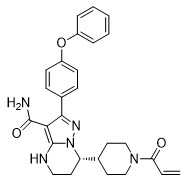
Brand names
BRUKINSA
Active ingredients
ZANUBRUTINIB
Indications
INDICATIONS AND USAGE BRUKINSA is a kinase inhibitor indicated for the treatment of adult patients with: Mantle cell lymphoma (MCL) who have received at least one prior therapy. ( 1.1 ) This indication is approved under accelerated approval based on overall response rate. Continued approval for this indication may be contingent upon verification and description of clinical benefit in a confirmatory trial. Waldenström's macroglobulinemia (WM). ( 1.2 ) Relapsed or refractory marginal zone lymphoma (MZL) who have received at least one anti–CD20-based regimen. ( 1.3 ) This indication is approved under accelerated approval based on overall response rate. Continued approval for this indication may be contingent upon verification and description of clinical benefit in a confirmatory trial. Chronic lymphocytic leukemia (CLL) or small lymphocytic lymphoma (SLL). ( 1.4 ) Relapsed or refractory follicular lymphoma (FL), in combination with obinutuzumab, after two or more lines of systemic therapy. ( 1.5 ) This indication is approved under accelerated approval based on response rate and durability of response. Continued approval for this indication may be contingent upon verification and description of clinical benefit in a confirmatory trial. 1.1 Mantle Cell Lymphoma BRUKINSA is indicated for the treatment of adult patients with mantle cell lymphoma (MCL) who have received at least one prior therapy. This indication is approved under accelerated approval based on overall response rate [see Clinical Studies (14.1) ] . Continued approval for this indication may be contingent upon verification and description of clinical benefit in a confirmatory trial. 1.2 Waldenström's Macroglobulinemia BRUKINSA is indicated for the treatment of adult patients with Waldenström's macroglobulinemia (WM) [see Clinical Studies (14.2) ] . 1.3 Marginal Zone Lymphoma BRUKINSA is indicated for the treatment of adult patients with relapsed or refractory marginal zone lymphoma (MZL) who have received at least one anti–CD20-based regimen. This indication is approved under accelerated approval based on overall response rate [see Clinical Studies (14.3) ] . Continued approval for this indication may be contingent upon verification and description of clinical benefit in a confirmatory trial. 1.4 Chronic Lymphocytic Leukemia or Small Lymphocytic Lymphoma BRUKINSA is indicated for the treatment of adult patients with chronic lymphocytic leukemia (CLL) or small lymphocytic lymphoma (SLL) [see Clinical Studies (14.4) ] . 1.5 Follicular Lymphoma BRUKINSA is indicated for the treatment of adult patients with relapsed or refractory follicular lymphoma (FL), in combination with obinutuzumab, after two or more lines of systemic therapy. This indication is approved under accelerated approval based on response rate and durability of response [see Clinical Studies (14.5) ] . Continued approval for this indication may be contingent upon verification and description of clinical benefit in a confirmatory trial.
Dosage
DOSAGE AND ADMINISTRATION Recommended dosage: 160 mg orally twice daily or 320 mg orally once daily with or without food; swallow whole with water. Tablets can be split in half as prescribed by the healthcare provider. ( 2.1 ) Reduce BRUKINSA dose in patients with severe hepatic impairment. ( 2.2 , 8.7 ) Advise patients not to open, break, or chew capsules. ( 2.1 ) Advise patients not to chew or crush tablets. ( 2.1 ) Manage toxicity using treatment interruption, dose reduction, or discontinuation. ( 2.4 ) 2.1 Recommended Dosage The recommended dosage of BRUKINSA for monotherapy or in combination with obinutuzumab is 160 mg taken orally twice daily or 320 mg taken orally once daily until disease progression or unacceptable toxicity. Capsule Administration Instructions Administer BRUKINSA capsules with or without food [see Clinical Pharmacology (12.3) ] . Advise patients to swallow capsules whole with water and not to open, break, or chew capsules. Tablet Administration Instructions Administer BRUKINSA tablets with or without food [see Clinical Pharmacology (12.3) ] . Advise patients to swallow tablets whole with water and not to chew or crush the tablets. The tablets can be split in half as prescribed by the healthcare provider. Missed Dose If a dose of BRUKINSA is missed, it should be taken as soon as possible on the same day with a return to the normal schedule the following day. 2.2 Dosage Modification for Use in Hepatic Impairment The recommended dosage of BRUKINSA for patients with severe hepatic impairment (Child-Pugh class C) is 80 mg orally twice daily; no dosage modification is recommended for patients with mild or moderate hepatic impairment (Child-Pugh class A or B) [see Use in Specific Populations (8.7) and Clinical Pharmacology (12.3) ] . 2.3 Dosage Modifications for Drug Interactions Recommended dosage modifications of BRUKINSA for drug interactions are provided in Table 1 [see Drug Interactions (7.1) ] . Table 1: Dosage Modifications for Use with CYP3A Inhibitors or Inducers Coadministered Drug Recommended BRUKINSA Dosage (Starting Dose: 160 mg twice daily or 320 mg once daily) Clarithromycin 250 mg twice daily Since clarithromycin 250 mg twice daily acts as a moderate CYP3A inhibitor, it is recommended that patients be administered clarithromycin 250 mg twice daily with 80 mg BRUKINSA twice daily [see Clinical Pharmacology (12.3) ] . 80 mg twice daily Modify or interrupt zanubrutinib dose as recommended for adverse reactions [see Dosage and Administration (2.4) ] . Clarithromycin 500 mg twice daily 80 mg once daily Posaconazole suspension 100 mg once daily 80 mg twice daily Posaconazole suspension dosage higher than 100 mg once daily Posaconazole delayed-release tablets 300 mg once daily Posaconazole intravenous 300 mg once daily 80 mg once daily Other strong CYP3A inhibitor 80 mg once daily Moderate CYP3A inhibitor 80 mg twice daily Strong CYP3A inducer Avoid concomitant use. Moderate CYP3A inducer Avoid concomitant use. If these inducers cannot be avoided, increase BRUKINSA dose to 320 mg twice daily. After discontinuation of a CYP3A inhibitor or moderate CYP3A inducer, resume previous dose of BRUKINSA [see Dosage and Administration (2.1 , 2.2) and Drug Interactions (7.1) ] . 2.4 Dosage Modifications for Adverse Reactions Recommended dosage modifications of BRUKINSA for Grade 3 or higher adverse reactions are provided in Table 2. Table 2: Recommended Dosage Modifications for Adverse Reaction Adverse Reaction Adverse Reaction Occurrence Dosage Modification (Starting Dose: 160 mg twice daily or 320 mg once daily) Hematological toxicities [see Warnings and Precautions (5.3) ] Grade 3 or Grade 4 febrile neutropenia Platelet count decreased to 25,000-50,000/mm 3 with significant bleeding Neutrophil count decreased to <500/mm 3 (lasting more than 10 consecutive days) Platelet count decreased to <25,000/mm 3 (lasting more than 10 consecutive days) First Interrupt BRUKINSA Once toxicity has resolved to Grade 1 or lower or baseline: Resume at 160 mg twice daily or 320 mg once daily. Second Interrupt BRUKINSA Once toxicity has resolved to Grade 1 or lower or baseline: Resume at 80 mg twice daily or 160 mg once daily. Third Interrupt BRUKINSA Once toxicity has resolved to Grade 1 or lower or baseline: Resume at 80 mg once daily. Fourth Discontinue BRUKINSA Nonhematological toxicities [see Warnings and Precautions (5.5) and Adverse Reactions (6.1) ] Severe or life-threatening nonhematological toxicities Evaluate the benefit-risk before resuming treatment at the same dosage for Grade 4 nonhematological toxicity. First Interrupt BRUKINSA Once toxicity has resolved to Grade 1 or lower or baseline: Resume at 160 mg twice daily or 320 mg once daily. Second Interrupt BRUKINSA Once toxicity has resolved to Grade 1 or lower or baseline: Resume at 80 mg twice daily or 160 mg once daily. Third Interrupt BRUKINSA Once toxicity has resolved to Grade 1 or lower or baseline: Resume at 80 mg once daily. Fourth Discontinue BRUKINSA Asymptomatic lymphocytosis in CLL and MCL should not be regarded as an adverse reaction, and these patients should continue taking BRUKINSA. Refer to the obinutuzumab prescribing information for management of obinutuzumab toxicities.
Warnings
WARNINGS AND PRECAUTIONS Hemorrhage : Monitor for bleeding and manage appropriately. ( 5.1 ) Infections : Monitor patients for signs and symptoms of infection, including opportunistic infections, and treat as needed. ( 5.2 ) Cytopenias : Monitor complete blood counts during treatment. ( 5.3 ) Second Primary Malignancies : Other malignancies have developed including skin cancers and non-skin carcinomas. Monitor and advise patients to use sun protection. ( 5.4 ) Cardiac Arrhythmias : Monitor for signs and symptoms of arrhythmias and manage appropriately. ( 5.5 ) Hepatotoxicity, Including Drug-Induced Liver Injury : Monitor hepatic function throughout treatment. ( 5.6 ) Embryo-Fetal Toxicity : Can cause fetal harm. Advise women of the potential risk to a fetus and to use effective contraception. ( 5.7 ) 5.1 Hemorrhage Fatal and serious hemorrhage has occurred in patients with hematological malignancies treated with BRUKINSA. Grade 3 or higher hemorrhage including intracranial and gastrointestinal hemorrhage, hematuria, and hemothorax was reported in 3.8% of patients treated with BRUKINSA in clinical trials, with fatalities occurring in 0.2% of patients. Bleeding of any grade, excluding purpura and petechiae, occurred in 32% of patients. Bleeding has occurred in patients with and without concomitant antiplatelet or anticoagulation therapy. Coadministration of BRUKINSA with antiplatelet or anticoagulant medications may further increase the risk of hemorrhage. Monitor for signs and symptoms of bleeding. Discontinue BRUKINSA if intracranial hemorrhage of any grade occurs. Consider the benefit-risk of withholding BRUKINSA for 3-7 days before and after surgery depending upon the type of surgery and the risk of bleeding. 5.2 Infections Fatal and serious infections (including bacterial, viral, or fungal infections) and opportunistic infections have occurred in patients with hematological malignancies treated with BRUKINSA. Grade 3 or higher infections occurred in 26% of patients, most commonly pneumonia (7.9%), with fatal infections occurring in 3.2% of patients. Infections due to hepatitis B virus (HBV) reactivation have occurred. Consider prophylaxis for herpes simplex virus, pneumocystis jirovecii pneumonia, and other infections according to standard of care in patients who are at increased risk for infections. Monitor and evaluate patients for fever or other signs and symptoms of infection and treat appropriately. 5.3 Cytopenias Grade 3 or 4 cytopenias, including neutropenia (21%), thrombocytopenia (8%), and anemia (8%) based on laboratory measurements, developed in patients treated with BRUKINSA [see Adverse Reactions (6.1) ]. Grade 4 neutropenia occurred in 10% of patients, and Grade 4 thrombocytopenia occurred in 2.5% of patients. Monitor complete blood counts regularly during treatment and interrupt treatment, reduce the dose, or discontinue treatment as warranted [see Dosage and Administration (2.4) ] . Treat using growth factor or transfusions, as needed. 5.4 Second Primary Malignancies Second primary malignancies, including non-skin carcinoma, have occurred in 14% of patients treated with BRUKINSA. The most frequent second primary malignancy was non-melanoma skin cancers (8%), followed by other solid tumors in 7% of the patients (including melanoma in 1% of patients) and hematologic malignancies (0.7%). Advise patients to use sun protection and monitor patients for the development of second primary malignancies. 5.5 Cardiac Arrhythmias Serious cardiac arrhythmias have occurred in patients treated with BRUKINSA. Atrial fibrillation and atrial flutter were reported in 4.4% of patients treated with BRUKINSA, including Grade 3 or higher cases in 1.9% of patients. Patients with cardiac risk factors, hypertension, and acute infections may be at increased risk. Grade 3 or higher ventricular arrhythmias were reported in 0.3% of patients. Monitor for signs and symptoms of cardiac arrhythmias (e.g., palpitations, dizziness, syncope, dyspnea, chest discomfort), manage appropriately [see Dosage and Administration (2.4) ] , and consider the risks and benefits of continued BRUKINSA treatment. 5.6 Hepatotoxicity, Including Drug-Induced Liver Injury Hepatotoxicity, including severe, life-threatening, and potentially fatal cases of drug-induced liver injury (DILI), has occurred in patients treated with Bruton tyrosine kinase inhibitors, including BRUKINSA. Evaluate bilirubin and transaminases at baseline and throughout treatment with BRUKINSA. For patients who develop abnormal liver tests after BRUKINSA, monitor more frequently for liver test abnormalities and clinical signs and symptoms of hepatic toxicity. If DILI is suspected, withhold BRUKINSA. Upon confirmation of DILI, discontinue BRUKINSA. 5.7 Embryo-Fetal Toxicity Based on findings in animals, BRUKINSA can cause fetal harm when administered to a pregnant woman. Administration of zanubrutinib to pregnant rats during the period of organogenesis caused embryo-fetal toxicity, including malformations at exposures that were 5 times higher than those reported in patients at the recommended dose of 160 mg twice daily. Advise women to avoid becoming pregnant while taking BRUKINSA and for 1 week after the last dose. Advise men to avoid fathering a child during treatment and for 1 week after the last dose. If this drug is used during pregnancy, or if the patient becomes pregnant while taking this drug, the patient should be apprised of the potential hazard to a fetus [see Use in Specific Populations (8.1) ] .
Contraindications
CONTRAINDICATIONS None. None. ( 4 )
Drug interactions
DRUG INTERACTIONS CYP3A Inhibitors: Modify BRUKINSA dose with moderate or strong CYP3A inhibitors as described. ( 2.3 , 7.1 ) CYP3A Inducers: Avoid coadministration with strong or moderate CYP3A inducers. Dose adjustment may be recommended with moderate CYP3A inducers. ( 2.3 , 7.1 ) 7.1 Effect of Other Drugs on BRUKINSA Table 17: Drug Interactions that Affect Zanubrutinib Moderate and Strong CYP3A Inhibitors Clinical Impact Coadministration with a moderate or strong CYP3A inhibitor increases zanubrutinib C max and AUC [see Clinical Pharmacology (12.3) ] which may increase the risk of BRUKINSA toxicities. Prevention or management Reduce BRUKINSA dosage when coadministered with moderate or strong CYP3A inhibitors [see Dosage and Administration (2.3) ] . Moderate and Strong CYP3A Inducers Clinical Impact Coadministration with a moderate or strong CYP3A inducer decreases zanubrutinib C max and AUC [see Clinical Pharmacology (12.3) ] which may reduce BRUKINSA efficacy. Prevention or management Avoid coadministration of BRUKINSA with strong CYP3A inducers [see Dosage and Administration (2.3) ] . Avoid coadministration of BRUKINSA with moderate CYP3A inducers [see Dosage and Administration (2.3) ] . If these inducers cannot be avoided, increase BRUKINSA dosage to 320 mg twice daily [see Dosage and Administration (2.3) ] .
Adverse reactions
ADVERSE REACTIONS The following clinically significant adverse reactions are discussed in more detail in other sections of the labeling: Hemorrhage [see Warnings and Precautions (5.1) ] Infections [see Warnings and Precautions (5.2) ] Cytopenias [see Warnings and Precautions (5.3) ] Second Primary Malignancies [see Warnings and Precautions (5.4) ] Cardiac Arrhythmias [see Warnings and Precautions (5.5) ] Hepatotoxicity, including DILI [see Warnings and Precautions (5.6) ] The most common adverse reactions (≥30%), including laboratory abnormalities, are neutrophil count decreased, platelet count decreased, upper respiratory tract infection, hemorrhage, and musculoskeletal pain. ( 6.1 ) To report SUSPECTED ADVERSE REACTIONS, contact BeOne Medicines at 1-877-828-5596 or FDA at 1-800-FDA-1088 or www.fda.gov/medwatch . 6.1 Clinical Trials Experience Because clinical trials are conducted under widely varying conditions, adverse reaction rates observed in the clinical trials of a drug cannot be directly compared to rates in the clinical trials of another drug and may not reflect the rates observed in practice. The data in the WARNINGS AND PRECAUTIONS reflect exposure to BRUKINSA in nine monotherapy and 2 combination clinical trials, administered at 160 mg twice daily in 1608 patients and at 320 mg once daily in 121 patients. Among these 1729 patients, the median duration of exposure was 27.6 months, 78% of patients were exposed for at least 12 months, and 60% of patients were exposed for at least 24 months. In this pooled safety population, the most common adverse reactions (≥30%), including laboratory abnormalities, were neutrophil count decreased (51%), platelet count decreased (41%), upper respiratory tract infection (38%), hemorrhage (32%), and musculoskeletal pain (31%). Mantle Cell Lymphoma (MCL) The safety of BRUKINSA was evaluated in 118 patients with MCL who received at least one prior therapy in two single-arm clinical trials, BGB-3111-206 [NCT03206970] and BGB-3111-AU-003 [NCT02343120] [see Clinical Studies (14.1) ] . The median age of patients who received BRUKINSA in studies BGB-3111-206 and BGB-3111-AU-003 was 62 years (range: 34 to 86), 75% were male, 75% were Asian, 21% were White, and 94% had an ECOG performance status of 0 to 1. Patients had a median of 2 prior lines of therapy (range: 1 to 4). The BGB-3111-206 trial required a platelet count ≥75 × 10 9 /L and an absolute neutrophil count ≥1 × 10 9 /L independent of growth factor support, hepatic enzymes ≤2.5 × upper limit of normal, total bilirubin ≤1.5 × ULN. The BGB-3111-AU-003 trial required a platelet count ≥50 × 10 9 /L and an absolute neutrophil count ≥1 × 10 9 /L independent of growth factor support, hepatic enzymes ≤3 × upper limit of normal, total bilirubin ≤1.5 × ULN. Both trials required a creatinine clearance (CLcr) ≥30 mL/min. Both trials excluded patients with prior allogeneic hematopoietic stem cell transplant, exposure to a BTK inhibitor, known infection with HIV, and serologic evidence of active hepatitis B or hepatitis C infection, and patients requiring strong CYP3A inhibitors or strong CYP3A inducers. Patients received BRUKINSA 160 mg twice daily or 320 mg once daily. Among patients receiving BRUKINSA, 79% were exposed for 6 months or longer, and 68% were exposed for greater than one year. Fatal adverse reactions within 30 days of the last dose of BRUKINSA occurred in 8 (7%) of 118 patients with MCL. Fatal cases included pneumonia in 2 patients and cerebral hemorrhage in one patient. Serious adverse reactions were reported in 36 patients (31%). The most frequent serious adverse reactions that occurred were pneumonia (11%) and hemorrhage (5%). Of the 118 patients with MCL treated with BRUKINSA, 8 (7%) patients discontinued treatment due to adverse reactions in the trials. The most frequent adverse reaction leading to treatment discontinuation was pneumonia (3.4%). One (0.8%) patient experienced an adverse reaction leading to dose reduction (hepatitis B). Table 3 summarizes the adverse reactions in BGB-3111-206 and BGB-3111-AU-003. Table 3: Adverse Reactions (≥10%) in Patients Receiving BRUKINSA in BGB-3111-206 and BGB-3111-AU-003 Trials Body System Adverse Reaction Percent of Patients (N=118) All Grades % Grade 3 or Higher % Infections and infestations Upper respiratory tract infection Upper respiratory tract infection includes upper respiratory tract infection, upper respiratory tract infection viral. 39 0 Pneumonia Pneumonia includes pneumonia, pneumonia fungal, pneumonia cryptococcal, pneumonia streptococcal, atypical pneumonia, lung infection, lower respiratory tract infection, lower respiratory tract infection bacterial, lower respiratory tract infection viral. 15 10 Includes fatal adverse reaction. Urinary tract infection 11 0.8 Skin and subcutaneous tissue disorders Rash Rash includes all related terms containing rash. 36 0 Bruising Bruising includes all related terms containing bruise, bruising, contusion, ecchymosis. 14 0 Gastrointestinal disorders Diarrhea 23 0.8 Constipation 13 0 Vascular disorders Hypertension 12 3.4 Hemorrhage Hemorrhage includes all related terms containing hemorrhage, hematoma. 11 3.4 Musculoskeletal and connective tissue disorders Musculoskeletal pain Musculoskeletal pain includes musculoskeletal pain, musculoskeletal discomfort, myalgia, back pain, arthralgia, arthritis. 14 3.4 Respiratory, thoracic, and mediastinal disorders Cough 12 0 Other clinically significant adverse reactions that occurred in <10% of patients with mantle cell lymphoma include major hemorrhage (defined as ≥ Grade 3 hemorrhage or CNS hemorrhage of any grade) (5%) and headache (4.2%). Table 4: Selected Laboratory Abnormalities Based on laboratory measurements. (>20%) in Patients with MCL in Studies BGB-3111-206 and BGB-3111-AU-003 Laboratory Parameter Percent of Patients (N=118) All Grades (%) Grade 3 or 4 (%) Hematologic abnormalities Neutrophils decreased 45 20 Lymphocytosis Asymptomatic lymphocytosis is a known effect of BTK inhibition. 41 16 Platelets decreased 40 7 Hemoglobin decreased 27 6 Chemistry abnormalities Blood uric acid increased 29 2.6 ALT increased 28 0.9 Bilirubin increased 24 0.9 Waldenström's Macroglobulinemia (WM) The safety of BRUKINSA was investigated in two cohorts of Study BGB-3111-302 (ASPEN). Cohort 1 included 199 patients with MYD88 mutation ( MYD88 MUT ) WM, randomized to and treated with either BRUKINSA (101 patients) or ibrutinib (98 patients). The trial also included a non-randomized arm, Cohort 2, with 26 wild type MYD88 ( MYD88 WT ) WM patients and 2 patients with unknown MYD88 status [see Clinical Studies (14.2) ] . Among patients who received BRUKINSA, 93% were exposed for 6 months or longer, and 89% were exposed for greater than 1 year. In Cohort 1 of the ASPEN study safety population (N=101), the median age of patients who received BRUKINSA was 70 years (45-87 years old); 67% were male, 86% were White, 4% were Asian, and 10% were not reported (unknown race). In Cohort 2 of the ASPEN study safety population (N=28), the median age of patients who received BRUKINSA was 72 (39-87 years old); 50% were male, 96% were White, and 4% were not reported (unknown race). In Cohort 1, serious adverse reactions occurred in 44% of patients who received BRUKINSA. Serious adverse reactions in >2% of patients included influenza (3%), pneumonia (4%), neutropenia and neutrophil count decreased (3%), hemorrhage (4%), pyrexia (3%), and febrile neutropenia (3%). In Cohort 2, serious adverse reactions occurred in 39% of patients. Serious adverse reactions in >2 patients included pneumonia (14%). Permanent discontinuation of BRUKINSA due to an adverse reaction occurred in 2% of patients in Cohort 1 and included hemorrhage (1 patient), neutropenia and neutrophil count decreased (1 patient); in Cohort 2, permanent discontinuation of BRUKINSA due to an adverse reaction occurred in 7% of patients and included subdural hemorrhage (1 patient) and diarrhea (1
Mechanism of action
Mechanism of Action Zanubrutinib is a small-molecule inhibitor of Bruton's tyrosine kinase (BTK). Zanubrutinib forms a covalent bond with a cysteine residue in the BTK active site, leading to inhibition of BTK activity. BTK is a signaling molecule of the B-cell antigen receptor (BCR) and cytokine receptor pathways. In B-cells, BTK signaling results in activation of pathways necessary for B-cell proliferation, trafficking, chemotaxis, and adhesion. In nonclinical studies, zanubrutinib inhibited malignant B-cell proliferation and reduced tumor growth.
Available forms (4)
NDC examples
72579-01172579-122
Treats these conditions
Source: openFDA + RxNorm · 2026
Look up another medication