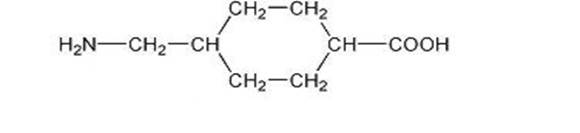
Tranexamic Acid — Antifibrinolytic Agent [EPC]. INDICATIONS AND USAGE Tranexamic acid in 0.7% sodium chloride injection is indicated in patients with hemophilia for short-term use (two to eight…
Boxed warning
WARNING: RISK OF MEDICATION ERRORS DUE TO INCORRECT ROUTE OF ADMINISTRATION Tranexamic acid injection is for intravenous use only. Serious, including fatal, adverse reactions including seizures and cardiac arrythmias have occurred when tranexamic acid injection was inadvertently administered via the neuraxial route [see Warnings and Precautions (5.1) ] . WARNING: RISK OF MEDICATION ERRORS DUE TO INCORRECT ROUTE OF ADMINISTRATION See full prescribing information for complete boxed warning. Tranexamic acid injection is for intravenous use only. Serious, including fatal, adverse reactions including seizures and cardiac arrythmias have occurred when tranexamic acid injection was inadvertently administered intrathecally via the neuraxial route. ( 5.1 )
Brand names
tranexamic acidTranexamic AcidTRANEXAMIC ACIDTranexamic Acid in Sodium ChlorideTranexamic acidTRANEXAMIC ACID IN SODIUM CHLORIDECyklokapron
INDICATIONS AND USAGE Tranexamic acid in 0.7% sodium chloride injection is indicated in patients with hemophilia for short-term use (two to eight days) to reduce or prevent hemorrhage and reduce the need for replacement therapy during and following tooth extraction. Tranexamic acid in 0.7% sodium chloride injection is an antifibrinolytic indicated in patients with hemophilia for short-term use (two to eight days) to reduce or prevent hemorrhage and reduce the need for replacement therapy during and following tooth extraction. ( 1 )
Dosage
DOSAGE AND ADMINISTRATION • Before Extraction: Administer 10 mg/kg actual body weight of tranexamic acid injection intravenously with replacement therapy as a single-dose. ( 2.1 ) • After Extraction: Administer 10 mg/kg actual body weight of tranexamic acid injection intravenously 3 to 4 times daily for 2 to 8 days. ( 2.1 ) • Infuse undiluted solution no more than 1 mL/minute to avoid hypotension. ( 2.3 ) • Reduce the dosage for patients with renal impairment. ( 2.2 , 8.6 ) 2.1 Recommended Dosage The recommended dose of tranexamic acid injection is 10 mg/kg actual body weight administered as a single intravenous dose immediately before tooth extractions. Following tooth extraction, tranexamic acid injection may be administered at a dose of 10 mg/kg actual body weight intravenously 3 to 4 times daily for 2 to 8 days . 2.2 Recommended Dosage for Patients With Varying Degrees of Renal Impairment For patients with moderate to severe impaired renal function, the following dosages are recommended: Table 1. Recommended Dosage in Patients With Varying Degrees of Renal Impairment Dose reduction is recommended for all doses, both before and after tooth extraction . Serum Creatinine (mg/dL) Tranexamic Acid Injection Dosage 1.36 mg/dL to 2.83 mg/dL 10 mg/kg intravenously twice daily 2.83 mg/dL to 5.66 mg/dL 10 mg/kg intravenously daily > 5.66 mg/dL 10 mg/kg intravenously every 48 hours or 5 mg/kg intravenously every 24 hours 2.3 Preparation and Administration Tranexamic acid injection is for intravenous administration only. Tranexamic acid injection can be administered undiluted or as a diluted solution. • Use aseptic technique to prepare tranexamic acid injection. • Parenteral drug products should be inspected visually for particulate matter and discoloration prior to administration, whenever solution and container permit. Tranexamic acid injection is a clear and colorless solution. Discard the vial if particulate matter is observed. • Calculate the dose (mg) based on the patient’s actual body weight and the total volume (mL) of tranexamic acid injection solution required. If diluting tranexamic acid injection , follow the instructions below: • From the diluent infusion bag, withdraw a volume equal to the volume of the tranexamic acid injection solution required for the patient’s dose. • Withdraw the required volume of tranexamic acid injection solution from the vial and dilute with a compatible diluent (see below) to make a final concentration of 10 mg/mL or 20 mg/mL. Discard any unused portion left in the vial. o For intravenous infusion, tranexamic acid injection may be mixed with most solutions for infusion such as electrolyte solutions, carbohydrate solutions, amino acid solutions, and Dextran solutions. o Heparin may be added to tranexamic acid injection. o Tranexamic acid injection should NOT be mixed with blood. o The drug is a synthetic amino acid and should NOT be mixed with solutions containing penicillin. • Gently invert the infusion bag to mix the diluted solution. DO NOT SHAKE. • If not used immediately, store the diluted tranexamic acid injection infusion solution at room temperature 20ºC to 25°C (68ºF to 77°F) for up to 4 hours . Administration Infuse undiluted solution no more than 1 mL/minute to avoid hypotension [see Adverse Reactions (6.2) ] . Administer the undiluted and diluted solutions intravenously according to Table 2. Table 2. Administration Rates for Undiluted and Diluted Solutions Undiluted solution Diluted solution Final concentration 100 mg/mL 10 mg/mL 20 mg/mL Administration rate 0.5 mL/minute (no more than 1 mL/minute) 5 mL/minute 2.5 mL/minute
Warnings
WARNINGS AND PRECAUTIONS Thromboembolism, including retinal occlusion, has been reported with tranexamic acid USP tablets use. Concomitant use of tranexamic acid USP tablets with combined hormonal contraceptives, Factor I X complex concentrates, anti-inhibitor coagulant concentrates or all-trans retinoic acid (oral tretinoin) may increase the risk of thrombosis. ( 5.1 ) Visual or ocular adverse reactions may occur with tranexamic acid USP tablets. Immediately discontinue use if visual or ocular symptoms occur. ( 5.1 ) In case of severe allergic reaction, discontinue tranexamic acid USP tablets and seek immediate medical attention. ( 5.2 ) Cerebral edema and cerebral infarction may be caused by use of tranexamic acid USP tablets in patients with subarachnoid hemorrhage. ( 5.3 ) Ligneous conjunctivitis has been reported in patients taking tranexamic acid. ( 5.4 ) 5.1 Thromboembolic Risk Venous and arterial thrombosis or thromboembolism, as well as cases of retinal artery and retinal vein occlusions, have been reported with tranexamic acid USP tablets. Retinal venous and arterial occlusion have been reported in patients using tranexamic acid. Patients should be instructed to report visual and ocular symptoms promptly. In the event of such symptoms, patients should be instructed to discontinue tranexamic acid USP tablets immediately and should be referred to an ophthalmologist for a complete ophthalmic evaluation, including dilated retinal examination, to exclude the possibility of retinal venous or arterial occlusion. Concomitant Use of Hormonal Contraceptives Combined hormonal contraceptives are known to increase the risk of venous thromboembolism, as well as arterial thromboses such as stroke and myocardial infarction. Because tranexamic acid USP tablets are antifibrinolytic, the risk of venous thromboembolism, as well as arterial thromboses such as stroke, may increase further when combined hormonal contraceptives are administered with tranexamic acid USP tablets. This is of particular concern in women who are obese or smoke cigarettes, especially smokers over 35 years of age. Women using combined hormonal contraception were excluded from the clinical trials supporting the safety and efficacy of tranexamic acid USP tablets, and there are no clinical trial data on the risk of thrombotic events with the concomitant use of tranexamic acid USP tablets with combined hormonal contraceptives. However, there have been US postmarketing reports of venous and arterial thrombotic events in women who have used tranexamic acid USP tablets concomitantly with combined hormonal contraceptives. For this reason, concomitant use of tranexamic acid with combined hormonal contraceptives is contraindicated [see Contraindications (4.1) and Drug Interactions (7.1) ]. Concomitant Use with Factor I X Complex Concentrates or Anti-Inhibitor Coagulant Concentrates Tranexamic acid USP tablets are not recommended in patients taking either Factor I X complex concentrates or anti-inhibitor coagulant concentrates because the risk of thrombosis may be increased [see Drug Interactions (7.3) and Clinical Pharmacology (12.3) ]. Patients with Acute Promyelocytic Leukemia Taking Concomitant All-Trans Retinoic Acid (Oral Tretinoin) Tranexamic acid USP tablets are not recommended in patients with acute promyelocytic leukemia taking all-trans retinoic acid for remission induction because of possible exacerbation of the procoagulant effect of all-trans retinoic acid [see Drug Interactions (7.4) and Clinical Pharmacology (12.3) ]. 5.2 Severe Allergic Reactions A case of severe allergic reaction to tranexamic acid USP tablets was reported in the clinical trials, involving a subject who experienced dyspnea, tightening of her throat, and facial flushing that required emergency medical treatment. A case of anaphylactic shock has also been reported in the literature, involving a patient who received an intravenous bolus of tranexamic acid. Tranexamic acid USP tablets are contraindicated in females of reproductive potential with known hypersensitivity to tranexamic acid. 5.3 Subarachnoid Hemorrhage Cerebral edema and cerebral infarction may be caused by use of tranexamic acid USP tablets in patients with subarachnoid hemorrhage. 5.4 Ligneous Conjunctivitis Ligneous conjunctivitis has been reported in patients taking tranexamic acid. The conjunctivitis resolved following cessation of tranexamic acid USP tablets.
Contraindications
CONTRAINDICATIONS • Concomitant use of combined hormonal contraceptives ( 4.1 ) • Active thromboembolic disease or a history or intrinsic risk of thrombosis or thromboembolism, including retinal vein or artery occlusion ( 4.1 ) • Hypersensitivity to tranexamic acid ( 4.2 ) 4.1 Thromboembolic Risk Tranexamic acid tablets are contraindicated in females of reproductive potential who are [see Warnings and Precautions ( 5.1 )]: • Using combined hormonal contraception • Known to have any of the following conditions: o Active thromboembolic disease (e.g., deep vein thrombosis, pulmonary embolism, or cerebral thrombosis) o A history of thrombosis or thromboembolism, including retinal vein or artery occlusion o An intrinsic risk of thrombosis or thromboembolism (e.g., thrombogenic valvular disease, thrombogenic cardiac rhythm disease, or hypercoagulopathy) 4.2 Hypersensitivity to Tranexamic Acid Tranexamic acid tablets are contraindicated in females with reproductive potential with known hypersensitivity to tranexamic acid [see Warnings and Precautions ( 5.2 ) and Adverse Reactions ( 6.1 )].
Drug interactions
DRUG INTERACTIONS No drug-drug interaction studies were conducted with tranexamic acid USP tablets. Concomitant therapy with tissue plasminogen activators may decrease the efficacy of both tranexamic acid USP tablets and tissue plasminogen activators. ( 7.2 ) 7.1 Combined Hormonal Contraceptives Because tranexamic acid USP tablets are antifibrinolytic, concomitant use of combined hormonal contraception and tranexamic acid USP tablets may increase the thrombotic risk associated with combined hormonal contraceptives. For this reason, concomitant use of tranexamic acid USP tablets with combined hormonal contraceptives is contraindicated [see Contraindications (4) and Warnings and Precautions (5.1) ] . 7.2 Tissue Plasminogen Activators Concomitant therapy with tissue plasminogen activators may decrease the efficacy of both tranexamic acid USP tablets and tissue plasminogen activators. Discontinue tranexamic acid USP tablets if a patient requires tissue plasminogen activators. 7.3 Factor I X Complex Concentrates or Anti-Inhibitor Coagulant Concentrates Tranexamic acid USP tablets are not recommended in patients taking either Factor I X complex concentrates or anti-inhibitor coagulant concentrates because the risk of thrombosis may be increased [see Warnings and Precautions (5.1) ]. 7.4 All-Trans Retinoic Acid (Oral Tretinoin) Tranexamic acid USP tablets are not recommended in patients with acute promyelocytic leukemia taking all-trans retinoic acid for remission induction because of possible exacerbation of the procoagulant effect of all-trans retinoic acid [see Warnings and Precautions (5.1) ].
Adverse reactions
ADVERSE REACTIONS Most common adverse reactions in clinical trials (≥ 5%, and more frequent in tranexamic acid USP tablets-treated subjects compared to placebo-treated subjects) are headache, sinus and nasal symptoms, back pain, abdominal pain, musculoskeletal pain, joint pain, muscle cramps, migraine, anemia and fatigue. ( 6.1 ) To report SUSPECTED ADVERSE REACTIONS, contact Nordic Pharma, Inc. at 1-844-267-4641 or FDA at 1-800-FDA-1088 or www.fda.gov/medwatch . 6.1 Clinical Trial Experience Because clinical trials are conducted under widely varying conditions, adverse reaction rates observed in the clinical trials of a drug cannot be directly compared to the rates in the clinical trials of another drug and may not reflect the rates observed in clinical practice. Adverse Reactions in Short-term Studies The safety of tranexamic acid USP tablets in the treatment of heavy menstrual bleeding in females of reproductive potential was studied in two randomized, double-blind, placebo-controlled studies [see Clinical Studies (14) ]. Study 1 compared the effects of two doses of tranexamic acid USP tablets (1950 mg and 3900 mg per day for up to 5 days during each menstrual period) versus placebo over a 3-cycle treatment duration. A total of 304 women were randomized to this study, with 115 receiving at least one dose of 3900 mg/day of tranexamic acid USP tablets. Study 2 compared the effects of tranexamic acid USP tablets (3900 mg/day) versus placebo over a 6-cycle treatment duration. A total of 196 women were randomized to this study, with 117 receiving at least one dose of tranexamic acid USP tablets. Across the studies, the combined exposure to 3900 mg/day tranexamic acid USP tablets was 947 cycles and the average duration of use was 3.4 days per cycle. In both studies, subjects were generally healthy women who had menstrual blood loss of ≥ 80 mL. In these studies, subjects were 18 to 49 years of age with a mean age of approximately 40 years, had cyclic menses every 21–35 days, and a body mass index (BMI) of approximately 32 kg/m 2 . On average, subjects had a history of heavy menstrual bleeding for approximately 10 years and 40% had fibroids as determined by transvaginal ultrasound. Approximately 70% were Caucasian, 25% were Black, and 5% were Asian, Native American, Pacific Islander, or Other. Seven percent (7%) of all subjects were of Hispanic origin. Women using hormonal contraception were excluded from the trials. A list of adverse reactions occurring in ≥ 5% of subjects and more frequently in tranexamic acid USP tablets-treated subjects receiving 3900 mg/day compared to placebo-treated subjects is provided in Table 2. Table 2. Adverse Reactions * Reported in Women with Heavy Menstrual Bleeding (Studies 1 and 2) Tranexamic acid USP tablets 3900 mg/day n (%) (N=232) Placebo n (%) (N=139) * Adverse reactions that were reported by ≥ 5% of tranexamic acid USP tablets-treated subjects and more frequently in tranexamic acid USP tablets-treated subjects compared to placebo-treated subjects a Includes headache and tension headache b Nasal and sinus symptoms include nasal, respiratory tract and sinus congestion, sinusitis, acute sinusitis, sinus headache, allergic sinusitis and sinus pain, and multiple allergies and seasonal allergies c Abdominal pain includes abdominal tenderness and discomfort d Musculoskeletal pain includes musculoskeletal discomfort and myalgia e Arthralgia includes joint stiffness and swelling Number of Subjects with at Least One Adverse Reaction 208 (89.7%) 122 (87.8%) Headache a 117 (50.4%) 65 (46.8%) Nasal & sinus symptoms b 59 (25.4%) 24 (17.3%) Back pain 48 (20.7%) 21 (15.1%) Abdominal pain c 46 (19.8%) 25 (18.0%) Musculoskeletal pain d 26 (11.2%) 4 (2.9%) Arthralgia e 16 (6.9%) 7 (5.0%) Muscle cramps & spasms 15 (6.5%) 8 (5.8%) Migraine 14 (6.0%) 8 (5.8%) Anemia 13 (5.6%) 5 (3.6%) Fatigue 12 (5.2%) 6 (4.3%) Adverse Reactions in Long-term Studies Long-term safety of tranexamic acid USP tablets was studied in two open-label studies. In one study, subjects with physician-diagnosed heavy menstrual bleeding (not using the alkaline hematin methodology) were treated with 3900 mg/day for up to 5 days during each menstrual period for up to 27 menstrual cycles. A total of 781 subjects were enrolled and 239 completed the study through 27 menstrual cycles. A total of 12.4% of the subjects withdrew due to adverse reactions. Women using hormonal contraception were excluded from the study. The total exposure in this study to 3900 mg/day tranexamic acid USP tablets was 10,213 cycles. The average duration of tranexamic acid USP tablets use was 2.9 days per cycle. A long-term open-label extension study of subjects from the two short-term efficacy studies was also conducted in which subjects were treated with 3900 mg/day for up to 5 days during each menstrual period for up to 9 menstrual cycles. A total of 288 subjects were enrolled and 196 subjects completed the study through 9 menstrual cycles. A total of 2.1% of the subjects withdrew due to adverse reactions. The total exposure to 3900 mg/day tranexamic acid USP tablets in this study was 1,956 cycles. The average duration of tranexamic acid USP tablets use was 3.5 days per cycle. The types and severity of adverse reactions in these two long-term open-label trials were similar to those observed in the double-blind, placebo-controlled studies although the percentage of subjects reporting them was greater in the 27-month study, most likely because of the longer study duration. A case of severe allergic reaction to tranexamic acid USP tablets was reported in the extension trial, involving a subject on her fourth cycle of treatment, who experienced dyspnea, tightening of her throat, and facial flushing that required emergency medical treatment. 6.2 Postmarketing Experience The following adverse reactions have been identified from postmarketing experience with tranexamic acid USP tablets. Because these reactions are reported voluntarily from a population of uncertain size, it is not always possible to reliably estimate their frequency or establish a causal relationship to drug exposure. Eye disorders: Impaired color vision and other visual disturbances Gastrointestinal disorders: Nausea, vomiting, and diarrhea Immune system disorders: Anaphylactic shock and anaphylactoid reactions Nervous system disorders: Dizziness Skin and subcutaneous tissue disorders: Allergic skin reactions Vascular disorders: Thromboembolic events (e.g., deep vein thrombosis, pulmonary embolism, cerebral thrombosis, acute renal cortical necrosis, and central retinal artery and vein obstruction); cases have been associated with concomitant use of combined hormonal contraceptives
Mechanism of action
CLINICAL PHARMACOLOGY 12.1 Mechanism of Action Tranexamic acid is a synthetic lysine amino acid derivative, which diminishes the dissolution of hemostatic fibrin by plasmin. In the presence of tranexamic acid, the lysine receptor binding sites of plasmin for fibrin are occupied, preventing binding to fibrin monomers, thus preserving and stabilizing fibrin’s matrix structure. The antifibrinolytic effects of tranexamic acid are mediated by reversible interactions at multiple binding sites within plasminogen. Native human plasminogen contains 4 to 5 lysine binding sites with low affinity for tranexamic acid (K d = 750 µmol/L) and 1 with high affinity (K d = 1.1 µmol/L). The high affinity lysine site of plasminogen is involved in its binding to fibrin. Saturation of the high affinity binding site with tranexamic acid displaces plasminogen from the surface of fibrin. Although plasmin may be formed by conformational changes in plasminogen, binding to and dissolution of the fibrin matrix is inhibited. 12.2 Pharmacodynamics Tranexamic acid, at in vitro concentrations of 25 - 100 µM, reduces by 20 - 60% the maximal rate of plasmin lysis of fibrin catalyzed by tissue plasminogen activator (tPA). Elevated concentrations of endometrial, uterine, and menstrual blood tPA are observed in women with heavy menstrual bleeding (HMB) compared to women with normal menstrual blood loss. The effect of tranexamic acid on lowering endometrial tPA activity and menstrual fluid fibrinolysis is observed in women with HMB receiving tranexamic acid tablets total oral doses of 2-3 g/day for 5 days. In healthy subjects, tranexamic acid at blood concentrations less than 10 mg/mL has no effect on the platelet count, the coagulation time or various coagulation factors in whole blood or citrated blood. Tranexamic acid, however, at blood concentrations of 1 and 10 mg/mL prolongs the thrombin time. Cardiac Electrophysiology The effect of tranexamic acid tablets on QT interval was evaluated in a randomized, single-dose, 4-way crossover study in 48 healthy females aged 18 to 49 years. Subjects received (1) tranexamic acid tablets 1300 mg (2) tranexamic acid tablets 3900 mg (three times the maximum recommended single dose), (3) moxifloxacin 400 mg, and (4) placebo. There was no significant increase in the corrected QT interval at any time up to 24 hours after the administration of either dose of tranexamic acid tablets. Moxifloxacin, the active control, was associated with a maximum 14.1 msec mean increase in corrected QT interval (moxifloxacin – placebo) at 3 hours after administration. 12.3 Pharmacokinetics Absorption After a single oral administration of 1300 mg of tranexamic acid tablets, the peak plasma concentration (C max ) occurred at approximately 3 hours (T max ). The absolute bioavailability of tranexamic acid tablets in women aged 18-49 is approximately 45%. Following multiple oral doses (1300 mg tablets three times daily) administration of tranexamic acid tablets for 5 days, the mean C max increased by approximately 19% and the mean area under the plasma concentration-time curve (AUC) remained unchanged, compared to a single oral dose administration (1300 mg). Plasma concentrations reached steady state at the 5 th dose of tranexamic acid tablets on Day 2. The mean plasma pharmacokinetic parameters of tranexamic acid determined in 19 healthy women following a single (1300 mg) and multiple (1300 mg tablets three times daily for 5 days) oral dose of tranexamic acid tablets are shown in Table 3. Table 3. Mean (CV%) Pharmacokinetic Parameters Following a Single (1300 mg) and Multiple Dose (1300 mg three times daily for 5 days) Oral Administration of Tranexamic Acid Tablets in 19 Healthy Women under Fasting Conditions Parameter Arithmetic Mean (CV%) Single dose Multiple dose C max (mcg/mL) 13.83 (32.14) 16.41 (26.19) AUC tldc (mcg∙h/mL) 77.96 (31.14) 77.67 a (29.39) AUC inf (mcg∙h/mL) 80.19 (30.43) - T max (h) b 2.5 (1 – 5) 2.5 (2 – 3.5) t 1/2 (h) 11.08 (16.94) - C max = maximum concentration AUC tldc = area under the drug concentration curve from time 0 to time of last determinable concentration AUC inf = area under the drug concentration curve from time 0 to infinity T max = time to maximum concentration t 1/2 = terminal elimination half-life a AUC 0-tau (mcg·h/mL) = area under the drug concentration curve from time 0 to 8 hours b Data presented as median (range) Effect of food : Tranexamic acid tablets may be administered with or without food. A single dose administration (1300 mg) of tranexamic acid tablets with food increased both C max and AUC by 7% and 16%, respectively. Distribution Tranexamic acid is 3% bound to plasma proteins with no apparent binding to albumin. Tranexamic acid is distributed with an initial volume of distribution of 0.18 L/kg and steady-state apparent volume of distribution of 0.39 L/kg. Tranexamic acid crosses the placenta. The concentration in cord blood after an intravenous injection of 10 mg/kg to pregnant women is about 30 mg/L, as high as in the maternal blood. Tranexamic acid concentration in cerebrospinal fluid is about one tenth of the plasma concentration. The drug passes into the aqueous humor of the eye achieving a concentration of approximately one tenth of plasma concentrations. Elimination Most elimination post intravenous administration occurred during the first 10 hours, giving an apparent elimination half-life of approximately 2 hours. The mean terminal half-life of tranexamic acid is approximately 11 hours. Plasma clearance of tranexamic acid is 110-116 mL/min. Metabolism A small fraction of the tranexamic acid is metabolized. Excretion Tranexamic acid is eliminated by urinary excretion primarily via glomerular filtration with more than 95% of the dose excreted unchanged. Excretion of tranexamic acid is about 90% at 24 hours after intravenous administration of 10 mg/kg. Specific Populations Pediatric Patients Tranexamic acid tablets are indicated for females of reproductive age (not approved for use in premenarcheal girls). In a randomized, single dose, two-way crossover study of two dose levels (650 mg and 1,300 mg), pharmacokinetics of tranexamic acid was evaluated in 20 female adolescents (12 to 16 years of age) with heavy menstrual bleeding. The C max and AUC values after a single oral dose of 650 mg in the adolescent females were 32 – 36% less than those after a single oral dose of 1,300 mg in the adolescent females. The C max and AUC values after a single oral dose of 1300 mg in the adolescent females were 20 – 25% less than those in the adult females given the same dose in a separate study. [See Use in Specific Populations ( 8.4 )] Patients with Renal Impairment The effect of renal impairment on the disposition of Tranexamic acid tablets has not been evaluated. Urinary excretion following a single intravenous injection of tranexamic acid declines as renal function decreases. Following a single 10 mg/kg intravenous injection of tranexamic acid in 28 patients, the 24-hour urinary fractions of tranexamic acid with serum creatinine concentrations 1.4 – 2.8, 2.8 – 5.7, and greater than 5.7 mg/dL were 51, 39, and 19%, respectively. The 24-hour tranexamic acid plasma concentrations for these patients demonstrated a direct relationship to the degree of renal impairment. Therefore, a lower dosage is needed in patients with renal impairment [see Dosage and Administration ( 2.2 ) ]. Patients with Hepatic Impairment The effect of hepatic impairment on the disposition of tranexamic acid tablets has not been evaluated. One percent and 0.5 percent of an oral dose are excreted as a dicarboxylic acid and acetylated metabolite, respectively. Because only a small fraction of the drug is metabolized, the recommended dosage in patients with hepatic impairment is the same as in patients with normal hepatic impairment. Drug Interactions Studies No drug-drug interaction studies were conducted with tranexamic acid tablets. All-Trans Retinoic Acid (Oral
A drug lookup is just the start. Eleplan keeps the whole care plan in one place.
Medications, diagnoses, documents, appointments, and the whole care team — organized and always in sync, with Ellie, your AI care assistant, on top of it. Free to start.