Technetium Tc99m Generator
Managing this medication for someone you care for? Eleplan keeps diagnoses, medications and appointments in one plan.
Start free with EleplanMedication reference
Technetium Tc99m Generator
Radioactive Diagnostic Agent [EPC] — INTRAVENOUS
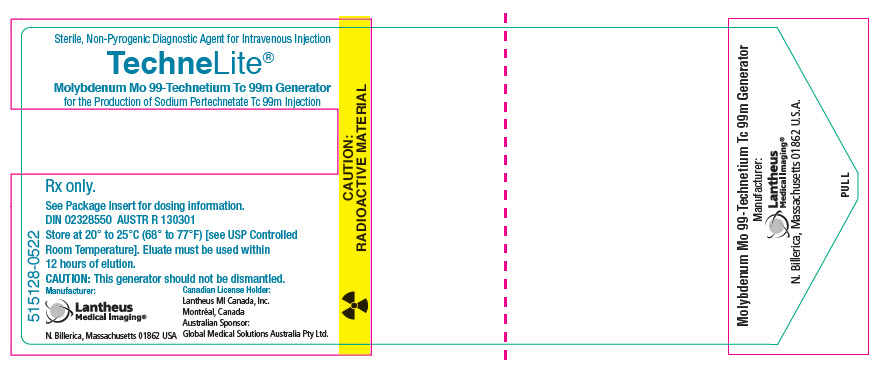
Technetium Tc99m Generator — Radioactive Diagnostic Agent [EPC]. INDICATIONS AND USAGE: The Technelite generator is a source of sodium pertechnetate Tc 99m for use in the preparation of FDA-approved diagnostic…
Brand names
TechneLite
Active ingredients
TECHNETIUM TC-99M SODIUM PERTECHNETATE
Indications
INDICATIONS AND USAGE: The Technelite generator is a source of sodium pertechnetate Tc 99m for use in the preparation of FDA-approved diagnostic radiopharmaceuticals, as described in the labeling of these diagnostic radiopharmaceutical kits. Sodium Pertechnetate Tc 99m Injection is used IN ADULTS as an agent for: Thyroid Imaging Salivary Gland Imaging Urinary Bladder Imaging (direct isotopic cystography) for the detection of vesico-ureteral reflux. Nasolacrimal Drainage System Imaging Sodium Pertechnetate Tc 99m Injection is used IN CHILDREN as an agent for: Thyroid Imaging Urinary Bladder Imaging (direct isotopic cystography) for the detection of vesico-ureteral reflux.
Dosage
DOSAGE AND ADMINISTRATION: Sodium Pertechnetate Tc 99m Injection is usually administered by intravascular injection. For imaging the urinary bladder and ureters (direct isotopic cystography), the Sodium Pertechnetate Tc 99m Injection is administered by direct instillation aseptically into the bladder via a urethral catheter, following which the catheter is flushed with approximately 200 mL of 0.9% Sodium Chloride Injection, USP directly into the bladder. The dosage employed varies with each diagnostic procedure. When imaging the nasolacrimal drainage system, instill the Sodium Pertechnetate Tc 99m Injection by the use of a device such as a micropipette or similar method which will ensure the accuracy of the dose. The suggested dose range employed for various diagnostic indications in the average ADULT PATIENT (70kg) is: Vesico-ureteral Imaging 18.5 to 37MBq (0.5 to 1mCi) Thyroid Gland Imaging 37 to 370MBq (1 to 10mCi) Salivary Gland Imaging 37 to 185MBq (1 to 5mCi) Nasolacrimal Drainage System Maximum 3.7MBq (100µCi) The recommended dosage range in PEDIATRIC PATIENTS is: Vesico-ureteral Imaging 18.5 to 37MBq (0.5 to 1mCi) Thyroid Gland Imaging 2.22 to 2.96MBq (60 to 80µCi)/kg body weight The patient dose should be measured by a suitable radioactivity calibration system immediately prior to administration of the dose. Parenteral drug products should be inspected visually for particulate matter and discoloration prior to administration whenever solution and container permit. The solution to be administered as the patient dose should be clear and contain no particulate matter. Do not use an eluate of the TECHNELITE ® , Technetium Tc 99m Generator later than one (1) working day after elution (12 hours). Radiation Dosimetry The estimated absorbed radiation doses to an average ADULT and Pediatric patient from an intravenous injection of a maximum dose of 1110MBq (30 millicuries) of Sodium Pertechnetate Tc 99m Injection distributed uniformly in the total body are shown in Tables 5 and 6. Table 5. Adult Absorbed Radiation Doses (mGy) from Intravenous Injection Organ Absorbed Radiation Dose (mGy) for a 1110 MBq (30mCi) dose To obtain radiation absorbed dose in rads (30 mCi dose) from the above table, divide individual organ values by a factor of 10 (does not apply for effective dose). Adrenals 4.1 Urinary Bladder Wall 20 Bone Surfaces 6.2 Brain 2.2 Breasts 2 Gallbladder Wall 8.3 Stomach Wall 29 Small Intestine 18 ULI Wall 63 LLI Wall 23 Heart Wall 3.5 Kidneys 6 Liver 4.7 Lungs 2.9 Muscle 3.6 Ovaries 11 Pancreas 6.3 Red Marrow 4.1 Skin 2 Spleen 4.8 Testes 3.1 Thymus 2.7 Thyroid 24 Uterus 9 Remaining Tissues 3.9 Effective Dose (mSv) 14 Table 6. Pediatric Absorbed Radiation Doses (mGy) from Intravenous Injection Age 15 years 10 years 5 years 1 year To obtain radiation absorbed dose in rads (30 mCi dose) from the above table, divide individual organ values by a factor of 10 (does not apply for effective dose). Administered activity in MBq (mCi) 1110 (30) 740 (20) 555 (15) 370 (10) Organ Adrenals 5.3 5.4 6.2 7.1 Urinary Bladder Wall 26 22 18 22 Bone Surfaces 7.6 7.5 8.1 10 Brain 2.8 3.1 3.7 4.5 Breasts 2.6 2.6 3.2 4.1 Gallbladder Wall 11 12 13 13 Stomach Wall 38 36 43 59 Small Intestine 22 23 26 30 ULI Wall 81 89 110 140 LLI Wall 31 33 40 48 Heart Wall 4.5 4.6 5.2 6.4 Kidneys 7.2 6.9 7.8 8.5 Liver 6 6.7 8 9.1 Lungs 3.8 3.8 4.4 5.3 Muscle 4.5 4.5 5 6 Ovaries 14 13 14 17 Pancreas 8.1 8.2 8.9 10 Red Marrow 5.1 5 5.2 6 Skin 2.5 2.6 3.2 3.8 Spleen 6 6 6.7 7.8 Testes 4.1 4.3 4.9 6 Thymus 3.6 3.5 4.2 5.3 Thyroid 40 41 67 81 Uterus 11 11 12 14 Remaining Tissues 4.8 4.8 5.4 6.4 Effective Dose (mSv) 19 19 23 29 The estimated absorbed radiation doses to an average ADULT from the instillation of Sodium Pertechnetate Tc 99m Injection for imaging the nasolacrimal drainage system are shown in Table 7. Table 7. Absorbed Radiation Dose from Dacryoscintigraphy Using Sodium Pertechnetate Tc 99m Absorbed Dose Target Organ mGy/ 3.7MBq (rad/ 100µCi) * Assuming no blockage of drainage system Eye Lens: If lacrimal fluid turnover is 16%/min If lacrimal fluid turnover is 100%/min If drainage system is blocked Total Body* Ovaries* Testes* Thyroid* 0.140 0.022 4.020 0.011 0.030 0.009 0.130 0.014 0.002 0.402 0.001 0.003 0.001 0.013 In pediatric patients, an average 30 minute exposure to 37MBq (1 millicurie) of Sodium Pertechnetate Tc 99m Injection following instillation for direct cystography, results in an estimated absorbed radiation dose shown in Table 8. Table 8. Pediatric Absorbed Radiation Dose from Cystography Age Bladder wall dose, mGy (rad) Gonadal dose, mGy (rad) 1 year 3.6 (0.36) 0.15 (0.015) 5 years 2.0 (0.2) 0.095 (0.0095) 10 years 1.3 (0.13) 0.066 (0.0066) 15 years 0.92 (0.092) 0.046 (0.0046)
Warnings
WARNINGS: Radiation risks associated with the use of Sodium Pertechnetate Tc 99m Injection are greater in children than in adults and, in general, the younger the child, the greater the risk owing to greater absorbed radiation doses and longer life-expectancy. These greater risks should be taken firmly into account in all benefit-risk assessments involving children. Long-term cumulative radiation exposure may be associated with an increased risk of cancer.
Contraindications
CONTRAINDICATIONS: None known.
Adverse reactions
ADVERSE REACTIONS: Allergic reactions including anaphylaxis have been reported infrequently following the administration of Sodium Pertechnetate Tc 99m Injection.
Mechanism of action
CLINICAL PHARMACOLOGY: The pertechnetate ion distributes in the body similarly to the iodide ion but is not organified when trapped in the thyroid gland. It also concentrates in the choroid plexus, thyroid gland, salivary glands, and stomach. However, in contrast to the iodide ion, the pertechnetate ion is released unchanged from the thyroid gland. After intravascular administration the pertechnetate ion gradually equilibrates with the extracellular space. A fraction is promptly excreted via the kidneys. Following the administration of Sodium Pertechnetate Tc 99m Injection as an eye drop, the drug mixes with tears within the conjunctival space. Within seconds to minutes it leaves the conjunctival space and escapes into the inferior meatus of the nose through the nasolacrimal drainage system. During this process the pertechnetate ion passes through the canaliculi, the lacrimal sac and the nasolacrimal duct. In the event of any anatomical or functional blockage of the drainage system there will be a backflow resulting in tearing (epiphora). Thus the pertechnetate escapes the conjunctival space in the tears. While the major part of the pertechnetate escapes within a few minutes of normal drainage and tearing, it has been documented that there is some degree of transconjunctival absorption with a fractional turnover rate of 0.015/min in normal individuals, 0.021/min in patients without any sac and 0.027/min in patients with inflamed conjunctiva due to chronic dacryocystitis. Individual values may vary but these rates are probably representative and indicate that the maximum possible pertechnetate absorbed will remain below one thousandth of that used in other routine diagnostic procedures.
NDC examples
11994-09011994-091
Treats these conditions
Source: openFDA + RxNorm · 2026
Look up another medication