voxelotor 500 MG Oral Tablet
Managing this medication for someone you care for? Eleplan keeps diagnoses, medications and appointments in one plan.
Start free with EleplanClinical drug
voxelotor 500 MG Oral Tablet
500 MG · Oral Tablet · oral
A form of voxelotor →
voxelotor 500 MG Oral Tablet — Other hematological agents. INDICATIONS AND USAGE OXBRYTA is indicated for the treatment of sickle cell disease (SCD) in adults and pediatric patients 4 years of age and older…
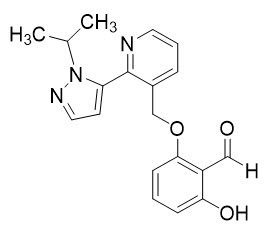
Active ingredient
Classification
Other hematological agentsHemoglobin S Polymerization Inhibitor
Drug interactions
Voxelotor has several drug interactions primarily involving CYP3A4 substrates and inducers.
- majorsensitive CYP3A4 substrates — may lead to reduced efficacy of voxelotor
- majorstrong or moderate CYP3A4 inducers — may decrease voxelotor plasma and whole blood concentrations
- moderatemidazolam — increased systemic exposure of midazolam
Indications
INDICATIONS AND USAGE OXBRYTA is indicated for the treatment of sickle cell disease (SCD) in adults and pediatric patients 4 years of age and older. This indication is approved under accelerated approval based on increase in hemoglobin (Hb) [see Clinical Studies (14) ] . Continued approval for this indication may be contingent upon verification and description of clinical benefit in confirmatory trial(s). OXBRYTA is a hemoglobin S polymerization inhibitor indicated for the treatment of sickle cell disease in adults and pediatric patients 4 years of age and older. This indication is approved under accelerated approval based on increase in hemoglobin (Hb). Continued approval for this indication may be contingent upon verification and description of clinical benefit in confirmatory trial(s). ( 1 )
Dosage
DOSAGE AND ADMINISTRATION OXBRYTA can be taken with or without food. ( 2.7 ) Recommended dosage: • Adults and pediatric patients 12 years and older: 1,500 mg orally once daily. ( 2.1 ) • Pediatric patients 4 to less than 12 years: Dosing with OXBRYTA is based on body weight. See Table 1 for complete dosing recommendations. ( 2.2 ) Recommended dosage for severe hepatic impairment (Child Pugh C) : • Adults and pediatric patients 12 years and older: 1,000 mg orally once daily. ( 2.3 ) • Pediatric patients 4 to less than 12 years: Reduce the dose of OXBRYTA based on body weight. See Table 2 for complete dosing recommendations. ( 2.4 ) 2.1 Recommended Dosage for Adults and Pediatric Patients 12 Years and Older The recommended dosage of OXBRYTA is 1,500 mg orally once daily. 2.2 Recommended Dosage for Pediatric Patients 4 Years to Less Than 12 Years For pediatric patients 4 years to less than 12 years, select the appropriate product (OXBRYTA tablets or OXBRYTA tablets for oral suspension) based on patient's ability to swallow tablets and patient's weight. The recommended dosage of OXBRYTA for pediatric patients 4 years to less than 12 years is shown in Table 1. Table 1: Recommended OXBRYTA Dosage in Pediatric Patients 4 Years to Less Than 12 Years Body Weight Recommended Dose (once daily) 40 kg or greater 1,500 mg 20 kg to less than 40 kg 900 mg 10 kg to less than 20 kg 600 mg 2.3 Recommended Dosage for Adults and Pediatric Patients 12 Years and Older with Hepatic Impairment The recommended dosage of OXBRYTA in adults and pediatric patients 12 years and older with severe hepatic impairment (Child Pugh C) is 1,000 mg orally once daily. No dosage adjustment of OXBRYTA is required for patients with mild or moderate hepatic impairment [ see Use in Specific Populations (8.6) and Clinical Pharmacology (12.3) ]. 2.4 Recommended Dosage for Pediatric Patients 4 Years to Less Than 12 Years with Hepatic Impairment The recommended dosage of OXBRYTA in pediatric patients 4 years to less than 12 years with severe hepatic impairment (Child Pugh C) is described in Table 2. No dosage adjustment of OXBRYTA is required for patients with mild or moderate hepatic impairment [see Use in Specific Populations (8.6) and Clinical Pharmacology (12.3) ] . Table 2: Recommended OXBRYTA Dosage in Pediatric Patients 4 Years to Less Than 12 Years with Severe Hepatic Impairment (Child Pugh C) Body Weight Recommended Dose (once daily) 40 kg or greater 1,000 mg (two 500 mg tablets) or 900 mg (three 300 mg tablets for oral suspension or three 300 mg tablets) 20 kg to less than 40 kg 600 mg 10 kg to less than 20 kg 300 mg 2.5 Recommended Dosage of OXBRYTA for Adults and Pediatric Patients 12 Years and Older When Used with Concomitant Strong or Moderate CYP3A4 Inducers CYP3A4 Inducers Avoid concomitant use of strong or moderate CYP3A4 inducers with OXBRYTA [see Drug Interactions (7.1) and Clinical Pharmacology (12.3) ] . If concomitant use of strong CYP3A4 inducers is unavoidable, the recommended dosage of OXBRYTA is 2,500 mg orally once daily. If concomitant use of moderate CYP3A4 inducers is unavoidable, the recommended dosage of OXBRYTA is 2,000 mg orally once daily. 2.6 Recommended Dosage of OXBRYTA for Pediatric Patients 4 Years to Less Than 12 Years When Used with Concomitant Strong or Moderate CYP3A4 Inducers CYP3A4 Inducers Avoid concomitant use of strong or moderate CYP3A4 inducers with OXBRYTA [see Drug Interactions (7.1) and Clinical Pharmacology (12.3) ] . If concomitant use of strong or moderate CYP3A4 inducers is unavoidable, see Table 3 for dosage. Table 3: OXBRYTA Recommended Dosage for Pediatric Patients 4 Years to Less Than 12 Years When Used with Concomitant Strong or Moderate CYP3A4 Inducers Body Weight Recommended Dose (once daily) Concomitant Use of Strong CYP3A4 Inducers Concomitant Use of Moderate CYP3A4 Inducers 40 kg or greater 2,500 mg (five 500 mg tablets) or 2,400 mg (eight 300 mg tablets for oral suspension or eight 300 mg tablets) 2,000 mg (four 500 mg tablets) or 2,100 mg (seven 300 mg tablets for oral suspension or seven 300 mg tablets) 20 kg to less than 40 kg 1,500 mg 1,200 mg 10 kg to less than 20 kg 900 mg 900 mg 2.7 Important Administration Instructions Administer OXBRYTA orally, once daily with or without food. If a dose is missed, or not administered entirely, resume dosing the following day. OXBRYTA may be given with or without hydroxyurea. OXBRYTA 300 mg and 500 mg Tablets Patients should swallow OXBRYTA tablets whole. Do not cut, crush, or chew the tablets. OXBRYTA 300 mg Tablets for Oral Suspension Patients should disperse tablets for oral suspension immediately before administration in a cup and in room temperature clear liquid (such as drinking water, clear soda, apple juice, clear electrolyte drinks, clear flavored drinks, or clear sports drinks) before swallowing. Do not swallow whole, cut, crush, or chew the tablets for oral suspension. Recommended Daily Dose Number of Tablets for Oral Suspension Minimum Recommended Volume of Clear Drink 300 mg 1 5 mL (1 teaspoon) 600 mg 2 10 mL (2 teaspoons) 900 mg 3 15 mL (3 teaspoons) 1,200 mg 4 20 mL (4 teaspoons) 1,500 mg 5 25 mL (5 teaspoons) 2,100 mg 7 35 mL (7 teaspoons) 2,400 mg 8 40 mL (8 teaspoons) • After the tablets start to disintegrate, swirl the contents of the cup until the tablets are dispersed, wait 1 to 5 minutes, swirl the contents of the cup again, and then orally administer the contents of the cup. The tablet(s) will not completely dissolve; there will still be small tablet clumps in the mixture. • Resuspend any residue left in the cup in more clear drink and administer. Repeat until no tablet residue is left in the cup. Tablets for oral suspension may be substituted for tablets in adults and pediatric patients 12 years and older with difficulty swallowing the tablets. Use the number of tablets for oral suspension needed to achieve the recommended dose.
Warnings
WARNINGS AND PRECAUTIONS • Hypersensitivity Reactions: Observe for signs and symptoms and manage promptly. ( 5.1 ) • Laboratory Test Interference: Perform quantification of hemoglobin species when patient is not receiving OXBRYTA. ( 5.2 ) 5.1 Hypersensitivity Reactions Serious hypersensitivity reactions after administration of OXBRYTA have occurred in <1% of patients treated. Clinical manifestations may include generalized rash, urticaria, mild shortness of breath, mild facial swelling, and eosinophilia [see Adverse Reactions (6.1) ] . Drug reaction with eosinophilia and systemic symptoms (DRESS) has been reported in postmarketing experience with OXBRYTA [see Adverse Reactions (6.2) ] . Patients who develop a combination of skin rash, fever, peripheral eosinophilia, and internal systemic organ involvement (e.g., hepatic, renal, pulmonary) while receiving OXBRYTA should undergo medical evaluation. Advise patients of the signs and symptoms of severe hypersensitivity reactions, including DRESS. If hypersensitivity reactions occur, discontinue OXBRYTA and administer appropriate medical therapy. Do not reinitiate OXBRYTA in patients who experience these symptoms with previous use. 5.2 Laboratory Test Interference OXBRYTA administration may interfere with measurement of Hb subtypes (HbA, HbS, and HbF) by high-performance liquid chromatography (HPLC) [see Drug Interactions (7.3) ]. If precise quantitation of Hb species is required, chromatography should be performed when the patient has not received OXBRYTA therapy in the immediately preceding 10 days.
Contraindications
CONTRAINDICATIONS OXBRYTA is contraindicated in patients with a history of serious drug hypersensitivity reaction to voxelotor or excipients. Clinical manifestations may include generalized rash, urticaria, mild shortness of breath, mild facial swelling, and eosinophilia [see Warnings and Precautions (5.1) and Adverse Reactions (6.1) ]. Prior drug hypersensitivity to voxelotor or excipients. ( 4 )
Mechanism of action
Mechanism of Action Voxelotor is a hemoglobin S (HbS) polymerization inhibitor that binds to HbS with a 1:1 stoichiometry and exhibits preferential partitioning to red blood cells (RBCs). By increasing the affinity of Hb for oxygen, voxelotor demonstrates dose-dependent inhibition of HbS polymerization. Nonclinical studies suggest that voxelotor may inhibit RBC sickling, improve RBC deformability, and reduce whole blood viscosity.
Indicated ICD-10 codes
Source: RxNorm + openFDA + RxClass + FAERS · 2026
Look up another medication