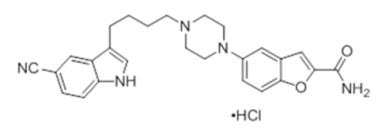
vilazodone hydrochloride 40 MG Oral Tablet — Other antidepressants. INDICATIONS AND USAGE Vilazodone hydrochloride tablets are indicated for the treatment of major depressive disorder (MDD) in adults [see Clinical Stud
Boxed warning
WARNING: SUICIDAL THOUGHTS AND BEHAVIORS Antidepressants increased the risk of suicidal thoughts and behaviors in pediatric and young adult patients in short-term studies. Closely monitor all antidepressant-treated patients for clinical worsening and for emergence of suicidal thoughts and behaviors [see Warnings and Precautions ( 5.1 )] . Vilazodone hydrochloride tablets are not approved for use in pediatric patients [see Use in Specific Populations ( 8.4) ] . WARNING: SUICIDAL THOUGHTS AND BEHAVIORS See full prescribing information for complete boxed warning. Antidepressants increase the risk of suicidal thoughts and behaviors in pediatric and young adult patients. ( 5.1 ) Closely monitor all antidepressant-treated patients for clinical worsening and emergence of suicidal thoughts and behaviors. ( 5.1 ) Vilazodone hydrochloride tablets are not approved for use in pediatric patients. ( 8.4 )
INDICATIONS AND USAGE Vilazodone hydrochloride tablets are indicated for the treatment of major depressive disorder (MDD) in adults [see Clinical Studies ( 14 )] . Vilazodone hydrochloride tablets are indicated for the treatment of major depressive disorder (MDD) in adults. ( 1 )
Dosage
DOSAGE AND ADMINISTRATION Recommended target dosage: 20 mg to 40 mg once daily with food. ( 2.1 , 12.3 ) To titrate: start with initial dosage of 10 mg once daily for 7 days, followed by 20 mg once daily. The dose may be increased up to 40 mg once daily after a minimum of 7 days between dosage increases. ( 2.1 ) Prior to initiating vilazodone hydrochloride tablets, screen for bipolar disorder. ( 2.2 , 5.4 ) When discontinuing vilazodone hydrochloride tablets, reduce dosage gradually. ( 2.4 , 5.5 ) 2.1 Dosage for Treatment of Major Depressive Disorder The recommended target dosage for vilazodone hydrochloride tablets is 20 mg to 40 mg orally once daily with food [see Clinical Pharmacology ( 12.3 ), Clinical Studies ( 14 )] . To achieve the target dosage, titrate vilazodone hydrochloride tablets as follows: Start with an initial dosage of 10 mg once daily with food for 7 days, Then increase to 20 mg once daily with food. The dose may be increased up to 40 mg once daily with food after a minimum of 7 days between dosage increases. If a dose is missed, it should be taken as soon as the patient remembers. If it is almost time for the next dose, the patient should skip the missed dose and take the next dose at the regular time. Two doses should not be taken at the same time. 2.2 Screen for Bipolar Disorder Prior to Starting Vilazodone Hydrochloride Tablets Prior to initiating treatment with vilazodone hydrochloride tablets or another antidepressant, screen patients for a personal or family history of bipolar disorder, mania, or hypomania [see Warnings and Precautions ( 5.4 )] . 2.3 Switching to or from a Monoamine Oxidase Inhibitor Antidepressant At least 14 days must elapse between discontinuation of a monoamine oxidase inhibitor (MAOI) antidepressant and initiation of vilazodone hydrochloride tablets. In addition, at least 14 days must elapse after stopping vilazodone hydrochloride tablets before starting an MAOI antidepressant [see Contraindications ( 4 ), Warnings and Precautions ( 5.2 )] . 2.4 Dosage Adjustments with CYP3A4 Inhibitors or Inducers Patients receiving concomitant CYP3A4 inhibitors : During concomitant use of a strong CYP3A4 inhibitor (e.g., itraconazole, clarithromycin, voriconazole), the vilazodone hydrochloride tablets dose should not exceed 20 mg once daily. The original vilazodone hydrochloride tablet dose level, can be resumed when the CYP3A4 inhibitor is discontinued [see Drug Interactions ( 7 )] . Patients receiving concomitant CYP3A4 inducers : Based on clinical response, consider increasing the dosage of vilazodone hydrochloride tablets by 2-fold, up to a maximum 80 mg once daily, over 1 to 2 weeks in patients taking strong CYP3A4 inducers (e.g., carbamazepine, phenytoin, rifampin) for greater than 14 days. If CYP3A4 inducers are discontinued, gradually reduce the vilazodone hydrochloride tablets dosage to its original level over 1 to 2 weeks [see Drug Interactions ( 7 )] . 2.5 Discontinuing Treatment with Vilazodone Hydrochloride Tablets Adverse reactions may occur upon discontinuation of vilazodone hydrochloride tablets [see Warnings and Precautions ( 5.5 )] . A gradual reduction in dosage rather than abrupt cessation is recommended whenever possible. Vilazodone hydrochloride tablets should be down tapered from the 40 mg once daily dose to 20 mg once daily for 4 days, followed by 10 mg once daily for 3 days. Patients taking vilazodone hydrochloride tablets 20 mg once daily should be tapered to 10 mg once daily for 7 days.
Warnings
WARNINGS AND PRECAUTIONS • Serotonin Syndrome: Increased risk when co-administered with other serotonergic agents (e.g., SSRI, SNRI, triptans, amphetamines), but also when taken alone. If it occurs, discontinue vilazodone hydrochloride tablets and initiate supportive treatment (5.2). • Increased Risk of Bleeding: Concomitant use of aspirin, nonsteroidal anti-inflammatory drugs (NSAIDs), other antiplatelet drugs, warfarin, and other anticoagulants may increase this risk (5.3). • Activation of Mania/Hypomania: Screen patients for bipolar disorder (5.4). • Seizures: Can occur with treatment. Use with caution in patients with a seizure disorder (5.6). • Angle Closure Glaucoma: Avoid use of antidepressants, including vilazodone hydrochloride tablets, in patients with untreated anatomically narrow angles (5.7). • Sexual Dysfunction: Vilazodone hydrochloride tablets may cause symptoms of sexual dysfunction (5.9). 5.1 Suicidal Thoughts and Behavior in Adolescents and Young Adults In pooled analyses of placebo-controlled trials of antidepressant drugs (SSRIs and other antidepressant classes) that included approximately 77,000 adult patients, and over 4,500 pediatric patients, the incidence of suicidal thoughts and behaviors in antidepressant-treated patients age 24 years and younger was greater in antidepressant-treated patients than in placebo-treated patients. There was considerable variation in risk of suicidal thoughts and behaviors among drugs, but there was an increased risk identified in young patients for most drugs studied. There were differences in absolute risk of suicidal thoughts and behaviors across the different indications, with the highest incidence in patients with MDD. The drug-placebo differences in the number of cases of suicidal thoughts and behaviors per 1000 patients treated are provided in Table 1. Table 1: Risk Differences of the Number of Patients with Suicidal Thoughts or Behaviors in the Pooled Placebo-Controlled Trials of Antidepressants in Pediatric and Adult Patients Age Range Drug-Placebo Difference in Number of Patients with Suicidal Thoughts or Behaviors per 1000 Patients Treated Increases Compared to Placebo <18 14 additional patients 18 to 24 5 additional patients Decreases Compared to Placebo 25 to 64 1 fewer patient ≥65 6 fewer patients It is unknown whether the risk of suicidal thoughts and behaviors in children, adolescents, and young adults extends to longer-term use, i.e., beyond four months. However, there is substantial evidence from placebo-controlled maintenance studies in adults with MDD that antidepressants delay the recurrence of depression and that depression itself is a risk factor for suicidal thoughts and behaviors. Monitor all antidepressant-treated patients for clinical worsening and emergence of suicidal thoughts and behaviors, especially during the initial few months of drug therapy and at times of dosage changes. Counsel family members or caregivers of patients to monitor for changes in behavior and to alert the healthcare provider. Consider changing the therapeutic regimen, including possibly discontinuing vilazodone hydrochloride tablets, in patients whose depression is persistently worse, or who are experiencing emergent suicidal thoughts or behaviors. 5.2 Serotonin Syndrome Serotonin and norepinephrine reuptake inhibitors (SNRIs) and selective serotonin reuptake inhibitor (SSRIs), including vilazodone hydrochloride tablets, can precipitate serotonin syndrome, a potentially life-threatening condition. The risk is increased with concomitant use of other serotonergic drugs (including triptans, tricyclic antidepressants, fentanyl, lithium, tramadol, tryptophan, buspirone, amphetamines, and St. John’s Wort) and with drugs that impair metabolism of serotonin, i.e., MAOIs [see Contraindications (4) and Drug Interactions (7)] . Serotonin syndrome can also occur when these drugs are used alone. Symptoms of serotonin syndrome were noted in 0.1% of MDD patients treated with vilazodone hydrochloride tablets in premarketing clinical trials. Serotonin syndrome signs and symptoms may include mental status changes (e.g., agitation, hallucinations, delirium, and coma), autonomic instability (e.g., tachycardia, labile blood pressure, dizziness, diaphoresis, flushing, hyperthermia), neuromuscular symptoms (e.g., tremor, rigidity, myoclonus, hyperreflexia, incoordination), seizures, and gastrointestinal symptoms (e.g., nausea, vomiting, diarrhea). The concomitant use of vilazodone hydrochloride tablets with MAOIs is contraindicated. In addition, do not initiate vilazodone hydrochloride tablets in a patient being treated with MAOIs such as linezolid or intravenous methylene blue. No reports involved the administration of methylene blue by other routes (such as oral tablets or local tissue injection). If it is necessary to initiate treatment with an MAOI such as linezolid or intravenous methylene blue in a patient taking vilazodone hydrochloride tablets, discontinue vilazodone hydrochloride tablets before initiating treatment with the MAOI [see Contraindications (4), Drug Interactions (7.1)]. Monitor all patients taking vilazodone hydrochloride tablets for the emergence of serotonin syndrome. Discontinue treatment with vilazodone hydrochloride tablets and any concomitant serotonergic agents immediately if the above symptoms occur, and initiate supportive symptomatic treatment. If concomitant use of vilazodone hydrochloride tablets with other serotonergic drugs is clinically warranted, inform patients of the increased risk for serotonin syndrome and monitor for symptoms. 5.3 Increased Risk of Bleeding Drugs that interfere with serotonin reuptake inhibition, including vilazodone hydrochloride tablets, increase the risk of bleeding events. Concomitant use of aspirin, nonsteroidal anti-inflammatory drugs (NSAIDS), other antiplatelet drugs, warfarin, and other anticoagulants may add to this risk. Case reports and epidemiological studies (case-control and cohort design) have demonstrated an association between use of drugs that interfere with serotonin reuptake and the occurrence of gastrointestinal bleeding. Bleeding events related to drugs that interfere with serotonin reuptake have ranged from ecchymosis, hematoma, epistaxis, and petechiae to life-threatening hemorrhages. Inform patients about the risk of bleeding associated with the concomitant use of vilazodone hydrochloride tablets and antiplatelet agents or anticoagulants. For patients taking warfarin, carefully monitor coagulation indices when initiating, titrating, or discontinuing vilazodone hydrochloride tablets. 5.4 Activation of Mania or Hypomania In patients with bipolar disorder, treating a depressive episode with vilazodone hydrochloride tablets or another antidepressant may precipitate a mixed/manic episode. In controlled clinical trials, patients with bipolar disorder were excluded; however, symptoms of mania or hypomania were reported in 0.1% of undiagnosed patients treated with vilazodone hydrochloride tablets. Prior to initiating treatment with vilazodone hydrochloride tablets, screen patients for any personal or family history of bipolar disorder, mania, or hypomania [see Dosage and Administration (2.2)] . 5.5 Discontinuation Syndrome Adverse reactions after discontinuation of serotonergic antidepressants, particularly after abrupt discontinuation, include: nausea, sweating, dysphoric mood, irritability, agitation, dizziness, sensory disturbances (e.g., paresthesia, such as electric shock sensations), tremor, anxiety, confusion, headache, lethargy, emotional lability, insomnia, hypomania, tinnitus, and seizures. A gradual reduction in dosage rather than abrupt cessation is recommended whenever possible [see Dosage and Administration (2.5)] . 5.6 Seizures Vilazodone hydrochloride tablets have not been systematically evaluated in patients with a seizure disorder. Patients with a history of seizures were excluded from clinical studies. Vilazodone hydroch
Contraindications
CONTRAINDICATIONS Vilazodone hydrochloride tablets are contraindicated in: Patients taking, or within 14 days of stopping, monoamine oxidase inhibitors (MAOIs), including MAOIs such as linezolid or intravenous methylene blue, because of an increased risk of serotonin syndrome [see Warnings and Precautions ( 5.2 ), Drug Interactions ( 7 )] . Concomitant use of monoamine oxidase inhibitors (MAOIs), or use within 14 days of stopping MAOIs. ( 4 )
Mechanism of action
Mechanism of action The mechanism of the action of vilazodone in the treatment of major depressive disorder is not fully understood, but is thought to be related to its enhancement of serotonergic activity in the CNS through selective inhibition of serotonin reuptake. Vilazodone is also a partial agonist at serotonergic 5-HT 1A receptors; however, the net result of this action on serotonergic transmission and its role in vilazodone’s antidepressant effect are unknown.
A drug lookup is just the start. Eleplan keeps the whole care plan in one place.
Medications, diagnoses, documents, appointments, and the whole care team — organized and always in sync, with Ellie, your AI care assistant, on top of it. Free to start.