vemurafenib 240 MG Oral Tablet
Managing this medication for someone you care for? Eleplan keeps diagnoses, medications and appointments in one plan.
Start free with EleplanClinical drug
vemurafenib 240 MG Oral Tablet
240 MG · Oral Tablet · oral
A form of vemurafenib →
vemurafenib 240 MG Oral Tablet — B-Raf serine-threonine kinase (BRAF) inhibitors. INDICATIONS AND USAGE ZELBORAF ® is a kinase inhibitor indicated for the treatment of patients with unresectable or metastatic melanoma with BRAF…
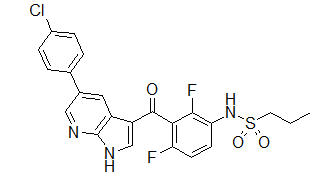
Active ingredient
Classification
B-Raf serine-threonine kinase (BRAF) inhibitorsKinase Inhibitor
Drug interactions
Vemurafenib has several significant drug interactions that can affect its efficacy and toxicity.
- majorstrong CYP3A4 inhibitors — increased toxicity due to increased plasma concentrations of vemurafenib
- majorstrong CYP3A4 inducers — decreased efficacy due to decreased plasma concentrations of vemurafenib
- majorCYP1A2 substrates with a narrow therapeutic window — increased systemic exposure and potential toxicity of CYP1A2 substrates
- moderateipilimumab — increased transaminases and bilirubin
- majorP-gp substrates with narrow therapeutic indices — increased systemic exposure of P-gp substrates
Indications
INDICATIONS AND USAGE ZELBORAF ® is a kinase inhibitor indicated for the treatment of patients with unresectable or metastatic melanoma with BRAF V600E mutation as detected by an FDA-approved test. ( 1.1 , 2.1 ) ZELBORAF ® is indicated for the treatment of patients with Erdheim- Chester Disease with BRAF V600 mutation. ( 1.2 , 2.1 ) Limitation of Use: ZELBORAF is not indicated for treatment of patients with wild-type BRAF melanoma ( 2.1 , 5.2 ) 1.1 Unresectable or Metastatic Melanoma ZELBORAF ® is indicated for the treatment of patients with unresectable or metastatic melanoma with BRAF V600E mutation as detected by an FDA-approved test. Limitation of Use: ZELBORAF is not indicated for treatment of patients with wild-type BRAF melanoma [see Warnings and Precautions (5.2) ] . 1.2 Erdheim-Chester Disease ZELBORAF ® is indicated for the treatment of patients with Erdheim-Chester Disease (ECD) with BRAF V600 mutation.
Dosage
DOSAGE AND ADMINISTRATION Confirm the presence of BRAF V600E mutation in tumor specimens prior to initiation of treatment with ZELBORAF. ( 2.1 ) Recommended dose: 960 mg orally twice daily taken approximately 12 hours apart with or without a meal. ( 2.2 ) 2.1 Patient Selection for Treatment of Melanoma Confirm the presence of BRAF V600E mutation in melanoma tumor specimens prior to initiation of treatment with ZELBORAF [see Warnings and Precautions (5.2) ] . Information on FDA-approved tests for the detection of BRAF V600 mutations in melanoma is available at http://www.fda.gov/CompanionDiagnostics. 2.2 Recommended Dose The recommended dose of ZELBORAF is 960 mg (four 240 mg tablets) orally every 12 hours with or without a meal. A missed dose can be taken up to 4 hours prior to the next dose. Treat patients with ZELBORAF until disease progression or unacceptable toxicity occurs. Do not take an additional dose if vomiting occurs after ZELBORAF administration, but continue with the next scheduled dose. Do not crush or chew the tablets. 2.3 Dose Modifications For New Primary Cutaneous Malignancies: No dose modifications are recommended. For Other Adverse Reactions: Permanently discontinue ZELBORAF for any of the following: Grade 4 adverse reaction, first appearance (if clinically appropriate) or second appearance QTc prolongation > 500 ms and increased by > 60 ms from pre-treatment values [see Warnings and Precautions (5.5) ] Withhold ZELBORAF for NCI-CTCAE (v4.0) intolerable Grade 2 or greater adverse reactions. Upon recovery to Grade 0–1, restart ZELBORAF at a reduced dose as follows: 720 mg twice daily for first appearance of intolerable Grade 2 or Grade 3 adverse reactions 480 mg twice daily for second appearance of Grade 2 (if intolerable) or Grade 3 adverse reactions or for first appearance of Grade 4 adverse reaction (if clinically appropriate) Do not dose reduce to below 480 mg twice daily. 2.4 Dose Modification for Strong CYP3A4 Inducers Avoid concomitant use of strong CYP3A4 inducers during treatment with ZELBORAF [see Drug Interactions (7.1) and Clinical Pharmacology (12.3) ] . If concomitant use of a strong CYP3A4 inducer is unavoidable, increase the dose of ZELBORAF by 240 mg (one tablet) as tolerated. After discontinuation of a strong CYP3A4 inducer for two weeks, resume the ZELBORAF dose that was taken prior to initiating the strong CYP3A4 inducer.
Warnings
WARNINGS AND PRECAUTIONS New Primary Cutaneous Malignancies: Perform dermatologic evaluations prior to initiation of therapy, every 2 months while on therapy, and for up to 6 months following discontinuation of ZELBORAF. Manage with excision and continue treatment without dose adjustment. ( 5.1 ) New Non-Cutaneous Squamous Cell Carcinoma: Evaluate for symptoms or clinical signs of new non-cutaneous SCC before initiation of treatment and periodically during treatment. ( 5.1 ) Other Malignancies: Monitor patients receiving ZELBORAF closely for signs or symptoms of other malignancies ( 5.1 ). Tumor Promotion in BRAF Wild-Type Melanoma: Increased cell proliferation can occur with BRAF inhibitors ( 5.2 ). Serious Hypersensitivity Reactions including anaphylaxis and Drug Reaction with Eosinophilia and Systemic Symptoms (DRESS Syndrome): Discontinue ZELBORAF for severe hypersensitivity reactions. ( 5.3 ) Severe Dermatologic Reactions, including Stevens-Johnson Syndrome and Toxic Epidermal Necrolysis: Discontinue ZELBORAF for severe dermatologic reactions. ( 5.4 ) QT Prolongation: Monitor ECG and electrolytes before and during treatment. Withhold ZELBORAF for QTc of 500 ms or greater. Correct electrolyte abnormalities and control for cardiac risk factors for QT prolongation. ( 5.5 ) Hepatotoxicity: Measure liver enzymes and bilirubin before initiating ZELBORAF and monitor monthly during treatment. ( 5.6 ) Photosensitivity: Advise patients to avoid sun exposure. ( 5.7 ) Serious Ophthalmologic Reactions: Monitor for signs and symptoms of uveitis. ( 5.8 ) Embryo-Fetal Toxicity: Can cause fetal harm. Advise females of the potential risk to the fetus and to use effective contraception. ( 5.9 , 8.1 , 8.3 ) Radiation Sensitization and Radiation Recall: Severe cases have been reported. ( 5.10 ). Renal Failure: Measure serum creatinine before initiating ZELBORAF and monitor periodically during treatment ( 5.11 ). Dupuytren's Contracture and plantar fascial fibromatosis: Events should be managed with dose reduction, treatment interruption, or treatment discontinuation. ( 5.12 ). 5.1 New Primary Malignancies Cutaneous Malignancies Cutaneous squamous cell carcinoma, keratoacanthoma, and melanoma occurred at a higher incidence in patients receiving ZELBORAF compared to those in the control arm in Trial 1. The incidence of cutaneous squamous cell carcinomas (cuSCC) and keratoacanthomas in the ZELBORAF arm was 24% compared to < 1% in the dacarbazine arm [see Adverse Reactions (6.1) ] . The median time to the first appearance of cuSCC was 7 to 8 weeks; approximately 33% of patients who developed a cuSCC while receiving ZELBORAF experienced at least one additional occurrence with median time between occurrences of 6 weeks. Potential risk factors associated with cuSCC observed in clinical studies using ZELBORAF included age (≥ 65 years), prior skin cancer, and chronic sun exposure. In Trial 4, in patients with ECD, the incidence of cuSCC and/or keratoacanthomas was 40.9% (9/22). The median time to first appearance of cuSCC amongst patients with at least one occurrence was 12.1 weeks. In Trial 1, in patients with unresectable or metastatic melanoma, new primary malignant melanoma occurred in 2.1% (7/336) of patients receiving ZELBORAF compared to none of the patients receiving dacarbazine. Perform dermatologic evaluations prior to initiation of therapy and every 2 months while on therapy. Manage suspicious skin lesions with excision and dermatopathologic evaluation. Consider dermatologic monitoring for 6 months following discontinuation of ZELBORAF. Non-Cutaneous Squamous Cell Carcinoma Non-cutaneous squamous cell carcinomas (non-cuSCC) of the head and neck can occur in patients receiving ZELBORAF [see Adverse Reactions (6.1) ] . Monitor patients receiving ZELBORAF closely for signs or symptoms of new non-cuSCC. Other Malignancies Based on mechanism of action, ZELBORAF may promote malignancies associated with activation of RAS through mutation or other mechanisms [see Warnings and Precautions (5.2) ] . Monitor patients receiving ZELBORAF closely for signs or symptoms of other malignancies. Cases of myeloid neoplasms amongst patients with ECD have been observed, including in patients who have received ZELBORAF. Monitoring complete blood count in ECD patients with co-existing myeloid malignancies is recommended. 5.2 Tumor Promotion in BRAF Wild-Type Melanoma In vitro experiments have demonstrated paradoxical activation of MAP-kinase signaling and increased cell proliferation in BRAF wild-type cells that are exposed to BRAF inhibitors. Confirm evidence of BRAF V600E mutation in tumor specimens prior to initiation of ZELBORAF [see Indications and Usage (1) and Dosage and Administration (2.1) ] . 5.3 Hypersensitivity Reactions Anaphylaxis and other serious hypersensitivity reactions can occur during treatment and upon re-initiation of treatment with ZELBORAF. Severe hypersensitivity reactions included generalized rash and erythema, hypotension, and drug reaction with eosinophilia and systemic symptoms (DRESS syndrome). Permanently discontinue ZELBORAF in patients who experience a severe hypersensitivity reaction [see Adverse Reactions (6.2) ] . 5.4 Dermatologic Reactions Severe dermatologic reactions, including Stevens-Johnson syndrome and toxic epidermal necrolysis, can occur in patients receiving ZELBORAF. Permanently discontinue ZELBORAF in patients who experience a severe dermatologic reaction [see Adverse Reactions (6.1) ]. 5.5 QT Prolongation Concentration-dependent QT prolongation occurred in an uncontrolled, open-label QT sub-study in previously treated patients with BRAF V600E mutation-positive metastatic melanoma [see Clinical Pharmacology (12.2) ] . QT prolongation may lead to an increased risk of ventricular arrhythmias, including Torsade de Pointes. Do not start treatment in patients with uncorrectable electrolyte abnormalities, QTc > 500 ms, or long QT syndrome, or in patients who are taking medicinal products known to prolong the QT interval. Prior to and following treatment initiation or after dose modification of ZELBORAF for QTc prolongation, evaluate ECG and electrolytes (including potassium, magnesium, and calcium) after 15 days, monthly during the first 3 months, and then every 3 months thereafter or more often as clinically indicated. Withhold ZELBORAF in patients who develop QTc > 500 ms (Grade 3). Upon recovery to QTc ≤ 500 ms (Grade ≤ 2), restart at a reduced dose. Permanently discontinue ZELBORAF treatment if the QTc interval remains > 500 ms and increased > 60 ms from pre-treatment values after controlling cardiac risk factors for QT prolongation (e.g., electrolyte abnormalities, congestive heart failure, and bradyarrhythmias) [see Dosage and Administration (2.3) ] . 5.6 Hepatotoxicity Liver injury leading to functional hepatic impairment, including coagulopathy or other organ dysfunction, can occur with ZELBORAF [see Adverse Reactions (6.1) ] . Monitor transaminases, alkaline phosphatase, and bilirubin before initiation of treatment and monthly during treatment, or as clinically indicated. Manage laboratory abnormalities with dose reduction, treatment interruption, or treatment discontinuation [see Dosage and Administration (2.3) ] . Concurrent Administration with Ipilimumab The safety and effectiveness of ZELBORAF in combination with ipilimumab have not been established [see Indications and Usage (1) ] . In a dose-finding trial, Grade 3 increases in transaminases and bilirubin occurred in a majority of patients who received concurrent ipilimumab (3 mg/kg) and vemurafenib (960 mg BID or 720 mg BID) [see Drug Interactions (7.3) ]. 5.7 Photosensitivity Mild to severe photosensitivity can occur in patients treated with ZELBORAF [see Adverse Reactions (6.1) ] . Advise patients to avoid sun exposure, wear protective clothing and use a broad spectrum UVA/UVB sunscreen and lip balm (SPF ≥ 30) when outdoors. Institute dose modifications for intolerable Grade 2
Contraindications
CONTRAINDICATIONS None. None
Mechanism of action
Mechanism of Action Vemurafenib is a low molecular weight, orally available inhibitor of some mutated forms of BRAF serine- threonine kinase, including BRAF V600E. Vemurafenib also inhibits other kinases in vitro such as CRAF, ARAF, wild-type BRAF, SRMS, ACK1, MAP4K5, and FGR at similar concentrations. Some mutations in the BRAF gene including V600E result in constitutively activated BRAF proteins, which can cause cell proliferation in the absence of growth factors that would normally be required for proliferation. Vemurafenib has anti-tumor effects in cellular and animal models of melanomas with mutated BRAF V600E.
Source: RxNorm + openFDA + RxClass + FAERS · 2026
Look up another medication