trabectedin 1 MG Injection
Managing this medication for someone you care for? Eleplan keeps diagnoses, medications and appointments in one plan.
Start free with EleplanClinical drug
trabectedin 1 MG Injection
1 MG · Injection · injection
A form of trabectedin →
trabectedin 1 MG Injection — Other plant alkaloids and natural products. INDICATIONS AND USAGE YONDELIS ® is indicated for the treatment of adult patients with unresectable or metastatic liposarcoma or leiomyosarcoma who…
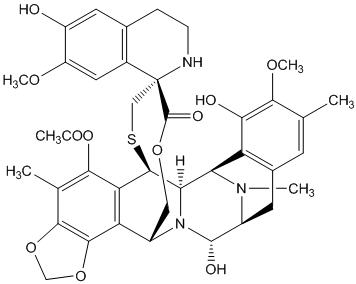
Active ingredient
Classification
Other plant alkaloids and natural productsAlkylating Drug
Drug interactions
Trabectedin has significant interactions with CYP3A inhibitors and inducers, affecting its systemic exposure.
- majorstrong CYP3A inhibitors — increased systemic exposure of trabectedin
- majorstrong CYP3A inducers — decreased systemic exposure of trabectedin
Indications
INDICATIONS AND USAGE YONDELIS ® is indicated for the treatment of adult patients with unresectable or metastatic liposarcoma or leiomyosarcoma who received a prior anthracycline-containing regimen [see Clinical Studies (14) ] . YONDELIS is an alkylating drug indicated for the treatment of adult patients with unresectable or metastatic liposarcoma or leiomyosarcoma who received a prior anthracycline-containing regimen ( 1 )
Dosage
DOSAGE AND ADMINISTRATION Administer at 1.5 mg/m 2 as a 24-hour intravenous infusion, every 3 weeks through a central venous line ( 2.1 , 2.6 ) Premedication: dexamethasone 20 mg intravenously, 30 min before each infusion ( 2.3 ) Hepatic Impairment: Administer at 0.9 mg/m 2 as a 24-hour intravenous infusion, every 3 weeks through a central venous line in patients with moderate hepatic impairment ( 2.2 ) 2.1 Recommended Dosage The recommended dose is 1.5 mg/m 2 administered as an intravenous infusion over 24 hours through a central venous line every 21 days (3 weeks), until disease progression or unacceptable toxicity. 2.2 Recommended Dosage in Patients with Hepatic Impairment The recommended dosage of YONDELIS in patients with moderate hepatic impairment (bilirubin levels greater than 1.5 times to 3 times the upper limit of normal, and AST and ALT less than 8 times the upper limit of normal) is 0.9 mg/m 2 every 21 days (3 weeks). Do not administer YONDELIS to patients with severe hepatic impairment (bilirubin levels above 3 times the upper limit of normal, and any AST and ALT) [ see Use in Specific Populations (8.6) and Clinical Pharmacology (12.3) ] . 2.3 Premedication Administer dexamethasone 20 mg intravenously 30 minutes prior to each dose of YONDELIS. 2.4 Dosage Modifications for Adverse Reactions Permanently discontinue YONDELIS for: Persistent adverse reactions requiring a delay in dosing of more than 3 weeks. Adverse reactions requiring dose reduction following YONDELIS administered at 1.0 mg/m 2 for patients with normal hepatic function or at 0.3 mg/m 2 for patients with pre-existing moderate hepatic impairment. Severe liver dysfunction: bilirubin two times the upper limit of normal, and AST or ALT three times the upper limit of normal, and alkaline phosphatase less than two times the upper limit of normal in the prior treatment cycle for patients with normal liver function at baseline. Exacerbation of liver dysfunction in patients with pre-existing moderate hepatic impairment. Capillary leak syndrome. Rhabdomyolysis. Grade 3 or 4 cardiac adverse events (AEs) indicative of cardiomyopathy or for subjects with an LVEF that decreases below the lower limit of normal. The recommended dose modifications for adverse reactions are listed in Table 1. Once reduced, the dose of YONDELIS should not be increased in subsequent treatment cycles. Table 1: Recommended Dosage Modification Laboratory Result or Adverse Reaction DELAY next dose of YONDELIS for up to 3 weeks REDUCE next dose of YONDELIS by one dose level for adverse reaction(s) during prior cycle Platelets Less than 100,000 platelets/microliter Less than 25,000 platelets/microliter Absolute neutrophil count Less than 1,500 neutrophils/microliter Less than 1,000 neutrophils/microliter with fever/infection Less than 500 neutrophils/microliter lasting more than 5 days Total bilirubin Greater than the upper limit of normal Greater than the upper limit of normal Aspartate aminotransferase (AST) or alanine aminotransferase (ALT) More than 2.5 times the upper limit of normal More than 5 times the upper limit of normal Alkaline phosphatase (ALP) More than 2.5 times the upper limit of normal More than 2.5 times the upper limit of normal Creatine phosphokinase More than 2.5 times the upper limit of normal More than 5 times the upper limit of normal Other non-hematologic adverse reactions Grade 3 or 4 Grade 3 or 4 The recommended starting doses and dose reductions for YONDELIS are listed in Table 2: Table 2: Recommended Starting Doses and Dose Reductions Starting Dose and Dose Reduction For patients with normal hepatic function or mild hepatic impairment Including patients with bilirubin greater than 1 to 1.5 times the upper limit of normal, and any AST or ALT. prior to initiation of YONDELIS treatment For patients with moderate hepatic impairment Including patients with bilirubin levels greater than 1.5 times to 3 times the upper limit of normal, and AST and ALT less than 8 times the upper limit of normal. prior to initiation of YONDELIS treatment Starting Dose 1.5 mg/m 2 0.9 mg/m 2 Dose Reduction First dose reduction 1.2 mg/m 2 0.6 mg/m 2 Second dose reduction 1.0 mg/m 2 0.3 mg/m 2 2.5 Preparation for Administration YONDELIS is a hazardous drug. Follow applicable special handling and disposal procedures. 1 Parenteral drug products should be inspected visually for particulate matter and discoloration prior to administration, whenever solution and container permit. Using aseptic technique, inject 20 mL of Sterile Water for Injection, USP into the vial. Shake the vial until complete dissolution. The reconstituted solution is clear, colorless to pale brownish-yellow, and contains 0.05 mg/mL of trabectedin. Inspect for particulate matter and discoloration prior to further dilution. Discard vial if particles or discoloration are observed. Immediately following reconstitution, withdraw the calculated volume of trabectedin and further dilute in 500 mL of 0.9% Sodium Chloride, USP or 5% Dextrose Injection, USP. Do not mix YONDELIS with other drugs. Discard any remaining solution within 30 hours of reconstituting the lyophilized powder. YONDELIS diluted solution is compatible with Type I colorless glass vials, polyvinylchloride (PVC) and polyethylene (PE) bags and tubing, PE and polypropylene (PP) mixture bags, polyethersulfone (PES) in-line filters, titanium, platinum or plastic ports, silicone and polyurethane catheters, and pumps having contact surfaces made of PVC, PE, or PE/PP. 2.6 Administration Infuse the reconstituted, diluted solution over 24 hours through a central venous line using an infusion set with a 0.2 micron polyethersulfone (PES) in-line filter. Complete infusion within 30 hours of initial reconstitution. Discard any unused portion of the reconstituted product or of the infusion solution.
Warnings
WARNINGS AND PRECAUTIONS Neutropenic sepsis: Severe, and fatal, neutropenic sepsis may occur. Monitor neutrophil count during treatment. Withhold YONDELIS for neutrophil count < 1,500/mcL ( 2.4 , 5.1 ) Rhabdomyolysis: Rhabdomyolysis may occur. Monitor creatine phosphokinase (CPK) levels prior to each administration. Withhold YONDELIS for CPK more than 2.5 times the upper limit of normal. ( 2.4 , 5.2 ) Hepatotoxicity: Hepatotoxicity may occur. Monitor and delay and/or reduce dose if needed ( 5.3 ) Cardiomyopathy: Severe and fatal cardiomyopathy can occur. Patients with left ventricular ejection fraction (LVEF) < lower limit of normal, prior cumulative anthracycline dose of ≥300 mg/m 2 , age ≥65 years, or a history of cardiovascular disease may be at increased risk of developing new or worsening cardiac dysfunction. Discontinue YONDELIS in patients who develop decreased LVEF or cardiomyopathy ( 2.4 , 5.4 ) Capillary leak syndrome: Monitor and discontinue YONDELIS for capillary leak syndrome ( 5.5 ) Embryo-fetal toxicity: Can cause fetal harm. Advise of potential risk to a fetus and use effective contraception ( 5.7 , 8.1 , 8.3 ) 5.1 Neutropenic Sepsis Neutropenic sepsis, including fatal cases, can occur with YONDELIS. In Trial ET743-SAR-3007, the incidence of Grade 3 or 4 neutropenia, based on laboratory values, in patients receiving YONDELIS was 43% (161/378). The median time to the first occurrence of Grade 3 or 4 neutropenia was 16 days (range: 8 days to 9.7 months); the median time to complete resolution of neutropenia was 13 days (range: 3 days to 2.3 months). Febrile neutropenia (fever ≥38.5 °C with Grade 3 or 4 neutropenia) occurred in 18 patients (5%) treated with YONDELIS. Ten patients (2.6%) experienced neutropenic sepsis, 5 of whom had febrile neutropenia, which was fatal in 4 patients (1.1%). Assess neutrophil count prior to administration of each dose of YONDELIS and periodically throughout the treatment cycle. Withhold or reduce dose of YONDELIS based on severity of adverse reaction [see Dosage and Administration (2.4) ] . 5.2 Rhabdomyolysis YONDELIS can cause rhabdomyolysis and musculoskeletal toxicity. In Trial ET743-SAR-3007, rhabdomyolysis leading to death occurred in 3 (0.8%) of the 378 patients receiving YONDELIS. Elevations in creatine phosphokinase (CPK) occurred in 122 (32%) of the 378 patients receiving YONDELIS, including Grade 3 or 4 CPK elevation in 24 patients (6%), compared to 15 (9%) of the 172 patients receiving dacarbazine with any CPK elevation, including 1 patient (0.6%) with Grade 3 CPK elevation. Among the 24 patients receiving YONDELIS with Grade 3 or 4 CPK elevation, renal failure occurred in 11 patients (2.9%); rhabdomyolysis with the complication of renal failure occurred in 4 of these 11 patients (1.1%). The median time to first occurrence of Grade 3 or 4 CPK elevations was 2 months (range: 1 to 11.5 months). The median time to complete resolution was 14 days (range: 5 days to 1 month). Assess CPK levels prior to each administration of YONDELIS. Withhold, reduce dose, or permanently discontinue based on severity of adverse reaction [see Dosage and Administration (2.4) ] . 5.3 Hepatotoxicity Hepatotoxicity, including hepatic failure, can occur with YONDELIS. Patients with serum bilirubin levels above the upper limit of normal or AST or ALT levels >2.5 × upper limit of normal were not enrolled in Trial ET743-SAR-3007. In Trial ET743-SAR-3007, the incidence of Grade 3–4 elevated liver function tests (LFTs; defined as elevations in ALT, AST, total bilirubin, or alkaline phosphatase) was 35% (134/378) in patients receiving YONDELIS. The median time to development of Grade 3–4 elevation in ALT or AST was 29 days (range: 3 days to 11.5 months). Of the 134 patients with Grade 3–4 elevations in LFTs, 114 (85%) experienced complete resolution with the median time to complete resolution of 13 days (range: 4 days to 4.4 months). In Trial ET743-SAR-3007, the incidence of drug-induced liver injury (defined as concurrent elevation in ALT or AST of more than three times the upper limit of normal, alkaline phosphatase less than two times the upper limit of normal, and total bilirubin at least two times the upper limit of normal) was 1.3% (5/378) in patients receiving YONDELIS. ALT or AST elevation greater than eight times the upper limit of normal occurred in 18% (67/378) of patients receiving YONDELIS. Assess LFTs prior to each administration of YONDELIS and as clinically indicated based on underlying severity of pre-existing hepatic impairment. Manage elevated LFTs with treatment interruption, dose reduction, or permanent discontinuation based on severity and duration of LFT abnormality [see Dosage and Administration (2.4) and Use in Specific Populations (8.6) ]. 5.4 Cardiomyopathy Cardiomyopathy including cardiac failure, congestive heart failure, ejection fraction decreased, diastolic dysfunction, or right ventricular dysfunction can occur with YONDELIS. In Trial ET743-SAR-3007, a significant decrease in LVEF was defined as an absolute decrease of ≥15% or below the lower limit of normal with an absolute decrease of ≥5%. Patients with a history of New York Heart Association Class II to IV heart failure or abnormal left ventricular ejection fraction (LVEF) at baseline were ineligible. In Trial ET743-SAR-3007, cardiomyopathy occurred in 23 patients (6%) receiving YONDELIS and in four patients (2.3%) receiving dacarbazine. Grade 3 or 4 cardiomyopathy occurred in 15 patients (4%) receiving YONDELIS and 2 patients (1.2%) receiving dacarbazine; cardiomyopathy leading to death occurred in 1 patient (0.3%) receiving YONDELIS and in none of the patients receiving dacarbazine. The median time to development of Grade 3 or 4 cardiomyopathy in patients receiving YONDELIS was 5.3 months (range: 26 days to 15.3 months). Patients with LVEF < lower limit of normal, prior cumulative anthracycline dose of ≥300 mg/m 2 , age ≥65 years, or a history of cardiovascular disease may be at increased risk of cardiac dysfunction. Assess LVEF by echocardiogram (ECHO) or multigated acquisition (MUGA) scan before initiation of YONDELIS and at 2- to 3-month intervals thereafter until YONDELIS is discontinued. Discontinue treatment with YONDELIS based on severity of adverse reaction [see Dosage and Administration (2.4) ] . 5.5 Capillary Leak Syndrome Capillary leak syndrome (CLS) characterized by hypotension, edema, and hypoalbuminemia has been reported with YONDELIS, including serious CLS resulting in death. Monitor for signs and symptoms of CLS. Discontinue YONDELIS and promptly initiate standard management for patients with CLS, which may include a need for intensive care [see Adverse Reactions (6.2) ] . 5.6 Extravasation Resulting in Tissue Necrosis Extravasation of YONDELIS, resulting in tissue necrosis requiring debridement, can occur. Evidence of tissue necrosis can occur more than 1 week after the extravasation. There is no specific antidote for extravasation of YONDELIS. Administer YONDELIS through a central venous line [see Dosage and Administration (2.6) ] . 5.7 Embryo-Fetal Toxicity Based on its mechanism of action, YONDELIS can cause fetal harm when administered to a pregnant woman. Advise females of reproductive potential to use effective contraception during therapy and for at least 8 months after the last dose of YONDELIS. Advise males with female partners of reproductive potential to use effective contraception during therapy and for at least 5 months after the last dose of YONDELIS [see Use in Specific Populations (8.1 , 8.3) ] .
Contraindications
CONTRAINDICATIONS YONDELIS is contraindicated in patients with known severe hypersensitivity, including anaphylaxis, to trabectedin. Known hypersensitivity to trabectedin ( 4 )
Mechanism of action
Mechanism of Action Trabectedin is an alkylating drug that binds guanine residues in the minor groove of DNA, forming adducts and resulting in a bending of the DNA helix towards the major groove. Adduct formation triggers a cascade of events that can affect the subsequent activity of DNA binding proteins, including some transcription factors, and DNA repair pathways, resulting in perturbation of the cell cycle and eventual cell death.
Indicated ICD-10 codes
Source: RxNorm + openFDA + RxClass + FAERS · 2026
Look up another medication