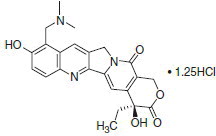
topotecan 0.25 MG Oral Capsule — Topoisomerase 1 (TOP1) inhibitors. INDICATIONS AND USAGE Topotecan Hydrochloride for injection is a topoisomerase inhibitor indicated for treatment of: Patients with metastatic…
Boxed warning
WARNING: BONE MARROW SUPPRESSION Do not give Topotecan Injection to patients with baseline neutrophil counts less than 1,500 cells/mm 3 . In order to monitor the occurrence of bone marrow suppression, primarily neutropenia, which may be severe and result in infection and death, monitor peripheral blood counts frequently on all patients receiving Topotecan Injection . [see Warnings and Precautions ( 5.1 ) ] WARNING: BONE MARROW SUPPRESSION See full prescribing information for complete boxed warning Do not give Topotecan to patients with baseline neutrophil counts less than 1,500 cells/mm 3 . In order to monitor the occurrence of bone marrow suppression, primarily neutropenia, which may be severe and result in infection and death, monitor peripheral blood cell counts frequently on all patients receiving Topotecan Injection. ( 5.1 )
INDICATIONS AND USAGE Topotecan Hydrochloride for injection is a topoisomerase inhibitor indicated for treatment of: Patients with metastatic ovarian cancer after disease progression on or after initial or subsequent chemotherapy, as a single agent ( 1.1 ) Patients with small cell lung cancer (SCLC) platinum-sensitive disease who progressed at least 60 days after initiation of first-line chemotherapy, as a single agent ( 1.2 ) Patients with Stage IV-B, recurrent, or persistent cervical cancer which is not amenable to curative treatment, in combination with cisplatin ( 1.3 ) 1.1 Ovarian Cancer Topotecan hydrochloride for injection, as a single agent, is indicated for the treatment of patients with metastatic ovarian cancer after disease progression on or after initial or subsequent chemotherapy. 1.2 Small Cell Lung Cancer Topotecan hydrochloride for injection, as a single agent, is indicated for the treatment of patients with small cell lung cancer (SCLC) with platinum-sensitive disease who progressed at least 60 days after initiation of first-line chemotherapy. 1.3 Cervical Cancer Topotecan hydrochloride for injection, in combination with cisplatin, is indicated for the treatment of patients with Stage IV-B, recurrent, or persistent cervical cancer not amenable to curative treatment.
Dosage
DOSAGE AND ADMINISTRATION Verify dose using body surface area prior to dispensing. Recommended dosage should not exceed 4 mg [see Overdosage 10 ]. Prior to administration of the first course of Topotecan Injection, patients must have a baseline neutrophil count of >1,500 cells/mm 3 and a platelet count of >100,000 cells/mm 3 . Small cell lung cancer: 1.5 mg/m 2 by intravenous infusion over 30 minutes daily for 5 consecutive days, starting on day one of a 21-day course. ( 2.1 ) Cervical cancer: 0.75 mg/m 2 by intravenous infusion over 30 minutes on days 1, 2, and 3 followed by cisplatin 50 mg/m 2 by intravenous infusion on day 1 repeated every 21 days. ( 2.2 ) See Dosage Modification Guidelines for patients with neutropenia or reduced platelets.( 2.1 , 2.2 ) See Dosage Adjustment in Renal Impairment. ( 2.3 ) 2.1 Small Cell Lung Cancer Recommended Dosage The recommended dose of topotecan is 1.5 mg/m 2 by intravenous infusion over 30 minutes daily for 5 consecutive days, starting on day 1 of a 21-day course. In the absence of tumor progression, a minimum of 4 courses is recommended because tumor response may be delayed. The median time to response in 4 small cell lung cancer trials was 5 to 7 weeks. Dosage Modification Guidelines In the event of severe neutropenia (defined as <500 cells/mm 3 ) during any course, reduce the dose by 0.25 mg/m 2 (to 1.25 mg/m 2 ) for subsequent courses. Alternatively, in the event of severe neutropenia, administer G-CSF (granulocyte-colony stimulating factor) following the subsequent course (before resorting to dose reduction) starting from day 6 of the course (24 hours after completion of topotecan administration). In the event the platelet count falls below 25,000 cells/mm 3 , reduce doses by 0.25 mg/m 2 (to 1.25 mg/m 2 ) for subsequent courses. 2.2 Cervical Cancer Recommended Dosage The recommended dose of Topotecan Injection is 0.75 mg/m 2 by intravenous infusion over 30 minutes daily on days 1, 2, and 3; followed by cisplatin 50 mg/m 2 by intravenous infusion on day 1 repeated every 21 days (a 21-day course). Dosage Modification Guidelines Dosage adjustments for subsequent courses of Topotecan Injection in combination with cisplatin are specific for each drug. See manufacturer’s prescribing information for cisplatin administration and hydration guidelines and for cisplatin dosage adjustment in the event of hematologic toxicity In the event of severe febrile neutropenia (defined as <1000 cells/mm 3 with temperature of 38°C or 100.4°F), reduce the dose of Topotecan Injection to 0.60 mg/m 2 for subsequent courses. Alternatively, in the event of severe febrile neutropenia, administer G-CSF following the subsequent course (before resorting to dose reduction) starting from day 4 of the course (24 hours after completion of administration of Topotecan Injection). If febrile neutropenia occurs despite the use of G-CSF, reduce the dose of Topotecan Injection to 0.45 mg/m 2 for subsequent courses. In the event the platelet count falls below 25,000 cells/mm 3 , reduce doses to 0.60 mg/m 2 for subsequent courses. 2.3 Dosage Adjustment in Specific Populations Renal Impairment No dosage adjustment of Topotecan Injection appears to be required for patients with mild renal impairment (Cl cr 40 to 60 mL/min.). Dosage adjustment of Topotecan Injection to 0.75 mg/m 2 is recommended for patients with moderate renal impairment (20 to 39 mL/min.). Insufficient data are available in patients with severe renal impairment to provide a dosage recommendation for Topotecan Injection. [see Use in Specific Populations ( 8.6 ) and Clinical Pharmacology ( 12.3 ) ] Topotecan Injection in combination with cisplatin for the treatment of cervical cancer should only be initiated in patients with serum creatinine ≤1.5 mg/dL. In the clinical trial, cisplatin was discontinued for a serum creatinine >1.5 mg/dL. Insufficient data are available regarding continuing monotherapy with Topotecan Injection after cisplatin discontinuation in patients with cervical cancer. 2.4 Instructions for Handling, Preparation and Intravenous Administration Handling Topotecan is a cytotoxic anticancer drug. Prepare Topotecan Injection under a vertical laminar flow hood while wearing gloves and protective clothing. If Topotecan Injection solution contacts the skin, wash the skin immediately and thoroughly with soap and water. If Topotecan Injection contacts mucous membranes, flush thoroughly with water. Use procedures for proper handling and disposal of anticancer drugs. Several guidelines on this subject have been published. 1-4 Preparation and Administration The appropriate volume of the Topotecan Injection is diluted in a minimum of 50 mL of 0.9% Sodium Chloride Injection, USP or 5% Dextrose Injection, USP prior to administration. Infuse over 30 minutes. Topotecan Injection diluted for infusion is stable for 4 hours at room temperature or 24 hours at refrigerated temperature in ambient lighting conditions. Topotecan Injection is supplied as a multiple dose vial. Studies have shown the product is stable for 28 days after initial puncture when stored at room temperature.
Warnings
WARNINGS AND PRECAUTIONS Bone marrow suppression: Administer Topotecan Injection only to patients with adequate bone marrow reserves. Monitor peripheral blood counts and adjust the dose if needed. ( 5.1 ) Topotecan-induced neutropenia can lead to neutropenic colitis. ( 5.2 ) Interstitial lung disease: topotecan has been associated with reports of interstitial lung disease. Monitor patients for symptoms and discontinue Topotecan Injection if the diagnosis is confirmed. ( 5.3 ) Pregnancy: Can cause fetal harm. Advise women of potential risk to the fetus. ( 5.4 , 8.1 ) 5.1 Bone Marrow Suppression Bone marrow suppression (primarily neutropenia) is the dose-limiting toxicity of Topotecan Injection. Neutropenia is not cumulative over time. In the comparative study, in small cell lung cancer, the treatment-related death rates were 5% for topotecan and 4% for CAV (cyclophosphamide-doxorubicin-vincristine). Neutropenia From a combined experience of patients receiving topotecan which included patients treated for small cell lung cancer: Grade 4 neutropenia (<500 cells/mm 3 ) was most common during course 1 of treatment (60% of patients) and occurred in 39% of all courses, with a median duration of 7 days. The nadir neutrophil count occurred at a median of 12 days. Therapy-related sepsis or febrile neutropenia occurred in 23% of patients, and sepsis was fatal in 1%. Pancytopenia has been reported. Cervical cancer experience: Grade 3 and grade 4 neutropenia affected 26 % and 48 % of patients, respectively. Thrombocytopenia From a combined experience of patients receiving topotecan which included patients treated for small cell lung cancer: Grade 4 thrombocytopenia (<25,000/mm 3 ) occurred in 27% of patients and in 9% of courses, with a median duration of 5 days and platelet nadir at a median of 15 days. Platelet transfusions were given to 15% of patients in 4% of courses. Cervical cancer experience: Grade 3 and grade 4 thrombocytopenia affected 26 % and 7 % of patients, respectively. Anemia From a combined experience of patients receiving topotecan which included patients treated for small cell lung cancer: Grade 3/4 anemia (<8 g/dL) occurred in 37% of patients and in 14% of courses. Median nadir was at day 15. Transfusions were needed in 52% of patients in 22% of courses. Cervical cancer experience: Grade 3 and grade 4 anemia affected 34 % and 6 % of patients, respectively. Monitoring of Bone Marrow Function Administer Topotecan Injection only in patients with adequate bone marrow reserves, including baseline neutrophil count of at least 1,500 cells/mm 3 and platelet count at least 100,000/mm 3 . Monitor peripheral blood counts frequently during treatment with Topotecan Injection. Do not treat patients with subsequent courses of Topotecan Injection until neutrophils recover to >1,000 cells/mm 3 , platelets recover to >100,000 cells/mm 3 , and hemoglobin levels recover to 9 g/dL (with transfusion if necessary).Severe myelotoxicity has been reported when Topotecan Injection is used in combination with cisplatin [see Drug Interactions ( 7 ) ] 5.2 Neutropenic Colitis Topotecan-induced neutropenia can lead to neutropenic colitis. Fatalities due to neutropenic colitis have been reported in clinical trials with Topotecan Injection. In patients presenting with fever, neutropenia, and a compatible pattern of abdominal pain, consider the possibility of neutropenic colitis. 5.3 Interstitial Lung Disease Topotecan Injection has been associated with reports of interstitial lung disease (ILD), some of which have been fatal [see Adverse Reactions ( 6.2 ) ]. Underlying risk factors include history of ILD, pulmonary fibrosis, lung cancer, thoracic exposure to radiation, and use of pneumotoxic drugs and/or colony stimulating factors. Monitor patients for pulmonary symptoms indicative of interstitial lung disease (e.g., cough, fever, dyspnea, and/or hypoxia), and discontinue Topotecan Injection if a new diagnosis of ILD is confirmed. 5.4 Pregnancy Pregnancy Category D Topotecan Injection can cause fetal harm when administered to a pregnant woman. Topotecan caused embryolethality, fetotoxicity, and teratogenicity in rats and rabbits when administered during organogenesis. There are no adequate and well controlled studies of Topotecan Injection in pregnant women. If this drug is used during pregnancy, or if a patient becomes pregnant while receiving Topotecan Injection, the patient should be apprised of the potential hazard to the fetus. [see Use in Specific Populations, Pregnancy ( 8.1 ) ] 5.5 Inadvertent Extravasation Inadvertent extravasation with topotecan has been observed, most reactions have been mild but severe cases have been reported.
Contraindications
CONTRAINDICATIONS Topotecan Injection is contraindicated in patients who have a history of severe hypersensitivity reactions (e.g., anaphylactoid reactions) to topotecan or to any of its ingredients. Topotecan Injection should not be used in patients with severe bone marrow depression. History of severe hypersensitivity reactions (e.g., anaphylactoid reactions) to topotecan or any of its ingredients ( 4 ) Severe bone marrow depression ( 4 )
Mechanism of action
CLINICAL PHARMACOLOGY 12.1 Mechanism of Action Topoisomerase I relieves torsional strain in DNA by inducing reversible single-strand breaks. Topotecan binds to the topoisomerase I-DNA complex and prevents re-ligation of these single-strand breaks. The cytotoxicity of topotecan is thought to be due to double-strand DNA damage produced during DNA synthesis, when replication enzymes interact with the ternary complex formed by topotecan, topoisomerase I, and DNA. Mammalian cells cannot efficiently repair these double-strand breaks. 12.3 Pharmacokinetics Following administration of topotecan hydrochloride for injection at doses of 0.5 to 1.5 mg/m 2 (0.1 to 0.3 times the recommended single agent dose) administered as a 30-minute infusion, area under the curve (AUC) increases proportionally with dose. Distribution Protein binding of topotecan is approximately 35%. Elimination The terminal half-life of topotecan is 2 to 3 hours following intravenous administration. Metabolism Topotecan undergoes a reversible pH-dependent hydrolysis of its pharmacologically active lactone moiety. At pH less than or equal to 4, the lactone is exclusively present, whereas the ring-opened hydroxyl-acid form predominates at physiologic pH. Topotecan is metabolized to an N-demethylated metabolite in vitro . The mean metabolite: parent AUC ratio was about 3% for total topotecan and topotecan lactone following intravenous administration. Excretion The overall recovery of total topotecan and its N-desmethyl metabolite in urine and feces over 9 days averaged 73% ± 2% following an intravenous dose. Mean values of 51% ± 3% as total topotecan and 3% ± 1% as N desmethyl topotecan were excreted in the urine. Fecal elimination of total topotecan accounted for 18% ± 4% while fecal elimination of N-desmethyl topotecan was 1.7% ± 0.6%. An O-glucuronidation metabolite of topotecan and N-desmethyl topotecan has been identified in the urine. Specific Populations No clinically significant differences in the pharmacokinetics of topotecan were observed based on age, sex, or hepatic impairment following intravenous administration. Patients with Renal Impairment Compared to patients with CLcr (calculated by the Cockcroft-Gault method using ideal body weight) greater than 60 mL/min, plasma clearance of topotecan lactone decreased by 33% in patients with CLcr 40 to 60 mL/min and decreased 65% in patients with CLcr 20 to 39 mL/min. The effect on topotecan pharmacokinetics in patients with CLcr less than 20 mL/min is unknown [see Dosage and Administration ( 2.6 )] . Drug Interaction Studies Clinical Studies No clinically significant changes in topotecan pharmacokinetics were observed when coadministered cisplatin. No clinically significant changes in the pharmacokinetics of free platinum were observed in patients coadministered cisplatin with topotecan. In Vitro Studies Topotecan does not inhibit CYP1A2, CYP2A6, CYP2C8/9, CYP2C19, CYP2D6, CYP2E, CYP3A, or CYP4A or dihydropyrimidine dehydrogenase.
A drug lookup is just the start. Eleplan keeps the whole care plan in one place.
Medications, diagnoses, documents, appointments, and the whole care team — organized and always in sync, with Ellie, your AI care assistant, on top of it. Free to start.