succimer 100 MG Oral Capsule
Managing this medication for someone you care for? Eleplan keeps diagnoses, medications and appointments in one plan.
Start free with EleplanClinical drug
succimer 100 MG Oral Capsule
100 MG · Oral Capsule · oral
A form of succimer →
succimer 100 MG Oral Capsule. INDICATIONS AND USAGE CHEMET is indicated for the treatment of lead poisoning in pediatric patients aged 1 year and older with blood lead levels…
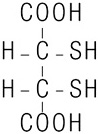
Active ingredient
Classification
Lead Chelator
Drug interactions
CHEMET may interfere with laboratory tests and should not be used with other chelation therapies.
- majorCaNa2 EDTA — concomitant use is not recommended
- unknownketones in urine — may cause false positive results
- moderateserum uric acid — may cause falsely decreased measurements
- moderatecreatinine phosphokinase (CPK) — may cause falsely decreased measurements
Indications
INDICATIONS AND USAGE CHEMET is indicated for the treatment of lead poisoning in pediatric patients aged 1 year and older with blood lead levels above 45 mcg/dL. CHEMET is a lead chelator indicated for the treatment of lead poisoning in pediatric patients aged 1 year and older with blood lead levels above 45 mcg/dL. ( 1 ) Limitations of Use CHEMET is not indicated for prophylaxis of lead poisoning in a lead-containing environment. ( 1 ) CHEMET does not cross the blood-brain barrier and is not indicated to treat encephalopathy associated with lead toxicity. ( 1 ) Limitations of Use CHEMET is not indicated for prophylaxis of lead poisoning in a lead-containing environment. CHEMET does not cross the blood-brain barrier and is not indicated to treat encephalopathy associated with lead toxicity.
Dosage
DOSAGE AND ADMINISTRATION See Full Prescribing Information for important pretreatment evaluations. ( 2.1 ) Ensure patients receiving CHEMET are adequately hydrated. ( 2.3 ) Administer CHEMET capsules whole when possible. ( 2.3 ) Pediatric patients who cannot swallow whole capsules: Sprinkle contents of capsule in food (or on a spoon followed by a drink). ( 2.3 ) Recommended Dosage: 10 mg/kg or 350 mg/m 2 orally every 8 hours for five days followed by 10 mg/kg or 350 mg/m 2 orally every 12 hours for an additional 14 days. ( 2.2 ) 2.1 Important Pretreatment Evaluations Identify the source of lead in the pediatric patient's environment and eliminate the source prior to beginning treatment with CHEMET. Assess the following before initiating treatment with CHEMET: Blood lead concentration Complete blood count (CBC) with differential and platelets [see Dosage and Administration (2.2) , Warnings and Precautions (5.2) ] Ensure absolute neutrophil count (ANC) > 1500/mcL [see Dosage and Administration (2.2) ] Transaminases (AST/ALT) [see Warnings and Precautions (5.3) and Use in Specific Populations (8.6) ] Renal function with blood urea nitrogen (BUN), creatinine, urinary protein [see Use in Specific Populations (8.5) ] . Patients who have previously received Edetate calcium disodium (CaNa 2 EDTA) with or without dimercaprol may receive CHEMET for subsequent treatment after an interval of four weeks. 2.2 Recommended Dosage The recommended dosage of CHEMET for pediatric patients with lead poisoning is 10 mg/kg or 350 mg/m 2 orally every 8 hours for five days followed by 10 mg/kg or 350 mg/m 2 orally every 12 hours for an additional 14 days [see Table 1 CHEMET Pediatric Dosing Chart ]. Initiation of therapy at higher doses is not recommended. The total treatment course consists of 19 days. After discontinuation of CHEMET, elevated blood levels and associated symptoms may return rapidly because of redistribution of lead from bone stores to soft tissues and blood. Assess blood lead concentration after the completion of a 19 day course and every week until stable. Repeated courses may be administered after two weeks off treatment if blood lead concentrations remain elevated. A minimum of two weeks between treatment courses is recommended unless blood lead concentrations indicate the need for more prompt treatment. Table 1. CHEMET Pediatric Dosing Chart Weight in Kilograms (kg) Dose (mg) Number of Capsules 8 to15 kg 100 mg 1 16 to 23 kg 200 mg 2 24 to 34 kg 300 mg 3 35 to 44 kg 400 mg 4 >45 kg 500 mg 5 The safety of uninterrupted dosing longer than 3 weeks has not been established and is not recommended. Dosage Modifications for Neutropenia Monitor CBCs weekly. If the absolute neutrophil count (ANC) is <1200/mcL interrupt CHEMET. Resume CHEMET when ANC has recovered to >1500/mcL (or the patient's baseline count). Immediately discontinue CHEMET for signs/symptoms of infection. Only rechallenge patients who developed neutropenia with CHEMET therapy if the benefit clearly outweighs the potential risk. 2.3 Preparation and Administration Instructions Administer CHEMET capsules whole. In pediatric patients who cannot swallow the capsules whole, separate the capsule and sprinkle the medicated beads on a small amount of soft food or put them in a spoon and follow with a fruit drink. Ensure that all patients receiving CHEMET are adequately hydrated [see Use in Specific Populations (8.5) , Pharmacokinetics (12.3) ] .
Warnings
WARNINGS AND PRECAUTIONS Hypersensitivity and dermatologic reactions: Interrupt treatment if rash or mucocutaneous vesicular eruptions occur. ( 5.1 ) Neutropenia: Monitor complete blood counts, interrupt treatment for ANC below 1200/mcL, and monitor for infection. ( 5.2 ) Hepatic Toxicity: Monitor hepatic transaminases (ALT/AST); interrupt treatment if above 5 times ULN. ( 5.3 ) Embryo-Fetal Toxicity: May cause fetal harm when administered to a pregnant woman. ( 5.5 ) 5.1 Hypersensitivity and Dermatologic Reactions CHEMET can cause hypersensitivity reactions and dermatologic reactions. Rash Rash occurs in approximately 4% of patients treated with CHEMET. Interrupt treatment if rash occurs. Consider rechallenge if lead levels are high enough to warrant retreatment. Hypersensitivity reactions including urticaria and angioedema have been reported on repeated administration of CHEMET [see Contraindications (4) ]. Mucocutaneous Reactions Mucocutaneous vesicular eruptions can occur with CHEMET use and may increase with each treatment course. Monitor patients requiring repeated CHEMET courses for the occurrence of mucocutaneous eruptions, including oral, urethral, and perianal. Interrupt treatment if mucocutaneous vesicular eruptions occur. 5.2 Neutropenia Iron chelators, including CHEMET, can cause neutropenia. Monitoring of complete blood counts is recommended [see Dosage and Administration (2.2) ] . Interrupt treatment if absolute neutrophil count (ANC) is <1200/mcL and interrupt treatment until recovery to above 1500/mcL (or the patient's baseline count). Only rechallenge patients who developed neutropenia with CHEMET therapy if the benefit clearly outweighs the potential risk. If rechallenge is attempted, monitor CBC more frequently. Monitor for signs and symptoms of infection and immediately discontinue CHEMET if they develop. 5.3 Hepatic Toxicity Elevated transaminases (ALT/AST) occurred in 6-10% of patients treated with CHEMET. Monitor serum AST and ALT at baseline and at least weekly during treatment. Monitor patients with a history of liver disease more frequently. Serum aminotransferase elevations above 5 times the upper limit of normal (if confirmed) should lead to dose reduction or temporary cessation. 5.4 Embryo-Fetal Toxicity Based on findings from animal reproduction studies, CHEMET may cause fetal harm when administered to a pregnant woman. Advise females of reproductive potential to use an effective method of contraception during treatment with CHEMET and for 14 days after the final dose [see Use in Specific Populations (8.1 , 8.3) ] . 5.5 Laboratory Test Interference CHEMET may interfere with serum and urinary laboratory tests [see Drug Interactions (7.1) ] .
Contraindications
CONTRAINDICATIONS CHEMET is contraindicated in patients with a history of hypersensitivity reaction to succimer. Reactions have included mucocutaneous vesicular eruptions, urticaria, and angioedema [see Warnings and Precautions (5.1) ] . Patients with a history of hypersensitivity reaction to succimer. ( 4 )
Mechanism of action
Mechanism of Action Succimer is a lead chelator; it forms water soluble chelates and, consequently, increases the urinary excretion of lead.
Indicated ICD-10 codes
Source: RxNorm + openFDA + RxClass + FAERS · 2026
Look up another medication