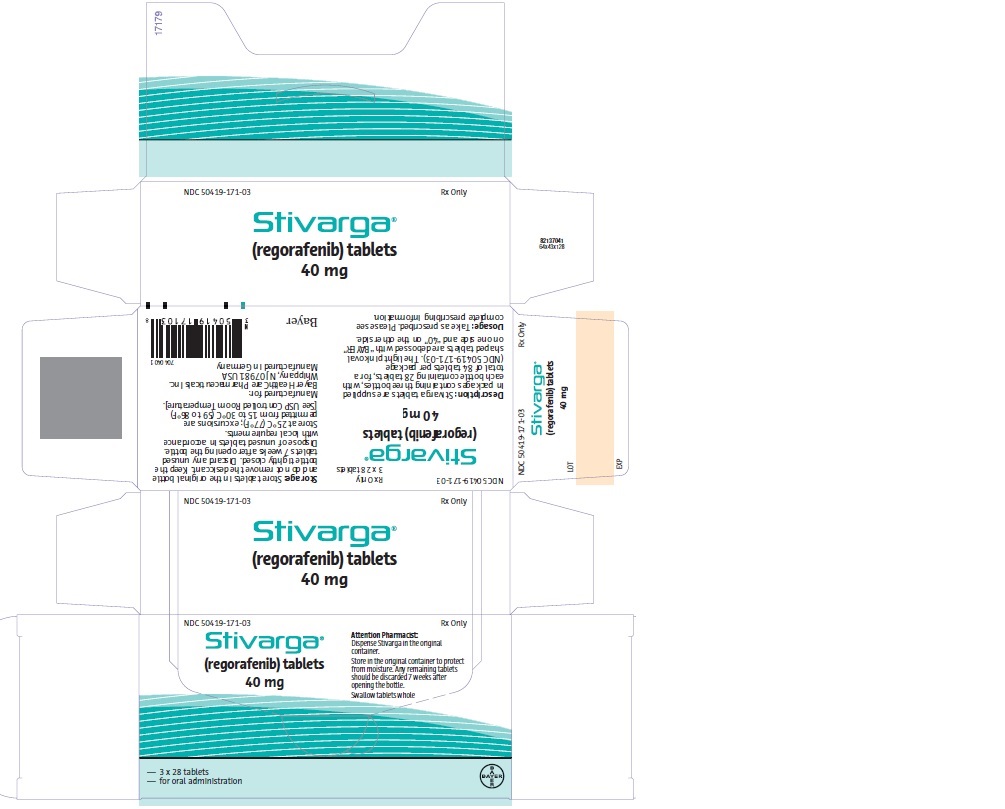
regorafenib 40 MG Oral Tablet — Other protein kinase inhibitors. INDICATIONS AND USAGE STIVARGA is a kinase inhibitor indicated for the treatment of adult patients with: • Metastatic colorectal cancer (CRC) who…
Boxed warning
WARNING: HEPATOTOXICITY • Severe and sometimes fatal hepatotoxicity has occurred in clinical trials [see Warnings and Precautions ( 5.1 )] . • Monitor hepatic function prior to and during treatment [see Warnings and Precautions ( 5.1 )]. • Interrupt and then reduce or discontinue STIVARGA for hepatotoxicity as manifested by elevated liver function tests or hepatocellular necrosis, depending upon severity and persistence [see Dosage and Administration ( 2.2 )] . WARNING: HEPATOTOXICITY See full prescribing information for complete boxed warning. • Severe and sometimes fatal hepatotoxicity has occurred in clinical trials. ( 5.1 ) • Monitor hepatic function prior to and during treatment. ( 5.1 ) • Interrupt and then reduce or discontinue STIVARGA for hepatotoxicity as manifested by elevated liver function tests or hepatocellular necrosis, depending upon severity and persistence. ( 2.2 )
Regorafenib has several significant interactions with strong CYP3A4 inducers and inhibitors, as well as with BCRP substrates.
majorstrong CYP3A4 inducers — decreased efficacy of regorafenib
majorstrong CYP3A4 inhibitors — increased toxicity of regorafenib
moderateBCRP substrates — increased exposure to BCRP substrates
Indications
INDICATIONS AND USAGE STIVARGA is a kinase inhibitor indicated for the treatment of adult patients with: • Metastatic colorectal cancer (CRC) who have been previously treated with fluoropyrimidine-, oxaliplatin- and irinotecan-based chemotherapy, an anti-VEGF therapy, and, if RAS wild-type, an anti-EGFR therapy. ( 1.1 ) • Locally advanced, unresectable or metastatic gastrointestinal stromal tumor (GIST) who have been previously treated with imatinib mesylate and sunitinib malate. ( 1.2 ) • Hepatocellular carcinoma (HCC) who have been previously treated with sorafenib ( 1.3 ) 1.1 Colorectal Cancer STIVARGA is indicated for the treatment of adult patients with metastatic colorectal cancer (CRC) who have been previously treated with fluoropyrimidine-, oxaliplatin- and irinotecan-based chemotherapy, an anti-VEGF therapy, and, if RAS wild-type, an anti-EGFR therapy. 1.2 Gastrointestinal Stromal Tumors STIVARGA is indicated for the treatment of adult patients with locally advanced, unresectable or metastatic gastrointestinal stromal tumor (GIST) who have been previously treated with imatinib mesylate and sunitinib malate. 1.3 Hepatocellular Carcinoma STIVARGA is indicated for the treatment of adult patients with hepatocellular carcinoma (HCC) who have been previously treated with sorafenib.
Dosage
DOSAGE AND ADMINISTRATION • Recommended dose: 160 mg orally, once daily for the first 21 days of each 28-day cycle. ( 2.1 ) • Take STIVARGA after a low-fat meal. ( 2.1 , 12.3 ) 2.1 Recommended Dose The recommended dose is 160 mg STIVARGA (four 40 mg tablets) taken orally once daily for the first 21 days of each 28-day cycle. Continue treatment until disease progression or unacceptable toxicity. Take STIVARGA at the same time each day. Swallow tablet whole with water after a low-fat meal that contains less than 600 calories and less than 30% fat [see Clinical Pharmacology ( 12.3 )] . Do not take two doses of STIVARGA on the same day to make up for a missed dose from the previous day. 2.2 Dose Modifications If dose modifications are required, reduce the dose in 40 mg (one tablet) increments; the lowest recommended daily dose of STIVARGA is 80 mg daily. Interrupt STIVARGA for the following: • Grade 2 hand-foot skin reaction (HFSR) [palmar-plantar erythrodysesthesia syndrome (PPES)] that is recurrent or does not improve within 7 days despite dose reduction; interrupt therapy for a minimum of 7 days for Grade 3 HFSR • Symptomatic Grade 2 hypertension • Any Grade 3 or 4 adverse reaction • Worsening infection of any grade Reduce the dose of STIVARGA to 120 mg: • For the first occurrence of Grade 2 HFSR of any duration • After recovery of any Grade 3 or 4 adverse reaction except infection • For Grade 3 aspartate aminotransferase (AST)/alanine aminotransferase (ALT) elevation, only resume if the potential benefit outweighs the risk of hepatotoxicity Reduce the dose of STIVARGA to 80 mg: • For re-occurrence of Grade 2 HFSR at the 120 mg dose • After recovery of any Grade 3 or 4 adverse reaction at the 120 mg dose (except hepatotoxicity or infection) Discontinue STIVARGA permanently for the following: • Failure to tolerate 80 mg dose • Any occurrence of AST or ALT more than 20 times the upper limit of normal (ULN) • Any occurrence of AST or ALT more than 3 times ULN with concurrent bilirubin more than 2 times ULN • Re-occurrence of AST or ALT more than 5 times ULN despite dose reduction to 120 mg • For any Grade 4 adverse reaction; only resume if the potential benefit outweighs the risks
Warnings
WARNINGS AND PRECAUTIONS • Hepatotoxicity : Monitor liver function tests. Withhold and then reduce or discontinue STIVARGA based on severity and duration. ( 5.1 ) • Infections : Withhold STIVARGA in patients with worsening or severe infections. ( 5.2 ) • Hemorrhage : Permanently discontinue STIVARGA for severe or life-threatening hemorrhage. ( 5.3 ) • Gastrointestinal perforation or fistula : Discontinue STIVARGA. ( 5.4 ) • Dermatologic toxicity : Withhold and then reduce or discontinue STIVARGA depending on severity and persistence of dermatologic toxicity. ( 5.5 ) • Hypertension : Temporarily or permanently withhold STIVARGA for severe or uncontrolled hypertension. ( 5.6) • Cardiac ischemia and infarction : Withhold STIVARGA for new or acute cardiac ischemia/infarction and resume only after resolution of acute ischemic events. ( 5.7) • Reversible posterior leukoencephalopathy syndrome (RPLS) : Discontinue STIVARGA. ( 5.8) • Risk of impaired wound healing : Withhold for at least 2 weeks prior to elective surgery. Do not administer for at least 2 weeks after major surgery and until adequate wound healing. The safety of resumption of STIVARGA after resolution of wound healing complications has not been established. ( 5.9 ) • Embryo-fetal toxicity : Can cause fetal harm. Advise women of potential risk to a fetus and to use effective contraception during treatment and for 2 months after the final dose. Advise males to use effective contraception for 2 months after the final dose. ( 5.10 , 8.1 , 8.3 ) 5.1 Hepatotoxicity Severe drug-induced liver injury with fatal outcome occurred in STIVARGA-treated patients in clinical trials. In most cases, liver dysfunction occurred within the first 2 months of therapy and was characterized by a hepatocellular pattern of injury. Additionally, hyperammonemic encephalopathy, including fatal cases, have been reported in the postmarketing setting in patients treated with STIVARGA. The risk of hyperammonemic encephalopathy appears increased in patients with liver dysfunction, liver metastases, or primary liver cancer. In the CORRECT study, fatal hepatic failure occurred in 1.6% of patients in the regorafenib arm and in 0.4% of patients in the placebo arm. In the GRID study , fatal hepatic failure occurred in 0.8% of patients in the regorafenib arm. In the RESORCE study, there was no increase in the incidence of fatal hepatic failure as compared to placebo [see Adverse Reactions ( 6.1 )] . Obtain liver function tests (ALT, AST, and bilirubin) before initiation of STIVARGA and monitor at least every two weeks during the first 2 months of treatment. Thereafter, monitor monthly or more frequently as clinically indicated. Monitor liver function tests weekly in patients experiencing elevated liver function tests until improvement to less than 3 times the ULN or baseline. For patients who develop unexplained lethargy or changes in mental status, measure ammonia level and initiate appropriate clinical management. Temporarily hold and then reduce or permanently discontinue STIVARGA depending on the severity and persistence of hepatotoxicity as manifested by elevated liver function tests or hepatocellular necrosis [see Dosage and Administration ( 2.2 ) and Use in Specific Populations ( 8.6 )] . If hyperammonemic encephalopathy is confirmed, withhold and consider permanent discontinuation of STIVARGA. 5.2 Infections STIVARGA caused an increased risk of infections. The overall incidence of infection (Grades 1-5) was higher (32% vs. 17%) in 1142 STIVARGA-treated patients as compared to the control arm in randomized placebo‑controlled trials.The incidence of grade 3 or greater infections in STIVARGA treated patients was 9%. The most common infections were urinary tract infections (5.7%), nasopharyngitis (4.0%), mucocutaneous and systemic fungal infections (3.3%) and pneumonia (2.6%). Fatal outcomes caused by infection occurred more often in patients treated with STIVARGA (1.0%) as compared to patients receiving placebo (0.3%); the most common fatal infections were respiratory (0.6% in STIVARGA-treated patients vs 0.2% in patients receiving placebo). Withhold STIVARGA for Grade 3 or 4 infections, or worsening infection of any grade. Resume STIVARGA at the same dose following resolution of infection [see Dosage and Administration ( 2.2 )] . 5.3 Hemorrhage STIVARGA caused an increased incidence of hemorrhage. The overall incidence (Grades 1-5) was 18.2% in 1142 patients treated with STIVARGA and 9.5% in patients receiving placebo in randomized, placebo‑controlled trials. The incidence of grade 3 or greater hemorrhage in patients treated with STIVARGA was 3.0%. The incidence of fatal hemorrhagic events was 0.7%, involving the central nervous system or the respiratory, gastrointestinal, or genitourinary tracts. Permanently discontinue STIVARGA in patients with severe or life-threatening hemorrhage. Monitor INR levels more frequently in patients receiving warfarin [see Clinical Pharmacology ( 12.3 )] . 5.4 Gastrointestinal Perforation or Fistula Gastrointestinal perforation occurred in 0.6% of 4518 patients treated with STIVARGA across all clinical trials of STIVARGA administered as a single agent; this included eight fatal events. Gastrointestinal fistula occurred in 0.8% of patients treated with STIVARGA and 0.2% of patients in placebo arm across randomized, placebo-controlled trials. Permanently discontinue STIVARGA in patients who develop gastrointestinal perforation or fistula. 5.5 Dermatologic Toxicity In randomized, placebo-controlled trials, adverse skin reactions occurred in 71.9% of patients in the regorafenib arm and in 25.5% of patients in the placebo arm, including hand-foot skin reaction (HFSR) also known as palmar-plantar erythrodysesthesia syndrome (PPES), and severe rash requiring dose modification. In the randomized, placebo-controlled trials, the overall incidence of HFSR was higher in 1142 STIVARGA-treated patients (53%) than in the placebo-treated patients (8%). Most cases of HFSR in STIVARGA-treated patients appeared during the first cycle of treatment. The incidences of Grade 3 HFSR (16% versus <1%), Grade 3 rash (3% versus <1%), serious adverse reactions of erythema multiforme (<0.1% vs. 0%) and Stevens-Johnson Syndrome (<0.1% vs. 0%) were also higher in STIVARGA-treated patients [see Adverse Reactions (6.1)] . Across all trials, a higher incidence of HFSR was observed in Asian patients treated with STIVARGA (all grades: 72%; Grade 3: 18%) [see Use in Specific Populations ( 8.8 )] . Toxic epidermal necrolysis occurred in 0.02% of 4518 STIVARGA-treated patients across all clinical trials of STIVARGA administered as a single agent. Withhold STIVARGA, reduce the dose, or permanently discontinue STIVARGA depending on the severity and persistence of dermatologic toxicity [see Dosage and Administration ( 2.2 )] . Institute supportive measures for symptomatic relief. 5.6 Hypertension In randomized, placebo-controlled trials, hypertensive crisis occurred in 0.2% of patients in the regorafenib arms and in none of the patients in the placebo arms. STIVARGA caused an increased incidence of hypertension (30% versus 8% in CORRECT, 59% versus 27% in GRID, and 31% versus 6% in RESORCE) [see Adverse Reactions ( 6.1)]. The onset of hypertension occurred during the first cycle of treatment in most patients who developed hypertension (67% in randomized, placebo-controlled trials). Do not initiate STIVARGA unless blood pressure is adequately controlled. Monitor blood pressure weekly for the first 6 weeks of treatment and then every cycle, or more frequently, as clinically indicated. Temporarily or permanently withhold STIVARGA for severe or uncontrolled hypertension [see Dosage and Administration ( 2.2 )]. 5.7 Cardiac Ischemia and Infarction STIVARGA increased the incidence of myocardial ischemia and infarction (0.9% vs 0.2%) in randomized placebo-controlled trials [see Adverse Reactions ( 6.1 )] . Withhold STIVARGA in patients who deve
Contraindications
CONTRAINDICATIONS None. None.
Mechanism of action
Mechanism of Action Regorafenib is a small molecule inhibitor of multiple membrane-bound and intracellular kinases involved in normal cellular functions and in pathologic processes such as oncogenesis, tumor angiogenesis, metastasis and tumor immunity. In in vitro biochemical or cellular assays, regorafenib or its major human active metabolites M-2 and M-5 inhibited the activity of RET, VEGFR1, VEGFR2, VEGFR3, KIT, PDGFR-alpha, PDGFR-beta, FGFR1, FGFR2, TIE2, DDR2, TrkA, Eph2A, RAF-1, BRAF, BRAF V600E, SAPK2, PTK5, Abl and CSF1R at concentrations of regorafenib that have been achieved clinically. In in vivo models, regorafenib demonstrated anti-angiogenic activity in a rat tumor model and inhibition of tumor growth in several mouse xenograft models including some for human colorectal carcinoma, gastrointestinal stromal and hepatocellular carcinoma. Regorafenib also demonstrated anti-metastatic activity in a mouse xenograft model and two mouse orthotopic models of human colorectal carcinoma.
A drug lookup is just the start. Eleplan keeps the whole care plan in one place.
Medications, diagnoses, documents, appointments, and the whole care team — organized and always in sync, with Ellie, your AI care assistant, on top of it. Free to start.