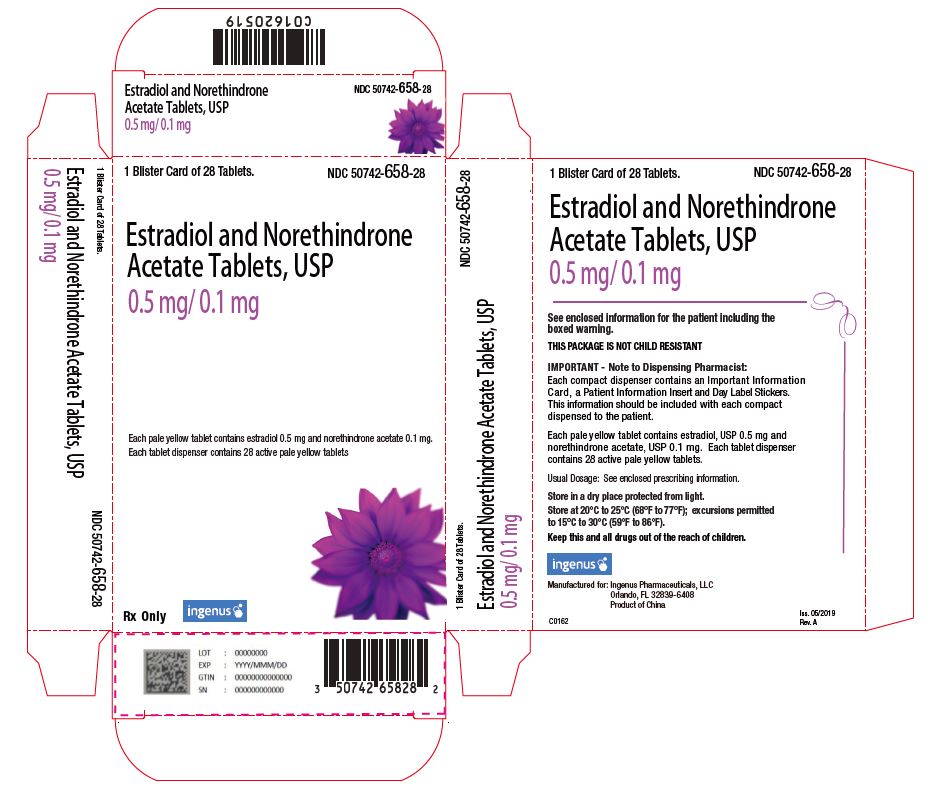
norethindrone 0.35 MG Oral Tablet — Progestogens and estrogens, sequential preparations. INDICATIONS AND USAGE 1. Indications Progestin-only oral contraceptives are indicated for the prevention of pregnancy. 2. Efficacy If used…
Boxed warning
Cigarette smoking greatly increases the possibility of suffering heart attacks and strokes. Women who use oral contraceptives are strongly advised not to smoke. WARNING: Cigarette smoking greatly increases the possibility of suffering heart attacks and strokes. Women who use oral contraceptives are strongly advised not to smoke.
majorombitasvir/paritaprevir/ritonavir — potential for ALT elevations
majordasabuvir — potential for ALT elevations
Indications
INDICATIONS AND USAGE 1. Indications Progestin-only oral contraceptives are indicated for the prevention of pregnancy. 2. Efficacy If used perfectly, the first-year failure rate for progestin-only oral contraceptives is 0.3%. However, the typical failure rate is estimated to be closer to 9%, due to late or omitted pills. Table 1 lists the pregnancy rates for users of all major methods of contraception. Table 1: Percentage of Women Experiencing an Unintended Pregnancy During the First Year of Typical Use and the First Year of Perfect Use of Contraception and the Percentage Continuing Use at the End of the First Year. United States. Method (1) % of Women Experiencing an Unintended Pregnancy within the First Year of Use % of Women Continuing Use at One Year 3 Typical Use 1 (2) Perfect Use 2 (3) (4) No method 4 85 85 Spermicides 5 28 18 42 Fertility awareness-based methods 24 47 Standard Days method 6 5 TwoDay method 6 4 Ovulation method 6 3 Symptothermal method 6 0.4 Withdrawal 22 4 46 Sponge 36 Parous Women 24 20 Nulliparous Women 12 9 Condom 7 Female (fc) 21 5 41 Male 18 2 43 Diaphragm 8 12 6 57 Combined pill and progestin-only pill 9 0.3 67 Norelgestromin and ethinyl estradiol patch 9 0.3 67 NuvaRing 9 0.3 67 Depo-Provera 6 0.2 56 Intrauterine contraceptives ParaGard (copper T) 0.8 0.6 78 Mirena (LNg) 0.2 0.2 80 Implanon 0.05 0.05 84 Female Sterilization 0.5 0.5 100 Male Sterilization 0.15 0.10 100 Emergency Contraception: Emergency contraceptive pills or insertion of a copper intrauterine contraceptive after unprotected intercourse substantially reduces the risk of pregnancy. 9 (See Chapter 6.). Lactational Amenorrhea Method: LAM is a highly effective, temporary method of contraception. 10 (See Chapter 18.) Source: Trussell J. Contraceptive Efficacy. In Hatcher RA, Trussell J, Nelson AL, Cates W, Kowal D, Policar M. Contraceptive Techology: Twentieth Revised Edition. New York NY: Ardent Media, 2011. ——————————————————————————————————————————————————————————————————— Notes: 1 Among typical couples who initiate use of a method (not necessarily for the first time), the percentage who experience an accidental pregnancy during the first year if they do not stop use for any other reason. Estimates of the probability of pregnancy during the first year of typical use for spermicides, withdrawal, fertility awareness-based methods, the diaphragm, the male condom, the oral contraceptive pill, and Depo-Provera are taken from the 1995 National Survey of Family Growth corrected for underreporting of abortion; see the text for the derivation of estimates for the other methods. 2 Among couples who initiate use of a method (not necessarily for the first time) and who use it perfectly (both consistently and correctly), the percentage who experience an accidental pregnancy during the first year if they do not stop use for any other reason. See the text for the derivation of the estimate for each method. 3 Among couples attempting to avoid pregnancy, the percentage who continue to use a method for 1 year. 4 The percentages becoming pregnant in columns (2) and (3) are based on data from populations where contraception is not used and from women who cease using contraception in order to become pregnant. Among such populations, about 89% become pregnant within 1 year. This estimate was lowered slightly (to 85%) to represent the percentage who would become pregnant within 1 year among women now relying on reversible methods of contraception if they abandoned contraception altogether. 5 Foams, creams, gels, vaginal suppositories, and vaginal film. 6 The Ovulation and TwoDay methods are based on evaluation of cervical mucus. The Standard Days method avoids intercourse on cycle days 8 through 19. The Symptothermal method is a double-check method based on evaluation of cervical mucus to determine the first fertile day and evaluation of cervical mucus and temperature to determine the last fertile day. 7 Without spermicides. 8 With spermicidal cream or jelly. 9 ella, Plan B One-Step and Next Choice are the only dedicated products specifically marketed for emergency contraception. The label for Plan B One-Step (one dose is 1 white pill) says to take the pill within 72 hours after unprotected intercourse. Research has shown that all of the brands listed here are effective when used within 120 hours after unprotected sex. The label for Next Choice (one dose is 1 peach pill) says to take 1 pill within 72 hours after unprotected intercourse and another pill 12 hours later. Research has shown that both pills can be taken at the same time with no decrease in efficacy or increase in side effects and that they are effective when used within 120 hours after unprotected sex. The FDA has in addition declared the following 19 brands of oral contraceptives to be safe and effective for emergency contraception: Ogestrel (1 dose is 2 white pills), Nordette (1 dose is 4 light-orange pills), Cryselle, Levora, Low-Ogestrel, Lo/Ovral, or Quasence (1 dose is 4 white pills), Jolessa, Portia, Seasonale or Trivora (1 dose is 4 pink pills), Seasonique (1 dose is 4 light-blue-green pills), Enpresse (one dose is 4 orange pills), Lessina (1 dose is 5 pink pills), Aviane or LoSeasonique (one dose is 5 orange pills), Lutera or Sronyx (one dose is 5 white pills), and Lybrel (one dose is 6 yellow pills). 10 However, to maintain effective protection against pregnancy, another method of contraception must be used as soon as menstruation resumes, the frequency or duration of breastfeeds is reduced, bottle feeds are introduced, or the baby reaches 6 months of age. Emzahh ™ Tablets have not been studied for and are not indicated for use in emergency contraception.
Dosage
DOSAGE AND ADMINISTRATION Therapy with norethindrone acetate tablets must be adapted to the specific indications and therapeutic response of the individual patient. Secondary amenorrhea, abnormal uterine bleeding due to hormonal imbalance in the absence of organic pathology: 2.5 to 10 mg norethindrone acetate tablets may be given daily for 5 to 10 days to produce secretory transformation of an endometrium that has been adequately primed with either endogenous or exogenous estrogen. Progestin withdrawal bleeding usually occurs within three to seven days after discontinuing norethindrone acetate tablets therapy. Patients with a past history of recurrent episodes of abnormal uterine bleeding may benefit from planned menstrual cycling with norethindrone acetate tablets. Endometriosis: Initial daily dosage of 5 mg norethindrone acetate tablets for two weeks. Dosage should be increased by 2.5 mg per day every two weeks until 15 mg per day of norethindrone acetate tablets is reached. Therapy may be held at this level for six to nine months or until annoying breakthrough bleeding demands temporary termination.
Warnings
WARNINGS Cigarette smoking increases the risk of serious cardiovascular disease. Women who use oral contraceptives should be strongly advised not to smoke. Norethindrone tablets do not contain estrogen and, therefore, this insert does not discuss the serious health risks that have been associated with the estrogen component of combined oral contraceptives (COCs). The healthcare professional is referred to the prescribing information of combined oral contraceptives for a discussion of those risks. The relationship between progestin-only oral contraceptives and these risks is not fully defined. The healthcare professional should remain alert to the earliest manifestation of symptoms of any serious disease and discontinue oral contraceptive therapy when appropriate. 1. Ectopic Pregnancy The incidence of ectopic pregnancies for progestin-only oral contraceptive users is 5 per 1000 woman-years. Up to 10% of pregnancies reported in clinical studies of progestin-only oral contraceptive users are extrauterine. Although symptoms of ectopic pregnancy should be watched for, a history of ectopic pregnancy need not be considered a contraindication to use of this contraceptive method. Healthcare professionals should be alert to the possibility of an ectopic pregnancy in women who become pregnant or complain of lower abdominal pain while on progestin-only oral contraceptives. 2. Delayed Follicular Atresia/Ovarian Cysts If follicular development occurs, atresia of the follicle is sometimes delayed and the follicle may continue to grow beyond the size it would attain in a normal cycle. Generally these enlarged follicles disappear spontaneously. Often they are asymptomatic; in some cases they are associated with mild abdominal pain. Rarely they may twist or rupture, requiring surgical intervention. 3. Irregular Genital Bleeding Irregular menstrual patterns are common among women using progestin-only oral contraceptives. If genital bleeding is suggestive of infection, malignancy or other abnormal conditions, such nonpharmacologic causes should be ruled out. If prolonged amenorrhea occurs, the possibility of pregnancy should be evaluated. 4. Carcinoma of the Breast and Reproductive Organs Some epidemiological studies of oral contraceptive users have reported an increased relative risk of developing breast cancer, particularly at a younger age and apparently related to duration of use. These studies have predominantly involved combined oral contraceptives and there is insufficient data to determine whether the use of POPs similarly increases the risk. A meta-analysis of 54 studies found a small increase in the frequency of having breast cancer diagnosed for women who were currently using combined oral contraceptives or had used them within the past ten years. This increase in the frequency of breast cancer diagnosis, within ten years of stopping use, was generally accounted for by cancers localized to the breast. There was no increase in the frequency of having breast cancer diagnosed ten or more years after cessation of use. Women with breast cancer should not use oral contraceptives because the role of female hormones in breast cancer has not been fully determined. Some studies suggest that oral contraceptive use has been associated with an increase in the risk of cervical intraepithelial neoplasia in some populations of women. However, there continues to be controversy about the extent to which such findings may be due to differences in sexual behavior and other factors. There is insufficient data to determine whether the use of POPs increases the risk of developing cervical intraepithelial neoplasia. 5. Hepatic Neoplasia Benign hepatic adenomas are associated with combined oral contraceptive use, although the incidence of benign tumors is rare in the United States. Rupture of benign, hepatic adenomas may cause death through intra-abdominal hemorrhage. Studies have shown an increased risk of developing hepatocellular carcinoma in combined oral contraceptive users. However, these cancers are rare in the U.S. There is insufficient data to determine whether POPs increase the risk of developing hepatic neoplasia.
Contraindications
CONTRAINDICATIONS Known or suspected pregnancy. There is no indication for norethindrone acetate tablets in pregnancy. (See PRECAUTIONS .) Undiagnosed vaginal bleeding Known, suspected or history of cancer of the breast Active deep vein thrombosis, pulmonary embolism or history of these conditions Active or recent (e.g., within the past year) arterial thromboembolic disease (e.g., stroke, myocardial infarction) Impaired liver function or liver disease As a diagnostic test for pregnancy Hypersensitivity to any of the drug components
Mechanism of action
CLINICAL PHARMACOLOGY Norethindrone acetate induces secretory changes in an estrogen-primed endometrium. On a weight basis, it is twice as potent as norethindrone. PHARMACOKINETICS Absorption Norethindrone acetate is completely and rapidly deacetylated to norethindrone (NET) after oral administration, and the disposition of norethindrone acetate is indistinguishable from that of orally administered norethindrone. Norethindrone acetate is rapidly absorbed from norethindrone acetate tablets, with maximum plasma concentration of norethindrone generally occurring at about 2 hours post-dose. The pharmacokinetic parameters of norethindrone following single oral administration of norethindrone acetate tablets in 29 healthy female volunteers are summarized in Table 1. Table 1 Pharmacokinetic Parameters after a Single Dose of Norethindrone Acetate Tablets in Healthy Women AUC = area under the curve, C max = maximum plasma concentration, t max = time at maximum plasma concentration, t 1/2 = half-life, SD = standard deviation Norethindrone acetate tablets (n=29) Arithmetic Mean ± SD Norethindrone (NET) AUC (0-inf)(ng/ml*h) 166.9 ± 56.28 C max (ng/ml) 26.19 ± 6.19 t max (h) 1.83 ± 0.58 t 1/2 (h) 8.51 ± 2.19 Figure 1. Mean Plasma Concentration Profile after a Single Dose of 5 mg Administered to 29 Healthy Female Volunteers under Fasting Conditions Figure 1. Mean Plasma Concentration Profile after a Single Dose of 5 mg Administered to 29 Healthy Female Volunteers under Fasting Conditions Effect of Food The effect of food administration on the pharmacokinetics of norethindrone acetate tablets has not been studied. Distribution Norethindrone is 36% bound to sex hormone-binding globulin (SHBG) and 61% bound to albumin. Volume of distribution of norethindrone is about 4 L/kg. Metabolism Norethindrone undergoes extensive biotransformation, primarily via reduction, followed by sulfate and glucuronide conjugation. The majority of metabolites in the circulation are sulfates, with glucuronides accounting for most of the urinary metabolites. Excretion Plasma clearance value for norethindrone is approximately 0.4 L/hr/kg. Norethindrone is excreted in both urine and feces, primarily as metabolites. The mean terminal elimination half-life of norethindrone following a single dose administration of norethindrone acetate tablets is approximately 9 hours. SPECIAL POPULATIONS Geriatrics The effect of age on the pharmacokinetics of norethindrone after norethindrone acetate tablets administration has not been evaluated. Race The effect of race on the disposition of norethindrone after norethindrone acetate tablets administration has not been evaluated. Renal Insufficiency The effect of renal disease on the disposition of norethindrone after norethindrone acetate tablets administration has not been evaluated. In premenopausal women with chronic renal failure undergoing peritoneal dialysis who received multiple doses of an oral contraceptive containing ethinyl estradiol and norethindrone, plasma norethindrone concentration was unchanged compared to concentrations in premenopausal women with normal renal function. Hepatic Insufficiency The effect of hepatic disease on the disposition of norethindrone after norethindrone acetate tablets administration has not been evaluated. However, norethindrone acetate tablets are contraindicated in markedly impaired liver function or liver disease. Drug Interactions No pharmacokinetic drug interaction studies investigating any drug-drug interactions with norethindrone acetate tablets have been conducted.
A drug lookup is just the start. Eleplan keeps the whole care plan in one place.
Medications, diagnoses, documents, appointments, and the whole care team — organized and always in sync, with Ellie, your AI care assistant, on top of it. Free to start.