Clinical drug
nabilone 2 MG Oral Capsule
2 MG · Oral Capsule · oral
A form of nabilone →
nabilone 2 MG Oral Capsule — Other antiemetics. INDICATIONS AND USAGE Cesamet capsules are indicated for the treatment of the nausea and vomiting associated with cancer chemotherapy in patients who
Active ingredient
Classification
Other antiemeticsCannabinoid
Drug interactions
Nabilone has several potential interactions with other drugs, particularly CNS depressants, which can lead to additive effects.
- majordiazepam — impaired psychomotor function
- majorsodium secobarbital — additive drowsiness and CNS depression
- majoralcohol — increased positive subjective mood effects
- majorcodeine — additive drowsiness and CNS depression
- majoramphetamines, cocaine, other sympathomimetic agents — additive hypertension, tachycardia, possibly cardiotoxicity
- moderateatropine, scopolamine, antihistamines, other anticholinergic agents — additive or super-additive tachycardia, drowsiness
- moderateamitriptyline, amoxapine, desipramine, other tricyclic antidepressants — additive tachycardia, hypertension, drowsiness
- majorbarbiturates, benzodiazepines, ethanol, lithium, opioids, buspirone, antihistamines, muscle relaxants, other CNS depressants — additive drowsiness and CNS depression
- unknowndisulfiram — reversible hypomanic reaction
- unknownfluoxetine — hypomanic symptoms
- moderateantipyrine, barbiturates — decreased clearance of these agents
- moderatetheophylline — increased metabolism of theophylline
- moderateopioids — cross-tolerance and mutual potentiation
- moderatenaltrexone — enhanced oral THC effects
Indications
INDICATIONS AND USAGE Cesamet capsules are indicated for the treatment of the nausea and vomiting associated with cancer chemotherapy in patients who have failed to respond adequately to conventional antiemetic treatments. This restriction is required because a substantial proportion of any group of patients treated with Cesamet can be expected to experience disturbing psychotomimetic reactions not observed with other antiemetic agents. Because of its potential to alter the mental state, Cesamet is intended for use under circumstances that permit close supervision of the patient by a responsible individual particularly during initial use of Cesamet and during dose adjustments. Cesamet contains nabilone, which is controlled in Schedule II of the Controlled Substances Act. Schedule II substances have a high potential for abuse. Prescriptions for Cesamet should be limited to the amount necessary for a single cycle of chemotherapy (i.e., a few days). Cesamet capsules are not intended to be used on as needed basis or as a first antiemetic product prescribed for a patient. As with all controlled drugs, prescribers should monitor patients receiving nabilone for signs of excessive use, abuse and misuse. Patients who may be at increased risk for substance abuse include those with a personal or family history of substance abuse (including drug or alcohol abuse) or mental illness.
Dosage
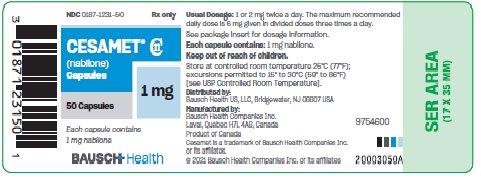
DOSAGE AND ADMINISTRATION The usual adult dosage is 1 or 2 mg 2 times a day. On the day of chemotherapy, the initial dose should be given 1 to 3 hours before the chemotherapeutic agent is administered. To minimize side effects, it is recommended that the lower starting dose be used and that the dose be increased as necessary. A dose of 1 or 2 mg the night before may be useful. The maximum recommended daily dose is 6 mg given in divided doses 3 times a day. Cesamet may be administered 2 or 3 times a day during the entire course of each cycle of chemotherapy and, if needed, for 48 hours after the last dose of each cycle of chemotherapy.
Warnings
WARNINGS • The effects of Cesamet may persist for a variable and unpredictable period of time following its oral administration. Adverse psychiatric reactions can persist for 48 to 72 hours following cessation of treatment. • Cesamet has the potential to affect the CNS, which might manifest itself in dizziness, drowsiness, euphoria “high”, ataxia, anxiety, disorientation, depression, hallucinations and psychosis. • Cesamet can cause tachycardia and orthostatic hypotension. • Because of individual variation in response and tolerance to the effects of Cesamet, patients should remain under supervision of a responsible adult especially during initial use of Cesamet and during dose adjustments. • Patients receiving treatment with Cesamet should be specifically warned not to drive, operate machinery, or engage in any hazardous activity while receiving Cesamet. • Cesamet should not be taken with alcohol, sedatives, hypnotics, or other psychoactive substances because these substances can potentiate the central nervous system effects of nabilone.
Contraindications
CONTRAINDICATIONS Cesamet is contraindicated in any patient who has a history of hypersensitivity to any cannabinoid.
Mechanism of action
CLINICAL PHARMACOLOGY Pharmacodynamics Cesamet (nabilone) is an orally active synthetic cannabinoid which, like other cannabinoids, has complex effects on the central nervous system (CNS). It has been suggested that the antiemetic effect of nabilone is caused by interaction with the cannabinoid receptor system, i.e., the CB (1) receptor, which has been discovered in neural tissues. Nontherapeutic Effects: Cesamet, a synthetic cannabinoid, has the potential to be abused and to produce psychological dependence. Cesamet has complex effects on the central nervous system. Its effects on the mental state (i.e., “inner mental life”) are similar to those of cannabis. Subjects given Cesamet may experience changes in mood (euphoria, detachment, depression, anxiety, panic, paranoia), decrements in cognitive performance and memory, a decreased ability to control drives and impulses, and alterations in the experience of reality (e.g., distortions in the perception of objects and the sense of time, hallucinations). These phenomena appear to be more common when larger doses of Cesamet are administered; however, a full-blown picture of psychosis (psychotic organic brain syndrome) may occur in patients receiving doses within the lower portion of the therapeutic range. Data on the chronic use of Cesamet are not available; experience with cannabis suggests that chronic use of cannabinoids may be associated with a variety of untoward effects on motivation, cognition, judgment, as well as other mental status changes. Whether these phenomena reflect the underlying character of individuals chronically abusing cannabis or are a result of the use of cannabis is not known. The simultaneous use of Cesamet and alcohol or barbiturates may produce additive depressive effects on central nervous system function. Possible changes in mood and other adverse behavioral effects may occur in patients receiving Cesamet. Patients should remain under supervision of a responsible adult while using Cesamet. Cesamet has central nervous system activity. It produces relaxation, drowsiness, and euphoria in the recommended dosage range. Tolerance to these effects develops rapidly and is readily reversible. In addition to effects on the mental state, Cesamet has several systemic actions; most prominent are dry mouth and hypotension. Cesamet has been observed to elevate supine and standing heart rates and to cause supine and orthostatic hypotension. In clinical studies, oral administration of 2 mg of Cesamet did produce some decrease in airway resistance in normal controls but had no effect in patients with asthma. No other nontherapeutic effects of clinical significance due to Cesamet have been reported. Pharmacokinetics Absorption and Distribution: Cesamet (nabilone) appears to be completely absorbed from the human gastrointestinal tract when administered orally. Following oral administration of a 2 mg dose of radiolabeled nabilone, peak plasma concentrations of approximately 2 ng/mL nabilone and 10 ng equivalents/mL total radioactivity are achieved within 2.0 hours. The plasma half-life (T ½ ) values for nabilone and total radioactivity of identified and unidentified metabolites are about 2 and 35 hours, respectively. The initial rapid disappearance of radioactivity represents uptake and distribution of nabilone into tissue and the slower phase elimination by metabolism and excretion. The apparent volume of distribution of nabilone is about 12.5 L/kg. Nabilone exhibits dose linearity within its therapeutic range. Clinical data suggests that the intake of food does not significantly affect either the rate or extent of absorption. Metabolism: Metabolism of nabilone is extensive and several metabolites have been identified. Precise information concerning the metabolites that may accumulate is not available. The relative activities of the metabolites and the parent drug have not been established. There are at least two metabolic pathways involved in the biotransformation of nabilone. A minor pathway is initiated by the stereospecific enzymatic reduction of the 9-keto moiety of nabilone to produce the isomeric carbinol metabolite. The peak concentrations of nabilone and its carbinol metabolites are comparable, but their combined exposures in plasma do not account for more than 20% of that of total radioactivity. Secondly, a metabolite of nabilone in feces has been identified as a diol formed by reduction of the 9-keto group plus oxidation at the penultimate carbon of the dimethylheptyl side chain. In addition, there is evidence of extensive metabolism of Cesamet by multiple P450 enzyme isoforms. In vitro P450 inhibition studies using human liver microsomes showed that nabilone did not significantly inhibit CYP1A2, 2A6, 2C19, 2D6, and 3A4 (using midazolam and nifedipine as substrates). Nabilone had a weak inhibitory effect on CYP 2E1 and 3A4 (testosterone; IC 50 > 50 µM) and had a moderate inhibitory effect on CYP2C8 and 2C9 (IC 50 > 10 µM). However, in clinical use, the very low nabilone plasma concentration is unlikely to interfere with the P450-mediated degradation of co-administered drugs. Chronic oral administration of 1 mg t.i.d. for 14 days to 3 subjects gave no indication there was any significant accumulation of nabilone. Available evidence suggests that one or more of the metabolites has a terminal elimination half-life that exceeds that of nabilone. Consequently, in repeated use, the metabolites may accumulate at concentrations in excess of the parent drug. Elimination: The route and rate of the elimination of nabilone and its metabolites are similar to those observed with other cannabinoids, including delta-9-THC (dronabinol). When nabilone is administered intravenously, the drug and its metabolites are eliminated mainly in the feces (approximately 67%) and to a lesser extent in the urine (approximately 22%) within 7 days. Of the 67% recovered from the feces, 5% corresponded to the parent compound and 16% to its carbinol metabolite. Following oral administration about 60% of nabilone and its metabolites were recovered in the feces and about 24% in urine. Therefore, it appears that the major excretory pathway is the biliary system. The effects of age, gender, hepatic dysfunction, and renal insufficiency on the metabolism and elimination of nabilone have not been determined. Special Populations: The pharmacokinetic profile of Cesamet has not been investigated in either pediatric (see PRECAUTIONS, Pediatric Use ) or geriatric patients (see PRECAUTIONS, Geriatric Use ). Clinical Trials Cesamet was evaluated for its effectiveness and safety in the treatment of nausea and vomiting induced by cancer chemotherapy in patients receiving a wide variety of chemotherapy regimens, including low-dose cisplatin (20 mg/m2) in both placebo-controlled and active controlled (prochlorperazine) trials. During Cesamet treatment patients reported a higher incidence of adverse effects. The most frequent were drowsiness, vertigo, dry mouth and euphoria. However, most of the adverse effects occurring with Cesamet were of mild to moderate severity (see ADVERSE REACTIONS ).
Indicated ICD-10 codes
Source: RxNorm + openFDA + RxClass + FAERS · 2026
Look up another medication