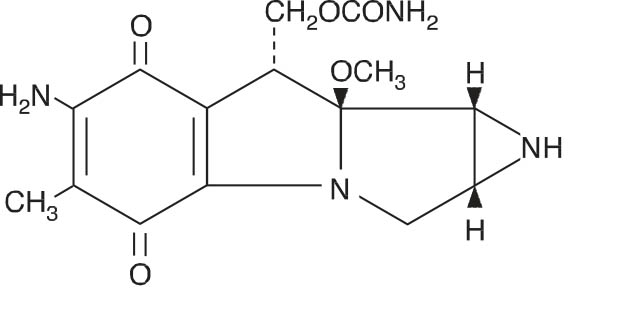
mitomycin 20 MG Injection — Other cytotoxic antibiotics. INDICATIONS AND USAGE Mitomycin for Injection is not recommended as single-agent, primary therapy. It has been shown to be useful in the therapy of…
Boxed warning
WARNINGS Mitomycin should be administered under the supervision of a qualified physician experienced in the use of cancer chemotherapeutic agents. Appropriate management of therapy and complications is possible only when adequate diagnostic and treatment facilities are readily available. Bone marrow suppression, notably thrombocytopenia and leukopenia, which may contribute to overwhelming infections in an already compromised patient, is the most common and severe of the toxic effects of mitomycin (see “ WARNINGS ” and “ ADVERSE REACTIONS ” Sections). Hemolytic Uremic Syndrome (HUS) a serious complication of chemotherapy, consisting primarily of microangiopathic hemolytic anemia, thrombocytopenia, and irreversible renal failure, has been reported in patients receiving systemic mitomycin. The syndrome may occur at any time during systemic therapy with mitomycin as a single agent or in combination with other cytotoxic drugs; however, most cases occur at doses ≥ 60 mg of mitomycin. Blood product transfusion may exacerbate the symptoms associated with this syndrome. The incidence of the syndrome has not been defined.
Off Label Use375Nausea163Diarrhoea150Fatigue118Drug Ineffective110Thrombocytopenia110Neutropenia107Rash107
Indications
INDICATIONS AND USAGE Mitomycin for Injection is not recommended as single-agent, primary therapy. It has been shown to be useful in the therapy of disseminated adenocarcinoma of the stomach or pancreas in proven combinations with other approved chemotherapeutic agents and as palliative treatment when other modalities have failed. Mitomycin for Injection is not recommended to replace appropriate surgery and/or radiotherapy.
Dosage
DOSAGE AND ADMINISTRATION JELMYTO is for pyelocalyceal use only and not for intravenous use, topical use, or oral administration. ( 2.1 ) Administer 1.3 g of sodium bicarbonate orally the evening prior to, the morning of, and 30 minutes prior to instillation procedure (total of 3.9 g). ( 2.1 ) The dose of JELMYTO to be instilled is 4 mg per mL via ureteral catheter or nephrostomy tube, with total instillation volume based on volumetric measurements using pyelography, not to exceed 15 mL (60 mg of mitomycin). ( 2.2 ) Instill JELMYTO once weekly for six weeks. For patients with a complete response 3 months after JELMYTO initiation, JELMYTO instillations may be administered once a month for a maximum of 11 additional instillations. ( 2.2 ) 2.1 Important Administration Instructions See the Instructions for Administration provided separately. JELMYTO is for pyelocalyceal use only. JELMYTO is not for intravenous use, topical use, or oral administration. Prior to every instillation, instruct the patient to take 1.3 g of sodium bicarbonate orally the evening prior to, the morning of, and 30 minutes prior to the instillation procedure (total of 3.9 g). General anesthesia, local anesthesia, sedation, prophylactic antibiotics and/or antihistamines may be used at the discretion of the treating urologist. If the patient is to be anesthetized, advise the patient not to take sodium bicarbonate within 30 minutes prior to the treatment. Consider withholding diuretics one day prior to instillation until 4 hours post-instillation. When instilling JELMYTO, the entire syringe must be emptied within one minute. Advise patients that JELMYTO may discolor urine to a violet to blue color following the instillation procedure. Advise patients to avoid contact with urine for at least six hours post-instillation, to void urine sitting on a toilet, and to flush the toilet several times after use. 2.2 Recommended Dosage The dose of JELMYTO to be instilled is 4 mg per mL via ureteral catheter or a nephrostomy tube, with total instillation volume based on volumetric measurements using pyelography, not to exceed 15 mL (60 mg of mitomycin). Instill JELMYTO once weekly for six weeks. For patients with a complete response 3 months after JELMYTO initiation, JELMYTO instillations may be administered once a month for a maximum of 11 additional instillations. 2.3 Preparation and Handling See the Instructions for Pharmacy for preparation provided separately. JELMYTO is a hazardous drug. Follow applicable special handling and disposal procedures. 1 JELMYTO must be prepared under chilled conditions. Once reconstituted , the admixture will have a concentration of 4 mg of mitomycin per mL and will appear as a viscous liquid for instillation. Reconstituted JELMYTO has reverse thermal properties with a gelation point of approximately 19°C (66°F). Reconstituted JELMYTO should be instilled as soon as possible after reconstitution. Store reconstituted JELMYTO at 20°C to 25°C (68°F to 77°F) for up to 96 hours (4 days). JELMYTO will appear as a semisolid gel when stored under these conditions. Protect reconstituted JELMYTO from light. JELMYTO must be instilled as a chilled solution using a Uroject12 Lever, a Luer Lock syringe, and a ureteral catheter with molded Luer Lock connector. Once chilled at -3°C to 5°C (27°F to 41°F), JELMYTO will convert to a viscous liquid for instillation and is stable for up to 1 additional hour. Reconstituted JELMYTO must be instilled within 1 hour after it is converted to a viscous liquid.
Warnings
WARNINGS AND PRECAUTIONS Ureteric Obstruction: Ureteric obstruction may occur. Monitor patients for signs and symptoms of ureteric obstruction. Transient or long-term ureteral stents or alternative procedures may be required. Withhold or permanently discontinue JELMYTO based on the severity of the ureteric obstruction. ( 5.1 ) Bone Marrow Suppression: Thrombocytopenia and neutropenia may occur. Monitor blood counts. Withhold or permanently discontinue JELMYTO based on the severity. ( 5.2 ) Embryo-Fetal Toxicity: Can cause fetal harm. Advise of potential risk to a fetus and to use effective contraception. ( 5.3 , 8.1 , 8.3 ) 5.1 Ureteric Obstruction Ureteric obstruction, including ureteral stenosis and hydronephrosis, occurred in patients receiving JELMYTO. In the Olympus study, ureteric obstruction was reported in 58% (n=41) of patients receiving JELMYTO, including 17% (n=12) of patients who experienced Grade 3 obstruction. The median time to first onset was 72 days (range: 15-462). Interventions in the 41 patients experiencing ureteric obstruction included ureteral stent placement (88%), balloon dilatation (29%), and nephroureterectomy (4.9%). In the 36 patients who required ureteral stent placement, the median duration of indwelling stents was 52 days (range: 1-292). Ureteric obstruction did not resolve or resolved with sequelae in 44% (n=18) of these patients. Of the 41 patients who experienced ureteric obstruction, 17% (n=7) experienced Grades 1-2 increase in serum creatinine. In the 42 patients who only received JELMYTO during the treatment phase (no maintenance therapy), ureteric obstruction was reported in 40% (n=17). Monitor patients for signs and symptoms of ureteric obstruction, including flank pain, and fever, and for changes in renal function. Patients who experience obstruction may require transient or long-term ureteral stents or alternative procedures. Withhold or permanently discontinue JELMYTO based on the severity of ureteric obstruction. 5.2 Bone Marrow Suppression The use of JELMYTO can result in bone marrow suppression, particularly thrombocytopenia and neutropenia. In the Olympus study, Grade 3 thrombocytopenia occurred in three patients, Grade 3 anemia in one patient, and Grade 3 neutropenia in one patient. Gross extravasation of JELMYTO via urinary tract perforation or impaired mucosa was not observed in these patients. The following tests should be obtained prior to each treatment: Platelet count, white blood cell count differential and hemoglobin. Withhold JELMYTO for Grade 2 thrombocytopenia or neutropenia. Permanently discontinue for Grade 3 or greater thrombocytopenia or neutropenia. 5.3 Embryo-Fetal Toxicity Based on findings in animals and mechanism of action, JELMYTO can cause fetal harm when administered to a pregnant woman. In animal reproduction studies, administration of mitomycin resulted in teratogenicity. Advise females of reproductive potential to use effective contraception during treatment with JELMYTO and for 6 months following the last dose. Advise male patients with female partners of reproductive potential to use effective contraception during treatment with JELMYTO and for 3 months following the last dose [see Use in Specific Populations (8.1 , 8.3) and Clinical Pharmacology (12.1) ].
Contraindications
CONTRAINDICATIONS ZUSDURI is contraindicated in patients with: Perforation of the bladder [see Warnings and Precautions (5.1) ], Prior hypersensitivity reactions to mitomycin or any component of the product. Perforation of the bladder, ( 4 ) Prior hypersensitivity reaction to mitomycin or any component of the product. ( 4 )
Mechanism of action
CLINICAL PHARMACOLOGY Mitomycin selectively inhibits the synthesis of deoxyribonucleic acid (DNA). The guanine and cytosine content correlates with the degree of mitomycin-induced cross-linking. At high concentrations of the drug, cellular RNA and protein synthesis are also suppressed. In humans, mitomycin is rapidly cleared from the serum after intravenous administration. Time required to reduce the serum concentration by 50% after a 30 mg bolus injection is 17 minutes. After injection of 30 mg, 20 mg, or 10 mg Intravenous., the maximal serum concentrations were 2.4 mcg/mL, 1.7 mcg/mL, and 0.52 mcg/mL, respectively. Clearance is effected primarily by metabolism in the liver, but metabolism occurs in other tissues as well. The rate of clearance is inversely proportional to the maximal serum concentration because, it is thought, of saturation of the degradative pathways. Approximately 10% of a dose of mitomycin is excreted unchanged in the urine. Since metabolic pathways are saturated at relatively low doses, the percent of a dose excreted in urine increases with increasing dose. In children, excretion of intravenously administered mitomycin is similar. Animal Toxicology Mitomycin has been found to be carcinogenic in rats and mice. At doses approximating the recommended clinical dose in man, it produces a greater than 100 percent increase in tumor incidence in male Sprague-Dawley rats, and a greater than 50 percent increase in tumor incidence in female Swiss mice.
A drug lookup is just the start. Eleplan keeps the whole care plan in one place.
Medications, diagnoses, documents, appointments, and the whole care team — organized and always in sync, with Ellie, your AI care assistant, on top of it. Free to start.