isavuconazonium sulfate 186 MG Oral Capsule
Managing this medication for someone you care for? Eleplan keeps diagnoses, medications and appointments in one plan.
Start free with EleplanClinical drug
isavuconazonium sulfate 186 MG Oral Capsule
186 MG · Oral Capsule · oral
A form of isavuconazonium →
isavuconazonium sulfate 186 MG Oral Capsule. INDICATIONS AND USAGE CRESEMBA ® is an azole antifungal indicated for the treatment of: Invasive aspergillosis ( 1.1 ) and Invasive mucormycosis (…
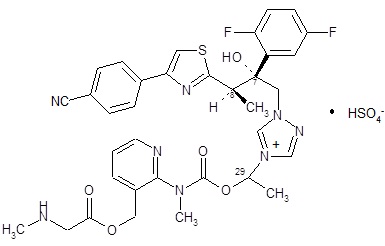
Active ingredient
Drug interactions
Isavuconazonium has several drug interactions that may affect its pharmacokinetics and the pharmacokinetics of coadministered drugs.
- majorketoconazole — more than a 5-fold increase in exposure of isavuconazole
- moderatelopinavir/ritonavir — 96% increase in exposure of isavuconazole
- majorrifampin — 97% decrease in exposure of isavuconazole
- moderateatorvastatin — potential increase in atorvastatin exposure
- moderatecyclosporine — increase in cyclosporine exposure
- moderatesirolimus — increase in sirolimus exposure
- moderatetacrolimus — increase in tacrolimus exposure
- moderatemidazolam — increase in midazolam exposure
- moderatebupropion — decrease in bupropion exposure
- moderatemycophenolate mofetil — increase in MMF exposure
- moderatedigoxin — increase in digoxin exposure
- majorvincristine — predicted to have a less than 2-fold increase in vincristine exposure
Real-world adverse events (FAERS)
Off Label Use980Death318Nausea156Febrile Neutropenia141Drug Ineffective138Pyrexia130Pneumonia121Condition Aggravated114
Indications
INDICATIONS AND USAGE CRESEMBA ® is an azole antifungal indicated for the treatment of: Invasive aspergillosis ( 1.1 ) and Invasive mucormycosis ( 1.2 ) as follows: • CRESEMBA for injection : adults and pediatric patients 1 year of age and older • CRESEMBA capsules : adults and pediatric patients 6 years of age and older who weigh 16 kilograms (kg) and greater 1.1 Invasive Aspergillosis CRESEMBA ® is indicated for the treatment of invasive aspergillosis as follows: CRESEMBA for injection : adults and pediatric patients 1 year of age and older [see Clinical Studies ( 14.1 ) and Clinical Pharmacology ( 12.4 )] CRESEMBA capsules : adults and pediatric patients 6 years of age and older who weigh 16 kilograms (kg) and greater [see Dosage and Administration ( 2.3 ) Clinical Studies ( 14.1 ) and Clinical Pharmacology ( 12.4 )] 1.2 Invasive Mucormycosis CRESEMBA is indicated for the treatment of invasive mucormycosis as follows: CRESEMBA for injection : adults and pediatric patients 1 year of age and older [see Clinical Studies ( 14.1 ) and Clinical Pharmacology ( 12.3 , 12.4 )] CRESEMBA capsules : adults and pediatric patients 6 years of age and older who weigh 16 kg and greater [see Dosage and Administration ( 2.3 )], Clinical Studies ( 14.1 ) and Clinical Pharmacology ( 12.3 , 12.4 )] 1.3 Usage Specimens for fungal culture and other relevant laboratory studies (including histopathology) to isolate and identify causative organism(s) should be obtained prior to initiating antifungal therapy. Therapy may be instituted before the results of the cultures and other laboratory studies are known. However, once these results become available, antifungal therapy should be adjusted accordingly.
Dosage
DOSAGE AND ADMINISTRATION Important Administration Instructions: • CRESEMBA for injection is intended for use in patients who are 1 year of age and older ( 2.1 , 2.3 ). • CRESEMBA for injection via nasogastric (NG) tube administration is intended for use by patients who are 6 years of age and older and weighing 16 kg and greater. ( 2.1 , 2.6 ). • CRESEMBA for injection must be administered through an in-line filter over a minimum of 1 hour. ( 2.1 , 2.5 ). • CRESEMBA capsules are intended for use in patients who are 6 years of age and older and weighing 16 kg and greater ( 2.1 , 2.3 ). • CRESEMBA capsules can be taken with or without food. ( 2.1 ). Recommended Dosage in Adult Patients ( 2.2 ): Recommended Dosage for CRESEMBA in Adult Patients ( 2.2 ) Dosage Form Loading Dose Maintenance Dose Start maintenance doses 12 to 24 hours after the last loading dose CRESEMBA for Injection, 372 mg/vial 372 mg of isavuconazonium sulfate per vial One reconstituted vial (372 mg) intravenously every 8 hours for 6 doses (48 hours) One reconstituted vial (372 mg) intravenously once daily CRESEMBA Capsules, 186 mg 186 mg of isavuconazonium sulfate per capsule Two 186 mg capsules (372 mg) orally every 8 hours for 6 doses (48 hours) Two 186 mg capsules (372 mg) orally once daily CRESEMBA Capsules, 74.5 mg 74.5 mg of isavuconazonium sulfate per capsule Five 74.5 mg capsules (372 mg) orally every 8 hours for 6 doses (48 hours) Five 74.5 mg capsules (372 mg) orally once daily Recommended Dosage in Pediatric Patients ( 2.3 ): • The maximum of any individual loading or daily maintenance dose to be administered to any pediatric patient is 372 mg of CRESEMBA. ( 2.3 ) Recommended Dosage for CRESEMBA in Pediatric Patients ( 2.3 ) Dosage Form Age Body Weight (kg) Loading Dose Maintenance Dose Start maintenance doses 12 to 24 hours after the last loading dose CRESEMBA for Injection, 372 mg/vial 372 mg of isavuconazonium sulfate per vial 1 to less than 3 years of age less than 18 kg 15 mg/kg intravenously every 8 hours for 6 doses (48 hours) 15 mg/kg intravenously once daily 3 to less than 18 years of age less than 37 kg 10 mg/kg intravenously every 8 hours for 6 doses (48 hours) 10 mg/kg intravenously once daily greater than or equal to 37 kg One reconstituted vial (372 mg) intravenously every 8 hours for 6 doses (48 hours) One reconstituted vial (372 mg) intravenously once daily CRESEMBA Capsules, 74.5 mg 74.5 mg of isavuconazonium sulfate per capsule 6 to less than 18 years of age 16 kg to less than 18 kg Two capsules (149 mg) orally every 8 hours for 6 doses (48 hours) Two capsules (149 mg) orally once daily 18 kg to less than 25 kg Three capsules (223.5 mg) orally every 8 hours for 6 doses (48 hours) Three capsules (223.5 mg) orally once daily 25 kg to less than 32kg Four capsules (298 mg) orally every 8 hours for 6 doses (48 hours) Four capsules (298 mg) orally once daily greater than or equal to 32 kg Five 74.5 mg capsules (372 mg) orally every 8 hours for 6 doses (48 hours) Five 74.5 mg capsules (372 mg) orally once daily 2.1 Important Administration Instructions for CRESEMBA CRESEMBA for Injection • CRESEMBA for injection is intended for use in patients who are 1 year of age and older [see Dosage and Administration ( 2.2 and 2.3 )]. • Intravenous formulation must be administered via an infusion set with an in-line filter (pore size 0.2 to 1.2 micron). • Infuse the intravenous formulation over a minimum of 1 hour in 250 mL of a compatible diluent, to reduce the risk for infusion-related reactions. Do not administer as an intravenous bolus injection. • Do not infuse CRESEMBA with other intravenous medications. • Flush intravenous lines with 0.9% sodium chloride injection, USP or 5% dextrose injection, USP prior to and after infusion of CRESEMBA. • After dilution of the intravenous formulation, avoid unnecessary vibration or vigorous shaking of the solution. Do not use a pneumatic transport system. Nasogastric Tube Administration of CRESEMBA for Injection • CRESEMBA for injection via nasogastric (NG) tube administration is intended for use by patients who are 6 years of age and older and weighing 16 kg and greater [see Dosage and Administration ( 2.2 , 2.3 and 2.6 ] . CRESEMBA Capsules • CRESEMBA capsules are intended for use in patients who are 6 years of age and older and weighing 16 kg and greater [see Dosage and Administration ( 2.2 and 2.3 )]. • Switching between the intravenous and oral formulations of CRESEMBA is acceptable as bioequivalence has been demonstrated. Loading dose is not required when switching between formulations. • With oral administration, swallow CRESEMBA capsules whole. Do not chew, crush, dissolve, or open the capsules. CRESEMBA capsules can be taken with or without food. 2.2 Recommended Dosage and Administration in Adult Patients Recommended dosage and administration of CRESEMBA for injection and capsules in adult patients is described in Table 1 below. CRESEMBA (isavuconazonium sulfate) is the prodrug of isavuconazole, an azole antifungal drug. Table 1. Recommended Dosage and Administration for CRESEMBA in Adult Patients Dosage Form Loading Dose Maintenance Dose Start maintenance doses 12 to 24 hours after the last loading dose. CRESEMBA for Injection, 372 mg/vial 372 mg 372 mg of isavuconazonium sulfate is equivalent to 200 mg of isavuconazole. of isavuconazonium sulfate per vial One reconstituted vial (372 mg ) intravenously every 8 hours for 6 doses (48 hours) One reconstituted vial (372 mg ) intravenously once daily CRESEMBA Capsules, 186 mg 186 mg 186 mg of isavuconazonium sulfate is equivalent to 100 mg of isavuconazole. of isavuconazonium sulfate per capsule Two 186 mg capsules (372 mg ) orally every 8 hours for 6 doses (48 hours) Two 186 mg capsules (372 mg ) orally once daily CRESEMBA Capsules, 74.5 mg 74.5 mg 74.5 mg of isavuconazonium sulfate is equivalent to 40 mg of isavuconazole. of isavuconazonium sulfate per capsule Five 74.5 mg capsules (372 mg ) orally every 8 hours for 6 doses (48 hours) Five 74.5 mg capsules (372 mg ) orally once daily 2.3 Recommended Dosage and Administration in Pediatric Patients Recommended dosage and administration of CRESEMBA for injection and CRESEMBA capsules in pediatric patients is described in Table 2 below [see Clinical Pharmacology ( 12.3 ) ] . The maximum of any individual loading or daily maintenance dose to be administered to any pediatric patient is 372 mg of CRESEMBA. Table 2. Recommended Dosage and Administration for CRESEMBA in Pediatric Patients Dosage Form Age Body Weight (kg) Loading Dose Maintenance Dose Start maintenance doses 12 to 24 hours after the last loading dose. CRESEMBA for Injection, 372 mg/vial 372 mg 372 mg of isavuconazonium sulfate is equivalent to 200 mg of isavuconazole. of isavuconazonium sulfate per vial 1 year to less than 3 years of age less than 18 kg 15 mg/kg intravenously every 8 hours for 6 doses (48 hours) 15 mg/kg intravenously once daily 3 years to less than 18 years of age less than 37 kg 10 mg/kg intravenously every 8 hours for 6 doses (48 hours) 10 mg/kg intravenously once daily greater than or equal to 37 kg One reconstituted vial (372 mg ) intravenously every 8 hours for 6 doses (48 hours) One reconstituted vial (372 mg ) intravenously once daily CRESEMBA Capsules, 74.5 mg 74.5 mg 74.5 mg of isavuconazonium sulfate is equivalent to 40 mg of isavuconazole. of isavuconazonium sulfate per capsule 6 to less than 18 years of age 16 kg to less than 18 kg Two capsules (149 mg) orally every 8 hours for 6 doses (48 hours) Two capsules (149 mg) orally once daily 18 kg to less than 25 kg Three capsules (223.5 mg) orally every 8 hours for 6 doses (48 hours) Three capsules (223.5 mg) orally once daily 25 kg to less than 32 kg Four capsules (298 mg) orally every 8 hours for 6 doses (48 hours) Four capsules (298 mg) orally once daily greater than or equal to 32 kg Five capsules Five 74.5 mg CRESEMBA capsules are equivalent to two 186 mg CRESEMBA capsules. (372 mg) oral
Warnings
WARNINGS AND PRECAUTIONS • Hepatic Adverse Drug Reactions: Serious hepatic reactions have been reported. Evaluate liver-related laboratory tests at the start and during the course of CRESEMBA therapy. ( 5.1 ) • Infusion-related reactions were reported during intravenous administration of CRESEMBA. Discontinue the infusion if these reactions occur. ( 5.2 ) • Hypersensitivity Reactions: Anaphylactic reactions, with fatal outcome, have been reported during treatment with CRESEMBA. Serious skin reactions, such as Stevens-Johnson syndrome, have been reported during treatment with other azole antifungal agents. Discontinue CRESEMBA if anaphylactic or serious skin reactions occur, and initiate supportive treatment as needed. ( 5.3 ) • Embryo-Fetal Toxicity: CRESEMBA may cause fetal harm when administered to a pregnant woman. Advise pregnant women of the potential risk to the fetus. Advise females of reproductive potential to use an effective method of contraception. ( 5.4 , 8.1 , 8.3 ) • Drug Interactions: Review patient’s concomitant medications. Several drugs may significantly alter isavuconazole concentrations. Isavuconazole may alter concentrations of several drugs. ( 5.5 , 7 , 12.3 ) • Drug Particulates: Intravenous formulation may form insoluble particulates following reconstitution. Administer CRESEMBA through an in-line filter. ( 2.4 , 5.6 ) 5.1 Hepatic Adverse Drug Reactions Hepatic adverse drug reactions (e.g., elevations in alanine aminotransferase (ALT), aspartate aminotransferase (AST), alkaline phosphatase, total bilirubin) have been reported in clinical trials. The elevations in liver-related laboratory tests were generally reversible and did not require discontinuation of CRESEMBA. Cases of more severe hepatic adverse drug reactions including hepatitis, cholestasis or hepatic failure including death have been reported in patients with serious underlying medical conditions (e.g., hematologic malignancy) during treatment with azole antifungal agents, including CRESEMBA. Evaluate liver-related laboratory tests at the start and during the course of CRESEMBA therapy. Monitor patients who develop abnormal liver-related laboratory tests during CRESEMBA therapy for the development of more severe hepatic injury. Discontinue CRESEMBA if clinical signs and symptoms consistent with liver disease develop that may be attributable to CRESEMBA [see Adverse Reactions ( 6.1 )] . 5.2 Infusion-Related Reactions Infusion-related reactions including hypotension, dyspnea, chills, dizziness, paresthesia, and hypoesthesia were reported during intravenous administration of CRESEMBA. Discontinue the infusion if these reactions occur [see Adverse Reactions ( 6.1 )] . 5.3 Hypersensitivity Reactions Anaphylactic Reactions Anaphylactic reactions, with fatal outcome, have been reported during treatment with CRESEMBA. Symptoms including dyspnea, hypotension, generalized erythema with flushing, and urticaria have been reported in such cases often soon after the initiation of treatment. Severe Skin Reactions Severe skin reactions, such as Stevens-Johnson syndrome, have been reported during treatment with other azole antifungal agents. Discontinue CRESEMBA if a patient develops an anaphylactic or severe cutaneous adverse reaction and initiate supportive treatment as needed. There is no information regarding cross-sensitivity between CRESEMBA and other azole antifungal agents though cross-sensitivity between other triazole agents has been reported. When prescribing CRESEMBA to patients with hypersensitivity to other azoles, monitor for signs and symptoms of hypersensitivity reactions. 5.4 Embryo-Fetal Toxicity Based on findings from animal reproduction studies, CRESEMBA may cause fetal harm when administered to a pregnant woman. Advise pregnant women of the potential risk to a fetus. Perinatal mortality was significantly increased in the offspring of pregnant rats dosed orally with isavuconazonium sulfate at 90 mg/kg/day (less than half the maintenance human dose based on AUC comparisons) during pregnancy through the weaning period. Isavuconazonium chloride administration was associated with dose-related increases in the incidences of rudimentary cervical ribs in rats and rabbits at 30 and 45 mg/kg, respectively, doses equivalent to about 0.2 and 0.1 of the human maintenance dose based on AUC comparisons. In rats, dose-related increases in the incidences of zygomatic arch fusion and supernumerary ribs/rudimentary supernumerary ribs were also noted at 30 mg/kg and above, equivalent to one fifth the maintenance human dose based on AUC comparisons [see Use in Specific Populations ( 8.1 )] . Advise females of reproductive potential to use an effective method of contraception during treatment with CRESEMBA and for 28 days after the final dose [see Use in Specific Populations ( 8.3 )] . 5.5 Drug Interactions Coadministration of CRESEMBA with strong CYP3A4 inhibitors such as ketoconazole or high-dose ritonavir and strong CYP3A4 inducers such as rifampin, carbamazepine, St. John’s wort, or long acting barbiturates is contraindicated [see Contraindications ( 4 ) and Drug Interactions ( 7 )] . 5.6 Drug Particulates Following dilution, CRESEMBA intravenous formulation may form precipitate from the insoluble isavuconazole. Administer CRESEMBA through an in-line filter [see Dosage and Administration ( 2.4 )] .
Contraindications
CONTRAINDICATIONS • CRESEMBA is contraindicated in persons with known hypersensitivity to isavuconazole. • Coadministration of strong CYP3A4 inhibitors, such as ketoconazole or high-dose ritonavir (400 mg every 12 hours), with CRESEMBA is contraindicated because strong CYP3A4 inhibitors can significantly increase the plasma concentration of isavuconazole [see Drug Interactions ( 7 ) and Clinical Pharmacology ( 12.3 )] . • Coadministration of strong CYP3A4 inducers, such as rifampin, carbamazepine, St. John’s wort, or long acting barbiturates with CRESEMBA is contraindicated because strong CYP3A4 inducers can significantly decrease the plasma concentration of isavuconazole [see Drug Interactions ( 7 ) and Clinical Pharmacology ( 12.3 )] . • CRESEMBA shortened the QTc interval in a concentration-related manner. CRESEMBA is contraindicated in patients with familial short QT syndrome [see Clinical Pharmacology ( 12.2 )] . • Hypersensitivity to CRESEMBA. ( 4 ) • Coadministration with strong CYP3A4 inhibitors, such as ketoconazole or high-dose ritonavir. ( 4 , 7 ) • Coadministration with strong CYP3A4 inducers, such as rifampin, carbamazepine, St. John’s wort, or long acting barbiturates. ( 4 , 7 ) • Use in patients with familial short QT syndrome. ( 4 )
Mechanism of action
Mechanism of Action Isavuconazonium sulfate is the prodrug of isavuconazole, an azole antifungal [see Microbiology ( 12.4 )] .
Source: RxNorm + openFDA + RxClass + FAERS · 2026
Look up another medication