fosdenopterin 9.5 MG Injection
Managing this medication for someone you care for? Eleplan keeps diagnoses, medications and appointments in one plan.
Start free with EleplanClinical drug
fosdenopterin 9.5 MG Injection
9.5 MG · Injection · injection
A form of fosdenopterin →
fosdenopterin 9.5 MG Injection — Various alimentary tract and metabolism products. INDICATIONS AND USAGE NULIBRY is indicated to reduce the risk of mortality in patients with molybdenum cofactor deficiency (MoCD) Type A. NULIBRY is…
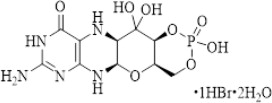
Active ingredient
Classification
Various alimentary tract and metabolism productsCyclic Pyranopterin Monophosphate
Indications
INDICATIONS AND USAGE NULIBRY is indicated to reduce the risk of mortality in patients with molybdenum cofactor deficiency (MoCD) Type A. NULIBRY is cyclic pyranopterin monophosphate (cPMP) indicated to reduce the risk of mortality in patients with molybdenum cofactor deficiency (MoCD) Type A. ( 1 )
Dosage
DOSAGE AND ADMINISTRATION Start NULIBRY if known or presumed MoCD Type A. Promptly discontinue if MoCD Type A is not confirmed by genetic testing. ( 2.1 ) Reconstitute before use and complete infusion within 4 hours of reconstitution. ( 2.2 , 2.4 ) Administer as an intravenous infusion once daily at a rate of 1.5 mL/minute with non-DEHP tubing with a 0.2 micron filter. Volumes below 2 mL may require syringe administration through slow intravenous push. ( 2.2 ) See Full Prescribing Information for additional important preparation instructions and administration instructions. ( 2.2 ) See the table below for the recommended dosage in patients less than one year of age. ( 2.3 ) Titration Schedule Preterm Neonates (Gestational Age Less than 37 Weeks) Term Neonates (Gestational Age 37 weeks and Above) Initial Dosage 0.4 mg/kg once daily 0.55 mg/kg once daily Month 1 0.7 mg/kg once daily 0.75 mg/kg once daily Month 3 0.9 mg/kg once daily 0.9 mg/kg once daily Recommended Dosage in Patients One Year of Age or Older: 0.9 mg/kg given as an intravenous infusion once daily. ( 2.3 ) 2.1 Patient Selection Start NULIBRY if the patient has a diagnosis or presumptive diagnosis of MoCD Type A. In patients with a presumptive diagnosis of MoCD Type A, confirm the diagnosis of MoCD Type A immediately after initiation of NULIBRY treatment. In such patients, discontinue NULIBRY if the MoCD Type A diagnosis is not confirmed by genetic testing. 2.2 Important Administration Information NULIBRY is intended for administration by a healthcare provider. If deemed appropriate by a healthcare provider, NULIBRY may be administered at home by the patient's caregiver. If NULIBRY can be administered by a caregiver/patient, advise them to read the detailed instructions on the preparation, administration, storage, and disposal of NULIBRY for caregivers [see Instructions for Use ]. NULIBRY is for intravenous infusion only. Administer with non-DEHP tubing with a 0.2 micron filter. Do not mix NULIBRY with other drugs (note NULIBRY is reconstituted with Sterile Water for Injection, USP). Do not administer as an infusion with other drugs. NULIBRY is given through an infusion pump at a rate of 1.5 mL per minute. Dose volumes below 2 mL may require syringe administration through slow intravenous push. Administration of NULIBRY must be completed within 4 hours of reconstitution [see Dosage and Administration ( 2.5 )] . 2.3 Recommended Dosage and Administration Recommended Dosage and Administration in Patients Less Than One Year of Age (by gestational age) The recommended dosage regimen of NULIBRY in patients less than one year of age (by gestational age) is based on actual body weight as shown in Table 1 . Table 1 Recommended Initial Dosage and Titration Schedule of NULIBRY for Patients Less Than One Year of Age by Gestational Age Titration Schedule Preterm Neonates (Gestational Age Less than 37 Weeks) Term Neonates (Gestational Age 37 Weeks and Above) Initial Dosage 0.4 mg/kg once daily 0.55 mg/kg once daily Dosage at Month 1 0.7 mg/kg once daily 0.75 mg/kg once daily Dosage at Month 3 0.9 mg/kg once daily 0.9 mg/kg once daily Recommended Dosage and Administration in Patients One Year of Age or Older For patients one year of age or older, the recommended dosage of NULIBRY is 0.9 mg/kg (based on actual body weight) administered as an intravenous infusion once daily. Recommendations for a Missed Dose If a NULIBRY dose is missed, administer the missed dose as soon as possible. Administer the next scheduled dose at least 6 hours after the administration of the missed dose. 2.4 Preparation and Administration Instructions NULIBRY must be reconstituted prior to use. Use aseptic technique during preparation and follow these instructions: Determine the total dose, number of vials needed, and total reconstituted dose volume based on the patient's weight and prescribed dose. Remove the required number of vials from the freezer to allow them to reach room temperature (by hand warming for 3 to 5 minutes or exposing to ambient air for approximately 30 minutes). Reconstitute each required NULIBRY vial with 5 mL of Sterile Water for Injection, USP. Gently swirl the vial continuously until the powder is completely dissolved. DO NOT shake. After reconstitution, the final concentration of NULIBRY reconstituted solution is 9.5 mg/5 mL (1.9 mg/mL). Parenteral drug products should be inspected visually for particulate matter and discoloration prior to administration, whenever solution and container permit. Reconstituted NULIBRY is a clear and colorless to pale yellow solution. Do not use if there are particles present or if the solution is discolored. Administer the total reconstituted dose. 2.5 Storage of Reconstituted Solution Reconstituted NULIBRY may be stored at room temperature [15°C to 25°C (59°F to 77°F)] or refrigerated [2°C to 8°C (36°F to 46°F)] for up to 4 hours including infusion time. If reconstituted NULIBRY is refrigerated, allow it to come to room temperature (by hand warming for 3 to 5 minutes or exposing to ambient air for approximately 30 minutes) before administration. Do not heat. Do not re-freeze NULIBRY after reconstitution. Do not shake. Discard all unused reconstituted NULIBRY solution 4 hours after reconstitution.
Warnings
WARNINGS AND PRECAUTIONS Potential for Photosensitivity : Advise patients/caregivers to avoid patient exposure to sunlight, and to have the patient wear sunscreen, protective clothing, and sunglasses when exposed to the sun. If photosensitivity occurs, advise caregivers/patients to seek medical attention immediately and consider a dermatological evaluation. ( 5.1 , 13.2 ) 5.1 Potential for Photosensitivity Animal studies have identified that NULIBRY has phototoxic potential [see Nonclinical Toxicology ( 13.2 )]. Advise NULIBRY-treated patients or their caregivers to avoid or minimize patient exposure to direct sunlight and artificial UV light exposure (i.e., UVA or UVB phototherapy) and adopt precautionary measures (e.g., have the patient wear protective clothing and hats, use broad spectrum sunscreen with high sun protection factor (SPF) in patients 6 months of age and older, and wear sunglasses when exposed to the sun). If photosensitivity occurs, advise caregivers/patients to seek medical attention immediately and consider a dermatological evaluation.
Contraindications
CONTRAINDICATIONS None. None. ( 4 )
Mechanism of action
Mechanism of Action Patients with MoCD Type A have mutations in the MOCS1 gene leading to deficient MOCS1A/B dependent synthesis of the intermediate substrate, cPMP. Substrate replacement therapy with NULIBRY provides an exogenous source of cPMP, which is converted to molybdopterin. Molybdopterin is then converted to molybdenum cofactor, which is needed for the activation of molybdenum-dependent enzymes, including sulfite oxidase (SOX), an enzyme that reduces levels of neurotoxic sulfites.
Indicated ICD-10 codes
Source: RxNorm + openFDA + RxClass + FAERS · 2026
Look up another medication