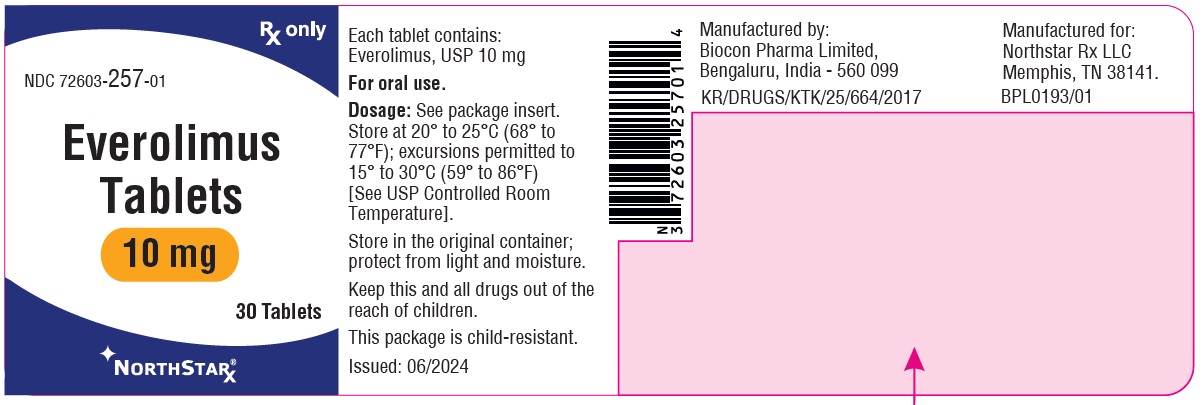
everolimus 1 MG Oral Tablet — Mammalian target of rapamycin (mTOR) kinase inhibitors. 1. INDICATIONS AND USAGE Everolimus tablets are a kinase inhibitor indicated for the treatment of: Postmenopausal women with advanced hormone…
Boxed warning
WARNING: MALIGNANCIES and SERIOUS INFECTIONS; KIDNEY GRAFT THROMBOSIS; NEPHROTOXICITY; and MORTALITY IN HEART TRANSPLANTATION Malignancies and Serious Infections • Only physicians experienced in immunosuppressive therapy and management of transplant patients should prescribe everolimus tablets. Patients receiving the drug should be managed in facilities equipped and staffed with adequate laboratory and supportive medical resources. The physician responsible for maintenance therapy should have complete information requisite for the follow-up of the patient [see Warnings and Precautions ( 5.1 )]. • Increased susceptibility to infection and the possible development of malignancies, such as lymphoma and skin cancer, may result from immunosuppression [see Warnings and Precautions ( 5.2 , 5.3 )]. Kidney Graft Thrombosis • An increased risk of kidney arterial and venous thrombosis, resulting in graft loss, was reported, mostly within the first 30 days posttransplantation [see Warnings and Precautions ( 5.4 )]. Nephrotoxicity • Increased nephrotoxicity can occur with use of standard doses of cyclosporine in combination with everolimus tablets. Therefore, reduced doses of cyclosporine should be used in combination with everolimus tablets in order to reduce renal dysfunction. It is important to monitor the cyclosporine and everolimus tablets whole blood trough concentration s [see Dosage and Administration ( 2.4 , 2.5 ), Warnings and Precautions ( 5.6 ), Clinical Pharmacology ( 12.7 , 12.8 )]. Mortality in Heart Transplantation • Increased mortality, often associated with serious infections, within the first three months posttransplantation was observed in a clinical trial of de novo heart transplant patients receiving immunosuppressive regimens with or without induction therapy. Use in heart transplantation is not recommended [see Warnings and Precautions ( 5.7 )]. WARNING: MALIGNANCIES and SERIOUS INFECTIONS; KIDNEY GRAFT THROMBOSIS; NEPHROTOXICITY; and MORTALITY IN HEART TRANSPLANTATION See full prescribing information for complete boxed warning. • Only physicians experienced in immunosuppressive therapy and management of transplant patients should use everolimus tablets ( 5.1 ) • Increased susceptibility to infection and the possible development of malignancies may result from immunosuppression ( 5.2 , 5.3 ) • Increased incidence of kidney graft thrombosis ( 5.4 ) • Reduced doses of cyclosporine are required for use in combination with everolimus tablets in order to reduce nephrotoxicity ( 2.4 , 2.5 , 5.6 , 12.7 , 12.8 ) • Increased mortality in a heart transplant clinical trial. Use in heart transplantation is not recommended ( 5.7 )
Mammalian target of rapamycin (mTOR) kinase inhibitorsKinase Inhibitor
Drug interactions
Everolimus has several drug interactions that require dose adjustments or avoidance of concomitant use.
majorP-gp and strong CYP3A4 inhibitors — Avoid concomitant use.
moderateP-gp and moderate CYP3A4 inhibitors — Reduce the dose as recommended.
moderateP-gp and strong CYP3A4 inducers — Increase the dose as recommended.
majorACE inhibitors — Increased risk for angioedema; avoid concomitant use.
Indications
1. INDICATIONS AND USAGE Everolimus tablets are a kinase inhibitor indicated for the treatment of: Postmenopausal women with advanced hormone receptor-positive, HER2-negative breast cancer in combination with exemestane after failure of treatment with letrozole or anastrozole. ( 1.1 ) Adults with progressive neuroendocrine tumors of pancreatic origin (PNET) and adults with progressive, well-differentiated, non-functional neuroendocrine tumors (NET) of gastrointestinal (GI) or lung origin that are unresectable, locally advanced or metastatic. Limitations of Use: Everolimus tablets are not indicated for the treatment of patients with functional carcinoid tumors. ( 1.2 ) Adults with advanced renal cell carcinoma (RCC) after failure of treatment with sunitinib or sorafenib. ( 1.3 ) Adults with renal angiomyolipoma and tuberous sclerosis complex (TSC), not requiring immediate surgery. ( 1.4 ) Everolimus tablets and everolimus tablets for oral suspension are kinase inhibitors indicated for the treatment of adult and pediatric patients aged 1 year and older with TSC who have subependymal giant cell astrocytoma (SEGA) that requires therapeutic intervention but cannot be curatively resected. ( 1.5 ) Everolimus tablets for oral suspension is a kinase inhibitor indicated for the adjunctive treatment of adult and pediatric patients aged 2 years and older with TSC-associated partial-onset seizures. ( 1.6 ) 1.1 Hormone Receptor-Positive, HER2-Negative Breast Cancer Everolimus tablets are indicated for the treatment of postmenopausal women with advanced hormone receptor-positive, HER2-negative breast cancer in combination with exemestane, after failure of treatment with letrozole or anastrozole. 1.2 Neuroendocrine Tumors (NET) Everolimus tablets are indicated for the treatment of adult patients with progressive neuroendocrine tumors of pancreatic origin (PNET) with unresectable, locally advanced or metastatic disease. Everolimus tablets are indicated for the treatment of adult patients with progressive, well-differentiated, non-functional NET of gastrointestinal (GI) or lung origin with unresectable, locally advanced or metastatic disease. Limitations of Use: Everolimus tablets are not indicated for the treatment of patients with functional carcinoid tumors [see Clinical Studies (14.2) ]. 1.3 Renal Cell Carcinoma (RCC) Everolimus tablets are indicated for the treatment of adult patients with advanced RCC after failure of treatment with sunitinib or sorafenib. 1.4 Tuberous Sclerosis Complex (TSC)-Associated Renal Angiomyolipoma Everolimus tablets are indicated for the treatment of adult patients with renal angiomyolipoma and TSC, not requiring immediate surgery. 1.5 Tuberous Sclerosis Complex (TSC)-Associated Subependymal Giant Cell Astrocytoma (SEGA) Everolimus tablets and Everolimus tablets for oral suspension are indicated in adult and pediatric patients aged 1 year and older with TSC for the treatment of SEGA that requires therapeutic intervention but cannot be curatively resected. 1.6 Tuberous Sclerosis Complex (TSC)-Associated Partial-Onset Seizures Everolimus tablets for oral suspension are indicated for the adjunctive treatment of adult and pediatric patients aged 2 years and older with TSC-associated partial-onset seizures.
Dosage
2. DOSAGE AND ADMINISTRATION Do not combine everolimus tablets and everolimus tablets for oral suspension to achieve the total daily dose. ( 2.1 ) Modify the dose for patients with hepatic impairment or for patients taking drugs that inhibit or induce P-glycoprotein (P-gp) and CYP3A4. ( 2.1 ) Breast Cancer: 10 mg orally once daily. ( 2.2 ) NET: 10 mg orally once daily. ( 2.3 ) RCC: 10 mg orally once daily. ( 2.4 ) TSC-Associated Renal Angiomyolipoma: 10 mg orally once daily. ( 2.5 ) TSC-Associated SEGA: 4.5 mg/m 2 orally once daily; adjust dose to attain trough concentrations of 5-15 ng/mL. ( 2.6 , 2.8 ) TSC-Associated Partial-Onset Seizures: 5 mg/ m 2 orally once daily; adjust dose to attain trough concentrations of 5-15 ng/mL. ( 2.7 , 2.8 ) 2.1 Important Dosage Information Everolimus tablets and everolimus tablets for oral suspension are two different dosage forms. Select the recommended dosage form based on the indication [see Indications and Usage (1) ] . Do not combine everolimus tablets and everolimus tablets for oral suspension to achieve the total dose. Modify the dosage for patients with hepatic impairment or for patients taking drugs that inhibit or induce P-glycoprotein (P-gp) and CYP3A4 [see Dosage and Administration (2.10 , 2.11 , 2.12) ]. 2.2 Recommended Dosage for Hormone Receptor-Positive, HER2-Negative Breast Cancer The recommended dosage of everolimus tablets is 10 mg orally once daily until disease progression or unacceptable toxicity. 2.3 Recommended Dosage for Neuroendocrine Tumors (NET) The recommended dosage of everolimus tablets is 10 mg orally once daily until disease progression or unacceptable toxicity. 2.4 Recommended Dosage for Renal Cell Carcinoma (RCC) The recommended dosage of everolimus tablets is 10 mg orally once daily until disease progression or unacceptable toxicity. 2.5 Recommended Dosage for Tuberous Sclerosis Complex (TSC)-Associated Renal Angiomyolipoma The recommended dosage of everolimus tablets is 10 mg orally once daily until disease progression or unacceptable toxicity. 2.6 Recommended Dosage for Tuberous Sclerosis Complex (TSC)-Associated Subependymal Giant Cell Astrocytoma (SEGA) The recommended starting dosage of everolimus tablets/everolimus tablets for oral suspension is 4.5 mg/m 2 orally once daily until disease progression or unacceptable toxicity [see Dosage and Administration (2.8) ]. 2.7 Recommended Dosage for Tuberous Sclerosis Complex (TSC)-Associated Partial-Onset Seizures The recommended starting dosage of everolimus tablets for oral suspension is 5 mg/m2 orally once daily until disease progression or unacceptable toxicity [see Dosage and Administration (2.8) ]. 2.8 Therapeutic Drug Monitoring (TDM) and Dose Titration for Tuberous Sclerosis Complex (TSC)-Associated Subependymal Giant Cell Astrocytoma (SEGA) and TSC-Associated Partial-Onset Seizures Monitor everolimus whole blood trough concentrations at time points recommended in Table 1. Titrate the dose to attain trough concentrations of 5 ng/mL to 15 ng/mL. Adjust the dose using the following equation: New dose The maximum dose increment at any titration must not exceed 5 mg. Multiple dose titrations may be required to attain the target trough concentration. = current dose × (target concentration divided by current concentration) When possible, use the same assay and laboratory for TDM throughout treatment. Table 1: Recommended Timing of Therapeutic Drug Monitoring Event When to Assess Trough Concentrations After Event Abbreviation: P-gp, P-glycoprotein. Initiation of everolimus tablets/everolimus tablets for oral suspension 1 to 2 weeks Modification of everolimus tablets/everolimus tablets for oral suspension dose 1 to 2 weeks Switch between everolimus tablets/everolimus tablets for oral suspension 1 to 2 weeks Initiation or discontinuation of P-gp and moderate CYP3A4 inhibitor 2 weeks Initiation or discontinuation of P-gp and strong CYP3A4 inducer 2 weeks Change in hepatic function 2 weeks Stable dose with changing body surface area (BSA) Every 3 to 6 months Stable dose with stable BSA Every 6 to 12 months 2.9 Dosage Modifications for Adverse Reactions Table 2 summarizes recommendations for dosage modifications of everolimus tablets/everolimus tablets for oral suspension for the management of adverse reactions. Table 2: Recommended Dosage Modifications for Everolimus Tablets/Everolimus Tablets for Oral Suspension for Adverse Reactions Adverse Reaction Severity Dosage Modification Non-infectious pneumonitis [see Warnings and Precautions (5.1) ] Grade 2 Withhold until improvement to Grade 0 or 1. Resume at 50% of previous dose; change to every other day dosing if the reduced dose is lower than the lowest available strength. Permanently discontinue if toxicity does not resolve or improve to Grade 1 within 4 weeks. Grade 3 Withhold until improvement to Grade 0 or 1. Resume at 50% of previous dose; change to every other day dosing if the reduced dose is lower than the lowest available strength. If toxicity recurs at Grade 3, permanently discontinue. Grade 4 Permanently discontinue. Stomatitis [see Warnings and Precautions (5.5) ] Grade 2 Withhold until improvement to Grade 0 or 1. Resume at same dose. If recurs at Grade 2, withhold until improvement to Grade 0 or 1. Resume at 50% of previous dose; change to every other day dosing if the reduced dose is lower than the lowest available strength. Grade 3 Withhold until improvement to Grade 0 or 1. Resume at 50% of previous dose; change to every other day dosing if the reduced dose is lower than the lowest available strength. Grade 4 Permanently discontinue. Metabolic events (e.g., hyperglycemia, dyslipidemia) [see Warnings and Precautions (5.9) ] Grade 3 Withhold until improvement to Grade 0, 1, or 2. Resume at 50% of previous dose; change to every other day dosing if the reduced dose is lower than the lowest available strength. Grade 4 Permanently discontinue. Other non-hematologic toxicities Grade 2 If toxicity becomes intolerable, withhold until improvement to Grade 0 or 1. Resume at same dose. If toxicity recurs at Grade 2, withhold until improvement to Grade 0 or 1. Resume at 50% of previous dose; change to every other day dosing if the reduced dose is lower than the lowest available strength. Grade 3 Withhold until improvement to Grade 0 or 1. Consider resuming at 50% of previous dose; change to every other day dosing if the reduced dose is lower than the lowest available strength. If recurs at Grade 3, permanently discontinue. Grade 4 Permanently discontinue. Thrombocytopenia [see Warnings and Precautions (5.10) ] Grade 2 Withhold until improvement to Grade 0 or 1. Resume at same dose. Grade 3 OR Grade 4 Withhold until improvement to Grade 0 or 1. Resume at 50% of previous dose; change to every other day dosing if the reduced dose is lower than the lowest available strength. Neutropenia [see Warnings and Precautions (5.10) ] Grade 3 Withhold until improvement to Grade 0, 1, or 2. Resume at same dose. Grade 4 Withhold until improvement to Grade 0, 1, or 2. Resume at 50% of previous dose; change to every other day dosing if the reduced dose is lower than the lowest available strength. Febrile neutropenia [see Warnings and Precautions (5.10) ] Grade 3 Withhold until improvement to Grade 0, 1, or 2, and no fever. Resume at 50% of previous dose; change to every other day dosing if the reduced dose is lower than the lowest available strength. Grade 4 Permanently discontinue. 2.10 Dosage Modifications for Hepatic Impairment The recommended dosages of everolimus tablets/everolimus tablets for oral suspension for patients with hepatic impairment are described in Table 3 [see Use in Specific Populations (8.6) ] : Table 3: Recommended Dosage Modifications for Patients With Hepatic Impairment Indication Dose Modification for Everolimus Tablets/Everolimus Tablets for Oral Suspension Abbreviations: NET, Neuroendocrine Tumors; RCC, Renal Cell Carcinoma; SEGA, Subependymal Giant Cell Astrocytoma; TS
Warnings
5. WARNINGS AND PRECAUTIONS Non-Infectious Pneumonitis: Monitor for clinical symptoms or radiological changes. Withhold or permanently discontinue based on severity. ( 2.9 , 5.1 ) Infections: Monitor for signs and symptoms of infection. Withhold or permanently discontinue based on severity. ( 2.9 , 5.2 ) Severe Hypersensitivity Reactions: Permanently discontinue for clinically significant hypersensitivity. ( 5.3 ) Angioedema: Patients taking concomitant angiotensin-converting-enzyme (ACE) inhibitors may be at increased risk for angioedema. Permanently discontinue for angioedema. ( 5.4 , 7.2 ) Stomatitis: Initiate dexamethasone alcohol-free mouthwash when starting treatment. ( 5.5 , 6.1 ) Renal Failure: Monitor renal function prior to treatment and periodically thereafter. ( 5.6 ) Risk of Impaired Wound Healing: Withhold for at least 1 week prior to elective surgery. Do not administer for at least 2 weeks following major surgery and until adequate wound healing. The safety of resumption of treatment after resolution of wound healing complications has not been established. ( 5.7 ) Geriatric Patients: Monitor and adjust dose for adverse reactions. ( 5.8 ) Metabolic Disorders: Monitor serum glucose and lipids prior to treatment and periodically thereafter. Withhold or permanently discontinue based on severity. ( 2.9 , 5.9 ) Myelosuppression: Monitor hematologic parameters prior to treatment and periodically thereafter. Withhold or permanently discontinue based on severity. ( 2.9 , 5.10 ) Risk of Infection or Reduced Immune Response with Vaccination: Avoid live vaccines and close contact with those who have received live vaccines. Complete recommended childhood vaccinations prior to starting treatment. ( 5.11 ) Radiation Sensitization and Radiation Recall: Severe radiation reactions may occur. ( 5.12 , 6.2 ) Embryo-Fetal Toxicity: Can cause fetal harm. Advise patients of reproductive potential of the potential risk to a fetus and to use effective contraception. ( 5.13 , 8.1 , 8.3 ) 5.1 Non-infectious Pneumonitis Non-infectious pneumonitis is a class effect of rapamycin derivatives. Non-infectious pneumonitis was reported in up to 19% of patients treated with everolimus tablets/everolimus tablets for oral suspension in clinical trials, some cases were reported with pulmonary hypertension (including pulmonary arterial hypertension) as a secondary event. The incidence of Grade 3 and 4 non-infectious pneumonitis was up to 4% and up to 0.2%, respectively [see Adverse Reactions (6.1) ]. Fatal outcomes have been observed. Consider a diagnosis of non-infectious pneumonitis in patients presenting with non-specific respiratory signs and symptoms. Consider opportunistic infections, such as pneumocystis jiroveci pneumonia (PJP) in the differential diagnosis. Advise patients to report promptly any new or worsening respiratory symptoms. Continue everolimus tablets/everolimus tablets for oral suspension without dose alteration in patients who develop radiological changes suggestive of non-infectious pneumonitis and have few or no symptoms. Imaging appears to overestimate the incidence of clinical pneumonitis. For Grade 2 to 4 non-infectious pneumonitis, withhold or permanently discontinue everolimus tablets/everolimus tablets for oral suspension based on severity [see Dosage and Administration (2.9) ]. Corticosteroids may be indicated until clinical symptoms resolve. Administer prophylaxis for PJP when concomitant use of corticosteroids or other immunosuppressive agents are required. The development of pneumonitis has been reported even at a reduced dose. 5.2 Infections Everolimus tablets/everolimus tablets for oral suspension have immunosuppressive properties and may predispose patients to bacterial, fungal, viral, or protozoal infections, including infections with opportunistic pathogens [see Adverse Reactions (6.1) ]. Localized and systemic infections, including pneumonia, mycobacterial infections, other bacterial infections, invasive fungal infections (e.g., aspergillosis, candidiasis, or PJP), and viral infections (e.g., reactivation of hepatitis B virus) have occurred. Some of these infections have been severe (e.g., sepsis, septic shock, or resulting in multisystem organ failure) or fatal. The incidence of Grade 3 and 4 infections was up to 10% and up to 3%, respectively. The incidence of serious infections was reported at a higher frequency in patients < 6 years of age [see Use in Specific Populations (8.4) ]. Complete treatment of preexisting invasive fungal infections prior to starting treatment. Monitor for signs and symptoms of infection. Withhold or permanently discontinue everolimus tablets/everolimus tablets for oral suspension based on severity of infection [see Dosage and Administration (2.9) ]. Administer prophylaxis for PJP when concomitant use of corticosteroids or other immunosuppressive agents are required. 5.3 Severe Hypersensitivity Reactions Hypersensitivity reactions to everolimus tablets/everolimus tablets for oral suspension have been observed and include anaphylaxis, dyspnea, flushing, chest pain, and angioedema (e.g., swelling of the airways or tongue, with or without respiratory impairment) [see Contraindications (4) ]. The incidence of Grade 3 hypersensitivity reactions was up to 1%. Permanently discontinue everolimus tablets/everolimus tablets for oral suspension for the development of clinically significant hypersensitivity. 5.4 Angioedema With Concomitant Use of Angiotensin-Converting Enzyme (ACE) Inhibitors Patients taking concomitant ACE inhibitors with everolimus tablets/everolimus tablets for oral suspension may be at increased risk for angioedema (e.g., swelling of the airways or tongue, with or without respiratory impairment). In a pooled analysis of randomized double-blind oncology clinical trials, the incidence of angioedema in patients taking everolimus tablets with an ACE inhibitor was 6.8% compared to 1.3% in the control arm with an ACE inhibitor. Permanently discontinue everolimus tablets/everolimus tablets for oral suspension for angioedema. 5.5 Stomatitis Stomatitis, including mouth ulcers and oral mucositis, has occurred in patients treated with everolimus tablets/everolimus tablets for oral suspension at an incidence ranging from 44% to 78% across clinical trials. Grades 3-4 stomatitis was reported in 4% to 9% of patients [see Adverse Reactions (6.1) ]. Stomatitis most often occurs within the first 8 weeks of treatment. When starting everolimus tablets/everolimus tablets for oral suspension, initiating dexamethasone alcohol-free oral solution as a swish and spit mouthwash reduces the incidence and severity of stomatitis [see Adverse Reactions (6.1) ]. If stomatitis does occur, mouthwashes and/or other topical treatments are recommended. Avoid alcohol-, hydrogen peroxide-, iodine-, or thyme- containing products, as they may exacerbate the condition. Do not administer antifungal agents, unless fungal infection has been diagnosed. 5.6 Renal Failure Cases of renal failure (including acute renal failure), some with a fatal outcome, have occurred in patients taking everolimus tablets. Elevations of serum creatinine and proteinuria have been reported in patients taking everolimus tablets/everolimus tablets for oral suspension [see Adverse Reactions (6.1) ]. The incidence of Grade 3 and 4 elevations of serum creatinine was up to 2% and up to 1%, respectively. The incidence of Grade 3 and 4 proteinuria was up to 1% and up to 0.5%, respectively. Monitor renal function prior to starting everolimus tablets/everolimus tablets for oral suspension and annually thereafter. Monitor renal function at least every 6 months in patients who have additional risk factors for renal failure. 5.7 Risk of Impaired Wound Healing Impaired wound healing can occur in patients who receive drugs that inhibit the VEGF signaling pathway. Therefore, everolimus tablets/everolimus tablets for oral suspension have the potential to adversely affect wound hea
Contraindications
4. CONTRAINDICATIONS Everolimus tablets/everolimus tablets for oral suspension are contraindicated in patients with clinically significant hypersensitivity to everolimus or to other rapamycin derivatives [see Warnings and Precautions (5.3) ]. Clinically significant hypersensitivity to everolimus or to other rapamycin derivatives. ( 4 )
Mechanism of action
Mechanism of Action Everolimus is an inhibitor of mammalian target of rapamycin (mTOR), a serine-threonine kinase, downstream of the PI3K/AKT pathway. The mTOR pathway is dysregulated in several human cancers and in tuberous sclerosis complex (TSC). Everolimus binds to an intracellular protein, FKBP-12, resulting in an inhibitory complex formation with mTOR complex 1 (mTORC1) and thus inhibition of mTOR kinase activity. Everolimus reduced the activity of S6 ribosomal protein kinase (S6K1) and eukaryotic initiation factor 4E-binding protein (4E-BP1), downstream effectors of mTOR, involved in protein synthesis. S6K1 is a substrate of mTORC1 and phosphorylates the activation domain 1 of the estrogen receptor which results in ligand-independent activation of the receptor. In addition, everolimus inhibited the expression of hypoxia-inducible factor (e.g., HIF-1) and reduced the expression of vascular endothelial growth factor (VEGF). Inhibition of mTOR by everolimus has been shown to reduce cell proliferation, angiogenesis, and glucose uptake in in vitro and/or in vivo studies. Constitutive activation of the PI3K/Akt/mTOR pathway can contribute to endocrine resistance in breast cancer. In vitro studies show that estrogen-dependent and HER2+ breast cancer cells are sensitive to the inhibitory effects of everolimus, and that combination treatment with everolimus and Akt, HER2, or aromatase inhibitors enhances the anti-tumor activity of everolimus in a synergistic manner. Two regulators of mTORC1 signalling are the oncogene suppressors tuberin-sclerosis complexes 1 and 2 ( TSC1, TSC2 ). Loss or inactivation of either TSC1 or TSC2 leads to activation of downstream signalling. In TSC, a genetic disorder, inactivating mutations in either the TSC1 or the TSC2 gene lead to hamartoma formation throughout the body as well as seizures and epileptogenesis. Overactivation of mTOR results in neuronal dysplasia, aberrant axonogenesis and dendrite formation, increased excitatory synaptic currents, reduced myelination, and disruption of the cortical laminar structure causing abnormalities in neuronal development and function. Treatment with an mTOR inhibitor in animal models of mTOR dysregulation in the brain resulted in seizure suppression, prevention of the development of new-onset seizures, and prevention of premature death.
A drug lookup is just the start. Eleplan keeps the whole care plan in one place.
Medications, diagnoses, documents, appointments, and the whole care team — organized and always in sync, with Ellie, your AI care assistant, on top of it. Free to start.