elagolix 200 MG Oral Tablet
Managing this medication for someone you care for? Eleplan keeps diagnoses, medications and appointments in one plan.
Start free with EleplanClinical drug
elagolix 200 MG Oral Tablet
200 MG · Oral Tablet · oral
A form of elagolix →
elagolix 200 MG Oral Tablet — Anti-gonadotropin-releasing hormones. INDICATIONS AND USAGE ORILISSA is indicated for the management of moderate to severe pain associated with endometriosis. Limitation s of Use: Limit…
Active ingredient
Classification
Anti-gonadotropin-releasing hormonesGonadotropin Releasing Hormone Receptor Antagonist
Drug interactions
Elagolix has several clinically important drug interactions that can affect the plasma concentrations of concomitant medications.
- moderatedigoxin — increased digoxin concentrations
- moderatemidazolam — decreased midazolam concentrations
- moderaterosuvastatin — decreased rosuvastatin concentrations
- minoromeprazole — increased omeprazole concentrations
- majorrifampin — decreased elagolix concentrations
- majorstrong CYP3A inhibitors — increased elagolix concentrations
- majorOATP1B1 inhibitors — increased elagolix concentrations
Indications
INDICATIONS AND USAGE ORILISSA is indicated for the management of moderate to severe pain associated with endometriosis. Limitation s of Use: Limit the duration of use based on the dose and coexisting condition (see Table 1 ) [see D osage and Administration ( 2.1 ) and Warnings and Precautions ( 5.1 ) ] . ORILISSA is a gonadotropin-releasing hormone (GnRH) receptor antagonist indicated for the management of moderate to severe pain associated with endometriosis. ( 1 ) Limitation s of Use: Limit the duration of use based on the dose and coexisting condition (see Table 1 ). ( 1 )
Dosage
DOSAGE AND ADMINISTRATION Normal liver function or mild hepatic impairment : 150 mg once daily for up to 24 months or 200 mg twice daily for up to 6 months. ( 2.1 ) Moderate hepatic impairment : 150 mg once daily for up to 6 months. ( 2.1 ) 2.1 Important Dosing Information Exclude pregnancy before starting ORILISSA or start ORILISSA within 7 days from the onset of menses. Take ORILISSA at approximately the same time each day, with or without food. Use the lowest effective dose, taking into account the severity of symptoms and treatment objectives [see Warnings and Precautions ( 5.1 , 5.3 , 5.4 ) and Clinical Studies ( 14 )] . Limit the duration of use because of bone loss ( Table 1 ) [see Warnings and Precautions ( 5.1 )] . Table 1. Recommended Dosage and Duration of Use Dosing Regimen Maximum Treatment Duration Coexisting Condition Initiate treatment with ORILISSA 150 mg once daily 24 months None Consider initiating treatment with ORILISSA 200 mg twice daily 6 months Dyspareunia Initiate treatment with ORILISSA 150 mg once daily. Use of 200 mg twice daily is not recommended. 6 months Moderate hepatic impairment (Child-Pugh Class B) 2.2 Hepatic Impairment No dosage adjustment of ORILISSA is required in women with mild hepatic impairment (Child-Pugh A). Compared to women with normal liver function, those with moderate hepatic impairment had approximately 3-fold higher elagolix exposures and those with severe hepatic impairment had approximately 7-fold higher elagolix exposures. Because of these increased exposures and risk for bone loss: ORILISSA 150 mg once daily is recommended for women with moderate hepatic impairment (Child-Pugh B) with the duration of treatment limited to 6 months. Use of ORILISSA 200 mg twice daily is not recommended for women with moderate hepatic impairment [see Use in Specific Populations ( 8.7 ) and Clinical Pharmacology ( 12.3 )] . ORILISSA is contraindicated in women with severe hepatic impairment (Child-Pugh C) [see Contraindications ( 4 ), Use in Specific Populations ( 8.7 ) and Clinical Pharmacology ( 12.3 )] . 2.3 Missed Dose Instruct the patient to take a missed dose of ORILISSA on the same day as soon as she remembers and then resume the regular dosing schedule. 150 mg once daily: take no more than 1 tablet each day. 200 mg twice daily: take no more than 2 tablets each day.
Warnings
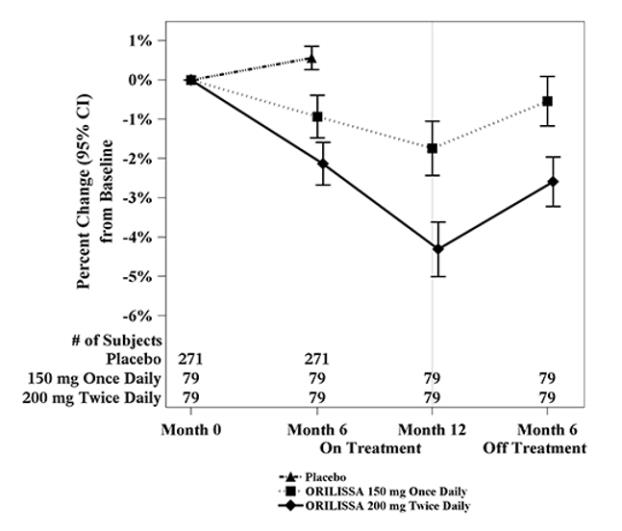
WARNINGS AND PRECAUTIONS Bone Loss : Dose- and duration-dependent decreases in bone mineral density (BMD) that may not be completely reversible. Assess BMD in women with additional risk factors for bone loss ( 5.1 ) Reduced Ability to Recognize Pregnancy : ORILISSA may alter menstrual bleeding, which may reduce the ability to recognize pregnancy. Perform testing if pregnancy is suspected. Discontinue if pregnancy is confirmed ( 5.2 ) Suicidal Ideation and Mood Disorders : Advise patients to seek medical attention for suicidal ideation, suicidal behavior, new onset or worsening depression, anxiety, or other mood changes ( 5.3 ) Hepatic Transaminase Elevations : Dose-dependent elevations in serum alanine aminotransferase (ALT). Counsel patients on signs and symptoms of liver injury ( 5.4 ) Interactions with Hormonal Contraceptives : Use non-hormonal contraception during treatment and for 28 days after discontinuing ORILISSA. Coadministration of ORILISSA 200 mg twice daily with an estrogen-containing contraceptive is not recommended because of the potential for increased estrogen-associated risks. Coadministration of ORILISSA with an estrogen-containing contraceptive may reduce the efficacy of ORILISSA. Coadministration with progestin-containing oral contraceptives may reduce the efficacy of the contraceptive. ( 5.5 ) 5.1 Bone Loss ORILISSA causes a dose-dependent decrease in bone mineral density (BMD). BMD loss is greater with increasing duration of use and may not be completely reversible after stopping treatment [see Adverse Reactions ( 6.1 )] . The impact of these BMD decreases on long-term bone health and future fracture risk are unknown. ORILISSA is contraindicated in women with known osteoporosis [see Contraindications ( 4 )]. Consider assessment of BMD in patients with a history of a low-trauma fracture or other risk factors for osteoporosis or bone loss. Limit the duration of use to reduce the extent of bone loss [see Dosage and Administration ( 2.2 )]. Although the effect of supplementation with calcium and vitamin D was not studied, such supplementation may be beneficial for all patients. 5.2 Change in Menstrual Bleeding Pattern and Reduced Ability to Recognize Pregnancy Women who take ORILISSA may experience a reduction in the amount, intensity or duration of menstrual bleeding, which may reduce the ability to recognize the occurrence of a pregnancy in a timely manner [see Adverse Reactions ( 6.1 )] . Perform pregnancy testing if pregnancy is suspected, and discontinue ORILISSA if pregnancy is confirmed. 5.3 Suicidal Ideation, Suicidal Behavior, and Exacerbation of Mood Disorders Suicidal ideation and behavior, including one completed suicide, occurred in subjects treated with ORILISSA in the endometriosis clinical trials. ORILISSA subjects had a higher incidence of depression and mood changes compared to placebo, and ORILISSA subjects with a history of suicidality or depression had a higher incidence of depression compared to subjects without such a history [see Adverse Reactions ( 6.1 )] . Promptly evaluate patients with depressive symptoms to determine whether the risks of continued therapy outweigh the benefits [see Adverse Reactions ( 6.1 )] . Patients with new or worsening depression, anxiety or other mood changes should be referred to a mental health professional, as appropriate. Advise patients to seek immediate medical attention for suicidal ideation and behavior. Reevaluate the benefits and risks of continuing ORILISSA if such events occur. 5.4 Hepatic Transaminase Elevations In clinical trials, dose-dependent elevations of serum alanine aminotransferase (ALT) at least 3-times the upper limit of the reference range occurred with ORILISSA. Use the lowest effective dose of ORILISSA and instruct patients to promptly seek medical attention in case of symptoms or signs that may reflect liver injury, such as jaundice. Promptly evaluate patients with elevations in liver tests to determine whether the benefits of continued therapy outweigh the risks [see Adverse Reactions ( 6.1 )] . 5.5 Interactions with Hormonal Contraceptives Advise women to use effective non-hormonal contraceptives during treatment with ORILISSA and for 28 days after discontinuing ORILISSA [see Use in Specific Populations ( 8.1 , 8.3 ), Drug Interactions ( 7.1 ), Clinical Pharmacology ( 12.3 )] . Increase in Estrogen Exposure and Potential Associated Increased Risks When ORILISSA 200 mg Twice Daily is Taken With Combined Hormonal Contraceptives Co-administration of a combined oral contraceptive (COC) (containing 20 mcg ethinyl estradiol/0.1 mg levonorgestrel) following administration of ORILISSA 200 mg twice daily for 14 days increases the plasma ethinyl estradiol concentration by 2.2-fold compared to this COC alone. ORILISSA 200 mg twice daily co-administered with a COC containing ethinyl estradiol may lead to increased risk of ethinyl estradiol-related adverse events including thromboembolic disorders and vascular events and is not recommended [see Drug Interactions ( 7.1 ), Clinical Pharmacology ( 12.3 )] . Potential for Reduced Efficacy of Progestin -Containing Hormonal Contraceptives Co-administration of ORILISSA 200 mg twice daily and a COC containing 0.1 mg levonorgestrel decreases the plasma concentrations of levonorgestrel by 27%, potentially affecting contraceptive efficacy. Co-administration of ORILISSA with COCs containing norethindrone acetate did not show reduction in plasma concentrations of norethindrone [see Drug Interactions ( 7.1 ), Clinical Pharmacology ( 12.3 )] . Co-administration of ORILISSA with progestin-containing intrauterine contraceptive systems has not been studied. Reduced efficacy of ORILISSA Based on the mechanism of action of ORILISSA, estrogen-containing contraceptives are expected to reduce the efficacy of ORILISSA. The effect of progestin-only contraceptives on the efficacy of ORILISSA is unknown.
Contraindications
CONTRAINDICATIONS ORILISSA is contraindicated in women: Who are pregnant [see Use in Specific Populations ( 8.1 )] . Exposure to ORILISSA early in pregnancy may increase the risk of early pregnancy loss. With known osteoporosis because of the risk of further bone loss [see Warnings and Precautions ( 5.1 )] With severe hepatic impairment [see Use in Specific Populations ( 8.7 ), Clinical Pharmacology ( 12.3 )] Taking inhibitors of organic anion transporting polypeptide (OATP)1B1 (a hepatic uptake transporter) that are known or expected to significantly increase elagolix plasma concentrations [see Drug Interactions ( 7.2 )] With known hypersensitivity reaction to ORILISSA or any of its inactive components. Reactions have included anaphylaxis and angioedema [see Adverse Reactions ( 6.2 )] . Pregnancy ( 4 ) Known osteoporosis ( 4 ) Severe hepatic impairment ( 4 ) Organic anion transporting polypeptide (OATP) 1B1 inhibitors that significantly increase elagolix plasma concentrations ( 4 ) Hypersensitivity reactions ( 4 , 6.2 )
Mechanism of action
Mechanism of Action ORILISSA is a GnRH receptor antagonist that inhibits endogenous GnRH signaling by binding competitively to GnRH receptors in the pituitary gland. Administration of ORILISSA results in dose-dependent suppression of luteinizing hormone (LH) and follicle-stimulating hormone (FSH), leading to decreased blood concentrations of the ovarian sex hormones, estradiol and progesterone.
Indicated ICD-10 codes
Source: RxNorm + openFDA + RxClass + FAERS · 2026
Look up another medication