eflornithine 139 MG/ML Topical Cream
Managing this medication for someone you care for? Eleplan keeps diagnoses, medications and appointments in one plan.
Start free with EleplanClinical drug
eflornithine 139 MG/ML Topical Cream
139 MG/ML · Topical Cream · topical
A form of eflornithine →
eflornithine 139 MG/ML Topical Cream — Other dermatologicals. INDICATIONS AND USAGE IWILFIN (eflornithine) is indicated to reduce the risk of relapse in adult and pediatric patients with high-risk neuroblastoma…
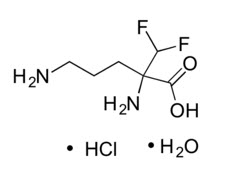
Active ingredient
Classification
Other dermatologicalsAntiprotozoal
Indications
INDICATIONS AND USAGE IWILFIN (eflornithine) is indicated to reduce the risk of relapse in adult and pediatric patients with high-risk neuroblastoma (HRNB) who have demonstrated at least a partial response to prior multiagent, multimodality therapy including anti-GD2 immunotherapy. IWILFIN is an ornithine decarboxylase inhibitor indicated to reduce the risk of relapse in adult and pediatric patients with high-risk neuroblastoma (HRNB) who have demonstrated at least a partial response to prior multiagent, multimodality therapy including anti-GD2 immunotherapy. ( 1 )
Dosage
DOSAGE AND ADMINISTRATION Prior to initiation of IWILFIN, perform baseline audiogram, complete blood count, and liver function tests. ( 2.1 , 5.3 ) Recommended dosage of IWILFIN is based on body surface area (see Table 1 ). ( 2.2 ) IWILFIN is taken orally twice daily with or without food until disease progression, unacceptable toxicity, or for a maximum of two years. ( 2.2 ) IWILFIN tablets may be swallowed whole, chewed, or crushed and mixed with soft food or liquid. ( 2.5 ) 2.1 Recommended Testing Before Initiating IWILFIN Prior to initiating IWILFIN, perform complete blood count, liver function tests, and baseline audiogram [see Warnings and Precautions (5.1 - 5.3) ]. 2.2 Recommended Dosage of IWILFIN The recommended IWILFIN dosage, based on body surface area (BSA), is provided in Table 1. Administer IWILFIN orally twice daily for two years or until recurrence of disease or unacceptable toxicity. Recalculate the BSA dosage every 3 months during treatment with IWILFIN. Table 1: Recommended Dose Body Surface Area (m 2 ) Dosage >1.5 768 mg (four tablets) orally twice a day 0.75 to 1.5 576 mg (three tablets) orally twice a day 0.5 to < 0.75 384 mg (two tablets) orally twice a day 0.25 to < 0.5 192 mg (one tablet) orally twice a day 2.3 Dosage Recommendations for Renal Impairment For the treatment of patients with severe renal impairment (eGFR <30 mL/min), reduce the recommended dose of IWILFIN by 50% as described in Table 2 [ see Use in Specific Populations (8.5) , Clinical Pharmacology (12.3) ]. Table 2: IWILFIN Dose Recommendations for Severely Renally Impaired Patients Body Surface Area (m 2 ) Recommended Dosage for Patients with Severe Renal Impairment (eGFR <30 mL/min) >1.5 384 mg (two tablets) orally twice a day 0.75 to 1.5 384 mg (two tablets) in the morning and 192 mg (one tablet) in the evening 0.5 to < 0.75 192 mg (one tablet) orally twice a day 0.25 to < 0.5 192 mg (one tablet) once a day 2.4 Dosage Modifications for Adverse Reactions The recommended dose reductions for adverse reactions are provided in Table 3. Table 3: Recommended IWILFIN Dose Reductions for Toxicity Management Current Dose Reduced Dose 768 mg (four tablets) orally twice a day 576 mg (three tablets) orally twice a day 576 mg (three tablets) orally twice a day 384 mg (two tablets) orally twice a day 384 mg (two tablets) orally twice a day 192 mg (one tablet) orally twice a day 192 mg (one tablet) orally twice a day 192 mg (one tablet) orally once daily If subsequent adverse reactions occur, continue dose reduction until reaching the minimum dose of one 192 mg tablet once per day. Permanently discontinue IWILFIN if the patient is unable to tolerate the minimum dose of 192 mg once daily. The recommended dosage modifications of IWILFIN for the management of adverse reactions are provided in Table 4. Table 4: Recommended IWILFIN Dosage Modifications for Adverse Reactions Adverse Reaction Severity Severity as defined by National Cancer Institute Common Terminology Criteria for Adverse Events (NCI CTCAE) version 4.03 Dosage Modification Myelosuppression [see Warnings and Precautions (5.1) ] Neutrophil count decreased <500/mm 3 Withhold IWILFIN until recovery to ≥500/mm 3 . If recovered within 7 days, resume IWILFIN at the same dose. If recovered after 7 days, resume IWILFIN at the next reduced dose level. Platelet count decreased <25,000/mm 3 Withhold IWILFIN until recovery to ≥25,000/mm 3 . If recovered within 7 days, resume IWILFIN at the same dose. If recovered between 7 and 14 days, resume IWILFIN at the next reduced dose level. If not recovered within 14 days, permanently discontinue IWILFIN. Anemia <8g/dL Withhold IWILFIN until recovery to ≥8g/dL. Resume IWILFIN at the same dose. If anemia recurs (<8g/dL) Withhold IWILFIN until recovery to ≥8g/dL. Resume IWILFIN at the next reduced dose level. Hepatotoxicity [see Warnings and Precautions (5.2) ] Aspartate aminotransferase increased or Alanine aminotransferase increased AST or ALT ≥10 × ULN Withhold IWILFIN until recovery to <10 × ULN. If recovered within 7 days, resume IWILFIN at the same dose. If recovered after 7 days, resume IWILFIN at the next reduced dose level. Hearing Loss [see Warnings and Precautions (5.3) ] Hearing loss Clinically concerning new or worsening hearing loss compared to IWILFIN baseline audiogram Continue dosing with IWILFIN and repeat audiogram in 3 weeks. If improved, continue IWILFIN at the same dose. If clinically concerning changes persist, hold IWILFIN for up to 30 days and repeat audiogram. If stable or improved, resume IWILFIN at the next reduced dose level. Other Adverse Reactions [see Adverse Reactions (6.1) ] Nausea, vomiting, or diarrhea Grade 3 If symptoms respond to supportive treatment (e.g., anti-emetic, anti-diarrheal), continue dosing with IWILFIN at the same dose. If symptoms do not respond to treatment, Withhold IWILFIN until recovery to ≤ Grade 2. Resume IWILFIN at the next reduced dose level. Other adverse reactions Grade 3 or 4 Withhold IWILFIN until recovery to ≤ Grade 2. Resume IWILFIN at the next reduced dose level. Recurrent Grade 4 Permanently discontinue IWILFIN. 2.5 Administration, Crushed Preparation, and Missed Dose Instructions Administration Administer IWILFIN orally twice daily, with or without food, for two years or until recurrence of disease or unacceptable toxicity [see Clinical Pharmacology (12.3) ] . IWILFIN tablets can be swallowed whole, chewed, or crushed. Crushed Preparation For patients who have difficulty swallowing tablets, IWILFIN can be chewed, or crushed then mixed with two tablespoons of soft food or liquid. Visually confirm the entire contents are consumed. If any crushed tablet particles remain in the container, mix with an additional small volume (e.g., no more than one ounce, 30 mL) of soft food or liquid. Discard crushed tablet preparation after one hour. Missed Dose A missed dose of IWILFIN should be administered as soon as possible. If the next dose is due within 7 hours, the missed dose should be skipped. If vomiting occurs after taking IWILFIN, an additional dose should not be administered. Continue with the next scheduled dose.
Warnings
WARNINGS AND PRECAUTIONS Myelosuppression: Monitor blood counts before and during treatment with IWILFIN. Withhold, reduce dose, or permanently discontinue based on severity. ( 5.1 ) Hepatotoxicity: Monitor liver function tests before and during treatment with IWILFIN. Withhold, reduce dose, or permanently discontinue based on severity. ( 5.2 ) Hearing Loss: Monitor hearing before and during treatment with IWILFIN. Withhold, reduce dose, or permanently discontinue based on severity. ( 5.3 ) Embryo-Fetal Toxicity: Can cause fetal harm. Advise females of reproductive potential of the potential risk to a fetus and to use effective contraception. ( 5.4 , 8.1 , 8.3 ) 5.1 Myelosuppression IWILFIN can cause myelosuppression. In the pooled safety population [see Adverse Reactions (6.1) ], Grade 3 or 4 neutropenia occurred in 4.2% of patients. Febrile neutropenia occurred in 0.6% of patients. Bone marrow failure occurred in 1 patient. Grade 3 or 4 thrombocytopenia occurred in 1.4% of patients. Grade 3 anemia occurred in 3.3% of patients. Monitor blood counts including neutrophil count, platelet count, and hemoglobin level prior to administration of IWILFIN and periodically during treatment. Withhold, reduce the dose, or permanently discontinue IWILFIN based on severity [see Dosage and Administration (2.4) ]. 5.2 Hepatotoxicity IWILFIN can cause hepatotoxicity. In the pooled safety population [see Adverse Reactions (6.1) ] , Grade 3 or 4 events of increased alanine aminotransferase (ALT) occurred in 11% of patients. Grade 3 or 4 events of increased aspartate aminotransferase (AST) occurred in 6% of patients. Grade 3 or 4 events of increased bilirubin occurred in 0.3% of patients. Increased ALT/AST leading to dose interruption or reduction occurred in 2.5% of patients. IWILFIN was discontinued due to increased ALT/AST in 0.6% of patients. Perform liver function tests (ALT, AST, and total bilirubin) prior to the start of IWILFIN, every month for the first six months of treatment, then once every 3 months or as clinically indicated, with more frequent testing in patients who develop transaminase or bilirubin elevations. Withhold and reduce the dose or permanently discontinue IWILFIN based on severity [see Dosage and Administration (2.4) and Adverse Reactions (6.1) ]. 5.3 Hearing Loss IWILFIN can cause hearing loss. In the pooled safety population [see Adverse Reactions (6.1) ] , 81% of patients had an abnormal audiogram at baseline. New or worsening hearing loss occurred in 13% of patients who received IWILFIN; hearing loss worsened from baseline to Grade 3 or 4 in 12% of patients. Tinnitus occurred in 1 patient. Hearing loss leading to dose interruption or reduction occurred in 4% of patients. New or worsening hearing loss requiring new use of hearing aids occurred in 7% of patients. IWILFIN was discontinued due to hearing loss in 1.4% of patients. Among all patients with new or worsening hearing loss during IWILFIN treatment, the hearing loss resolved to baseline in 9% of patients. Among 18 patients who experienced new or worsening hearing loss and had dose modifications, 67% (N=12) improved or resolved to baseline. Perform audiogram prior to initiation of therapy and at 6 month intervals, or as clinically indicated, to monitor for potential hearing loss. Withhold and reduce the dose or permanently discontinue IWILFIN based on severity [see Dosage and Administration (2.1 , 2.4) ]. 5.4 Embryo-Fetal Toxicity Based on findings from animal studies and its mechanism of action, IWILFIN can cause fetal harm when administered to a pregnant woman. In animal reproduction studies, oral administration of eflornithine to pregnant rats and rabbits during the period of organogenesis resulted in embryolethality at doses equivalent to the recommended human dose. Advise pregnant women and females of reproductive potential of the potential risk to a fetus. Advise females of reproductive potential to use effective contraception during treatment with IWILFIN and for 1 week after the last dose. Advise males with female partners of reproductive potential to use effective contraception during treatment with IWILFIN and for 1 week after the last dose [see Use in Specific Populations (8.1 , 8.3) ].
Contraindications
CONTRAINDICATIONS None. None ( 4 )
Mechanism of action
Mechanism of Action Eflornithine is an irreversible inhibitor of the enzyme ornithine decarboxylase (ODC), the first and rate-limiting enzyme in the biosynthesis of polyamines and a transcriptional target of MYCN . Polyamines are involved in differentiation and proliferation of mammalian cells and are important for neoplastic transformation. Inhibition of polyamine synthesis by eflornithine restored the balance of the LIN28/Let-7 metabolic pathway, which is involved in regulation of cancer stem cells and glycolytic metabolism, by decreasing expression of the oncogenic drivers MYCN and LIN28B in MYCN -amplified neuroblastoma. In vitro, eflornithine induced senescence and suppressed neurosphere formation in MYCN -amplified and MYCN non-amplified neuroblastoma cells, indicating a cytostatic effect. Treatment with eflornithine prevented or delayed tumor formation in mice injected with limiting dilutions of MYCN -amplified neuroblastoma cells.
Indicated ICD-10 codes
Source: RxNorm + openFDA + RxClass + FAERS · 2026
Look up another medication