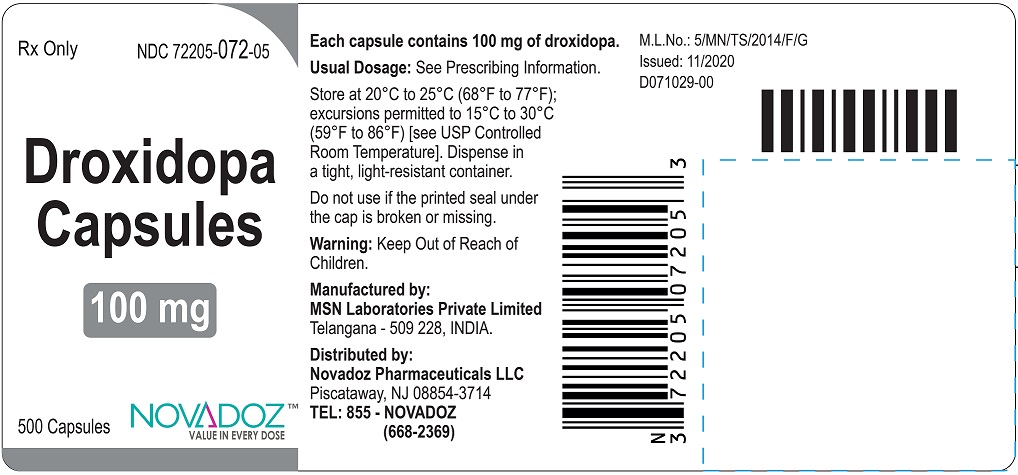
droxidopa 200 MG Oral Capsule — Adrenergic and dopaminergic agents. INDICATIONS AND USAGE Droxidopa capsules are indicated for the treatment of orthostatic dizziness, lightheadedness, or the "feeling that you are…
Boxed warning
WARNING: SUPINE HYPERTENSION WARNING: SUPINE HYPERTENSION Monitor supine blood pressure prior to and during treatment and more frequently when increasing doses. Elevating the head of the bed lessens the risk of supine hypertension, and blood pressure should be measured in this position. If supine hypertension cannot be managed by elevation of the head of the bed, reduce or discontinue droxidopa [ see Warnings and Precautions ( 5.1 ) ]. WARNING: SUPINE HYPERTENSION See full prescribing information for complete boxed warning. Monitor supine blood pressure prior to and during treatment and more frequently when increasing doses. Elevating the head of the bed lessens the risk of supine hypertension, and blood pressure should be measured in this position. If supine hypertension cannot be managed by elevation of the head of the bed, reduce or discontinue droxidopa. [ see Warnings and Precautions ( 5.1 ) ] .
Droxidopa has several drug interactions that may affect blood pressure and require dose adjustments.
moderatenorepinephrine — increased risk for supine hypertension
moderateephedrine — increased risk for supine hypertension
moderatemidodrine — increased risk for supine hypertension
moderatetriptans — increased risk for supine hypertension
moderatedopa-decarboxylase inhibitors — may require dose adjustments for droxidopa
majornon-selective MAO inhibitors — potential for increased blood pressure
majorlinezolid — potential for increased blood pressure
Indications
INDICATIONS AND USAGE Droxidopa capsules are indicated for the treatment of orthostatic dizziness, lightheadedness, or the "feeling that you are about to black out" in adult patients with symptomatic neurogenic orthostatic hypotension (nOH) caused by primary autonomic failure (Parkinson's disease [PD], multiple system atrophy, and pure autonomic failure), dopamine beta-hydroxylase deficiency, and non-diabetic autonomic neuropathy. Effectiveness beyond 2 weeks of treatment has not been established. The continued effectiveness of droxidopa capsules should be assessed periodically. Droxidopa capsules are indicated for the treatment of orthostatic dizziness, lightheadedness, or the "feeling that you are about to black out" in adult patients with symptomatic neurogenic orthostatic hypotension (nOH) caused by primary autonomic failure (Parkinson's disease [PD], multiple system atrophy, and pure autonomic failure), dopamine beta-hydroxylase deficiency, and non-diabetic autonomic neuropathy. Effectiveness beyond 2 weeks of treatment has not been established. The continued effectiveness of droxidopa capsules should be assessed periodically ( 1 ).
Dosage
DOSAGE AND ADMINISTRATION • Starting dose is 100 mg three times during the day ( 2.1 ) • Titrate by 100 mg three times daily, up to a maximum dose of 600 mg three times daily ( 2.1 ) • Take consistently with or without food ( 2.1 ) • To reduce the potential for supine hypertension, elevate the head of the bed and give the last dose at least 3 hours prior to bedtime ( 2.1 ) • Take droxidopa capsule whole ( 2.1 ) 2.1 Dosing Information The recommended starting dose of droxidopa capsules are 100 mg, taken orally three times daily: upon arising in the morning, at midday, and in the late afternoon at least 3 hours prior to bedtime (to reduce the potential for supine hypertension during sleep). Administer droxidopa capsules consistently, either with food or without food. Take droxidopa capsule whole. Titrate to symptomatic response, in increments of 100 mg three times daily every 24 to 48 hours up to a maximum dose of 600 mg three times daily (i.e., a maximum total daily dose of 1,800 mg). Monitor supine blood pressure prior to initiating droxidopa capsules and after increasing the dose. Patients who miss a dose of droxidopa capsules should take their next scheduled dose.
Warnings
WARNINGS AND PRECAUTIONS • Droxidopa capsules may cause supine hypertension and may increase cardiovascular risk if supine hypertension is not well-managed (5.1) • Hyperpyrexia and confusion (5.2) • May exacerbate symptoms in patients with existing ischemic heart disease, arrhythmias, and congestive heart failure (5.3) • Allergic reactions (5.4) 5.1 Supine Hypertension Droxidopa therapy may cause or exacerbate supine hypertension in patients with nOH. Patients should be advised to elevate the head of the bed when resting or sleeping. Monitor blood pressure, both in the supine position and in the recommended head-elevated sleeping position. Reduce or discontinue droxidopa if supine hypertension persists. If supine hypertension is not well-managed, droxidopa may increase the risk of cardiovascular events , particularly stroke. 5.2 Hyperpyrexia and Confusion Postmarketing cases of a symptom complex resembling neuroleptic malignant syndrome (NMS) have been reported with droxidopa use during postmarketing surveillance. Observe patients carefully when the dosage of droxidopa is changed or when concomitant levodopa is reduced abruptly or discontinued, especially if the patient is receiving neuroleptics. NMS is an uncommon but life-threatening syndrome characterized by fever or hyperthermia, muscle rigidity, involuntary movements, altered consciousness, and mental status changes. The early diagnosis of this condition is important for the appropriate management of these patients. 5.3 Ischemic Heart Disease, Arrhythmias, and Congestive Heart Failure Droxidopa may exacerbate existing ischemic heart disease, arrhythmias, and congestive heart failure. Careful consideration should be given to this potential risk prior to initiating therapy in patients with these conditions. 5.4 Allergic Reactions Hypersensitivity reactions including anaphylaxis, angioedema, bronchospasm, urticaria and rash have been reported in postmarketing experience. Some of these reactions resulted in emergency treatment. If a hypersensitivity reaction occurs, discontinue the drug and initiate appropriate therapy. This product contains FD&C Yellow No. 5 (tartrazine) which may also cause allergic-type reactions (including bronchial asthma) in certain susceptible persons. Although the overall incidence of FD&C Yellow No. 5 (tartrazine) sensitivity in the general population is low, it is frequently seen in patients who also have aspirin hypersensitivity [see Contraindications (4)].
Contraindications
CONTRAINDICATIONS Droxidopa capsules are contraindicated in patients who have a history of hypersensitivity to the drug or its ingredients [ see Warnings and Precautions ( 5.4 ) ] . History of hypersensitivity to the drug or its ingredients ( 4 )
Mechanism of action
Mechanism of Action The exact mechanism of action of droxidopa capsules in the treatment of neurogenic orthostatic hypotension is unknown droxidopa capsules is a synthetic amino acid analog that is directly metabolized to norepinephrine by dopa-decarboxylase, which is extensively distributed throughout the body. droxidopa capsules is believed to exert its pharmacological effects through norepinephrine and not through the parent molecule or other metabolites. Norepinephrine increases blood pressure by inducing peripheral arterial and venous vasoconstriction droxidopa capsules in humans induces small and transient rises in plasma norepinephrine.
A drug lookup is just the start. Eleplan keeps the whole care plan in one place.
Medications, diagnoses, documents, appointments, and the whole care team — organized and always in sync, with Ellie, your AI care assistant, on top of it. Free to start.