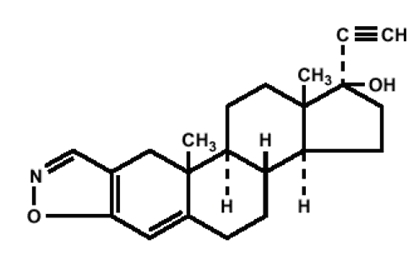
danazol 200 MG Oral Capsule — Antigonadotropins and similar agents. INDICATIONS AND USAGE Endometriosis. Danazol capsules are indicated for the treatment of endometriosis amenable to hormonal management. Hereditary…
Boxed warning
WARNINGS Use of danazol in pregnancy is contraindicated. A sensitive test (e.g., beta subunit test if available) capable of determining early pregnancy is recommended immediately prior to start of therapy. Additionally a non-hormonal method of contraception should be used during therapy. If a patient becomes pregnant while taking danazol, administration of the drug should be discontinued and the patient should be apprised of the potential risk to the fetus. Exposure to danazol in utero may result in androgenic effects on the female fetus; reports of clitoral hypertrophy, labial fusion, urogenital sinus defect, vaginal atresia, and ambiguous genitalia have been received (see PRECAUTIONS: Pregnancy, Teratogenic Effects ). Thromboembolism, thrombotic and thrombophlebitic events including sagittal sinus thrombosis and life-threatening or fatal strokes have been reported. Experience with long-term therapy with danazol is limited. Peliosis hepatis and benign hepatic adenoma have been observed with long-term use. Peliosis hepatis and hepatic adenoma may be silent until complicated by acute, potentially life-threatening intraabdominal hemorrhage. The physician therefore should be alert to this possibility. Attempts should be made to determine the lowest dose that will provide adequate protection. If the drug was begun at a time of exacerbation of hereditary angioneurotic edema due to trauma, stress or other cause, periodic attempts to decrease or withdraw therapy should be considered. Danazol has been associated with several cases of benign intracranial hypertension also known as pseudotumor cerebri. Early signs and symptoms of benign intracranial hypertension include papilledema, headache, nausea and vomiting, and visual disturbances. Patients with these symptoms should be screened for papilledema and, if present, the patients should be advised to discontinue danazol immediately and be referred to a neurologist for further diagnosis and care.
Danazol has several drug interactions that may require monitoring and dose adjustments.
majorwarfarin — Prolongation of prothrombin time
moderatecarbamazepine — Increase in carbamazepine levels
unknownantidiabetic drugs — Potential for insulin resistance
majorcyclosporin — Increased plasma levels leading to renal toxicity
majortacrolimus — Increased plasma levels leading to renal toxicity
moderatesynthetic vitamin D analogs — Increased calcemic response
majorstatins (simvastatin, atorvastatin, lovastatin) — Increased risk of myopathy and rhabdomyolysis
Indications
INDICATIONS AND USAGE Endometriosis. Danazol capsules are indicated for the treatment of endometriosis amenable to hormonal management. Hereditary Angioedema. Danazol capsules are indicated for the prevention of attacks of angioedema of all types (cutaneous, abdominal, laryngeal) in males and females.
Dosage
DOSAGE AND ADMINISTRATION Endometriosis. In moderate to severe disease, or in patients infertile due to endometriosis, a starting dose of 800 mg given in two divided doses is recommended. Amenorrhea and rapid response to painful symptoms is best achieved at this dosage level. Gradual downward titration to a dose sufficient to maintain amenorrhea may be considered depending upon patient response. For mild cases, an initial daily dose of 200 mg to 400 mg given in two divided doses is recommended and may be adjusted depending on patient response. Therapy should begin during menstruation. Otherwise, appropriate tests should be performed to ensure that the patient is not pregnant while on therapy with danazol capsules (see CONTRAINDICATIONS and WARNINGS ). It is essential that therapy continue uninterrupted for 3 to 6 months but may be extended to 9 months if necessary. After termination of therapy, if symptoms recur, treatment can be reinstituted. Hereditary Angioedema. The dosage requirements for continuous treatment of hereditary angioedema with danazol capsules should be individualized on the basis of the clinical response of the patient. It is recommended that the patient be started on 200 mg, two or three times a day. After a favorable initial response is obtained in terms of prevention of episodes of edematous attacks, the proper continuing dosage should be determined by decreasing the dosage by 50% or less at intervals of one to three months or longer if frequency of attacks prior to treatment dictates. If an attack occurs, the daily dosage may be increased by up to 200 mg. During the dose adjusting phase, close monitoring of the patient's response is indicated, particularly if the patient has a history of airway involvement.
Warnings
WARNINGS Use of danazol in pregnancy is contraindicated. A sensitive test (e.g., beta subunit test if available) capable of determining early pregnancy is recommended immediately prior to start of therapy. Additionally a non-hormonal method of contraception should be used during therapy. If a patient becomes pregnant while taking danazol, administration of the drug should be discontinued and the patient should be apprised of the potential risk to the fetus. Exposure to danazol in utero may result in androgenic effects on the female fetus; reports of clitoral hypertrophy, labial fusion, urogenital sinus defect, vaginal atresia, and ambiguous genitalia have been received (see Error! Hyperlink reference not valid.). Thromboembolism, thrombotic and thrombophlebitic events including sagittal sinus thrombosis and life-threatening or fatal strokes have been reported. Experience with long-term therapy with danazol is limited. Peliosis hepatis and benign hepatic adenoma have been observed with long-term use. Peliosis hepatis and hepatic adenoma may be silent until complicated by acute, potentially life-threatening intraabdominal hemorrhage. The physician therefore should be alert to this possibility. Attempts should be made to determine the lowest dose that will provide adequate protection. If the drug was begun at a time of exacerbation of hereditary angioneurotic edema due to trauma, stress or other cause, periodic attempts to decrease or withdraw therapy should be considered. Danazol has been associated with several cases of benign intracranial hypertension also known as pseudotumor cerebri. Early signs and symptoms of benign intracranial hypertension include papilledema, headache, nausea and vomiting, and visual disturbances. Patients with these symptoms should be screened for papilledema and, if present, the patients should be advised to discontinue danazol immediately and be referred to a neurologist for further diagnosis and care. A temporary alteration of lipoproteins in the form of decreased high density lipoproteins and possibly increased low density lipoproteins has been reported during danazol therapy. These alterations may be marked, and prescribers should consider the potential impact on the risk of atherosclerosis and coronary artery disease in accordance with the potential benefit of the therapy to the patient. Patients should be watched closely for signs of androgenic effects some of which may not be reversible even when drug administration is stopped.
Contraindications
CONTRAINDICATIONS Danazol capsules should not be administered to patients with: 1. Undiagnosed abnormal genital bleeding. 2. Markedly impaired hepatic, renal, or cardiac function. 3. Pregnancy (see WARNINGS ). 4. Breast feeding. 5. Porphyria-Danazol capsules can induce ALA synthetase activity and hence porphyrin metabolism. 6. Androgen-dependent tumor. 7. Active thrombosis or thromboembolic disease and history of such events. 8. Hypersensitivity to danazol.
Mechanism of action
CLINICAL PHARMACOLOGY Danazol suppresses the pituitary-ovarian axis. This suppression is probably a combination of depressed hypothalamic-pituitary response to lowered estrogen production, the alteration of sex steroid metabolism, and interaction of danazol with sex hormone receptors. The only other demonstrable hormonal effect is weak androgenic activity. Danazol depresses the output of both follicle-stimulating hormone (FSH) and luteinizing hormone (LH). Recent evidence suggests a direct inhibitory effect at gonadal sites and a binding of danazol to receptors of gonadal steroids at target organs. In addition, danazol has been shown to significantly decrease IgG, IgM and IgA levels, as well as phospholipid and IgG isotope autoantibodies in patients with endometriosis and associated elevations of autoantibodies, suggesting this could be another mechanism by which it facilitates regression of the disease. In the treatment of endometriosis, danazol alters the normal and ectopic endometrial tissue so that it becomes inactive and atrophic. Complete resolution of endometrial lesions occurs in the majority of cases. Changes in vaginal cytology and cervical mucus reflect the suppressive effect of danazol on the pituitary-ovarian axis. Changes in the menstrual pattern may occur. Generally, the pituitary-suppressive action of danazol is reversible. Ovulation and cyclic bleeding usually return within 60 to 90 days when therapy with danazol is discontinued. In the treatment of hereditary angioedema, danazol at effective doses prevents attacks of the disease characterized by episodic edema of the abdominal viscera, extremities, face, and airway which may be disabling and, if the airway is involved, fatal. In addition, danazol corrects partially or completely the primary biochemical abnormality of hereditary angioedema by increasing the levels of the deficient C1 esterase inhibitor (C1EI). As a result of this action the serum levels of the C4 component of the complement system are also increased. Pharmacokinetics Absorption: After oral administration of a 400 mg dose to healthy male volunteers, peak plasma concentrations of danazol are reached between 2 and 8 hours, with a median T max value of 4 hours. Steady state conditions are observed following 6 days of twice daily dosing of danazol capsules. The pharmacokinetic parameters for danazol capsules after administering a 400 mg oral dose to healthy males are summarized in the following table: Parameters Mean ± SD (n=15) C max (ng/mL) 69.6 ± 29.9 T max (h) 2.47 ± 1.62 AUC 0-∞ (ng*h/mL) 601 ± 181 t 1/2 (h) 9.70 ± 3.29 Total Body Clearance (L/h) 727 ± 221 The pharmacokinetic parameters for danazol capsules after oral administration of 100, 200 and 400 mg single doses to healthy female volunteers are summarized in the following table: Dose (mg) Mean C max ± SD (ng/mL) Mean T max (h) Mean AUC 0-∞ ± SD (ng*h/mL) Fasting Fed Fasting Fed Fasting Fed 100 45.9 ± 23.9 113.8 ± 46.0 1-8 2-6 484 ± 263 741 ± 265 200 63.8 ± 27.7 159 ± 57.3 1-6 2-4 681 ± 363 1252 ± 307 400 60.4 ± 30.0 253.7 ± 105.5 1-6 2-4 754 ± 443 1851 ± 605 Dose proportionality: Bioavailability studies indicate that blood levels do not increase proportionally with increases in the administered dose. Single dose administration of danazol capsules in healthy female volunteers found that a 4-fold increase in dose produced only a 1.6 and 2.5-fold increase in AUC and a 1.3 and 2.2-fold increase in C max in the fasted and fed state, respectively. A similar degree of non-dose proportionality was observed at steady state. Food Effect: Single dose administration of 100 mg and 200 mg capsules of danazol to female volunteers showed that both the extent of availability and the maximum plasma concentration increased by 3 to 4 fold, respectively, following a meal (> 30 grams of fat), when compared to the fasted state. Further, food also delayed mean time to peak concentration of danazol by about 30 minutes. Even after multiple dosing under less extreme food/fasting conditions, there remained approximately a 2 to 2.5 fold difference in bioavailability between the fed and fasted states. Distribution: Danazol is lipophilic and can partition into cell membranes, indicating the likelihood of distribution into deep tissue compartments. Metabolism and Excretion: Danazol appears to be metabolized and the metabolites are eliminated by renal and fecal pathways. The two primary metabolites excreted in the urine are 2-hydroxymethyl danazol and ethisterone. At least ten different products were identified in feces. The reported elimination half-life of danazol is variable across studies. The mean half-life of danazol in healthy males is 9.7 h. After 6 months of 200 mg three times a day dosing in endometriosis patients, the half-life of danazol was reported as 23.7 hours.
A drug lookup is just the start. Eleplan keeps the whole care plan in one place.
Medications, diagnoses, documents, appointments, and the whole care team — organized and always in sync, with Ellie, your AI care assistant, on top of it. Free to start.