bosentan 62.5 MG Oral Tablet — Antihypertensives for pulmonary arterial hypertension. INDICATIONS AND USAGE Bosentan tablets are indicated for the treatment of pulmonary arterial hypertension (PAH) (WHO Group 1): in adults to improve…
Boxed warning
WARNING: RISKS OF HEPATOTOXICITY and EMBRYO-FETALTOXICITY Because of the risks of hepatotoxicity and birth defects, bosentan tablets for oral suspension is available only through a restricted program called the Bosentan REMS Program. Under the Bosentan REMS, prescribers, patients, and pharmacies must enroll in the program [see Warnings and Precautions (5.3) ] . Hepatotoxicity In clinical studies, bosentan caused at least 3-fold upper limit of normal (ULN) elevation of liver aminotransferases (ALT and AST) in about 11% of patients, accompanied by elevated bilirubin in a small number of cases. Because these changes are a marker for potential serious hepatotoxicity, serum aminotransferase levels must be measured prior to initiation of treatment and then monthly [see Dosage and Administration (2.4) , Warnings and Precautions (5.1) ] . In the post marketing period, in the setting of close monitoring, rare cases of unexplained hepatic cirrhosis were reported after prolonged (> 12 months) therapy with bosentan in patients with multiple comorbidities and drug therapies. There have also been reports of liver failure. The contribution of bosentan in these cases could not be excluded. In at least one case, the initial presentation (after > 20 months of treatment) included pronounced elevations in aminotransferases and bilirubin levels accompanied by non-specific symptoms, all of which resolved slowly over time after discontinuation of bosentan. This case reinforces the importance of strict adherence to the monthly monitoring schedule for the duration of treatment and the treatment algorithm, which includes stopping bosentan with a rise of aminotransferases accompanied by signs or symptoms of liver dysfunction [see Dosage and Administration (2.4) ] . Elevations in aminotransferases require close attention [see Dosage and Administration (2.4) ] . Bosentan should generally be avoided in patients with elevated aminotransferases (>3xULN) at baseline because monitoring for hepatotoxicity may be more difficult. If liver aminotransferase elevations are accompanied by clinical symptoms of hepatotoxicity (such as nausea, vomiting, fever, abdominal pain, jaundice, or unusual lethargy or fatigue) or increases in bilirubin ≥2xULN, treatment with bosentan should be stopped. There is no experience with the reintroduction of bosentan in these circumstances. Embryo-Fetal Toxicity Bosentan is likely to cause major birth defects if used by pregnant females based on animal data [see Warnings and Precautions (5.2) , Use in Specific Populations (8.1) ] . Therefore, pregnancy must be excluded before the start of treatment with bosentan. Throughout treatment and for one month after stopping bosentan, females of reproductive potential must use two reliable methods of contraception unless the patient has an intrauterine device (IUD) or tubal sterilization, in which case no other contraception is needed. Hormonal contraceptives, including oral, injectable, transdermal, and implantable contraceptives should not be used as the sole means of contraception because these may not be effective in patients receiving bosentan [see Drug Interactions (7.2) ] . Obtain monthly pregnancy tests. WARNING: RISKS OF HEPATOTOXICITY and EMBRYO-FETAL TOXICITY See full prescribing information for complete boxed warning. Bosentan tablets for oral suspension are available only through a restricted distribution program called the Bosentan REMS Program because of these risks ( 5.3 ): Elevations of liver aminotransferases (ALT, AST) and liver failure have been reported with bosentan ( 5.1 ). Measure liver aminotransferases prior to initiation of treatment and then monthly ( 2.1 , 5.1 ). Discontinue bosentan if aminotransferase elevations are accompanied by signs or symptoms of liver dysfunction or injury or increases in bilirubin ≥2xULN ( 2.4 , 5.1 ). Based on animal data, bosentan is likely to cause major birth defects if used during pregnancy ( 4.1 , 5.2 , 8.1 ). Must exclude pregnancy before and during treatment ( 2.1 , 4.1 , 8.1 ). To prevent pregnancy, females of reproductive potential must use two re-liable forms of contraception during treatment and for one month after stopping bosentan ( 4.1 , 5.2 , 8.1 ).
majordrugs metabolized by CYP2C9 and CYP3A — decreased plasma concentrations of these drugs
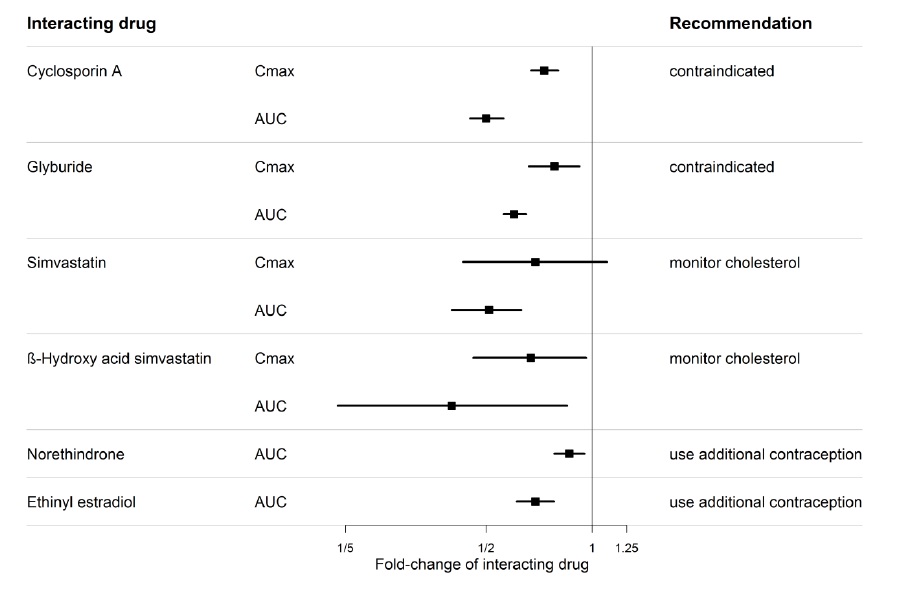
majorhormonal contraceptives — decreased effectiveness of contraceptives
Indications
INDICATIONS AND USAGE Bosentan tablets are indicated for the treatment of pulmonary arterial hypertension (PAH) (WHO Group 1): in adults to improve exercise ability and to decrease clinical worsening. Studies establishing effectiveness included predominantly patients with WHO Functional Class II-IV symptoms and etiologies of idiopathic or heritable PAH (60%), PAH associated with connective tissue diseases (21%), and PAH associated with congenital heart disease with left-to-right shunts (18%) [see Clinical Studies ( 14.1 )] . in pediatric patients aged 3 years and older with idiopathic or congenital PAH to improve pulmonary vascular resistance (PVR), which is expected to result in an improvement in exercise ability. Bosentan tablets are an endothelin receptor antagonist indicated for the treatment of pulmonary arterial hypertension (PAH) (WHO Group 1): in adults to improve exercise ability and to decrease clinical worsening. Studies establishing effectiveness included predominantly patients with WHO Functional Class II-IV symptoms and etiologies of idiopathic or heritable PAH (60%), PAH associated with connective tissue diseases (21%), and PAH associated with congenital heart disease with left-to-right shunts (18%) ( 1 ). in pediatric patients aged 3 years and older with idiopathic or congenital PAH to improve pulmonary vascular resistance (PVR), which is expected to result in an improvement in exercise ability ( 1 ).
Dosage
2. DOSAGE AND ADMINISTRATION • Patients older than 12 years of age: initiate at 62.5 mg orally twice daily; for patients weighing greater than 40 kg, increase to 125 mg orally twice daily after 4 weeks ( 2.2 ). • Patients 12 years of age and younger: dosage is based on weight, see Table 1 ( 2.2 ). • Reduce the dose and closely monitor patients developing aminotransferase elevations more than 3 x Upper Limit of Normal (ULN) ( 2.1 ). 2.1 Required Monitoring Healthcare professionals who prescribe bosentan tablets for oral suspension must enroll in the Bosentan REMS Program and must comply with the required monitoring to minimize the risks associated with bosentan [see Warnings and Precautions (5.3) ] . Obtain a pregnancy test in females of reproductive potential prior to bosentan treatment, monthly during treatment and one month after stopping bosentan. Initiate treatment with bosentan in females of reproductive potential only after a negative pregnancy test [see Boxed Warning , Contraindications (4.1) , Warnings and Precautions (5.3) , Use in Specific Populations (8.1 , 8.3) ] . Measure liver aminotransferase levels prior to initiation of treatment and then monthly [see Warnings and Precautions (5.1) ] . 2.2 Recommended Dosage Administer bosentan orally following the dosing recommendations in Table 1. Doses above 125 mg twice daily did not appear to confer additional benefit sufficient to offset the increased risk of hepatotoxicity. Table 1: Dosing Recommendations Initial 4 weeks Maintenance (after 4 weeks) Patients >12 years of age and >40 kg 62.5 mg twice daily 125 mg twice daily Patients >12 years of age and <40 kg 62.5 mg twice daily 62.5 mg twice daily Patients ≤12 years of age ≥4-8 kg ˃8-16 kg ˃16-24 kg ˃24-40 kg 16 mg twice daily 32 mg twice daily 48 mg twice daily 64 mg twice daily 16 mg twice daily 32 mg twice daily 48 mg twice daily 64 mg twice daily 2.3 Administration Bosentan tablets for oral suspension (dispersible tablets) should be administered orally twice daily. Disperse tablets for oral suspension, or dispersible tablet half, in a minimal amount of water immediately before administration. Store divided dispersible tablet pieces at 20 ºC to 25 ºC (68 ºF to 77 ºF) in the opened blister for up to 7 days. 2.4 Dosage Adjustments for Aminotransferase Elevations If aminotransferase levels increase, adjust monitoring and treatment plan according to Table 2. Discontinue bosentan if liver aminotransferase elevations are accompanied by clinical symptoms of hepatotoxicity (such as nausea, vomiting, fever, abdominal pain, jaundice, or unusual lethargy or fatigue) or bilirubin ≥2xUpper Limit of Normal (ULN). There is no experience with the reintroduction of bosentan in these circumstances. Table 2: Dosage Adjustment and Monitoring in Patients Developing Aminotransferase Elevations >3xULN ALT/AST levels Treatment and monitoring recommendations > 3 and ≤ 5xULN Confirm by another aminotransferase test; if confirmed, - in adults and pediatric patients >12 years and >40 kg , reduce the daily dose to 62.5 mg twice daily or interrupt treatment, and monitor aminotransferase levels at least every 2 weeks. If the aminotransferase levels return to pretreatment values, treatment may continue or be reintroduced at 62.5 mg twice daily, with reassessment of aminotransferase levels within 3 days. - in all other pediatric patients, interrupt treatment with no prior dose reduction. If the aminotransferase levels return to pretreatment values, reintroduce at the dose used prior to treatment interruption, with reassessment of aminotransferase levels within 3 days. > 5 and ≤ 8xULN Confirm by another aminotransferase test; if confirmed, stop treatment and monitor aminotransferase levels at least every 2 weeks. Once the aminotransferase levels return to pretreatment values, - in adults and pediatric patients >12 years and >40 kg , consider reintroduction of treatment at 62.5 mg twice daily, with reassessment of aminotransferase levels within 3 days. - in all other pediatric patients , consider reintroduction at the dose used prior to treatment interruption, with reassessment of aminotransferase levels within 3 days. > 8xULN Stop treatment permanently. There is no experience with reintroduction of bosentan in these circumstances. 2.5 Use with Ritonavir Co-administration of Bosentan in Patients on Ritonavir In patients who have been receiving ritonavir for at least 10 days, start bosentan at the recommended initial dose once daily or every other day based upon individual tolerability [see Cytochrome P450 Drug Interactions (7.1) ] . Co-administration of Ritonavir in Patients on Bosentan Discontinue use of bosentan at least 36 hours prior to initiation of ritonavir. After at least 10 days following the initiation of ritonavir, resume bosentan at the recommended initial dose once daily or every other day based upon individual tolerability [see Cytochrome P450 Drug Interactions (7.1) ] . 2.6 Use in Patients with Pre-existing Hepatic Impairment Avoid initiation of bosentan in patients with aminotransferases >3xULN. No dose adjustment is required in patients with mildly impaired liver function [see Warnings and Precautions (5.3) , Use in Specific Populations (8.6) , Clinical Pharmacology (12.3) ] .
Warnings
5. WARNINGS AND PRECAUTIONS • Fluid retention: May require intervention ( 5.4 ). • Pulmonary veno-occlusive disease (PVOD): If signs of pulmonary edema occur, consider the diagnosis of associated PVOD and consider discontinuing bosentan ( 5.5 ). • Decreased sperm counts ( 5.6 ). • Decreases in hemoglobin and hematocrit: Monitor hemoglobin levels after 1 and 3 months of treatment, then every 3 months thereafter ( 5.7 ). 5.1 Hepatotoxicity ALT or AST > 3xULN were observed in 11% of bosentan-treated patients (n = 658) compared to 2% of placebo-treated patients (n = 280). Three-fold increases were seen in 12% of 95 pulmonary arterial hypertension (PAH) patients on 125 mg twice daily and 14% of 70 PAH patients on 250 mg twice daily. Eight-fold increases were seen in 2% of PAH patients on 125 mg twice daily and 7% of PAH patients on 250 mg twice daily. Bilirubin increases to ≥3xULN were associated with aminotransferase increases in 2 of 658 (0.3%) of patients treated with bosentan. In a pooled analysis of four pediatric studies conducted in PAH (n =100), elevations in liver aminotransferases ≥3×ULN were observed in 2% of patients. The combination of hepatocellular injury (increases in aminotransferases of > 3xULN) and increases in total bilirubin (≥2xULN) is a marker for potential serious hepatotoxicity. Elevations of AST or ALT associated with bosentan are dose-dependent, occur both early and late in treatment, usually progress slowly, are typically asymptomatic, and usually have been reversible after treatment interruption or cessation. Aminotransferase elevations also may reverse spontaneously while continuing treatment with bosentan. Liver aminotransferase levels must be measured prior to initiation of treatment and then monthly and therapy adjusted accordingly [see Dosage and Administration (2.1 , 2.4 )] . Discontinue bosentan if liver aminotransferase elevations are accompanied by clinical symptoms of hepatotoxicity (such as nausea, vomiting, fever, abdominal pain, jaundice, or unusual lethargy or fatigue) or increases in bilirubin ≥2xULN. Avoid initiation of bosentan in patients with elevated aminotransferases (>3xULN) prior to drug initiation because monitoring hepatotoxicity in these patients may be more difficult [see Boxed Warning , Dosage and Administration (2.6) , Use in Specific Populations (8.6) ] . In WHO Functional Class II patients, consider whether the benefits of bosentan are sufficient to offset the risk of hepatotoxicity, which may preclude future use as their disease progresses. 5.2 Embryo-fetal Toxicity Based on data from animal reproduction studies, bosentan may cause fetal harm when administered to a pregnant female and is contraindicated in females who are pregnant. Advise females of reproductive potential of the potential risk to a fetus. Obtain a pregnancy test prior to bosentan treatment, monthly during treatment and for one month after stopping treatment. Advise females of reproductive potential to use two reliable forms of contraception during treatment with bosentan and for at least one month after the last dose [see Dosage and Administration (2) , Use in Specific Populations (8.1 , 8.3) ] . Bosentan tablets for oral suspension is only available for females through a restricted program under REMS [see Warnings and Precautions (5.3) ] . 5.3 Prescribing and Distribution Program for Bosentan Because of the risks of hepatotoxicity and birth defects, bosentan tablets for oral suspension is available only through a restricted program called the Bosentan REMS Program. As a component of the Bosentan REMS, prescribers, patients, and pharmacies must enroll in the program [see Boxed Warning , Warnings and Precautions (5.1 , 5.2) , Contraindications (4.1) ] . Required components of the bosentan tablets for oral suspension REMS are: Healthcare professionals who prescribe bosentan tablets for oral suspension must review the prescriber educational materials, enroll in the Bosentan REMS Program and comply with its requirements. Healthcare professionals must (1) review serum aminotransferases (ALT/AST) and bilirubin, and agree to order and monitor these tests monthly; and (2) for females of reproductive potential, confirm that the patient is not pregnant, and agree to order and monitor pregnancy tests monthly. To receive bosentan tablets for oral suspension, all patients must understand the risks and benefits, and complete a patient enrollment form. Pharmacies that dispense bosentan tablets for oral suspension must enroll in the program and agree to comply with the Bosentan REMS Program requirements. Further information about Bosentan and Bosentan and the Bosentan REMS Program is available at www.BosentanREMSProgram.com or 1-866-359-2612. 5.4 Fluid Retention Peripheral edema is a known clinical consequence of PAH and worsening PAH and is also a known effect of bosentan and other endothelin receptor antagonists. In PAH clinical trials with bosentan, combined adverse events of fluid retention or edema were reported in 1.7% (placebo-corrected) of patients. In addition, there have been numerous postmarketing reports of fluid retention in patients with pulmonary hypertension occurring within weeks after starting bosentan. Patients required intervention with a diuretic, fluid management, or hospitalization for decompensating heart failure. If clinically significant fluid retention develops, with or without associated weight gain, further evaluation should be undertaken to determine the cause, such as bosentan or underlying heart failure, and the possible need for treatment or discontinuation of bosentan [see Adverse Reactions (6.1) , Clinical Studies (14.2) ] . 5.5 Pulmonary Veno-Occlusive Disease If signs of pulmonary edema occur, consider the possibility of associated pulmonary veno-occlusive disease and consider whether bosentan should be discontinued. 5.6 Decreased Sperm Counts Decreased sperm counts have been observed in patients receiving bosentan. Preclinical data also suggest that bosentan, similar to other endothelin receptor antagonists, may have an adverse effect on spermatogenesis [see Adverse Reactions (6.1) , Nonclinical Toxicology (13.1) ] . 5.7 Decreases in Hemoglobin and Hematocrit Treatment with bosentan can cause a dose-related decrease in hemoglobin and hematocrit. There have been postmarketing reports of decreases in hemoglobin concentration and hematocrit that have resulted in anemia requiring transfusion. It is recommended that hemoglobin concentrations be checked after 1 and 3 months, and every 3 months thereafter. If a marked decrease in hemoglobin concentration occurs, further evaluation should be undertaken to determine the cause and need for specific treatment [see Adverse Reactions (6.1) ] .
Contraindications
4. CONTRAINDICATIONS • Pregnancy ( 4.1 ) • Use with Cyclosporine A ( 4.2 ) • Use with Glyburide ( 4.3 ) • Hypersensitivity ( 4.4 ) 4.1 Pregnancy Use of bosentan is contraindicated in females who are or may become pregnant. To prevent pregnancy, females of reproductive potential must use two reliable forms of contraception during treatment and for one month after stopping bosentan [see Boxed Warning , Warnings and Precautions (5.2) , Drug Interactions (7.2) , Use in Specific Populations (8.1) ] . 4.2 Use with Cyclosporine A Co-administration of cyclosporine A and bosentan resulted in markedly increased plasma concentrations of bosentan. Therefore, concomitant use of bosentan and cyclosporine A is contraindicated [see Cytochrome P450 Drug Interactions (7.1) ] . 4.3 Use with Glyburide An increased risk of liver enzyme elevations was observed in patients receiving glyburide concomitantly with bosentan. Therefore co-administration of glyburide and bosentan is contraindicated [see Cytochrome P450 Drug Interactions (7.1) ] . 4.4 Hypersensitivity Bosentan is contraindicated in patients who are hypersensitive to bosentan or any component of the product. Observed reactions include Drug Reaction with Eosinophilia and Systemic Symptoms (DRESS), anaphylaxis, rash, and angioedema [see Adverse Reactions (6.2) , Description (11) ] .
Mechanism of action
Mechanism of Action Bosentan is a specific and competitive antagonist at endothelin receptor types ET A and ET B . Bosentan has a slightly higher affinity for ET A receptors than for ET B receptors. The clinical impact of dual endothelin blockage is unknown. Endothelin-1 (ET-1) is a neurohormone, the effects of which are mediated by binding to ET A and ET B receptors in the endothelium and vascular smooth muscle. ET-1 concentrations are elevated in plasma and lung tissue of patients with PAH, suggesting a pathogenic role for ET-1 in this disease.
A drug lookup is just the start. Eleplan keeps the whole care plan in one place.
Medications, diagnoses, documents, appointments, and the whole care team — organized and always in sync, with Ellie, your AI care assistant, on top of it. Free to start.