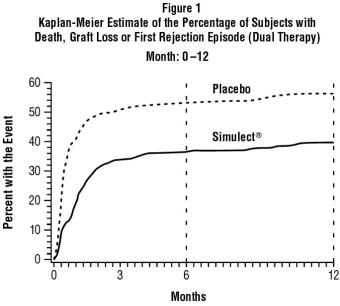
basiliximab 20 MG Injection — Interleukin inhibitors. INDICATIONS AND USAGE Simulect ® (basiliximab) is indicated for the prophylaxis of acute organ rejection in patients receiving renal transplantation…
Boxed warning
WARNING Only physicians experienced in immunosuppression therapy and management of organ transplantation patients should prescribe Simulect ® (basiliximab). The physician responsible for Simulect administration should have complete information requisite for the follow-up of the patient. Patients receiving the drug should be managed in facilities equipped and staffed with adequate laboratory and supportive medical resources.
Basiliximab can be used in combination with certain immunosuppressive agents without dose adjustment, but pharmacokinetics may be affected.
moderateazathioprine — Total body clearance of Simulect was reduced by an average of 22%.
moderatemycophenolate mofetil — Total body clearance of Simulect was reduced by an average of 51%.
moderatecyclosporine — Simulect can be added to regimens including cyclosporine without dose adjustment.
moderatecorticosteroids — Simulect can be added to regimens including corticosteroids without dose adjustment.
Indications
INDICATIONS AND USAGE Simulect ® (basiliximab) is indicated for the prophylaxis of acute organ rejection in patients receiving renal transplantation when used as part of an immunosuppressive regimen that includes cyclosporine, USP (MODIFIED), and corticosteroids. The efficacy of Simulect for the prophylaxis of acute rejection in recipients of other solid organ allografts has not been demonstrated.
Dosage
DOSAGE AND ADMINISTRATION Simulect ® (basiliximab) is used as part of an immunosuppressive regimen that includes cyclosporine, USP (MODIFIED) and corticosteroids. Simulect is for central or peripheral intravenous administration only. Reconstituted Simulect should be given either as a bolus injection or diluted to a volume of 25 mL (10-mg vial) or 50 mL (20-mg vial) with 0.9% Sodium Chloride Injection, USP or 5% Dextrose Injection, USP and administered as an intravenous infusion over 20 to 30 minutes. Bolus administration may be associated with nausea, vomiting and local reactions, including pain. Simulect should only be administered once it has been determined that the patient will receive the graft and concomitant immunosuppression. Patients previously administered Simulect should only be re-exposed to a subsequent course of therapy with extreme caution due to the potential risk of hypersensitivity (see WARNINGS). Parenteral drug products should be inspected visually for particulate matter and discoloration before administration. After reconstitution, Simulect should be a clear-to-opalescent, colorless solution. If particulate matter is present or the solution is colored, do not use. Care must be taken to assure sterility of the prepared solution because the drug product does not contain any antimicrobial preservatives or bacteriostatic agents. It is recommended that after reconstitution, the solution should be used immediately. If not used immediately, it can be stored at 2ºC to 8ºC (36ºF to 46ºF) for 24 hours or at room temperature for 4 hours. Discard the reconstituted solution if not used within 24 hours. No incompatibility between Simulect and polyvinyl chloride bags or infusion sets has been observed. No data are available on the compatibility of Simulect with other intravenous substances. Other drug substances should not be added or infused simultaneously through the same intravenous line. Adults In adult patients, the recommended regimen is two doses of 20 mg each. The first 20-mg dose should be given within 2 hours prior to transplantation surgery. The recommended second 20-mg dose should be given 4 days after transplantation. The second dose should be withheld if complications, such as severe hypersensitivity reactions to Simulect or graft loss occur. Pediatric In pediatric patients weighing less than 35 kg, the recommended regimen is two doses of 10 mg each. In pediatric patients weighing 35 kg or more, the recommended regimen is two doses of 20 mg each. The first dose should be given within 2 hours prior to transplantation surgery. The recommended second dose should be given 4 days after transplantation. The second dose should be withheld if complications, such as severe hypersensitivity reactions to Simulect or graft loss occur. Reconstitution of 10 mg Simulect ® Vial To prepare the reconstituted solution, add 2.5 mL of Sterile Water for Injection, USP, using aseptic technique, to the vial containing the Simulect powder. Shake the vial gently to dissolve the powder. The reconstituted solution is isotonic and may be given either as a bolus injection or diluted to a volume of 25 mL with 0.9% Sodium Chloride Injection, USP or 5% Dextrose Injection, USP for infusion. When mixing the solution, gently invert the bag in order to avoid foaming; DO NOT SHAKE . Reconstitution of 20 mg Simulect ® Vial To prepare the reconstituted solution, add 5 mL of Sterile Water for Injection, USP, using aseptic technique, to the vial containing the Simulect powder. Shake the vial gently to dissolve the powder. The reconstituted solution is isotonic and may be given either as a bolus injection or diluted to a volume of 50 mL with 0.9% Sodium Chloride Injection, USP or 5% Dextrose Injection, USP for infusion. When mixing the solution, gently invert the bag in order to avoid foaming; DO NOT SHAKE .
Warnings
WARNINGS. See Boxed WARNING.
Contraindications
CONTRAINDICATIONS Simulect ® (basiliximab) is contraindicated in patients with known hypersensitivity to basiliximab or any other component of the formulation. See composition of Simulect under DESCRIPTION. WARNINGS. See Boxed WARNING. General Simulect ® (basiliximab) should be administered under qualified medical supervision. Patients should be informed of the potential benefits of therapy and the risks associated with administration of immunosuppressive therapy. While neither the incidence of lymphoproliferative disorders nor opportunistic infections was higher in Simulect-treated patients than in placebo-treated patients, patients on immunosuppressive therapy are at increased risk for developing these complications and should be monitored accordingly. Hypersensitivity Severe acute (onset within 24 hours) hypersensitivity reactions, including anaphylaxis have been observed both on initial exposure to Simulect and/or following re-exposure after several months. These reactions may include hypotension, tachycardia, cardiac failure, dyspnea, wheezing, bronchospasm, pulmonary edema, respiratory failure, urticaria, rash, pruritus, and/or sneezing. Extreme caution should be exercised in all patients previously given Simulect when being administered a subsequent course of Simulect. A subgroup of patients may be particularly at risk of developing severe hypersensitivity reactions on re-administration. These are patients in whom concomitant immunosuppression was discontinued prematurely (e.g., due to abandoned transplantation or early loss of the graft) following the initial administration of Simulect. If a severe hypersensitivity reaction occurs, therapy with Simulect should be permanently discontinued. Medications for the treatment of severe hypersensitivity reactions, including anaphylaxis should be available for immediate use.
Mechanism of action
CLINICAL PHARMACOLOGY General Mechanism of Action: Basiliximab functions as an IL-2 receptor antagonist by binding with high affinity (K a = 1 x 10 10 M -1 ) to the alpha chain of the high affinity IL-2 receptor complex and inhibiting IL-2 binding. Basiliximab is specifically targeted against IL-2Rα, which is selectively expressed on the surface of activated T-lymphocytes. This specific high affinity binding of Simulect ® (basiliximab) to IL-2Rα competitively inhibits IL-2-mediated activation of lymphocytes, a critical pathway in the cellular immune response involved in allograft rejection. While in the circulation, Simulect impairs the response of the immune system to antigenic challenges. Whether the ability to respond to repeated or ongoing challenges with those antigens returns to normal after Simulect is cleared is unknown (see PRECAUTIONS). Pharmacokinetics Adults : Single-dose and multiple-dose pharmacokinetic studies have been conducted in patients undergoing first kidney transplantation. Cumulative doses ranged from 15 mg up to 150 mg. Peak mean ± SD serum concentration following intravenous infusion of 20 mg over 30 minutes is 7.1 ± 5.1 mg/L. There is a dose-proportional increase in C max and area under the curve (AUC) up to the highest tested single dose of 60 mg. The volume of distribution at steady state is 8.6 ± 4.1 L. The extent and degree of distribution to various body compartments have not been fully studied. The terminal half-life is 7.2 ± 3.2 days. Total body clearance is 41 ± 19 mL/h. No clinically relevant influence of body weight or gender on distribution volume or clearance has been observed in adult patients. Elimination half-life was not influenced by age (20-69 years), gender or race (see DOSAGE AND ADMINISTRATION). Pediatric : The pharmacokinetics of Simulect have been assessed in 39 pediatric patients undergoing renal transplantation. In infants and children (1-11 years of age, n = 25), the distribution volume and clearance were reduced by about 50% compared to adult renal transplantation patients. The volume of distribution at steady state was 4.8 ± 2.1 L, half-life was 9.5 ± 4.5 days and clearance was 17 ± 6 mL/h. Disposition parameters were not influenced to a clinically relevant extent by age (1-11 years of age), body weight (9-37 kg) or body surface area (0.44-1.20 m 2 ) in this age group. In adolescents (12-16 years of age, n = 14), disposition was similar to that in adult renal transplantation patients. The volume of distribution at steady state was 7.8 ± 5.1 L, half-life was 9.1 ± 3.9 days and clearance was 31 ± 19 mL/h (see DOSAGE AND ADMINISTRATION). Pharmacodynamics Complete and consistent binding to IL-2Rα in adults is maintained as long as serum Simulect levels exceed 0.2 mcg/mL. As concentrations fall below this threshold, the IL-2Rα sites are no longer fully bound and the number of T-cells expressing unbound IL-2Rα returns to pretherapy values within 1-2 weeks. The relationship between serum concentration and receptor saturation was assessed in 13 pediatric patients and was similar to that characterized in adult renal transplantation patients. In vitro studies using human tissues indicate that Simulect binds only to lymphocytes. The duration of clinically relevant IL-2 receptor blockade after the recommended course of Simulect is not known. When basiliximab was added to a regimen of cyclosporine, USP (MODIFIED) and corticosteroids in adult patients, the duration of IL-2Rα saturation was 36 ± 14 days (mean ± SD), similar to that observed in pediatric patients (36 ± 14 days) (see DOSAGE AND ADMINISTRATION). When basiliximab was added to a triple therapy regimen consisting of cyclosporine, USP (MODIFIED), corticosteroids, and azathioprine in adults, the duration was 50 ± 20 days and when added to cyclosporine, USP (MODIFIED), corticosteroids, and mycophenolate mofetil in adults, the duration was 59 ± 17 days (see PRECAUTIONS, Drug Interactions). No significant changes to circulating lymphocyte numbers or cell phenotypes were observed by flow cytometry.
A drug lookup is just the start. Eleplan keeps the whole care plan in one place.
Medications, diagnoses, documents, appointments, and the whole care team — organized and always in sync, with Ellie, your AI care assistant, on top of it. Free to start.