Clinical drug
atogepant 10 MG Oral Tablet
10 MG · Oral Tablet · oral
A form of atogepant →
atogepant 10 MG Oral Tablet — Calcitonin gene-related peptide (CGRP) antagonists. INDICATIONS AND USAGE QULIPTA is indicated for the preventive treatment of migraine in adults. QULIPTA is a calcitonin gene-related peptide receptor a
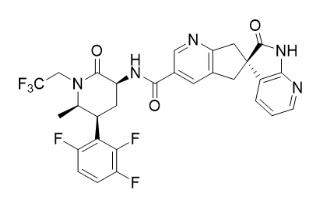
Active ingredient
Classification
Calcitonin gene-related peptide (CGRP) antagonistsCalcitonin Gene-related Peptide Receptor Antagonist
Drug interactions
Atogepant has several interactions with CYP3A4 inhibitors and inducers, as well as OATP inhibitors, which affect its dosage and efficacy.
- majorstrong CYP3A4 inhibitors — significant increase in exposure of atogepant
- majorstrong CYP3A4 inducers — significant decrease in exposure of atogepant
- majormoderate CYP3A4 inducers — decreased exposure of atogepant
- moderateweak CYP3A4 inducers — decreased exposure of atogepant
- moderateOATP inhibitors — increased exposure of atogepant
Indications
INDICATIONS AND USAGE QULIPTA is indicated for the preventive treatment of migraine in adults. QULIPTA is a calcitonin gene-related peptide receptor antagonist indicated for the preventive treatment of migraine in adults. ( 1 )
Dosage
DOSAGE AND ADMINISTRATION QULIPTA is taken orally with or without food. ( 2.1 ) For episodic migraine, the recommended dosage is 10 mg, 30 mg, or 60 mg taken once daily. ( 2.1 ) For chronic migraine, the recommended dosage is 60 mg taken once daily. ( 2.1 ) Severe Renal Impairment or End-Stage Renal Disease ( 2.2 , 8.6 ): Episodic migraine: 10 mg once daily. Chronic migraine: Not recommended. 2.1 Recommended Dosage QULIPTA is taken orally with or without food. Episodic Migraine The recommended dosage of QULIPTA for episodic migraine is 10 mg, 30 mg, or 60 mg taken once daily. Chronic Migraine The recommended dosage of QULIPTA for chronic migraine is 60 mg taken once daily. 2.2 Dosage Modification s Dosage modifications and usage recommendations for episodic and chronic migraine with concomitant use of specific drugs and for patients with renal impairment are provided in Table 1. Table 1 : Dos age Modifications for Drug Interactions and for Specific Populations Dosage Modifications Recommended Once Daily Dosage for Episodic Migraine Usage and Recommended Once Daily Dosage for Chronic Migraine Concomitant Drug [see Drug Interactions ( 7 )] Strong CYP3A4 Inhibitors ( 7.1 ) 10 mg 10 mg Strong CYP3A4 Inducers ( 7.2 ) 60 mg a Not recommended Moderate CYP3A4 Inducers ( 7.2 ) 60 mg Not recommended Weak CYP3A4 Inducers ( 7.2 ) 30 mg or 60 mg 60 mg a OATP Inhibitors ( 7.3 ) 10 mg or 30 mg 30 mg Renal Impairment [see Use in Specific Populations ( 8 )] Severe Renal Impairment and End-Stage Renal Disease (CLcr <30 mL/min) ( 8.6 ) 10 mg Not recommended a Coadministration decreases atogepant exposure. Monitor for reduced efficacy.
Warnings
WARNINGS AND PRECAUTIONS Hypersensitivity Reactions: If a hypersensitivity reaction occurs, discontinue QULIPTA and initiate appropriate therapy. Severe hypersensitivity reactions have included anaphylaxis and dyspnea. These reactions can occur days after administration. ( 5.1 ) Hypertension: New-onset or worsening of pre-existing hypertension may occur. ( 5.2 ) Raynaud’s phenomenon: New-onset or worsening of pre-existing Raynaud’s phenomenon may occur. ( 5.3 ) 5.1 Hypersensitivity Reactions Hypersensitivity reactions, including anaphylaxis, dyspnea, rash, pruritus, urticaria, and facial edema, have been reported with use of QULIPTA [see Adverse Reactions ( 6.2 )] . Hypersensitivity reactions can occur days after administration. If a hypersensitivity reaction occurs, discontinue QULIPTA and institute appropriate therapy [see Contraindications ( 4 )] . 5. 2 Hyper tension Development of hypertension and worsening of pre-existing hypertension have been reported following the use of CGRP antagonists, including QULIPTA, in the postmarketing setting. Some of the patients who developed new-onset hypertension had risk factors for hypertension. There were cases requiring initiation of pharmacological treatment for hypertension and, in some cases, hospitalization. Hypertension may occur at any time during treatment, but was most frequently reported within 7 days of therapy initiation. QULIPTA was discontinued in many of the reported cases. Monitor patients treated with QULIPTA for new-onset hypertension, or worsening of pre-existing hypertension, and consider whether discontinuation of QULIPTA is warranted if evaluation fails to establish an alternative etiology or blood pressure is inadequately controlled. 5. 3 Raynaud’s Phenomenon Development of Raynaud’s phenomenon and recurrence or worsening of pre-existing Raynaud’s phenomenon have been reported in the postmarketing setting following the use of CGRP antagonists, including QULIPTA. In reported cases with small molecule CGRP antagonists, symptom onset occurred a median of 1.5 days following dosing. Many of the cases reported serious outcomes, including hospitalizations and disability, generally related to debilitating pain. In most reported cases, discontinuation of the CGRP antagonist resulted in resolution of symptoms. QULIPTA should be discontinued if signs or symptoms of Raynaud’s phenomenon develop, and patients should be evaluated by a healthcare provider if symptoms do not resolve. Patients with a history of Raynaud’s phenomenon should be monitored for, and informed about the possibility of, worsening or recurrence of signs and symptoms.
Contraindications
CONTRAINDICATIONS QULIPTA is contraindicated in patients with a history of hypersensitivity to atogepant or any of the components of QULIPTA. Reactions have included anaphylaxis and dyspnea [see Warnings and Precautions ( 5.1 )] . Patients with a history of hypersensitivity to atogepant or to any of the components of QULIPTA. ( 4 )
Mechanism of action
Mechanism of Action Atogepant is a calcitonin gene-related peptide (CGRP) receptor antagonist.
Indicated ICD-10 codes
Source: RxNorm + openFDA + RxClass + FAERS · 2026
Look up another medication