ampicillin 125 MG Injection
Managing this medication for someone you care for? Eleplan keeps diagnoses, medications and appointments in one plan.
Start free with EleplanClinical drug
ampicillin 125 MG Injection
125 MG · Injection · injection
A form of ampicillin →
ampicillin 125 MG Injection — Penicillins with extended spectrum. INDICATIONS AND USAGE Ampicillin for Injection, USP is indicated in the treatment of infections caused by susceptible strains of the designated…
Boxed warning
Rx only PHARMACY BULK PACKAGE NOT FOR DIRECT INFUSION
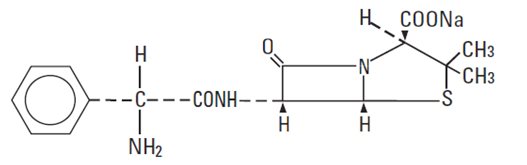
Active ingredient
Classification
Penicillins with extended spectrumPenicillin-class Antibacterial
Drug interactions
Ampicillin has several notable interactions with other drugs that can affect its efficacy and safety.
- moderateprobenecid — increased and prolonged blood levels of ampicillin
- moderateallopurinol — increased incidence of rashes
- majoraminoglycosides — inactivation of aminoglycosides
Real-world adverse events (FAERS)
Drug Ineffective979Foetal Exposure During Pregnancy673Drug Hypersensitivity657Pyrexia562Maternal Exposure During Pregnancy547Premature Baby527Off Label Use496Pneumonia428
Indications
INDICATIONS AND USAGE Ampicillin for Injection, USP is indicated in the treatment of infections caused by susceptible strains of the designated organisms in the following conditions: Respiratory Tract Infections caused by Streptococcus pneumoniae, Staphylococcus aureus (penicillinase and nonpenicillinase-producing), H. influenzae , and Group A beta-hemolytic streptococci . Bacterial Meningitis caused by E. coli, Group B Streptococci , and other Gram-negative bacteria ( Listeria monocytogenes, N. meningitidis ). The addition of an aminoglycoside with ampicillin may increase its effectiveness against Gram-negative bacteria. Septicemia and Endocarditis caused by susceptible Gram-positive organisms including Streptococcus spp., penicillin G-susceptible staphylococci , and enterococci . Gram-negative sepsis caused by E. coli , Proteus mirabilis and Salmonella spp. responds to ampicillin. Endocarditis due to enterococcal strains usually respond to intravenous therapy. The addition of an aminoglycoside may enhance the effectiveness of ampicillin when treating streptococcal endocarditis. Urinary Tract Infections caused by sensitive strains of E. coli and Proteus mirabilis . Gastrointestinal Infections caused by Salmonella typhi (typhoid fever), other Salmonella spp., and Shigella spp. (dysentery) usually respond to oral or intravenous therapy. Bacteriology studies to determine the causative organisms and their susceptibility to ampicillin should be performed. Therapy may be instituted prior to obtaining results of susceptibility testing. It is advisable to reserve the parenteral form of this drug for moderately severe and severe infections and for patients who are unable to take the oral forms. A change to oral ampicillin may be made as soon as appropriate. To reduce the development of drug-resistant bacteria and maintain the effectiveness of Ampicillin for Injection, USP and other antibacterial drugs, Ampicillin for Injection, USP should be used only to treat or prevent infections that are proven or strongly suspected to be caused by susceptible bacteria. When culture and susceptibility information are available, they should be considered in selecting or modifying antibacterial therapy. In the absence of such data, local epidemiology and susceptibility patterns may contribute to the empiric selection of therapy. Indicated surgical procedures should be performed.
Dosage
DOSAGE AND ADMINISTRATION This insert is for the Pharmacy Bulk Package and is intended for preparing IV admixtures only. Dosage recommendations for intramuscular or direct intravenous injection are for informational purposes only. Infections of the respiratory tract and soft tissues. Patients weighing 40 kg (88 lbs) or more: 250 to 500 mg every 6 hours. Patients weighing less than 40 kg (88 lbs): 25 to 50 mg/kg/day in equally divided doses at 6- to 8-hour intervals. Infections of the gastrointestinal and genitourinary tracts (including those caused by Neisseria gonorrhoeae in females). Patients weighing 40 kg (88 lbs) or more: 500 mg every 6 hours. Patients weighing less than 40 kg (88 lbs): 50 mg/kg/day in equally divided doses at 6-to 8-hour intervals. In the treatment of chronic urinary tract and intestinal infections, frequent bacteriological and clinical appraisal is necessary. Smaller doses than those recommended above should not be used. Higher doses should be used for stubborn or severe infections. In stubborn infections, therapy may be required for several weeks. It may be necessary to continue clinical and/or bacteriological follow-up for several months after cessation of therapy. Urethritis in males due to N. gonorrhoeae : Adults: Two doses of 500 mg each at an interval of 8 to 12 hours. Treatment may be repeated if necessary or extended if required. In the treatment of complications of gonorrheal urethritis, such as prostatitis and epididymitis, prolonged and intensive therapy is recommended. Cases of gonorrhea with a suspected primary lesion of syphilis should have darkfield examinations before receiving treatment. In all other cases where concomitant syphilis is suspected, monthly serological tests should be made for a minimum of four months. The doses for the preceding infections may be given by either the intramuscular or intravenous route. A change to oral ampicillin may be made when appropriate. Bacterial Meningitis. Adults and children: 150 to 200 mg/kg/day in equally divided doses every 3 to 4 hours. (Treatment may be initiated with intravenous drip therapy and continued with intramuscular injections.) The doses for other infections may be given by either the intravenous or intramuscular route. Neonates (less than or equal to 28 days of postnatal age): Dosage should be based on Gestational age and Postnatal age according to Table 1. Table 1: Dosage in Neonates (less than or equal to 28 days of postnatal age) for Bacterial Meningitis and Septicemia Gestational age (weeks) Postnatal age (days) Dosage less than or equal to 34 less than or equal to 34 greater than 34 less than or equal to 7 greater than or equal to 8 and less than 28 less than or equal to 28 100 mg/kg/day in equally divided doses every 12 hours 150 mg/kg/day in equally divided doses every 12 hours 150 mg/kg/day in equally divided doses every 8 hours Septicemia. Adults and children: 150 to 200 mg/kg/day. Start with intravenous administration for at least three days and continue with the intramuscular route every 3 to 4 hours. Neonates (less than or equal to 28 days of postnatal age): Dosage should be based on Gestational age and Postnatal age according to Table 1 (above). Treatment of all infections should be continued for a minimum of 48 to 72 hours beyond the time that the patient becomes asymptomatic or evidence of bacterial eradication has been obtained. A minimum of 10-days treatment is recommended for any infection caused by Group A beta-hemolytic streptococci to help prevent the occurrence of acute rheumatic fever or acute glomerulonephritis. DIRECTIONS FOR USE For Administration by Intravenous Infusion Reconstitute as directed below ( Directions for Proper Use of Pharmacy Bulk Package ) prior to diluting with an intravenous solution. IMPORTANT: This chemical stability information in no way indicates that it would be acceptable practice to use this product well after the preparation time. Good professional practice suggests that compounded admixtures should be administered as soon after preparation as is feasible. Stability studies on ampicillin sodium at several concentrations in various intravenous solutions indicate the drug will lose less than 10% activity at the temperatures noted for the time periods stated. Room Temperature (25°C) Diluent Concentrations Stability Periods Sterile Water for Injection up to 30 mg/mL 8 hours 0.9% Sodium Chloride Injection, USP up to 30 mg/mL 8 hours 5% Dextrose Injection, USP 10 to 20 mg/mL 1 hour 5% Dextrose Injection, USP up to 2 mg/mL 2 hours 5% Dextrose and 0.45% Sodium Chloride Injection, USP up to 2 mg/mL 2 hours Lactated Ringer’s Injection, USP up to 30 mg/mL 8 hours Refrigerated (4°C) Sterile Water for Injection 30 mg/mL 48 hours Sterile Water for Injection up to 20 mg/mL 72 hours 0.9% Sodium Chloride Injection, USP 30 mg/mL 24 hours 0.9% Sodium Chloride Injection, USP up to 20 mg/mL 48 hours Lactated Ringer’s Injection, USP up to 30 mg/mL 24 hours 5% Dextrose Injection, USP up to 20 mg/mL 1 hour 5% Dextrose and 0.45% Sodium Chloride Injection, USP up to 10 mg/mL 1 hour Only those solutions listed above should be used for the intravenous infusion of Ampicillin for Injection, USP. The concentrations should fall within the range specified. The drug concentration and the rate and volume of the infusion should be adjusted so that the total dose of Ampicillin for Injection, USP is administered before the drug loses its stability in the solution in use. Directions for Proper Use of Pharmacy Bulk Package This Pharmacy Bulk Package glass bottle contains ampicillin sodium equivalent to 10 grams of ampicillin. It is designed for use in the pharmacy in preparing IV admixtures using aseptic technique in a laminar flow hood. a) Add 94 mL Sterile Water for Injection, USP. The resulting solution will contain 100 milligrams ampicillin activity per mL, and is stable up to ONE HOUR at room temperature. b) Dilute further within ONE HOUR to a concentration of 5 mg to 10 mg per mL. See TABLE for suitable fluid. Use promptly. This chemical stability information in no way indicates that it would be acceptable practice to use this product well after the preparation time. Good professional practice suggests that compounded admixtures should be administered as soon after preparation as is feasible. c) Using aseptic technique under a laminar flow hood, the closure should be penetrated only one time after reconstitution using a suitable sterile dispensing set which allows measured dispensing of the contents. Use of a syringe and needle is not recommended as it may cause leakage. d) After entry, use entire contents of Pharmacy Bulk Package bottle promptly. The entire contents of the Pharmacy Bulk Package bottle must be dispensed within ONE HOUR of reconstitution. This time limit should begin with the introduction of solvent or diluent into the Pharmacy Bulk Package Bottle. e) The hanger label on the Pharmacy Bulk Package provides a suitable hanging device while dispensing contents. If the Pharmacy Bulk Package does not have a hanger label, a plastic bail band will provide a suitable hanging device. Use of this product is restricted to a suitable work area, such as a laminar flow hood. Parenteral drug products should be inspected visually for particulate matter and discoloration prior to administration, whenever solution and container permit. CAUTION: Not to be dispensed as a unit.
Warnings
WARNINGS SERIOUS AND OCCASIONALLY FATAL HYPERSENSITIVITY (ANAPHYLACTIC) REACTIONS HAVE BEEN REPORTED IN PATIENTS ON PENICILLIN THERAPY. ALTHOUGH ANAPHYLAXIS IS MORE FREQUENT FOLLOWING PARENTERAL THERAPY, IT HAS OCCURRED IN PATIENTS ON ORAL PENICILLINS. THESE REACTIONS ARE MORE LIKELY TO OCCUR IN INDIVIDUALS WITH A HISTORY OF SENSITIVITY TO MULTIPLE ALLERGENS. THERE HAVE BEEN REPORTS OF INDIVIDUALS WITH A HISTORY OF PENICILLIN HYPERSENSITIVITY WHO HAVE EXPERIENCED SEVERE REACTIONS WHEN TREATED WITH CEPHALOSPORINS. BEFORE THERAPY WITH ANY PENICILLIN, CAREFUL INQUIRY SHOULD BE MADE CONCERNING PREVIOUS HYPERSENSITIVITY REACTIONS TO PENICILLINS, CEPHALOSPORINS OR OTHER ALLERGENS. IF AN ALLERGIC REACTION OCCURS, APPROPRIATE THERAPY SHOULD BE CONSIDERED. SERIOUS ANAPHYLACTIC REACTIONS REQUIRE IMMEDIATE EMERGENCY TREATMENT WITH EPINEPHRINE. OXYGEN, INTRAVENOUS STEROIDS, AND AIRWAY MANAGEMENT, INCLUDING INTUBATION, SHOULD ALSO BE ADMINISTERED AS INDICATED. Severe Cutaneous Adverse Reactions Ampicillin may cause severe cutaneous adverse reactions (SCARs), such as toxic epidermal necrolysis (TEN), Stevens-Johnson syndrome (SJS), drug reaction with eosinophilia and systemic symptoms (DRESS), exfoliative dermatitis, erythema multiforme, and acute generalized exanthematous pustulosis (AGEP). If patients develop a skin rash, they should be monitored closely, and ampicillin discontinued if lesions progress. Hepatotoxicity Hepatic dysfunction, including hepatitis and cholestatic jaundice has been associated with the use of ampicillin. Hepatic toxicity is usually reversible; however, deaths have been reported. Hepatic function should be monitored at regular intervals in patients with hepatic impairment. Clostridioides difficile -Associated Diarrhea Clostridioides difficile -associated diarrhea (CDAD) has been reported with use of nearly all antibacterial agents, including ampicillin, and may range in severity from mild diarrhea to fatal colitis. Treatment with antibacterial agents alters the normal flora of the colon leading to overgrowth of C. difficile . C. difficile produces toxins A and B which contribute to the development of CDAD. Hypertoxin producing strains of C. difficile cause increased morbidity and mortality, as these infections can be refractory to antimicrobial therapy and may require colectomy. CDAD must be considered in all patients who present with diarrhea following antibacterial drug use. Careful medical history is necessary since CDAD has been reported to occur over two months after the administration of antibacterial agents. If CDAD is suspected or confirmed, ongoing antibacterial drug use not directed against C. difficile may need to be discontinued. Appropriate fluid and electrolyte management, protein supplementation, antibacterial treatment of C. difficile , and surgical evaluation should be instituted as clinically indicated.
Contraindications
CONTRAINDICATIONS The use of Ampicillin is contraindicated in individuals with a history of serious hypersensitivity reactions (e.g., anaphylaxis or Stevens-Johnson syndrome) to ampicillin or to other beta-lactam antibacterial drugs. Ampicillin is also contraindicated in infections caused by penicillinase-producing organisms. Ampicillin is contraindicated in patients with a previous history of cholestatic jaundice/hepatic dysfunction associated with treatment with ampicillin.
Mechanism of action
CLINICAL PHARMACOLOGY Ampicillin for Injection, USP diffuses readily into most body tissues and fluids. However, penetration into the cerebrospinal fluid and brain occurs only when the meninges are inflamed. Ampicillin is excreted largely unchanged in the urine and its excretion can be delayed by concurrent administration of probenecid. Due to maturational changes in renal function, ampicillin half-life decreases as postmenstrual age (a sum of gestational age and postnatal age) increases for infants with postnatal age of less than 28 days. The active form appears in the bile in higher concentrations than those found in serum. Ampicillin is the least serum-bound of all the penicillins, averaging about 20% compared to approximately 60 to 90% for other penicillins. Ampicillin for Injection, USP is well-tolerated by most patients and has been given in doses of 2 grams daily for many weeks without adverse reactions. Microbiology While in vitro studies have demonstrated the susceptibility of most strains of the following organisms, clinical efficacy for infections other than those included in the INDICATIONS AND USAGE section has not been demonstrated. Antibacterial Activity The following bacteria have been shown in in vitro studies to be susceptible to Ampicillin for Injection, USP: Gram-positive Bacteria Hemolytic and nonhemolytic streptococci Streptococcus pneumoniae Nonpenicillinase-producing staphylococci Clostridium spp. B. anthracis Listeria monocytogenes Most strains of enterococci. Gram-negative Bacteria H. influenzae N. gonorrhoeae N. meningitidis Proteus mirabilis Many strains of Salmonella , Shigella , and E. coli . AMPICILLIN does not resist destruction by penicillinase. Susceptibility Test Methods Diffusion Techniques Quantitative methods that require measurement of zone diameters provide reproducible estimates of the susceptibility of bacteria to antimicrobial compounds. One such standardized procedure 1,2 that has been recommended for use with disks to test the susceptibility of microorganisms to ampicillin, uses the 10 mcg ampicillin disk. Interpretation involves correlation of the diameter obtained in the disk test with the minimum inhibitory concentration (MIC) for ampicillin. Reports from the laboratory providing results of the standard single-disk susceptibility test with a 10 mcg ampicillin disk should be interpreted according to the criteria provided in Table 1. Dilution Techniques Quantitative methods that are used to determine minimum inhibitory concentrations (MICs) provide reproducible estimates of the susceptibility of bacteria to antimicrobial compounds. One such standardized procedure 1,3 uses a standardized dilution method (broth or agar) or equivalent with ampicillin powder. The MIC values obtained should be interpreted according to the criteria provided in Table 1. TABLE 1: SUSCEPTIBILITY TEST INTERPRETIVE CRITERIA Susceptibility Test Result Interpretive Criteria Pathogen Disk Diffusion (Zone diameter in mm) Minimal Inhibitory Concentration (MIC in mcg/mL) S I R S I R Enterobacteriaceae ≥17 14 to 16 ≤13 ≤8 16 ≥32 Enterococcus spp. ≥17 - ≤16 ≤8 - ≥16 Haemophilus influenzae and Haemophilus parainfluenzae ≥22 19 to 21 ≤18 ≤1 2 ≥4 Streptococcus spp. (beta-hemolytic group) ≥24 - - ≤0.25 - - Streptococcus spp. (viridans group) - - - ≤0.25 0.5 to 4 ≥8 Neisseria meningitidis - - - ≤0.12 0.25 to 1 ≥2 Non-meningitidis S. pneumoniae isolates may be considered susceptible to ampicillin if the isolate has a penicillin MIC of ≤ 0.06 mcg/mL. Susceptibility of staphylococci to ampicillin may be deduced from testing only penicillin and either cefoxitin or oxacillin. A report of “Susceptible” (S) indicates that the pathogen is likely to be inhibited by usually achievable concentrations of the antimicrobial compound in the blood. A report of “Intermediate” (I) indicates that the result should be considered equivocal, if the microorganism is not fully susceptible to alternative, clinically feasible drugs, the test should be repeated. This category implies possible clinical applicability in body sites where the drug is physiologically concentrated or in situations where high dosage of the drug can be used. This category also provides a buffer zone that prevents small uncontrolled technical factors from causing major discrepancies in interpretation. A report of “Resistant” (R) indicates that the pathogen is not likely to be inhibited if the antimicrobial compound in the blood reaches the concentrations usually achievable; other therapy should be selected. Quality Control Standardized susceptibility test procedures require the use of laboratory control microorganisms 1,2,3 . The 10 mcg ampicillin disk and the standard ampicillin powder should provide respectively the following zone diameters and MIC values in these laboratory test quality control strains: TABLE 2: ACCEPTABLE QUALITY CONTROL RANGES Acceptable Quality Control Ranges Microorganism Disk Diffusion (Zone diameter ranges in mm) Minimal Inhibitory Concentration Range (MIC in mcg/mL) Enterococcus faecalis ATCC ® 29212 - 0.5 to 2 Escherichia coli ATCC ® 25922 16 to 22 2 to 8 Escherichia coli ATCC ® 35218 6 > 32 Haemophilus influenzae ATCC ® 49247 13 to 21 2 to 8 Staphylococcus aureus ATCC ® 25923 27 to 35 - Staphylococcus aureus ATCC ® 29213 - 0.5 to 2 Streptococcus pneumoniae ATCC ® 49619 30 to 36 0.06 to 0.25
Source: RxNorm + openFDA + RxClass + FAERS · 2026
Look up another medication