adagrasib 200 MG Oral Tablet
Managing this medication for someone you care for? Eleplan keeps diagnoses, medications and appointments in one plan.
Start free with EleplanClinical drug
adagrasib 200 MG Oral Tablet
200 MG · Oral Tablet · oral
A form of adagrasib →
adagrasib 200 MG Oral Tablet — Other antineoplastic agents. INDICATIONS AND USAGE KRAZATI is an inhibitor of the RAS GTPase family indicated for: Non-small cell lung cancer (NSCLC)* • As a single agent, for…
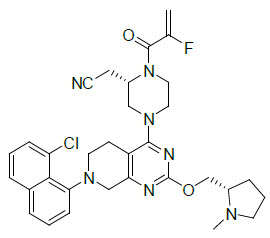
Active ingredient
Classification
Other antineoplastic agents
Drug interactions
Adagrasib has several clinically significant drug interactions that should be avoided to prevent adverse effects and reduced efficacy.
- majorstrong CYP3A4 inducers — reduces adagrasib exposure, potentially decreasing its effectiveness
- majorstrong CYP3A4 inhibitors — increases adagrasib concentrations, potentially increasing the risk of adverse reactions
- majorsensitive CYP3A substrates — increases exposure of CYP3A substrates, potentially increasing the risk of adverse reactions
- majorsensitive CYP2C9 substrates — increases exposure of CYP2C9 substrates, potentially increasing the risk of adverse reactions
- majorsensitive CYP2D6 substrates — increases exposure of CYP2D6 substrates, potentially increasing the risk of adverse reactions
- majorP-gp substrates — increases exposure of P-gp substrates, potentially increasing the risk of adverse reactions
- majordrugs that prolong QT interval — may result in a greater increase in the QTc interval and serious adverse reactions
Real-world adverse events (FAERS)
Death280Diarrhoea125Hospitalisation109Nausea95Vomiting85Off Label Use78Asthenia64Fatigue53
Indications
INDICATIONS AND USAGE KRAZATI is an inhibitor of the RAS GTPase family indicated for: Non-small cell lung cancer (NSCLC)* • As a single agent, for the treatment of adult patients with KRAS G12C-mutated locally advanced or metastatic NSCLC, as determined by an FDA-approved test, who have received at least one prior systemic therapy. ( 1.1 ) Colorectal cancer (CRC)* • In combination with cetuximab, for the treatment of adult patients with KRAS G12C-mutated locally advanced or metastatic CRC, as determined by an FDA-approved test, who have received prior treatment with fluoropyrimidine-, oxaliplatin-, and irinotecan-based chemotherapy. ( 1.2 ) *These indications are approved under accelerated approval based on objective response rate (ORR) and duration of response (DOR). Continued approval for these indications may be contingent upon verification and description of a clinical benefit in confirmatory trials. ( 1.1 , 1.2 ) 1.1 KRAS G12C-Mutated Locally Advanced or Metastatic Non-Small Cell Lung Cancer KRAZATI, as a single-agent, is indicated for the treatment of adult patients with KRAS G12C-mutated locally advanced or metastatic non-small cell lung cancer (NSCLC), as determined by an FDA-approved test [see Dosage and Administration (2.1) ] , who have received at least one prior systemic therapy. This indication is approved under accelerated approval based on objective response rate (ORR) and duration of response (DOR) [see Clinical Studies (14.1) ]. Continued approval for this indication may be contingent upon verification and description of a clinical benefit in a confirmatory trial. 1.2 KRAS G12C-Mutated Locally Advanced or Metastatic Colorectal Cancer KRAZATI in combination with cetuximab is indicated for the treatment of adult patients with KRAS G12C-mutated locally advanced or metastatic colorectal cancer (CRC), as determined by an FDA-approved test [see Dosage and Administration (2.1) ] , who have received prior treatment with fluoropyrimidine-, oxaliplatin-, and irinotecan-based chemotherapy. This indication is approved under accelerated approval based on ORR and DOR [see Clinical Studies (14.2) ] . Continued approval for this indication may be contingent upon verification and description of a clinical benefit in a confirmatory trial.
Dosage
DOSAGE AND ADMINISTRATION • Recommended dosage as a single agent for NSCLC and in combination with cetuximab for CRC: 600 mg orally twice daily. ( 2.2 ) • Swallow tablets whole with or without food. ( 2.2 ) 2.1 Patient Selection Non-Small Cell Lung Cancer Select patients for treatment of locally advanced or metastatic NSCLC with KRAZATI based on the presence of KRAS G12C mutation in plasma or tumor specimens [see Clinical Studies (14.1) ] . If no mutation is detected in a plasma specimen, test tumor tissue. Colorectal Cancer Select patients for treatment of locally advanced or metastatic CRC with KRAZATI based on the presence of KRAS G12C mutation in tumor specimens [see Clinical Studies (14.2) ] . Information on FDA-approved tests for the detection of a KRAS G12C mutation is available at: https://www.fda.gov/CompanionDiagnostics 2.2 Recommended Dosage The recommended dosage of KRAZATI as a single agent or in combination with cetuximab is 600 mg orally twice daily until disease progression or unacceptable toxicity. Refer to the cetuximab prescribing information for cetuximab dosage information [see Clinical Studies (14.2) ] . Take KRAZATI at the same time every day with or without food [see Clinical Pharmacology (12.3) ]. Swallow tablets whole. Do not chew, crush or split tablets. If vomiting occurs after taking KRAZATI, do not take an additional dose. Resume dosing at the next scheduled time. If a dose is inadvertently missed, it should be skipped if greater than 4 hours have elapsed from the expected dosing time. Resume dosing at the next scheduled time. 2.3 Dosage Modifications for Adverse Reactions Recommended dose reductions for adverse reactions for use of KRAZATI as a single agent or in combination with cetuximab are outlined in Table 1. If adverse reactions occur, a maximum of two dose reductions are permitted. Permanently discontinue KRAZATI in patients who are unable to tolerate 600 mg once daily. Table 1: Recommended KRAZATI Dosage Reductions for Adverse Reactions Dose Reduction Dosage First dose reduction 400 mg twice daily Second dose reduction 600 mg once daily Refer to the cetuximab prescribing information for dose modifications for adverse reactions associated with cetuximab. When KRAZATI is administered in combination with cetuximab, withhold or permanently discontinue cetuximab when KRAZATI is withheld or permanently discontinued. Treatment with KRAZATI as a single agent may be continued if cetuximab is permanently discontinued. [see Clinical Pharmacology (12.1) , Clinical Studies (14.2) ] . The recommended dosage modifications for adverse reactions are provided in Table 2. Table 2: Recommended KRAZATI Dosage Modifications for Adverse Reactions ALT = alanine aminotransferase; AST = aspartate aminotransferase; ILD = Interstitial Lung Disease; ULN = upper limit of normal Adverse Reaction Severity Grading defined by National Cancer Institute Common Terminology Criteria for Adverse Events (NCI CTCAE) version 5.0. Dosage Modification When KRAZATI is administered in combination with cetuximab, withhold or permanently discontinue treatment with cetuximab when withholding or permanently discontinuing treatment with KRAZATI. Nausea or vomiting despite appropriate supportive care (including anti-emetic therapy) [see Warnings and Precautions (5.1) ] Grade 3 or 4 • Withhold KRAZATI until recovery to ≤ Grade 1 or return to baseline. • Resume KRAZATI at the next lower dose level. Diarrhea despite appropriate supportive care (including anti-diarrheal therapy) [see Warnings and Precautions (5.1) ] Grade 3 or 4 • Withhold KRAZATI until recovery to ≤ Grade 1 or return to baseline. • Resume KRAZATI at the next lower dose level. QTc Interval Prolongation [see Warnings and Precautions (5.2) ] QTc absolute value greater than 500 ms or Greater than an increase of 60 ms from baseline • Withhold KRAZATI until QTc interval less than 481 ms or return to baseline. • Resume KRAZATI at the next lower dose level. Torsade de pointes, polymorphic ventricular tachycardia or signs or symptoms of serious or life-threatening arrhythmia • Permanently discontinue KRAZATI Hepatotoxicity [see Warnings and Precautions (5.3) ] Grade 2 AST or ALT • Decrease KRAZATI to the next lower dose level. Grade 3 or 4 AST or ALT • Withhold KRAZATI until recovery to ≤ Grade 1 or return to baseline. • Resume KRAZATI at the next lower dose level. AST or ALT > 3 × ULN with total bilirubin > 2 × ULN in the absence of alternative causes • Permanently discontinue KRAZATI Interstitial Lung Disease / Pneumonitis [see Warnings and Precautions (5.4) ] Any Grade • Withhold KRAZATI if ILD/pneumonitis is suspected. • Permanently discontinue KRAZATI if ILD/pneumonitis is confirmed Other Adverse Reactions [see Adverse Reactions (6.1) ] Grade 3 or 4 • Withhold KRAZATI until ≤ Grade 1 or return to baseline. • Resume KRAZATI at the next lower dose level.
Warnings
WARNINGS AND PRECAUTIONS • Gastrointestinal Adverse Reactions : Monitor patients for diarrhea, nausea and vomiting and provide supportive care as needed. Withhold, reduce the dose or permanently discontinue based on severity. ( 2.3 , 5.1 ) • QTc Interval Prolongation: Avoid concomitant use of KRAZATI with other products with a known potential to prolong the QTc interval. Monitor ECG and electrolytes particularly potassium and magnesium, in patients at risk, and in patients taking medications known to prolong the QT interval. Correct electrolyte abnormalities. Withhold, reduce the dose, or permanently discontinue based on severity. ( 2.3 , 5.2 ) • Hepatotoxicity: Monitor liver laboratory tests prior to the start of KRAZATI and monthly for 3 months after and as clinically indicated. Reduce the dose, withhold, or permanently discontinue based on severity. ( 2.3 , 5.3 ) • Interstitial Lung Disease (ILD) / Pneumonitis: Monitor for new or worsening respiratory symptoms. Withhold KRAZATI for suspected ILD/pneumonitis and permanently discontinue if no other potential causes of ILD/pneumonitis are identified. ( 2.3 , 5.4 ) 5.1 Gastrointestinal Adverse Reactions KRAZATI can cause severe gastrointestinal adverse reactions. In the pooled safety population [see Adverse Reactions (6.1) ] , who received single-agent KRAZATI, serious gastrointestinal adverse reactions observed were gastrointestinal bleeding in 3.8% including 0.8% Grade 3 or 4, gastrointestinal obstruction in 1.6% including 1.4% Grade 3 or 4, colitis in 0.5% including 0.3% Grade 3, ileus in 0.5%, and stenosis in 0.3%. In addition, nausea, diarrhea, or vomiting occurred in 89% of 366 patients, including 9% Grade 3. Nausea, diarrhea, or vomiting led to dosage interruption or dose reduction in 29% of patients and permanent discontinuation of adagrasib in 0.3%. In patients who received KRAZATI in combination with cetuximab [see Adverse Reactions (6.1) ] , serious gastrointestinal adverse reactions included gastrointestinal bleeding in 8.5% including 1.1% Grade 3 or 4, gastrointestinal obstruction in 5.3% including 5.3% Grade 3 or 4, colitis in 1.1% including 1.1% Grade 3 and ileus in 1.1%. In addition, nausea, diarrhea, or vomiting occurred in 92% of 94 patients, including 6% Grade 3. Nausea, diarrhea, or vomiting led to adagrasib dose interruption or dose reduction in 23% of patients. Monitor and manage patients using supportive care, including antidiarrheals, antiemetics, or fluid replacement, as indicated. Withhold, reduce the dose, or permanently discontinue KRAZATI based on severity [see Dosage and Administration (2.3) ]. 5.2 QTc Interval Prolongation KRAZATI can cause QTc interval prolongation, which can increase the risk for ventricular tachyarrhythmias (e.g., torsades de pointes) or sudden death . In the pooled safety population [see Adverse Reactions (6.1) ] who received single-agent KRAZATI , 6% of 366 patients with at least one post-baseline electrocardiogram (ECG) assessment had an average QTc ≥ 501 msec and 11% of patients had an increase from baseline of QTc > 60 msec. KRAZATI causes concentration-dependent increases in the QTc interval [see Clinical Pharmacology (12.2) ] . In patients who received KRAZATI in combination with cetuximab [see Adverse Reactions (6.1) ] , 5% of 93 patients with at least one post-baseline electrocardiogram (ECG) assessment had an average QTc ≥ 501 msec and 16% of patients had an increase from baseline of QTc > 60 msec. Avoid concomitant use of KRAZATI with other products with a known potential to prolong the QTc interval [see Drug Interactions (7.3) and Clinical Pharmacology (12.2) ]. Avoid use of KRAZATI in patients with congenital long QT syndrome and in patients with concurrent QTc prolongation. Monitor ECGs and electrolytes, particularly potassium and magnesium, prior to starting KRAZATI, during concomitant use, and as clinically indicated in patients with congestive heart failure, bradyarrhythmias, electrolyte abnormalities, and in patients who are unable to avoid concomitant medications that are known to prolong the QT interval. Correct electrolyte abnormalities. Withhold, reduce the dose, or permanently discontinue KRAZATI depending on severity [see Dosage and Administration (2.3) ] . 5.3 Hepatotoxicity KRAZATI can cause hepatotoxicity, which may lead to drug-induced liver injury and hepatitis. In the pooled safety population of 366 patients [see Adverse Reactions (6.1) ] who received single-agent KRAZATI , drug-induced liver injury was reported in 0.3% of patients, including 0.3% Grade 3. A total of 32% of patients who received adagrasib had increased alanine aminotransferase (ALT)/increased aspartate aminotransferase (AST); 5% were Grade 3 and 0.5% were Grade 4. The median time to first onset of increased ALT/AST was 3 weeks (range: 0.1 to 48). Overall hepatotoxicity occurred in 37%, and 7% were Grade 3 or 4. Hepatotoxicity leading to dose interruption or reduction occurred in 12% of patients. Adagrasib was discontinued due to hepatotoxicity in 0.5% of patients. In patients who received KRAZATI in combination with cetuximab [see Adverse Reactions (6.1) ] , 29% had increased alanine aminotransferase (ALT)/increased aspartate aminotransferase (AST); 5% were Grade 3 and 1.1% were Grade 4. The median time to first onset of increased ALT/AST was 4 weeks (range: 0.1 to 27). Overall hepatotoxicity occurred in 38%, and 10% were Grade 3 or 4. Hepatotoxicity leading to adagrasib dose interruption or reduction occurred in 12% of patients. Monitor liver laboratory tests (AST, ALT, alkaline phosphatase and total bilirubin) prior to the start of KRAZATI and monthly for 3 months or as clinically indicated, with more frequent testing in patients who develop transaminase elevations. Reduce the dose, withhold, or permanently discontinue KRAZATI based on severity [see Dosage and Administration (2.3) and Adverse Reactions (6.1) ]. 5.4 Interstitial Lung Disease / Pneumonitis KRAZATI can cause interstitial lung disease (ILD)/pneumonitis, which can be fatal. In the pooled safety population [see Adverse Reactions (6.1) ] who received single-agent KRAZATI , ILD/pneumonitis occurred in 4.1% of patients, 1.4% were Grade 3 or 4, and one case was fatal. The median time to first onset for ILD/pneumonitis was 12 weeks (range: 5 to 31 weeks). Adagrasib was discontinued due to ILD/pneumonitis in 0.8% of patients. In patients who received KRAZATI in combination with cetuximab [see Adverse Reactions (6.1) ] , Grade 1 ILD/pneumonitis occurred in 1.1% of patients. The time to first onset for ILD/pneumonitis was 38 weeks. Monitor patients for new or worsening respiratory symptoms indicative of ILD/pneumonitis (e.g., dyspnea, cough, fever) during treatment with KRAZATI. Withhold KRAZATI in patients with suspected ILD/pneumonitis and permanently discontinue KRAZATI if no other potential causes of ILD/pneumonitis are identified [see Dosage and Administration (2.3) ].
Contraindications
CONTRAINDICATIONS None. None. ( 4 )
Mechanism of action
Mechanism of Action Adagrasib is an irreversible inhibitor of KRAS G12C that covalently binds to the mutant cysteine in KRAS G12C and locks the mutant KRAS protein in its inactive state that prevents downstream signaling without affecting wild-type KRAS protein. Adagrasib inhibited tumor cell growth and viability in cells harboring KRAS G12C mutations and resulted in tumor regression in KRAS G12C-mutated tumor xenograft models with minimal off-target activity. Adagrasib in combination with cetuximab had increased antitumor activity in some cell line-derived and patient-derived KRAS G12C-mutant CRC tumor xenograft models compared to adagrasib or cetuximab alone.
Source: RxNorm + openFDA + RxClass + FAERS · 2026
Look up another medication