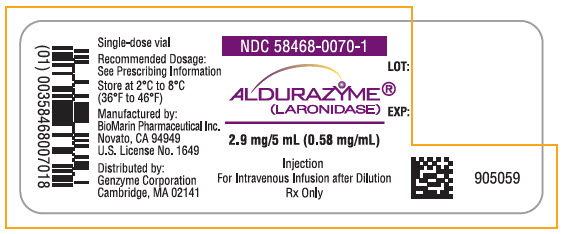
5 ML laronidase 0.58 MG/ML Injection — Enzymes. INDICATIONS AND USAGE ALDURAZYME ® is indicated for the treatment of: adult and pediatric patients with Hurler and Hurler-Scheie forms of…
Boxed warning
WARNING: HYPERSENSITIVITY REACTIONS INCLUDING ANAPHYLAXIS, and ACUTE RESPIRATORY COMPLICATIONS ASSOCIATED WITH ADMINISTRATION WARNING: HYPERSENSITIVITY REACTIONS INCLUDING ANAPHYLAXIS, and ACUTE RESPIRATORY COMPLICATIONS ASSOCIATED WITH ADMINISTRATION See full prescribing information for complete boxed warning . Appropriate medical monitoring and support measures, including cardiopulmonary resuscitation equipment, should be readily available. If a severe hypersensitivity reaction occurs, discontinue ALDURAZYME immediately and initiate appropriate medical treatment. ( 5.1 ) Patients with compromised respiratory function or acute respiratory disease may be at risk of serious acute exacerbation of their respiratory compromise due to infusion reactions and require additional monitoring. Appropriate respiratory support should be available during infusion. ( 5.2 ) Hypersensitivity Reactions Including Anaphylaxis Patients treated with ALDURAZYME have experienced life-threatening hypersensitivity reactions, including anaphylaxis. Appropriate medical monitoring and support measures, including cardiopulmonary resuscitation equipment, should be readily available during ALDURAZYME administration. If a severe hypersensitivity reaction (e.g., anaphylaxis) occurs, discontinue ALDURAZYME immediately and initiate appropriate medical treatment. In patients with severe hypersensitivity reactions, a desensitization procedure to ALDURAZYME may be considered [see Warnings and Precautions (5.1) ] . Acute Respiratory Complications Associated with Administration Patients with compromised respiratory function or acute respiratory disease may be at risk of serious acute exacerbation of their respiratory compromise due to infusion reactions and require additional monitoring [see Warnings and Precautions (5.2) ] .
INDICATIONS AND USAGE ALDURAZYME ® is indicated for the treatment of: adult and pediatric patients with Hurler and Hurler-Scheie forms of Mucopolysaccharidosis I (MPS I) and patients with the Scheie form of MPS I who have moderate to severe symptoms. ALDURAZYME is a hydrolytic lysosomal glycosaminoglycan (GAG)-specific enzyme indicated for the treatment of adult and pediatric patients with Hurler and Hurler-Scheie forms of Mucopolysaccharidosis I (MPS I) and for the treatment of patients with the Scheie form of MPS I who have moderate to severe symptoms. ( 1 ) Limitations of Use: The risks and benefits of treating mildly affected patients with the Scheie form have not been established. ( 1 ) ALDURAZYME has not been evaluated for effects on the central nervous system manifestations of the disorder. ( 1 ) Limitations of Use The safety and effectiveness of treating mildly affected patients with the Scheie form have not been established. The effect of ALDURAZYME on central nervous system manifestations of the disorder has not been determined.
Dosage
DOSAGE AND ADMINISTRATION For pretreatment recommendations, see Full Prescribing Information. ( 2.1 ) The recommended dosage is 0.58 mg/kg administered once weekly as an intravenous infusion. ( 2.2 ) For dosage and administration modifications due to hypersensitivity reactions or infusion-associated reactions (IARs), see Full Prescribing Information. ( 2.3 ) For instructions on preparation, storage, and administration, see Full Prescribing Information. ( 2.4 , 2.5 , 2.6 ) 2.1 Recommendations Prior to ALDURAZYME Treatment Premedication Prior to ALDURAZYME administration, consider premedicating with antihistamines, with or without antipyretics, 60 minutes before the start of infusion [see Warnings and Precautions (5.1 , 5.4) ]. Medical Support Appropriate medical monitoring and support measures, including cardiopulmonary resuscitation equipment, should be readily available during ALDURAZYME administration. 2.2 Recommended Dosage and Administration The recommended dosage of ALDURAZYME is 0.58 mg/kg (actual body weight) administered once weekly as an intravenous infusion. ALDURAZYME injection must be diluted with 0.9% Sodium Chloride Injection to a final volume of 50 mL, 100 mL or 250 mL as determined by the patient's body weight and cardiopulmonary condition: Patients with a body weight equal to or greater than 2 kg and less than 4 kg should receive a total volume of 50 mL; patients with a body weight equal to or greater than 4 kg and up to 20 kg should receive a total volume of 100 mL; and those patients with a body weight greater than 20 kg should receive a total volume of 250 mL [see Dosage and Administration (2.6) ]. For patients with underlying cardiac or respiratory compromise and weighing up to 30 kg, physicians may consider diluting ALDURAZYME in a volume of 100 mL and administering at a decreased infusion rate [see Dosage and Administration (2.6) ]. The initial infusion rate of ALDURAZYME is 10 mcg/kg/hr and may be increased every 15 minutes during the first hour, as tolerated, to a maximum infusion rate of 200 mcg/kg/hr. The maximum rate is then maintained for the remainder of the infusion (2 to 3 hours) [see Dosage and Administration (2.6) , Warnings and Precautions (5.2 , 5.3) ] . If one or more doses are missed, restart ALDURAZYME treatment as soon as possible and maintain the 1-week interval between infusions thereafter. Do not double a dose to compensate for a missed dose. 2.3 Administration Modifications due to Hypersensitivity or Infusion Associated Reaction In the event of a severe hypersensitivity reaction (e.g. anaphylaxis) or severe infusion-associated reaction (IAR), immediately discontinue ALDURAZYME administration and initiate appropriate medical treatment. For additional recommendations in the event of a severe hypersensitivity reaction, [ see Warnings and Precautions (5.1) ]. In the event of a mild to moderate hypersensitivity reaction or a mild to moderate IAR, consider temporarily holding the infusion for 15 to 30 minutes, or slowing the infusion rate by 25% to 50% [ see Dosage and Administration (2.6) ] , and initiating appropriate medical treatment [see Warnings and Precautions (5.1 , 5.4) ] . If symptoms persist despite holding or slowing the infusion, stop the infusion and monitor the patient. Consider re-initiating the infusion within 7 to 14 days using the incremental rate steps table [see Dosage and Administration (2.6) ] , up to 25% or 50% of the rate at which the reaction occurred with appropriate premedication. If symptoms subside after holding the infusion, resume infusion at a 25% to 50% reduced rate as tolerated. Alternatively, if symptoms subside after slowing the infusion, complete infusion at the reduced rate as tolerated. Starting with next infusion, increase the infusion rate by increments of 25% as tolerated until the recommended infusion rate is reached. Closely monitor the patient. 2.4 Preparation Instructions Prepare ALDURAZYME using low-protein-binding containers. There is no information on the compatibility of diluted ALDURAZYME with glass containers. Dilute ALDURAZYME in the following manner using aseptic technique: Determine the infusion bag volume and number of ALDURAZYME vials to be diluted based on actual body weight in kg and the recommended dose [see Dosage and Administration (2.2) ] . Round the number of vials up to the next whole number. Remove the appropriate number of ALDURAZYME vials from the refrigerator and allow the vials to reach room temperature 20°C to 25°C (68°F to 77°F) before use. Do not heat or microwave the vials. Visually inspect the solution in each vial for particulate matter and discoloration. The ALDURAZYME solution should be clear to slightly opalescent and colorless to pale yellow. Some translucency may be present in the solution. Discard if the solution is discolored or if visible particulate matter is present. Withdraw and discard a volume of the 0.9% Sodium Chloride Injection from an infusion bag, equal to the volume of ALDURAZYME to be added. Slowly withdraw the calculated volume of ALDURAZYME from the appropriate number of vials using caution to avoid excessive agitation. Do not use a filter needle, as this may cause agitation. Agitation may denature ALDURAZYME, rendering it biologically inactive. Discard any unused solution remaining in the vial. Slowly add the ALDURAZYME solution to the 0.9% Sodium Chloride Injection solution through the port of the infusion bag and avoid agitation. Do not use a filter needle. Gently rotate the infusion bag to ensure proper distribution of ALDURAZYME. Do not shake the infusion bag. 2.5. Storage Instruction for the Diluted Solution If the diluted ALDURAZYME solution is not used immediately: Refrigerate the diluted solution at 2°C to 8°C (36°F to 46°F) for up to 36 hours. Discard any unused ALDURAZYME diluted solution after 36 hours. Do not store the diluted solution at room temperature. The solution must be infused within 8 hours after removal from the refrigerator, inclusive of the total infusion time, or discarded. 2.6 Administration Instructions Use an infusion set equipped with a low-protein-binding, 0.2 micron, in-line filter to administer the diluted ALDURAZYME solution. The total volume of infusion [see Dosage and Administration (2.2) ] should be administered over approximately 3 to 4 hours as tolerated per the infusion rate steps outlined in Table 1 below. At the end of the infusion, flush the infusion line with 0.9% Sodium Chloride Injection, using the same infusion rate as the one used for the last part of the infusion. Do not infuse ALDURAZYME in the same intravenous line with other products. Table 1: Incremental Infusion Rate Steps and Volumes for ALDURAZYME ® Infusion by Patient Weight Patient Weight Range Total Infusion Volume Step 1 10 mcg/kg/hr Step 2 20 mcg/kg/hr Step 3 50 mcg/kg/hr Step 4 100 mcg/kg/hr Step 5 200 mcg/kg/hr Infusion Rate in mL/hour ≥2 to <4 kg 50 mL 1 2 4 8 16 ≥4 to <20 kg 100 mL 2 4 8 16 32 ≥20 kg 250 mL 5 10 20 40 80 Start infusion at rate in Step 1. In the absence of infusion-associated reactions after vital sign assessment, increase infusion rate sequentially per the steps in Table 1 every 15 minutes to reach the target rate in Step 5. Continue Step 5 until infusion is completed. The total infusion time is approximately 3 to 4 hours.
Warnings
WARNINGS AND PRECAUTIONS Risk of Acute Respiratory Complications: Patients with acute febrile or respiratory illness at the time of ALDURAZYME infusion may be at greater risk for infusion reactions. Consider delaying ALDURAZYME infusion. Sleep apnea is common in MPS I patients. Consider evaluating airway patency prior to initiation of treatment with ALDURAZYME. Appropriate respiratory support should be available during infusion. ( 5.2 ) Risk of Acute Cardiorespiratory Failure: Patients susceptible to fluid overload may be at increased risk for serious exacerbation of their cardiac or respiratory status during infusions. Consider a decreased total infusion volume and infusion rate when administering ALDURAZYME to these patients. Appropriate medical monitoring and support measures should be available during infusion. ( 2.2 , 5.3 ) Infusion Reactions: If severe IARs occur, discontinue ALDURAZYME and initiate appropriate medical treatment. ( 5.4 ) 5.1 Hypersensitivity Reactions Including Anaphylaxis Hypersensitivity reactions including anaphylaxis have been reported in patients during or up to 3 hours after ALDURAZYME infusions. Some of these reactions were life-threatening and included respiratory failure, respiratory distress, stridor, tachypnea, bronchospasm, obstructive airways disorder, hypoxia, hypotension, bradycardia, and urticaria. In clinical studies and postmarketing safety experience with ALDURAZYME, approximately 1% of patients experienced severe or serious hypersensitivity reactions. In patients with MPS I, pre-existing upper airway obstruction may have contributed to the severity of some reactions. Prior to ALDURAZYME administration, consider premedicating patients with antihistamines, with or without antipyretics, 60 minutes before the start of infusion. Appropriate medical monitoring and support measures, including cardiopulmonary resuscitation equipment, should be readily available during ALDURAZYME administration. Because of the potential for recurrent reactions, some patients who experience initial severe reactions may require prolonged observation. If a severe hypersensitivity reaction (e.g., anaphylaxis) occurs, discontinue ALDURAZYME immediately and initiate appropriate medical treatment. Exercise caution if epinephrine is being considered for use in patients with MPS I due to the increased prevalence of coronary artery disease in these patients. Interventions have included resuscitation, mechanical ventilatory support, emergency tracheotomy, hospitalization, and treatment with inhaled beta-adrenergic agonists, epinephrine, and intravenous corticosteroids [see Adverse Reactions (6) ]. Consider the risks and benefits of re-administering ALDURAZYME following severe hypersensitivity reactions (including anaphylaxis). Patients may be rechallenged using slower infusion rates. In patients with severe hypersensitivity reaction, desensitization measures to ALDURAZYME may be considered. If the decision is made to readminister ALDURAZYME, ensure the patient tolerates the infusion. If the patient tolerates the infusion, the rate may be increased to reach the recommended rate. If a mild or moderate hypersensitivity reaction occurs, consider temporarily holding the infusion or slowing the infusion rate [see Dosage and Administration (2.3) ]. 5.2 Acute Respiratory Complications Associated with Administration One patient with acute bronchitis and hypoxia experienced increased tachypnea during the first ALDURAZYME infusion that resolved without intervention. The patient's respiratory symptoms returned within 30 minutes of completing the infusion and responded to bronchodilator therapy. Approximately 6 hours after the infusion, the patient experienced coughing, then respiratory arrest, and died. Patients with an acute febrile or respiratory illness at the time of ALDURAZYME infusion may be at greater risk for infusion reactions. Careful consideration should be given to the patient's clinical status prior to administration of ALDURAZYME and consider delaying ALDURAZYME infusion. Sleep apnea is common in MPS I patients. Consider evaluating airway patency prior to initiation of treatment with ALDURAZYME. Patients using supplemental oxygen or continuous positive airway pressure (CPAP) during sleep should have these treatments readily available during infusion in the event of an infusion reaction, or extreme drowsiness/sleep induced by antihistamine use. 5.3 Acute Cardiorespiratory Failure In postmarketing experience, reports of acute cardiorespiratory failure have been reported with ALDURAZYME treatment [see Adverse Reactions (6.2) ] . Patients susceptible to fluid overload, or patients with acute underlying respiratory illness or compromised cardiac and/or respiratory function for whom fluid restriction is indicated may be at increased risk of serious exacerbation of their cardiac or respiratory status during infusions. Consider a decreased total infusion volume and infusion rate when administering ALDURAZYME to these patients [see Dosage and Administration (2.2) ]. Appropriate medical monitoring and support measures should be readily available during ALDURAZYME infusion, and some patients may require prolonged observation times that should be based on the individual needs of the patient. 5.4 Infusion-Associated Reactions ALDURAZYME may cause infusion-associated reactions (IARs). Prior to ALDURAZYME administration, consider pre-medicating with antihistamines, with or without antipyretics, 60 minutes before the start of infusion to reduce the risk of IARs. However, IARs may still occur in patients after receiving pre-medication. If a severe IAR occurs, discontinue ALDURAZYME immediately and initiate appropriate medical treatment. Consider the risks and benefits of re-administering ALDURAZYME following a severe IAR. Patients may be re-challenged using slower infusion rates. Once a patient tolerates the infusion, the infusion rate may be increased to reach the recommended infusion rate. If a mild or moderate IAR occurs, consider temporarily holding the infusion or slowing the infusion rate [see Dosage and Administration (2.3) , and Adverse Reactions (6.1 , 6.2) ] .
Contraindications
CONTRAINDICATIONS None. None. ( 4 )
Mechanism of action
Mechanism of Action Mucopolysaccharide storage disorders are caused by the deficiency of specific lysosomal enzymes required for the catabolism of glycosaminoglycans (GAG). Mucopolysaccharidosis I (MPS I) is characterized by the deficiency of α-L-iduronidase, a lysosomal hydrolase which catalyzes the hydrolysis of terminal α-L-iduronic acid residues of dermatan sulfate and heparan sulfate. Reduced or absent α-L-iduronidase activity results in the accumulation of the GAG substrates, dermatan sulfate and heparan sulfate, throughout the body and leads to widespread cellular, tissue, and organ dysfunction. The rationale of ALDURAZYME therapy in MPS I is to provide exogenous enzyme for uptake into lysosomes and increase the catabolism of GAG. ALDURAZYME uptake by cells into lysosomes is most likely mediated by the mannose-6-phosphate-terminated oligosaccharide chains of laronidase binding to specific mannose-6-phosphate receptors. Because many proteins in the blood are restricted from entry into the central nervous system (CNS) by the blood brain barrier, effects of intravenously administered ALDURAZYME on cells within the CNS cannot be inferred from activity in sites outside the CNS. The ability of ALDURAZYME to cross the blood brain barrier has not been evaluated in animal models or in clinical studies.
A drug lookup is just the start. Eleplan keeps the whole care plan in one place.
Medications, diagnoses, documents, appointments, and the whole care team — organized and always in sync, with Ellie, your AI care assistant, on top of it. Free to start.