2 ML trimethobenzamide hydrochloride 100 MG/ML Injection
Managing this medication for someone you care for? Eleplan keeps diagnoses, medications and appointments in one plan.
Start free with EleplanClinical drug
2 ML trimethobenzamide hydrochloride 100 MG/ML Injection
100 MG/ML · Injection · injection
A form of trimethobenzamide →
2 ML trimethobenzamide hydrochloride 100 MG/ML Injection — Aminoalkyl ethers. INDICATIONS AND USAGE Trimethobenzamide hydrochloride capsules is indicated in adults for the treatment of postoperative nausea and vomiting and for…
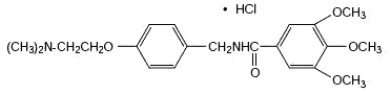
Active ingredient
Classification
Aminoalkyl ethersAntiemetic
Drug interactions
Trimethobenzamide has several interactions with CNS depressants and alcohol that may enhance drowsiness and other CNS effects.
- majoralcohol — may cause drowsiness
- majorCNS depressants (e.g., sedatives, hypnotics, opiates, anxiolytics, antipsychotics, anticholinergics) — may potentiate the effects of trimethobenzamide
Indications
INDICATIONS AND USAGE Trimethobenzamide hydrochloride capsules is indicated in adults for the treatment of postoperative nausea and vomiting and for nausea associated with gastroenteritis. Limitation of Use: Trimethobenzamide hydrochloride capsules is not recommended for use in pediatric patients due to the risk of extrapyramidal signs and symptoms and other serious central nervous system (CNS) effects, and the risk of exacerbation of the underlying disease in pediatric patients with Reye's syndrome or other hepatic impairment. Trimethobenzamide hydrochloride capsules are an antiemetic indicated in adults for the treatment of postoperative nausea and vomiting and for nausea associated with gastroenteritis. ( 1 ) Limitation of Use: • Trimethobenzamide hydrochloride capsules are not recommended for use in pediatric patients due to the risk of extrapyramidal signs and symptoms and other serious central nervous system (CNS) effects and the risk of exacerbation of the underlying disease in pediatric patients with Reye's syndrome or other hepatic impairment. ( 1 , 8.4 )
Dosage
Dosage and Administration (See WARNINGS and PRECAUTIONS .) Dosage should be adjusted according to the indication for therapy, severity of symptoms and the response of the patient. Geriatric Patients Dose adjustment such as reducing the total dose administered at each dosing or increasing the dosing interval should be considered in elderly patients with renal impairment (creatinine clearance ≤ 70 mL/min/1.73m 2 ). Final dose adjustment should be based upon integration of clinical efficacy and safety considerations. (See CLINICAL PHARMACOLOGY and PRECAUTIONS ). Patients with Renal Impairment In subjects with renal impairment (creatinine clearance ≤ 70 mL/min/1.73m 2 ), dose adjustment such as reducing the total dose administered at each dosing or increasing the dosing interval should be considered. (See CLINICAL PHARMACOLOGY and DOSAGE AND ADMINISTRATION ). INJECTABLE, 100 mg/mL (Not for use in pediatric patients) Usual Adult Dosage 2 mL (200 mg) t.i.d. or q.i.d. intramuscularly. NOTE: The injectable form is intended for intramuscular administration only; it is not recommended for intravenous use. Intramuscular administration may cause pain, stinging, burning, redness and swelling at the site of injection. Such effects may be minimized by deep injection into the upper outer quadrant of the gluteal region, and by avoiding the escape of solution along the route.
Warnings
WARNINGS AND PRECAUTIONS Acute Dystonic Reactions and Other Extrapyramidal Symptoms (EPS) : Depending on the severity of symptoms, reduce the dosage or discontinue the drug. Treat acute dystonic reactions with anticholinergics. Avoid trimethobenzamide hydrochloride capsules in patients receiving other drugs that are likely to cause EPS. ( 5.1 , 7.2 ) Masking of Other Serious Disorders : EPS and other CNS symptoms in patients treated with trimethobenzamide hydrochloride capsules may be confused with CNS signs of undiagnosed primary disease (e.g., encephalopathy, metabolic imbalance, Reye's Syndrome). If CNS symptoms occur, evaluate the risks and benefits of continuing trimethobenzamide hydrochloride capsules. ( 5.2 , 7.2 ) Other CNS Reactions : Coma, depression of mood, disorientation, and seizures have been reported. The recent use of other drugs that cause CNS depression or EPS symptoms may also increase the risk; consider reducing the dosage or discontinuing the drug. ( 5.3 , 7.1 , 7.2 ) Hepatotoxicity : Avoid use in patients whose signs and symptoms suggest the presence of hepatic impairment. Discontinue trimethobenzamide hydrochloride capsules in patients who develop impaired liver function while on treatment. ( 5.4 , 8.7 ) Effects on the Ability to Drive or Operate Machinery : Mental and/or physical abilities may be impaired. Concomitant use of other drugs that cause CNS depression or EPS symptoms may increase this effect; either trimethobenzamide hydrochloride capsules or the other interacting drug should be chosen, depending on the importance of the drug to the patient. ( 5.5 , 7.1 , 7.2 ) 5.1 Acute Dystonic Reactions and Other Extrapyramidal Symptoms (EPS) Extrapyramidal symptoms (EPS), manifested primarily as acute dystonic reactions, may occur with trimethobenzamide hydrochloride capsules. Dystonic reactions may include sudden onset of muscular spasms, especially in the head and neck or opisthotonos. Other EPS include laryngospasm, dysphagia, and oculogyric crisis. Involuntary spasms of the tongue and mouth may lead to difficulty in speaking and swallowing. Anticholinergic drugs can be used to treat acute dystonic reactions. EPS may also include akathisia, restlessness, akinesia, and other parkinsonian-like symptoms (e.g., tremor). Depending on the severity of symptoms, reduce the daily dosage of trimethobenzamide hydrochloride capsules by increasing the dosing interval or discontinue trimethobenzamide hydrochloride capsules [see Dosage and Administration (2.1) ] . Avoid trimethobenzamide hydrochloride capsules in patients receiving other drugs that are likely to cause EPS (e.g. antipsychotics) [see Drug Interactions (7.2) ] . 5.2 Masking of Other Serious Disorders EPS and other CNS symptoms which can occur in patients treated with trimethobenzamide hydrochloride capsules may be confused with CNS signs of undiagnosed primary disease (e.g., encephalopathy, metabolic imbalance, Reye's syndrome)) [see Warnings and Precautions ( 5.1 , 5.3 )]. If CNS symptoms occur, evaluate the risks and benefits of continuing trimethobenzamide hydrochloride capsules for each patient. 5.3 Other CNS Reactions Other serious CNS adverse reactions such as coma, depression of mood, disorientation, and seizures have been reported with trimethobenzamide hydrochloride capsules administration. The recent use of other drugs that cause CNS depression or EPS symptoms (e.g., alcohol, sedatives, hypnotics, opiates, anxiolytics, antipsychotics, and anticholinergics) may also increase the risk for these serious CNS reactions [see Warnings and Precautions (5.1 , 5.5 )]. Consider reducing the daily dosage of trimethobenzamide hydrochloride capsules by increasing the dosing interval or discontinuing the drug [see Dosage and Administration (2.1) , Drug Interactions (7.1 , 7.2 )] . 5.4 Hepatotoxicity Trimethobenzamide hydrochloride capsules is potentially hepatotoxic [see Adverse Reactions (6) ] . Avoid use of trimethobenzamide hydrochloride capsules in patients whose signs and symptoms suggest the presence of hepatic impairment . Discontinue trimethobenzamide hydrochloride capsules in patients who develop impaired liver function while taking trimethobenzamide hydrochloride capsules. 5.5 Effects on the Ability to Drive or Operate Machinery Trimethobenzamide hydrochloride capsules can cause drowsiness and may impair the mental and/or physical abilities required for the performance of hazardous tasks such as driving a motor vehicle or operating machinery [see Warnings and Precautions (5.1 , 5.3 )] . Concomitant use of other drugs that cause CNS depression or EPS symptoms (e.g., alcohol, sedatives, hypnotics, opiates, anxiolytics, antipsychotics, and anticholinergics) may increase this effect. Either trimethobenzamide hydrochloride capsules or the other interacting drug should be chosen, depending on the importance of the drug to the patient [ Drug Interactions (7.1 , 7.2 )]. Inform patients not to operate motor vehicles or other dangerous machinery until they are reasonably certain that trimethobenzamide hydrochloride capsules does not affect them adversely.
Contraindications
Contraindications The injectable form of Tigan ® is contraindicated in pediatric patients and in patients with known hypersensitivity to trimethobenzamide. Contraindications The injectable form of Tigan ® is contraindicated in pediatric patients and in patients with known hypersensitivity to trimethobenzamide.
Mechanism of action
Clinical Pharmacology Mechanism of Action The mechanism of action of Tigan ® as determined in animals is obscure, but may involve the chemoreceptor trigger zone (CTZ), an area in the medulla oblongata through which emetic impulses are conveyed to the vomiting center; direct impulses to the vomiting center apparently are not similarly inhibited. In dogs pretreated with trimethobenzamide HCl, the emetic response to apomorphine is inhibited, while little or no protection is afforded against emesis induced by intragastric copper sulfate. Pharmacokinetics The pharmacokinetics of trimethobenzamide have been studied in healthy adult subjects. Following administration of 200 mg (100 mg/mL) Tigan IM injection, the time to reach maximum plasma concentration (T max ) was about half an hour, about 15 minutes longer for Tigan 300 mg oral capsule than an I.M. injection. A single dose of Tigan 300 mg oral capsule provided a plasma concentration profile of trimethobenzamide similar to Tigan 200 mg I.M. The relative bioavailability of the capsule formulation compared to the solution is 100%. The mean elimination half-life of trimethobenzamide is 7 to 9 hours. Between 30 – 50% of a single dose in humans is excreted unchanged in the urine within 48 – 72 hours. The metabolic disposition of trimethobenzamide in humans is not known. Specifically, it is not known if active metabolites are generated in humans. Special Populations Age The clearance of trimethobenzamide is not known in patients with renal impairment. However, it may be advisable to consider reduction in the dosing of trimethobenzamide in elderly patients with renal impairment considering that a substantial amount of excretion and elimination of trimethobenzamide occurs via the kidney and that elderly patients may have various degrees of renal impairment. (See PRECAUTIONS: General and DOSAGE AND ADMINISTRATION ). Gender Systemic exposure to trimethobenzamide was similar between men (N=40) and women (N=28). Race Pharmacokinetics appeared to be similar for Caucasians (N=53) and African Americans (N=12). Renal Impairment The clearance of trimethobenzamide is not known in patients with renal impairment. However, it may be advisable to consider reduction in the dosing of trimethobenzamide in patients with renal impairment considering that a substantial amount of excretion and elimination of trimethobenzamide occurs via the kidney. (See PRECAUTIONS: General and DOSAGE AND ADMINISTRATION ).
Source: RxNorm + openFDA + RxClass + FAERS · 2026
Look up another medication