Physicians Ez Use B-12 Compliance
Managing this medication for someone you care for? Eleplan keeps diagnoses, medications and appointments in one plan.
Start free with EleplanMedication reference
Physicians Ez Use B-12 Compliance
INTRAMUSCULAR · SUBCUTANEOUS · TOPICAL
Physicians Ez Use B-12 Compliance. Uses For first aid to decrease germs in minor cuts scrapes burns For preparation of the skin prior to injection INDICATIONS AND USAGE Cyanocobalamin…
Brand names
Physicians EZ Use B-12 Compliance
Indications
Uses For first aid to decrease germs in minor cuts scrapes burns For preparation of the skin prior to injection INDICATIONS AND USAGE Cyanocobalamin is indicated for Vitamin B 12 deficiencies due to malabsorption which may be associated with the following conditions: Addisonian (pernicious) anemia Gastrointestinal pathology, dysfunction, or surgery, including gluten enteropathy or sprue, small bowel bacterial overgrowth, total or partial gastrectomy Fish tapeworm infestation Malignancy of pancreas or bowel Folic acid deficiency It may be possible to treat the underlying disease by surgical correction of anatomic lesions leading to small bowel bacterial overgrowth, expulsion of fish tapeworm, discontinuation of drugs leading to vitamin malabsorption (see Drug/Laboratory Test Interactions ), use of a gluten-free diet in nontropical sprue, or administration of antibiotics in tropical sprue. Such measures remove the need for long-term administration of cyanocobalamin. Requirements of Vitamin B 12 in excess of normal (due to pregnancy, thyrotoxicosis, hemolytic anemia, hemorrhage, malignancy, hepatic and renal disease) can usually be met with oral supplementation. Cyanocobalamin injection is also suitable for the Vitamin B 12 absorption test (Schilling test).
Dosage
Directions apply to skin as needed discard after single use DOSAGE AND ADMINISTRATION Avoid using the intravenous route. Use of this product intravenously will result in almost all of the vitamin being lost in the urine. Pernicious Anemia Parenteral Vitamin B 12 is the recommended treatment and will be required for the remainder of the patient’s life. The oral form is not dependable. A dose of 100 mcg daily for six or seven days should be administered by intramuscular or deep subcutaneous injection. If there is clinical improvement and if a reticulocyte response is observed, the same amount may be given on alternate days for seven doses, then every three to four days for another two to three weeks. By this time hematologic values should have become normal. This regimen should be followed by 100 mcg monthly for life. Folic acid should be administered concomitantly if needed. Patients With Normal Intestinal Absorption Where the oral route is not deemed adequate, initial treatment similar to that for patients with pernicious anemia may be indicated depending on the severity of the deficiency. Chronic treatment should be with an oral B 12 preparation. If other vitamin deficiencies are present, they should be treated. Schilling test The flushing dose is 1000 mcg. Parenteral drug products should be inspected visually for particulate matter and discoloration prior to administration, whenever solution and container permit. Pernicious Anemia Parenteral Vitamin B 12 is the recommended treatment and will be required for the remainder of the patient’s life. The oral form is not dependable. A dose of 100 mcg daily for six or seven days should be administered by intramuscular or deep subcutaneous injection. If there is clinical improvement and if a reticulocyte response is observed, the same amount may be given on alternate days for seven doses, then every three to four days for another two to three weeks. By this time hematologic values should have become normal. This regimen should be followed by 100 mcg monthly for life. Folic acid should be administered concomitantly if needed. Patients With Normal Intestinal Absorption Where the oral route is not deemed adequate, initial treatment similar to that for patients with pernicious anemia may be indicated depending on the severity of the deficiency. Chronic treatment should be with an oral B 12 preparation. If other vitamin deficiencies are present, they should be treated. Schilling test The flushing dose is 1000 mcg. Parenteral drug products should be inspected visually for particulate matter and discoloration prior to administration, whenever solution and container permit.
Warnings
Warnings For external use only Flammable - keep away from fire or flame Do not use with electrocautery procedures When using this product do not get into eyes apply over large areas of the body in case of deep or puncture wounds, animal bites or serious burns consult a doctor Stop use and ask a doctor if condition persists or gets worse or lasts for more than 72 hours do not use longer than 1 week unless directed by a doctor Keep out of reach of children. If swallowed, get medical help or contact a Poison Control Center right away. WARNINGS WARNING: This product contains aluminum that may be toxic. Aluminum may reach toxic levels with prolonged parenteral administration if kidney function is impaired. Premature neonates are particularly at risk because their kidneys are immature, and they require large amounts of calcium and phosphate solutions, which contain aluminum. Research indicates that patients with impaired kidney function, including premature neonates, who receive parenteral levels of aluminum at greater than 4 to 5 mcg/kg/day accumulate aluminum at levels associated with central nervous system and bone toxicity. Tissue loading may occur at even lower rates of administration. Patients with early Leber’s disease (hereditary optic nerve atrophy) who were treated with cyanocobalamin suffered severe and swift optic atrophy. Hypokalemia and sudden death may occur in severe megaloblastic anemia which is treated intensely. Anaphylactic shock and death have been reported after parenteral Vitamin B 12 administration. An intradermal test dose is recommended before cyanocobalamin injection is administered to patients suspected of being sensitive to this drug. This product contains benzyl alcohol. Benzyl alcohol has been reported to be associated with a fatal ‘‘Gasping Syndrome’’ in premature infants.
Contraindications
CONTRAINDICATIONS Sensitivity to cobalt and/or Vitamin B 12 is a contraindication.
Adverse reactions
ADVERSE REACTIONS Generalized Anaphylactic shock and death have been reported with administration of parenteral Vitamin B 12 (see WARNINGS ). Cardiovascular Pulmonary edema and congestive heart failure early in treatment; peripheral vascular thrombosis. Hematological Polycythemia vera. Gastrointestinal Mild transient diarrhea. Dermatological Itching; transitory exanthema. Miscellaneous Feeling of swelling of entire body. Generalized Anaphylactic shock and death have been reported with administration of parenteral Vitamin B 12 (see WARNINGS ). Cardiovascular Pulmonary edema and congestive heart failure early in treatment; peripheral vascular thrombosis. Hematological Polycythemia vera. Gastrointestinal Mild transient diarrhea. Dermatological Itching; transitory exanthema. Miscellaneous Feeling of swelling of entire body.
Mechanism of action
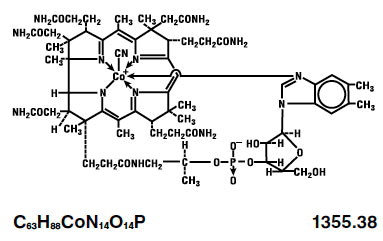
CLINICAL PHARMACOLOGY Vitamin B 12 is essential to growth, cell reproduction, hematopoiesis, nucleoprotein and myelin synthesis. Cyanocobalamin is quantitatively and rapidly absorbed from intramuscular and subcutaneous sites of injection; the plasma level of the compound reaches its peak within one hour after intramuscular injection. Absorbed Vitamin B 12 is transported via specific B 12 binding proteins, transcobalamin I and II to the various tissues. The liver is the main organ for Vitamin B 12 storage. Within 48 hours after injection of 100 or 1000 mcg of Vitamin B 12 , 50 to 98% of the injected dose may appear in the urine. The major portion is excreted within the first eight hours. Intravenous administration results in even more rapid excretion with little opportunity for liver storage. Gastrointestinal absorption of Vitamin B 12 depends on the presence of sufficient intrinsic factor and calcium ions. Intrinsic factor deficiency causes pernicious anemia, which may be associated with subacute combined degeneration of the spinal cord. Prompt parenteral administration of Vitamin B 12 prevents progression of neurologic damage. The average diet supplies about 5 to 15 mcg/day of Vitamin B 12 in a protein-bound form that is available for absorption after normal digestion. Vitamin B 12 is not present in foods of plant origin, but is abundant in foods of animal origin. In people with normal absorption, deficiencies have been reported only in strict vegetarians who consume no products of animal origin (including no milk products or eggs). Vitamin B 12 is bound to intrinsic factor during transit through the stomach; separation occurs in the terminal ileum in the presence of calcium, and Vitamin B 12 enters the mucosal cell for absorption. It is then transported by the transcobalamin binding proteins. A small amount (approximately 1% of the total amount ingested) is absorbed by simple diffusion, but this mechanism is adequate only with very large doses. Oral absorption is considered too undependable to rely on in patients with pernicious anemia or other conditions resulting in malabsorption of Vitamin B 12 . Cyanocobalamin is the most widely used form of Vitamin B 12 , and has hematopoietic activity apparently identical to that of the antianemia factor in purified liver extract. Hydroxocobalamin is equally as effective as cyanocobalamin, and they share the cobalamin molecular structure.
NDC examples
76420-527
Treats these conditions
Source: openFDA + RxNorm · 2026
Look up another medication